

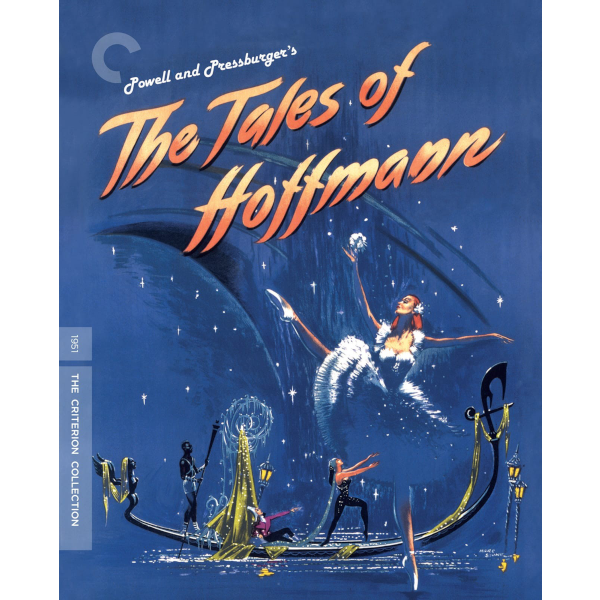

Looking for some extreme mental-visual stimulation? Seldom has so much cinematic artfulness been carried off with such taste and discretion. This overwhelmingly rich movie has retained its rapt following; we learn that it was a formative movie experience for both directors Martin Scorsese (of course) and George Romero (not so obvious). Any three minutes of this movie yield ten times more creative density than the best of music videos.
Filmed opera has always been popular; we’re told that there were silent adaptations of operatic stories in which people sang but were not heard. The Tales of Hoffmann uses the Jacques Offenbach opera as a springboard to an expanded experience that rallies everything that cinema could be in 1951. Exending extravagant theatrical design with surreal visuals, the movie takes operatic artifice to a new level. Every one of a million details on view have been crafted, shaped and tested to create a fantastic, unreal world. It’s impossible not to be drawn into it.

The ‘Archers’ collaboration of Michael Powell and Emeric Pressburger reached a peak of popularity with their 1947 The Red Shoes, a Technicolor dazzler that brought high-toned art to audiences that might never have bothered to attend a real ballet performance. Jack Cardiff’s striking colors illuminate ballerina Moira Shearer’s ambition to dance with the lethal red shoes of a fairy tale, shoes that force their wearer to dance until death. It’s said that ballet schools for young girls took a leap in popularity that year.
The movies of Powell and Pressburger were always about experimentation. Producer Korda wanted a follow-up to The Red Shoes, and that film’s music director Thomas Beecham sold them on the idea of doing an entire opera-ballet in a fantastic style similar to the Red Shoes ballet number. The adaptation of The Tales of Hoffmann makes the composer a character in a collection of three stories, each a doomed romance.

The entire story is told in dance — when people aren’t actually dancing their movements are ‘attuned’ to the music. Hoffmann (Robert Rounseville) sends a love note backstage to his dancer sweetheart Stella (Moira Shearer), but it’s intercepted by the devious and possesive Linsdorf (Robert Helpmann). While waiting in a bar with his best friend Nicklaus (Pamela Brown, playing a man) for the performance of The Dragonfly Ballet to finish, Hoffmann tells three tales of frustrated love. In The Tale of Olympia Hoffmann falls in love with a beautiful dancer (Shearer again), not knowing that she’s an automaton created by the magician Coppelius (Helpmann again). In The Tale of Giulietta Hoffmann is bewitched by the vain Giulietta (Ludmilla Tchérina) and almost loses his soul to a magic mirror. And in The Tale of Antonia Hoffman travels to a Greek island and falls in love with Antonia (Ann Ayars), who will die if she sings again.
The Tales of Hoffmann is a hard sell to fans that expect filmed opera to just be singers standing in scenery, performing vocal gymnastics that require refined tastes to appreciate. It’s also true that viewers incapable of relating to older music forms may have trouble engaging. The Red Shoes is a straight backstage drama with ballet sequences that range from slightly stylized to deliriously surreal. Hoffman offers a wealth of audio-visual stimulation that asks to be accepted as the whole show. Powell & Pressburger don’t ‘interpret’ the arts of music and dance for a wider public. Their ‘musical camera’ approach presents emotional impressions through color, movement and sound, not immediate identification with conventional characters.

Is it overdone? Umm . . . define ‘overdone.’
Most filmed operas play against giant sets and some are restaged on real locations, but it all boils down to not-necessarily-photogenic stars standing and singing. The Archers opt for an entirely cinematic landscape of illusions that could only be done in the camera. Powell’s clever ‘arts and crafts’ technique relates more to Georges Méliès’ silent film work than to modern optical trickery.
The end of Black Narcissus was apparently a major impetus for these ‘arts-‘ related musicals. The conclusion of Narcissus slips into an ‘operatic’ mode for its most dramatic sequence. A madwoman with murderous intentions approaches another on a towering precipice. Powell worked backwards from the normal plan: he first recorded the score and then engineered his visuals and action to follow the music, as in an animated cartoon. The entire sequence was clocked and plotted to the split second; actors performed to audio playback. This ‘composed film’ approach was then applied the ballet scene in their next film. The Red Shoes broke a barrier of literalism in musical film.

The only real progenitor of this in studio filmmaking was Busby Berkeley, but his work (with exceptions) sought to enlarge the glamour and spectacle of a stage show, ‘expanding’ the dance stage. Powell and Pressburger’s abstract camera magic works at levels of subtlety unseen in Berkeley’s universe of smiling chorines multiplied to infinity. Cameraman Jack Cardiff treated the screen as if it were a canvas; to achieve the correct imagistic note he might simply dash a superimposed brushstroke of color across the screen.
Because all of Hoffmann is done to playback, the actors and dancers lip-sync to voices not their own. The freedom from recording sound on the set gave the filmmakers the flexibility of silent movie days. Actors could be talked through scenes. The unwieldy Technicolor camera did not need its enormous and awkward sound blimp, making camera moves of every kid much easier.

Hoffman is an extended visual effect, mostly accomplished within the camera. Miniatures and superimposed artwork scenery are used quite a bit, while many sleight-of-hand jump-cuts and split screens are done without resort to optical trickery. For the best-known piece of Offenbach music, the Barcarole, a cartoonish gondola courses left to right across the screen. It’s stagecraft writ large, except the scenery and the camera do as much ‘dancing’ as do the ballerinas. The evil characters played by Robert Helpmann don’t always dance, but he moves so closely with the music that he seems to be part of it. Nowadays Helpmann is probably best known as The Child Catcher from Chitty Chitty Bang Bang.
Dancers Moira Shearer, Helpmann, Léonide Massine and Ludmilla Tchérina are riveting presences; Any Ayars is truly beautiful, and sings for herself as well. The nominal hero Hoffmann doesn’t hold our attention to the same degree. He’s curiously passive and unsympathetic in all three stories. The first and second stories are the strongest. Tchérina’s Giulietta is sort of a Succubus-vampire leading Hoffmann to his doom, while Shearer’s Olympia is revealed as a mechanical puppet reminiscent of Mary Morris’s deadly multi-armed statue in Powell’s The Thief of Bagdad. It’s quite disturbing to see Olympia disassembled like the flying horse from the same film.

Genre criticism can lead to various academic cul-de-sacs, especially when fitting unusual films into established pigeonholes. Phil Hardy’s Encyclopedia of Science Fiction Films lists The Tales of Hoffmann as Sci Fi because of the ‘robotic’ dancer Olympia. Martin Scorsese’s commentary enthusiastically explains how one amazing visual invention for the final The Tale of Antonia relates to refined horror. Ann Ayars’ Antonia exits a room in a hurry, but the door takes her back into the same room, evoking a haunting ‘no escape’ motif. Mario Bava employed the same space-warp distortion for his Operazione Paura. With its macabre themes, puppet masters and domineering mountebanks, Hoffman definitely rubs shoulders with horror art delirium.
The Tales of Hoffmann is a superb opera film that challenges the general audience. Most of what we see remains at a stylized remove: viewers caught unawares may not understand what they see but they certainly won’t be bored. I recall the movie being discussed mainly when some pundit wanted to argue that movies could ‘be art’ if they tried hard enough. We had a 1960s encyclopedia that ‘justified’ discussing Motion Pictures by fixating on artsy fare. The Tales of Hoffmann exemplified the distinction between high art and whatever vulgar thing Hollywood was doing.
It’s doubtful that Michael Powell and Emeric Pressburger ever worried themselves with such concerns.

