

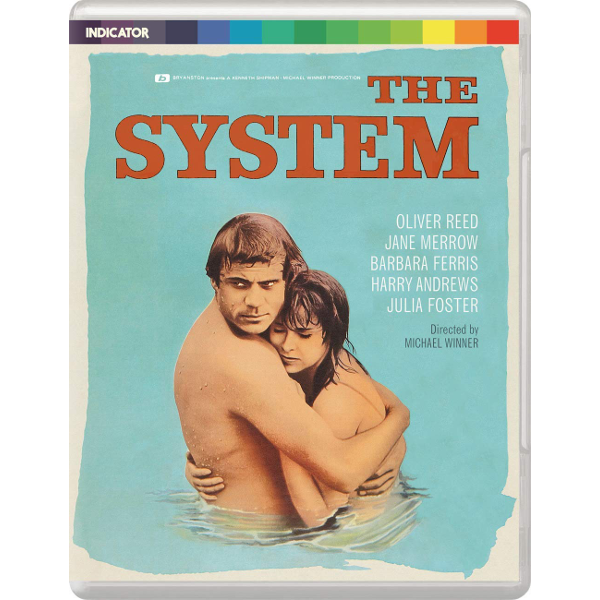

Are today’s critics aiming to rehabilitate the reputation of director Michael Winner? In previous decades Winner couldn’t get arrested in a roundup of favored directors. He survived through his latter career by making terrible Charles Bronson features, several of them for Cannon Films. Winner’s Marlon Brando movie The Nightcomers inspired the observation that he had an unerring knack for putting the camera in the wrong place. Michael Winner made tired westerns, weak thrillers and the execrable Won Ton Ton, the Dog Who Saved Hollywood, a picture that should have been a career kiss of death.
What needs to be remembered, however, is that director Winner began as a major ’60s talent, especially in three quirky films with Oliver Reed. Filmed in 1963, The System didn’t see U.S. showings until 1966, with the arguably better title The Girl-Getters. Made just before the English Invasion, its breezy semidocu style places Winner in the company of John Schlesinger (of Billy Liar) as a progressive young creative bursting from the confines of Kitchen Sink movies. In 1963 the Beatles were just coming into their own. England is somewhere between Teddy Boy roughhouse and fashion-conscious Mods. With its unsentimental look at boy-girl relationships, The System is ahead of the curve.

The seaside holiday town of Roxham is the target for an clique of young-20 males that have developed a coordinated ‘system’ to exploit the summer influx of young single women. Jumping on sea-bound trains, they chat up the girls before they even reach their hotels, and then divide up the best prospects for conquest. The unofficial leader of the pack is Stephen Taylor, a.k.a. Tinker (Oliver Reed), a ruthless seducer who sweeps fresh young girls off their feet with consummate skill. Tinker is actually a seaside local, a poor boy who scrapes out a living shooting tourist snaps. He uses his camera to flirt with willing young ‘thrushes,’ who don’t realize that their summer dream romances will amount to little more than an overnight fling. Tinker beds Lorna (Julia Foster of Lewis Gilbert’s Alfie), a sweet, defenseless thing incapable of realizing how little he thinks of her. Tinker also bumps into older local conquests. They still find him attractive, even if they’ll now have nothing to do with him. Then one of Tinker’s gang decides to quit the wild life and marry a girl he’s accidentally made pregnant.
This makes Tinker reflect on his own future — his semi-vagrant lifestyle can’t continue much longer. These thoughts persists when he meets Nicola (Jane Merrow), a cool fashion model with a new Buick Riviera. On vacation with her father (Guy Doleman of the Harry Palmer spy movies), Nicola is amenable to a seduction yet doesn’t surrender to Tinker’s control. Tinker bristles against Nicola’s wealthy friends but can’t help but get more deeply involved with her. He imagines that the independent Nicola might help him establish himself as a photographer in London. What Tinker doesn’t realize is that this smart modern girl is a more sophisticated user than he is. Can they work out some kind of future beyond their immediate mutual attraction?

Anyone seeing The Girl-Getters back in the day would agree that Michael Winner is on to a good thing. His movie has energy to spare, terrific on-location realism and a playful attitude toward editing and storytelling technique that says ‘fresh young director.’ The script by Peter Draper (I’ll Never Forget What’s ‘Is name) is smart and funny but not a comedy per se. The story arc veers between laughs and serious content, and no moralistic messages are dished out. Winner’s actors are into their roles, and resemble believable kids on the loose. A young, lean David Hemmings is a new addition to Tinker’s gang. He starts off shy but is soon thinking of new ways to improve ‘The System.’
Oliver Reed’s sly smile says everything. He’s a cad who realizes that he’s in a rut. Other tough-guy cameramen are poaching on his ‘licensed’ territory and his photo studio boss Larsey (Harry Andrews) is threatening to cut him off. Tinker defends his turf in a couple of convincing fights — Oliver Reed always excelled at such scenes. Tinker keeps most of the girls at arms’ length. When the vulnerable Suzy (Barbara Ferris of Children of the Damned) gets drunk and wails about her desire to have children, Tinker simply tunes her out. But Nicola shows him that he isn’t emotionally invulnerable. A different creature altogether, Nicola is definitely not ‘needy.’ Even her father warns Tinker that she gets her way in all things. Nicola’s poised manner, aloof come-ons and provocative verbal challenges keep Tinker on his toes. Although he makes a fool of himself trying to beat her posh boyfriends at tennis, Nicola clearly finds Tinker attractive. She takes an afternoon off to skinny-dip with him in a secluded cove. When the summer is winding up, Tinker makes overtures about an extended, more mature relationship. But Daddy is right: she’s too independent and footloose to let herself be restricted in any direction.

The System looks terrific, with its brisk editing revealing one attractive shot after another. The cinematographer was Nicolas Roeg, just off Roger Corman’s Masque of the Red Death and soon to be making his career breakthrough with David Lean and Francois Truffaut. His B&W images filmed amid holiday crowds add up to a polished semi-docu style. The movie is actually better-looking and less mannered than most of Richard Lester’s A Hard Day’s Night. Only one visual idea, a too-clever ‘snapshot’ gag, hasn’t aged well. Winner and his editor confect a number of early transitions by jumping to a freeze frame, which is pushed off-screen by a new still image. The second freeze-frame then pops to life as the next shot. It works the first couple of times but then loses its appeal. Thirty years later, the Push-Off became a standard item in non-linear editing effect menus.
Yet Michael Winner must be credited for The System’s many graces: a rich atmosphere, convincing characterizations and consistently interesting performances. The ‘presence’ of the beach, the pier, the pubs, clubs and Nicola’s ritzy party are put across brilliantly. This is one of Oliver Reed’s most varied performances — he works up fairly charming persona, to fleece the tourists and bed the girls. Yet he realizes that stepping up to Nicola’s class won’t be easy. Tinker is simply better acted than Reed’s exaggerated, rather stiff King in Joseph Losey’s These Are the Damned, made just a couple of seasons earlier.

Unless the reason is disinterest in Michael Winner, I’m don’t know why the movie has been overlooked. Its loose group of male rogues is sometimes compared to Fellini’s I Vitelloni, and could also be seen as a more serious, sexually mature Brit version of Where the Boys Are. Americans saw it after a two-year delay. In just those two seasons, a lot of changes occurred in fashion and music. In ’64 the mod style had not yet fully arrived, and some of the young women have early-’60s beehive hairdos, not the subdued, conformist look exemplified by The Knack: And How to Get It (a look that slayed this writer, back in junior high).
The System may not be a sprightly fantasy (Billy Liar), a working-class protest (The Loneliness of the Long Distance Runner) or a fountain of slapstick wit (The Knack) but it gives us an exciting taste of pre- swingin’ England. Perhaps Tinker’s character could have more depth, but we’re highly aware of his dilemma. It’s time to grow up, and Nicola shows him what it might be like to join a smarter crowd. But he simply doesn’t have the same options that she has.
