

“Mole Hole, Mole Hole — A land of renown!
Iraq is Up and Sumeria’s down!
And the Mole Men go to work in a hole in the ground!”
————————–old Arabian proverb
I seem to have a lot to say about this modest monster picture…
1956 marked the beginning of the downhill slope for the ’50s monster boom at Universal. William Alland was still tasked with putting exciting sci-fi fantasy fare on the screen, but was expected to cut costs. Jack Arnold tells everybody he got sick of sci-fi, but it’s more likely that Alland either couldn’t afford him or didn’t want to fight with him over credit for everything: we don’t know if Arnold turned down the Technicolor This Island Earth (1955), or if Alland pushed him aside in favor of Joseph Newman. Veteran assistant director John Sherwood and the much younger editor Virgil Vogel stepped up to the director’s chair; Universal’s The Mole People was Vogel’s first directing credit in a career that lasted until his death in 1996.
The Mole People hasn’t much of a reputation among Uni’s latter-day Alland-produced sci-fi pix. Alland skewed his budget dollars toward the promising The Land Unknown (1957), leaving John Sherwood’s The Creature Walks Among Us (1956), Nathan Juran’s The Deadly Mantis (1957) and The Mole People to be produced with table scraps. They were all eclipsed by producer Albert Zugsmith’s The Incredible Shrinking Man (1957), a reasonably-budgeted masterpiece that threw a dark shadow over most of William Alland’s accomplishments.

As Alland backed away from the field Universal went even cheaper, and the movies became more desperate. Some appear to have been made as filler to be double-billed with newly-imported Hammer films. Uni had already resorted to Curt Siodmak to produce and direct Curucu, Beast of the Amazon (1956), and The Thing that Couldn’t Die (1958) was produced and directed by Will Cowan, previously a specialist in short subjects. The more experienced Howard Christie produced director Sherwood’s relatively impressive The Monolith Monsters (1957). Joseph Gershenson took hundreds of music ‘supervision’ credits but was really a producer; he finished off the 1950s sci-fi/fantasy programmers — and his own producing career — with Monster on the Campus (Jack Arnold, 1958), Curse of the Undead (Edward Dein, 1958) and the rather nifty The Leech Woman (also Edward Dein, 1960).
For all its corner cutting, The Mole People is an overachiever. Its tiny budget is simply inadequate for its ambitious story, a return to the ‘lost civilization’ genre dominated by memories of the well-remembered She (1935), the semi-classic Lost Horizon (1937), and 1949’s Siren of Atlantis. Producer Seymour Nebenzal was likely able to get that Atlantis going only because he could re-use spectacular scenes from his classic 1932 German movie by G.W. Pabst, Die Herrin von Atlantis. William Alland surely looked for stock footage solutions, but found no appropriate Universal movie with scenes set in a fantastic underground ‘Sumerian’ city. For his mountain climbing scenes, he was able to source a nonfiction show from the early 1950s that documented the conquest of Mount Everest. As Tom Weaver points out in his commentary, for a later show Alland went ‘full Sam Katzman,’ building The Deadly Mantis around large quantities of overly-familiar stock footage.

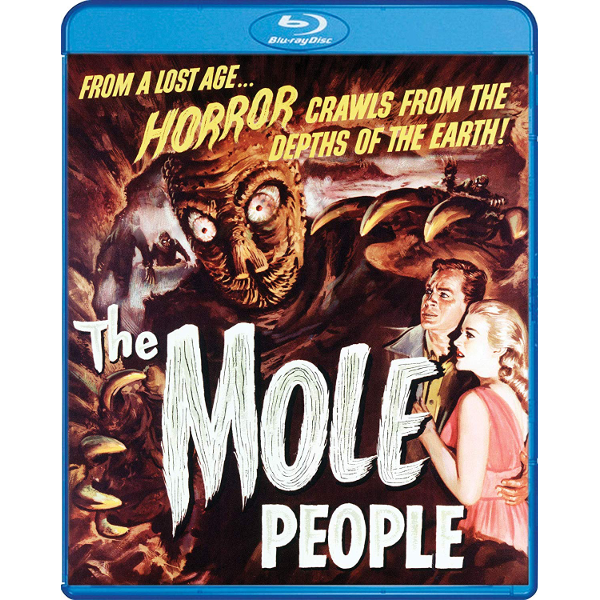
To star in Mole People Alland once again tapped the easy-going John Agar, and plucked the amiable Cynthia Patrick from the contract player list. Nestor Paiva was a ‘regular’ with Alland, and Alan Napier was a ‘regular’ in everything, industry-wide. The equally ubiquitous Hugh Beaumont gets almost as much screen time as Agar. The Mole People finds a quartet of archaeologists discovering Sumerian ruins in some high ‘Asian’ mountains. When they descend into a cave, they stumble into a Lost Civilization of albinos living entirely underground. Having deciphered Sumerian tablets, Dr. Bellamin (Hugh Beaumont) immediately converses in ancient Sumerian (ask a Linguist friend how silly that is) but it doesn’t matter, for the language spoken soon switches to English anyway. Neither Dr. Stuart nor the likable Professor Lafarge (Phil Chambers & Nestor Paiva) last very long, but handsome, charismatic Dr. Roger Bentley (John Agar) hits it off with a normal-complected slave girl, Adad (Cynthia Patrick). As in most Lost Civilizations, whether on Earth today, Earth in the past, Earth in the Future, the Moon, Venus, Mars or a moon of Jupiter, the main problem facing our heroes is political: some locals want the heretic outsiders executed, and others don’t.
Some Spoilers follow: Screenwriter László Görög brings some good thinking to this hoary setup, combining older ideas with nifty twists of his own. Sort of like H.G. Wells’ Morlocks, the Sumerians have been underground so long that they’ve become pale, mushroom-like albinos. They’re highly sensitive to light, even the light from the scientists’ flashlights. As they think all light comes from the God Ishtar, they assume that their visitors are messengers from the gods. This gives our heroes a reprieve, at least until their batteries run out. While we’re realizing that the producers have muffed a really good product tie-in opportunity with Eveready, one of the foreigners is found dead. The illusion of their immortality is spoiled, as in Kipling’s The Man Who Would Be King.
The Sumerians also worship a light in a sacred chamber that’s so bright, it burns them to death; Sumerian priest Elinu (Alan Napier) calls this light ‘the Fire of Ishtar.’ It comes in handy for that practice favored by all Lost Civilizations, human sacrifice. For a sacred ritual, a trio of maidens willingly walk into the blazing-bright death chamber.
Spoiler: The death ray turns out to be ordinary sunlight, and therefore only burns the hereditary albino Sumerians. This leads to a clever surprise, when the Sumerian priests sentence the surviving scientists to death. Just like a character in Lost Horizon, Adad comes from outside Sumeria, and is therefore also immune to the death light. That could be very convenient in the romance department, except that the Production Code required Adad to be treated as a non-white ‘other.’ As in Bird of Paradise and Broken Arrow, some arbitrary calamity must occur to keep the races separate. The odd thing is that in this case the Code’s racist rule seems a ridiculous technicality: the light-skinned Adad looks more Caucasian than do our smug American heroes.
Sidebar: the Sumerian city is supposed to be thousands of feet deep in the mountain, so the light would surely strike the bottom of the vertical shaft less often than your average planetary alignment or ‘magic hour’ sunbeam convergence in an Indiana Jones movie. But Elinu is able to call upon a good blast of high-noon light at most any time, day or night. This revelation doesn’t undo the essential brilliance of writer Görög’s story inventions: little kids follow and understand.

Enough with the sociology, what about the monsters?

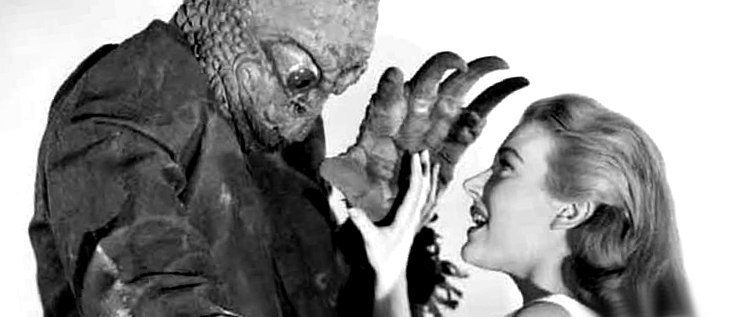
The Sumerian city has supply and demand issues. Their limited production capacity of edible mushrooms (their only diet?) drastically limits the population. To grow and harvest the mushrooms they have somehow created a race of Mole-Men, big hulking scaly (not hairy) creatures with giant mole-claws. Since Universal no longer wanted to pay for expensive full-body monster makeups, the Mole Men wear burlap gunny-sack clothing, with only their heads and claws sticking out. Key Mole Men have strange moving mouth pieces more suited for an insect than a mole, otherwise their faces do not change expression. For crowd scenes, less fancy, mass-produced masks appear to be employed.
Improving on the mostly decorative Metaluna Mutant, the Mole Men have an important role to play in the plot — they substitute for the native slaves that revolt against tyrant masters in other lost civilization movies. The monsters harvest the mushrooms in charcoal pits blanketed with eerie smoke, a budget version of Dante’s Inferno. When miffed, they can drag victims right down into the ground. Yet they remain sympathetic underdogs. They even come to the aid of our heroine, Adad.
Virgil Vogel directs as well as could be expected under the circumstances. A ritual dance has not a single interesting angle, showing how rushed things must have been. But Vogel’s dialogue scenes have a good pace, there aren’t too many unintentional laughs and we get enough key monster action to make kids happy. With no effects budget, the show is afforded just a handful of matte shots to represent giant ruins and the underground city in its enormous cavern. Many more shots appear to place the actors in front of rear-projected stills (I’m pretty sure). The design of the paintings is sub-par, while the optical work is not bad. But after far too much walking around in pitch-black tunnels, these inadequate effects shots are are not the breathtaking ‘reveals’ that the movie needs. Fortunately, Vogel does work up a reasonably exciting climax. The lumbering slaves emerge from the ground, attack various victims and stage a fairly good palace coup.
The Mole People is a mole-hill attempt at a Lost Civilization epic, but its engaged performances (minus the low-energy Hugh Beaumont, perhaps) and interesting story twists make up for some slow sequences. I rate it just below Universal’s best ’50s offerings, for its ambition and optimism. Better effects and color might improve it, but then the whole show would have to be upgraded, and how could they get Jeff Chandler or Dorothy Malone to play in a movie like this? We certainly don’t need a trendy ‘meaningful’ screenplay with a political edge — it wouldn’t be pleasant to see John Agar chastise the barbaric Sumerians with socially conscious patronizing:
“Elinu, your cruelty and human sacrifices are shameful, deplorable. ‘Mole People’ are fools that hide from the truth, that won’t learn or change their ways. No, those gentle creatures who feed you aren’t the Mole People — YOU are the Mole People.”


