
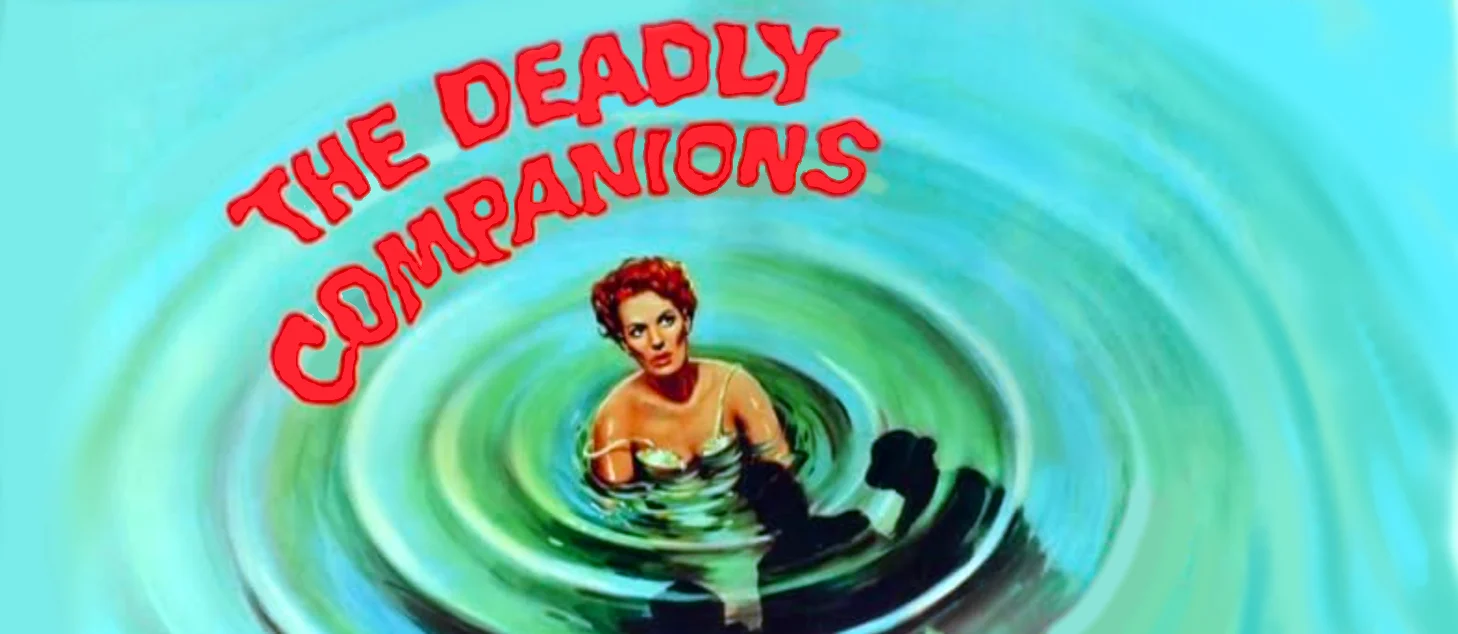


Is it possible that the movie The Deadly Companions was conceived on the set of Disney’s The Parent Trap? Stars Maureen O’Hara and Brian Keith got along well on that show, and Ms. O’Hara was looking for a commercial project to produce with her brother, Charles B. Fitzsimons. Other connections seem obvious enough: Keith had recently starred in Peckinpah’s unorthodox series The Westerner, which lasted for only 13 episodes but enhanced the writer-director’s reputation.
Most accounts of the filming of The Deadly Companions are told from Peckinpah’s perspective. Although noted for his authentic-sounding western dialogue, O’Hara and Fitzsimons wanted what many star-centric producers wanted — for the director to respect the fact that they were in charge. Any hope of a creative collaboration broke down in a power struggle. Ms. O’Hara ‘John Ford’ connection’ may have helped her secure a fine director of photography. William Clothier had worked his way up from W. Lee Wilder movies to being John Ford’s go-to cameraman; his previous assignment was John Wayne’s gigantic 65mm blockbuster The Alamo.

Have you heard that Sam Peckinpah sometimes didn’t get along with his producers?
Sam had scrapes with his TV collaborators as well, but the consensus is that there was no meeting of minds with Maureen O’Hara, who described her director as uncommunicative, surly and profane to an extreme. Such a low budget undertaking didn’t have room for the egos involved, and Peckinpah reportedly had no final say on anything, especially not editing and post-production. So we certainly won’t blame him for some aspects of the picture.

A.S. Fleischman’s screenplay is serviceable; it resembles the small-scale Ranown westerns that Budd Boetticher was making with Randolph Scott. It’s a shame that Peckinpah wasn’t permitted to augment the dialogue with his colorful western speeches. Auteurist critics like Jim Kitses were quick to point out themes in common with Peckinpah’s later work. The Deadly Companions has a crippled, neurotic hero and a wild and wooly villain; the context expresses contempt for frontier hypocrisy. Plus, the basic story has a grim, almost macabre aspect that would come out in one of Peckinpah’s better pictures, filmed a decade later.
Ex- Union soldier Yellowleg (Brian Keith) never takes off his hat around people, and nobody knows why. He enters Gila City with two troublemaking recent acquaintances, who are intent on robbing the bank. Billy Keplinger (Steve Cochran) is a showoff who wears stylish clothes, and Turk (Chill Wills) is a cheating gambler. Yellowleg learns that Turk is the same man who tried to scalp him in the Civil War. That explains his behavior with his hat — he still carries a nasty scar on his forehead.

The trio of bad men breaks up a Bible meeting run by the local parson (Strother Martin) and prepare to rob the bank, only for another gang to show up and beat them to it. When they shoot at the retreating thieves, a shot from Yellowleg accidentally kills a small boy. The boy’s mother is Kit Tilden (Maureen O’Hara), a bar girl. She has already been ostracized by the local bluenoses. They continue to scoff at her claim that she is a widow, that her boy was legitimate.
Kit angrily determines to transport her son’s body through Indian country to the ghost town of Siringo, where she can bury him next to her husband, his father. Yellowleg and his dangerous fellow travelers invite themselves on the journey, for different reasons.

The Deadly Companions plays like a morbid variation on one of the Boettticher/Scott films, but with less humor than writer Burt Kennedy’s norm. Fleischman fleshes out the characters with grotesque details. Brian Keith’s shyness about the scar on his hairline indicates a rather obvious castration complex. He also has a bum shoulder, and in shoot-outs he frequently drops his gun. Any more pronounced, and Yellowleg’s handicap would be like the pilot’s ‘drinking problem’ in the comedy Airplane. Despite Peckinpah’s lack of script input, Yellowleg comes off as a forerunner of one of Peckinpah’s later ‘cripples’ that nurse old leg wounds and nagging guilt complexes.
The villains are colorful, if not very original. Chill Wills’ Turk is a shambling weirdo who wears a shaggy fur coat, even in the desert heat. He rambles on about ‘Freedonia,” the private kingdom he wants to establish with slave labor. Twelve years later, Wills would return in practically the same role in Peckinpah’s Pat Garrett and Billy the Kid. In dress and manner, he’s echoed in another comic character from the Peckinpah corral, Slim Pickens’ wooly muleskinner in Major Dundee.

Steve Cochran’s Billy Keplinger is a stock girl-chasing dandy. His tacky-looking blue gambler’s vest, in bright blue, reminds us that The Deadly Companions has no official costume person. Everything we see may have been ‘off the rack’ for generic western use. As was a big theme in many ‘adult’ westerns of the late 1950s, the film’s major menace is that the oily Keplinger will rape the leading lady. The rather tasteless ad for the film shows menacing silhouettes hovering over Kit Tildon as she cowers in a water hole. But Ms. O’Hara had little in common with most actresses in similar roles: as a prime mover in the production, the threat of rape was her choice. They wanted the commercial hook without submitting to anything particularly daring.
It’s a slow film with a dark attitude. We see Kit Tilden in her dance hall costume only once; if she’s working as a prostitute, the film’s surface doesn’t acknowledge it. Most of her O’Hara’s concentrate on her various states of distress and anguish.
Peckinpah had a lot of stage experience. He would do great work with a few actresses (Mariette Hartley, Olivia de Havilland) yet did not become known for directing women. It is said that Maureen O’Hara not only found him crude and unprofessional, she soon refused his direction. Some accounts say that she forbade Peckinpah to speak to her on the set.
Peckinpah’s westerns have great characters and dialogue, but his direction was good only when cameraman Lucien Ballard was his director of cinematography. We think the films show that cameraman Ballard lined up a lot of the shots in Ride the High Country and The Wild Bunch, taking a lot of responsibility for the flow of images, while Peckinpah concentrated on his actors. Major Dundee’s blocking of scenes ranges from excellent to very weak.
In Deadly Companions it really looks as if Peckinpah called the shots on the fly. Anamorphic Panavision really needed a good eye for how angles would cut together. There is altogether too much ‘coverage’ of singles and close-ups. The main interior is a bar that is converted into a church for the reverend to preach, and Peckinpah never finds a good angle in it. The opening shows Turk balanced on a wobbly keg, with his hands tied, a noose around his neck and his crooked cards pinned to his shaggy coat. It’s a great image, but the scene around it has no shape.

The storyline often lacks a sense of going anywhere, despite there being a lot of cutting within scenes. I can imagine the producers thinking, ‘this is too slow,’ and asking, ‘what can we cut to here?’ At many moments in Companions, the cutting to additional angles feels random. The shot selection in Ride the High Country, The Wild Bunch and even Junnior Bonner is so good, we forget about the presence of a camera. Ballard even makes the many zoom shots in Wild Bunch look graceful.
“Siringo Macabro”
Away from Gila City in the open desert, William Clothier’s beautiful landscapes take over. The character action is predictble until Kit Tilden and Yellowleg find themselves alone in the wild, eventually dragging her son’s coffin by hand. Kit is determined to prove to Yellowleg that her dead husband Meade Tilden really existed. There’s a hint of something perverse about the enterprise, even though Maureen O’Hara plays everything without irony. Peckinpah certainly returned to similar material later on. The idea of two people moving a corpse across the desert rhymes with Peckinpah’s own Bring Me the Head of Alfredo Garcia. Companions’ vibe carries some of the same overtones of Edgar Allan Poe.

The Deadly Companions is noted for two more interesting sequences. The first is a highly original substitute for a standard shoot-out with Indians. After sunset, Kit and Yellowleg hunker down to witness a group of drunken Indians. They playfully re-enact a stagecoach robbery that perhaps happened earlier the same day. Braves on horseback chase their friends, that have dressed in the dresses of their presumed victims. The sequence is rather eerie, ghostly; it might look even better if the day-for-night effect were timed better.
The most-discussed moment is the confused ending. (Spoiler) Yellowleg elects to shoot it out with his ex-partners, who have returned from robbing the bank for real. Peckinpah said that he wanted to make a change to benefit the Yellowleg character: he successfully fights back against Turk and Billy, proving that his ‘handicap’ was more a mental problem than a physical one.
O’Hara and Fitzsimons apparently insisted on ‘protecting’ star Brian Keith’s heroic status by having Turk shoot Billy in the back, for the vaguest of revenge reasons. Poorly staged and awkwardly cut, the death of Billy is an almost complete letdown. Yellowleg’s role in the story is thus limited to finding a bond of common trust with Kit Tilden. The townsmen offer to let her return to Gila City, but Kit and Yellowleg choose to ride off alone.

 The audio is fairly clear, which is a help because there are no subtitles of any kind. There are also no chapter stops and no menu, just a Shoreline logo up front. But we can confirm that there is a disc inside, and it does play. The Finnish VHS carried the original, rather attractive Pathé America logo, but it's been trimmed from all subsequent Public Domain releases I've seen, including this one. →
We do not need subtitles, principally because the picture is a bore and inept beyond that, but Glenn’s review is great and honest. Three cheers for him.
There is a much better version available in Germany from Filmjuwelen. German title is “Gefährten des Todes”. It also includes a Mike Siegel documentary about Peckinpah’s early career and two audio commentaries (in German). No forced subtitles.