


From the moment we hear the tinkling notes of Ennio Morricone’s oddball music score, we know we’re in different territory than previous murder mystery movies. Dario Argento became a buzzword in the 1970s, but his popularity exploded with the first wave of DVD releases. The flood of DVDs of vintage European film product was very selective: no sword and sandal pepla to speak of, and at first not too many police action pictures, but a regular tsunami of quality Euro-horror of all kinds. At one of the few fan conventions I attended in the early 1990s, I saw dealers selling rip-off VHS tapes of obscure foreign movies with strange names, in mostly grim quality. I knew I didn’t want to pay twenty $ dollars a shot to see them in that condition.
Let’s assume that you already know about Gialli and the general trend of ’70s Italo pop cinema. It took DVD to show us how great some of these pictures looked. The overlap of early video adopters and potential fans of Euro-horror was strong in those days, before college kids found ways to pirate everything off the web, and made do with video on their smart phones. And the new DVDs, from a variety of vendors, were beautifully remastered with original audio tracks and extras. They made new widescreen TV monitors look great, and introduced a new (the last?) generation of film mans to the lush lounge soundtracks of continental composers like Bruno Nicolai, Riz Ortolani, Stelvio Cipriani, and the master, Ennio Morricone.
Back in the ’70s I think I was aware only of Dario Argento’s Suspiria and Four Flies on Gray Velvet. The big initial title for the Giallo slasher thriller subgenre was his 1970 The Bird with The Crystal Plumage (L’uccello dalle piume di cristallo), a visually stunning horror-inflected who-dunnit . It was the first direction credit for the former critic and screenwriter, and it’s no amateur effort. Ennio Morricone took a break from Western scores to provide the eccentric music that gives the film its modernist feel. Key collaborator Vittorio Storaro would soon become one of the more celebrated cinematographers in the world. The cinematographer infused the images with the high gloss of photos in Italian fashion and interior design magazines, the ones that weigh a pound each. By the time of Deep Red Argento’s films had become incredibly lush exercises in visual fetishism. The reflections from glossy close-ups of fancy footwear were almost as important as the story being told.

Argento’s script won’t impress Agatha Christie fans, as tracking down the killer is a string of suspect encounters, most of which could be shuffled in any order. In Rome, American writer Sam Dalmas (Tony Musante) witnesses a bizarre murder attempt at the art gallery of Alberto Ranieri (Umberto Raho). Trapped between glass doors, Sam is unable to assist the helpless victim Monica Ranieri (Eva Renzi). Inspector Morosini (Enrico Maria Salerno) confiscates Sam’s passport but decides he’s not a suspect. Morosini doesn’t mind that Sam and his girlfriend, model Julia (Suzy Kendall) investigate a related string of murders on their own. Surviving an assassination attempt by the sinister Needles (Reggie Nalder), Sam talks to an imprisoned pimp (Gildo Di Marco) who might know the assassin, a gay art dealer (Werner Peters) and the artist Berto Consalvi (Mario Adorf), whose disturbing painting of a murder scene was purchased by the mad killer. Bird expert and Sam’s friend professor Carlo Dover (Raf Valenti) borrows a recording of the killer’s voice, which may hold an important clue.
The way Argento tells his story made Crystal Plumage into a worldwide hit, wherever local censorship tolerated his borderline transgressive imagery, an impressive intersection of the skills of director Argento and cinematographer Storaro. The attractive Cromoscope visuals make use of strong compositions emphasizing sinister shadows and menacing silhouettes, but the style is less German expressionism than it is Italian fashion fetishism. We’re given tight close-ups of leather gloves and jackets, and a set of polished knives mounted in red felt. Argento’s mad killer is a collection of sensual textures, and the movie makes a glamour statement out of killings with butcher knives and razors. That and a fairly competent flair for suspense distinguish Crystal Plumage from other thrillers circa 1970.
Argento exploitative approach finds new angles to hold audience interest. Viewers respond to the admittedly gorgeous images, while the new relaxed censorship codes allow more latitude in disturbing sexual violence. Almost anonymous in the cast list are five beautiful actresses, given names but really known by their slots in the kill order: Victim #4, Victim #5. Storaro’s luscious images caress the near-nude bodies of more than one of the victims, providing prurient voyeuristic thrills.

Is the violence-against-women content offensive? One of the anonymous victims is first viewed preparing for bed in a see-through nightgown, before being savagely tormented by the knife-wielding fiend. We don’t ban films for their moral content (at the moment), but it’s true that this stuff seems pretty ugly and exploitative now. There have to be plenty of lonely and insecure guys that eagerly identify with the power and privilege of a sexually charged slasher murderer. Too many men already think of sex as a power relationship.
The episodic script is stacked with filler scenes with eccentric characters, like an American TV detective show. Argento goes for exotic detail made possible by the demise of the censors — a lineup nabs a transvestite, while the curious Dalmas seems to interview nothing but extroverts with alternate sexual-preference lifestyles. The most amusing of these is Mario Adorf’s hermit of an artist, who manages to paint without an income by raising his own food supply.
Don’t look to Crystal Plumage for sophisticated content. Argento’s stylishness can’t hide his reliance on clunky Hitchcock references. I caught a number of angles through peepholes, and a killer in a distinctive yellow jacket escapes by disappearing into a room full of men with identical jackets. There’s also an amusing twist on Hitchcock’s frequent culinary jokes, which will surely gross-out pet lovers. For his biggest revelation, Argento swipes an audio clue from Akira Kurosawa’s film work.
On the plus side, Argento’s Hitchcock quotes aren’t the blatant plagiarism found in Brian De Palma pictures. He also comes up with a number of interesting, fairly original visual ideas. Although 1970 was the height of the craze for shallow- focus montages, Crystal Plumage uses its long lenses with discretion and saves the zooms for disturbing overstatement, like a pull-out from the tongue of a screaming victim. Sinister reconnaissance views of potential victims pop to B&W as ‘stills’ are photographed. The reverse of that process creates an impressive frisson when a B&W photo of the mystery painting is suddenly replaced by the color original — hanging on the murderer’s wall.

Argento allows his cast to be reasonably natural in their (admittedly unchallenging) roles. Leads Tony Musante and Suzy Kendall are comfortably bland. Enrico Maria Salerno top cop is thoughtful instead of the expected bully. Various eccentrics (Pino Patti, Gildo Di Marco) are amusing, with favorite Werner Peters (The 1,000 Eyes of Dr. Mabuse, 36 Hours) mincing around an antiques store in a guest bit. He compares well with Martin Balsam in The Anderson Tapes. The interesting Eva Renzi and Umberto Raho are the married owners of a high-class art gallery, which seemingly specializes in artwork custom-designed for various bizarre murder scenarios. Some exterior views of the gallery resemble a surreal diorama, with its oversized statues of things like a dragon’s claw.
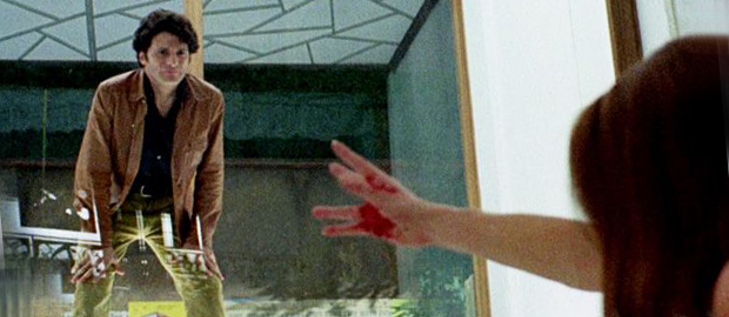
Argento opens with a horror set piece so arresting, its effect lasts through the rest of the film. Responding to a struggle he sees in the art gallery, Musante’s Sam is trapped in the gallery’s portico, between two glass walls. It’s like Rear Window, except that he’s barely five feet from the bleeding Monica Ranieri, and unable to aid her or run for help. The setup confects a frightening, voyeuristic distillation of the horror film experience — the dreadful spectacle is happening in full view, but audience surrogate Sam can do nothing about it.
Sam later returns to the same fateful location by a different route, an idea perhaps borrowed from the underrated 1945 comedy noir Lady on a Train — a Deanna Durbin movie! We have already seen the installation of a massive and dangerous-looking sculpted artwork, a big metal slab that looks like a pancake griddle for Attila the Hun. As soon as we see the spikes poking out of that thing, we know it’s going to show up later. Don’t forget the old movie rule — if in the first reel you introduce a ten-foot sculpture likely to crush and impale somebody, you must put it to use in the last reel.
Crystal Plumage has its plot holes and unfair red herrings, but nothing we can’t live with. Argento also requires a couple of extra scenes to wrap up his story, but otherwise his murderous movie machine is a winner.
