
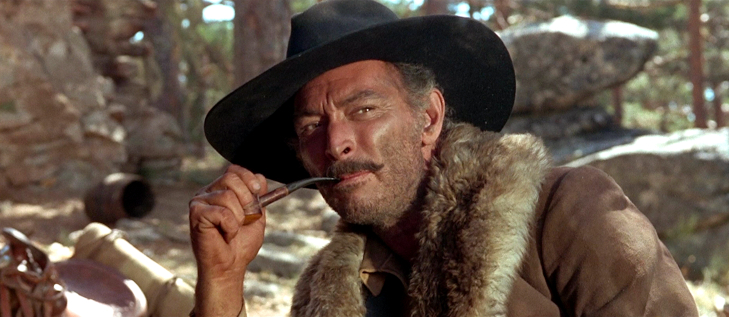


Actor Lee Van Cleef’s career prospects weren’t soaring around 1963 – 1964. After 14 years ‘in the business’ everybody knew his face but only fans of westerns and sci-fi knew his name. Originally spotted by Fred Zinnemann and Stanley Kramer for High Noon, the hawknosed Van Cleef bit the dust in scores of oaters and crime pictures without climbing above the day player bracket. It was mostly TV that paid the bills — Sky King, Space Patrol, The Lone Ranger. Directors Joseph H. Lewis, John Sturges, Budd Boetticher and John Ford tapped Van Cleef’s recognition factor as an Instant Villain, but by 1965 he was doing guest shots on things like My Mother the Car.
Although not quite 40, Van Cleef was no longer comfortable sitting a horse for extended periods of time, due to an earlier back injury. Westerns were being phased out everywhere but on TV . . . was it maybe time to change professions?
Two years later Lee Van Cleef was suddenly the second-biggest western star in Europe. Unable to attract a Hollywood star to play opposite Clint Eastwood, Van Cleef proved a perfect fit for Sergio Leone’s revisionist take on the classic West. Italian producer Alberto Grimaldi immediately starred Van Cleef in his own western vehicle, with Sergio Sollima directing. Sollima had written some sword ‘n’ sandals and had directing credits on a trio of second-string spy pictures. The Italian title La resa dei conti was borrowed from an Ennio Morricone music cue for a gunslingers’ showdown; it translates as ‘The Settling of Accounts.’ The show would also put Sollima on the map — he’d immediately move onto two more action westerns with Lee Van Cleef’s younger co-star, Tomas Milian.

Alberto Grimaldi made the most of a smart production deal with United Artists, which held back the American release of Leone’s Dollars Trilogy to properly prepare a dynamite advertising blitz. The marketers for James Bond did an even better job touting for The Man With No Name. The resulting vogue for ‘spaghetti’ westerns gave Lee Van Cleef’s career a powerful boost, a wave also caught by composer Ennio Morricone. La resa dei conti is blessed with a Morricone score that may be the composer’s most exciting work in a western.
The show arrived in America a full 15 months after its Rome premiere, re-titled The Big Gundown and shorn of a full half-hour of footage. In Germany it was reportedly even shorter. The U.S. distributor was Columbia. Thirty years later, when the studio prepped Gundown for a restoration, I got to witness a screening of the one surviving Technicolor release print held in their vaults. Longtime ‘DVD Savant’ correspondent Malcolm Alcala attended as well. The word ‘surviving’ only applied in the sense that the print could give colorists an idea of the film’s original look. The show was a mess. Between film damage, flurries of rough splices, bad-looking replacement footage and plain missing material, at least half of it wouldn’t go through a projector. We only heard fragments of Ennio Morricone’s terrific music score. Even in tatters it was enough to hook me — the picture became something I had to see in a more complete form.
The full-length Italo The Big Gundown didn’t disappoint us. Although the pace slows in the middle, the third act builds to a knockout finish. Quentin Tarantino buried Gundown as his 11th favorite Italian western, but most fans rate it 4th, immediately after Sergio Leone’s Dollars Trilogy.
Powerhouse Indicator is touting their new two-disc Region B The Big Gundown special edition as the first UK Blu-ray release. It first arrived in Region B eleven years ago from the German label Explosive Media. In 2013, Grindhouse Releasing issued a Region A domestic disc. American collectors that are Region-B capable may be enticed by PI’s new extras.
Producer Grimaldi did his best to give The Big Gundown production values in line with the Dollars films. The cinematographer is Carlo Carlini, of La Strada and Il Generale Della Rovere. Leone’s designer Carlo Simi is back, as is composer Ennio Morricone, with a main theme “Run Man Run” sung by Cristy (Maria Cristina Brancucci). It may Morricone’s single most exciting western cue.

Director Sergio Sollima generates narrative suspense, a quality that eludes many Italo oaters. The opening concocts a classy entrance for the respected lawman Jonathan Corbett (Van Cleef), blasting down a trio of outlaw fugitives. Corbett is then enlisted by the burly, glad-handing railroad baron Brokston (Walter Barnes) to hunt down and kill Cuchillo (Tomas Milian), a Mexican accused of raping and murdering a little girl. As an added inducement Brokston offers support for the lawman’s Senatorial campaign. Chasing Cuchillo into Mexico, Corbett finds that capturing the wily bandit is a tall order. Along the way, the lawman learns more about the real motivations behind Brokston’s urgent manhunt.
The Big Gundown shapes up as one of the earlier ‘political’ Italo westerns: writer Franco Solinas co-wrote Gillo Pontecorvo’s powerful anti-Colonial The Battle of Algiers and Queimada. This film’s biggest villain is a corrupt Yankee capitalist, the greedy, arrogant Brokston. The millionaire is confident that Corbett’s lawman cred will make him a shoo-in for public office, like Wyatt Earp or Pat Garrett. But Brokston really wants a puppet Congressman to rubber-stamp his plan for a Texas-Mexico railroad. Sergio Sollima shows the economic tyranny of the rich in the West. Directors Sergio Corbucci and Damiano Damiani were more consistent with leftist themes, in several movies in which the Mexican Revolution commented on present-day political struggles.
Lee Van Cleef had been cast against type as a respectable character in For a Few Dollars More, The Big Gundown promotes him to full-on hero status. Even though riding a horse was painful, the actor prospered as a western hero for several years. Turning his image around 180°, Van Cleef even took up the role made famous by Yul Brynner in The Magnificent Seven Ride! (1972).
Did producer Alberto Grimaldi also aim to attract a non-western ‘youth audience’ to The Big Gundown? Equal star emphasis is given to Tomas Milian, a handsome Cuban-born actor whose most prestigious role to date was opposite Romy Schneider in Boccaccio ’70. This time out he’s no playboy, even if he seems to have a girlfriend in every town. The earthy peasant Cuchillo is a wanted fugitive who lives by his wits. It’s also a very physical role. Ragged and filthy, actor Milian must run for miles across a rough landscape with only sandals on his feet. Cuchillo doesn’t even have a hat against the desert sun.

Cuchillo is a deadly killer with a knife, but he has a mischievous nature, and welcomes each new ordeal with a smile. The Mexican has hippie appeal, and may have made viewers think of a recent Marxist martyr, the charismatic Che Guevara. Cuchillo’s central episodes chart something of a Peon’s Progress: in a retort to John Ford’s Wagon Master, our bandit seduces a Mormon girl in a caravan of settlers. He also comes across a perverse situation at an isolated ranch, where a widow (Nieves Navarro) seemingly maintains a stable of toughs as her sexual playthings. Cuchillo becomes her choice of the hour; he must use his wits to walk away in one piece. This is the least interesting episode, with standard low-grade Spaghetti cruelty — beating, torture, a savage whipping.
For most of the movie Cuchillo has no horse to ride. But he’s a skilled survivor and proves to be Jonathan Corbett’s equal in the strategic double-crosses favored by writer Sergio Donati. We believe Corbett when he admits that he now respects the grimy fugitive. The more he learns about Cuchillo, the more he realizes that Brokston has lied to him — Cuchillo is a rogue, but not a sex killer.

The crown of villainy shifts to Brokston’s bodyguard-associate the Baron von Schulenberg, played by Gérard Herter of Caltiki, il mostro immortale. ↑ Brokston and von Schulenberg eventually show up at the Mexican rancho of Don Gomez Serrano (Alfredo Santacruz). Don Serrano is a man of integrity, unlike Brokston, who wants to turn the hunt for Cuchillo into a sporting event. The preening von Schulenberg is eager to challenge Corbett to a shooting match. In a plot twist similar to Richard Brooks’ The Professionals (1966), Corbett learns that his entire mission to Mexico has been a fraud. A violent ‘settling of accounts’ is indicated.
The overall pace of The Big Gundown jumps into high gear in the film’s most dynamic sequence. Accompanied by weird percussive riff in Ennio Morricone’s soaring music score, Cuchillo flees on foot cross-country, chased by a full mounted posse. Tomas Milian earns his money here, dashing like a scared rabbit and trying to outrun Brokston’s dogs. Director Sollima makes good use of some bleached-looking, rugged desert rocks.
The show concludes in a series of duels, with rifles, six-guns and a knife as weapons of choice. The satisfying finish confirms Jonathan Corbett’s wisdom as a judge of character, accepting Cuchillo as an honorable equal. For the finale, with Cuchillo finally on a horse, the two heroes make a stunning exit across a vast sand dune, backed by Morricone’s electric guitar and Cristy’s frantic vocal, which elevates into a scream. Tomas Milian would return as Cuchillo in director Sollima’s follow-up feature, Corri uomo corri (1968) — aka Run, Man, Run.
Everyone loves Sergio Leone’s westerns but too much of the Italo wing of the genre blurs into generic exercises in cynical brutality. The Big Gundown is one of the few that overachieves, delivering a similar stand-alone western adventure experience.


Excellent film and an excellent release. Lee Van Cleef was the best and these releases are most welcome. There was a double sided poster which was also included in the initial release.
I agree with Derrick. Excellent film. I also bought the two-disc edition. Cool poster!