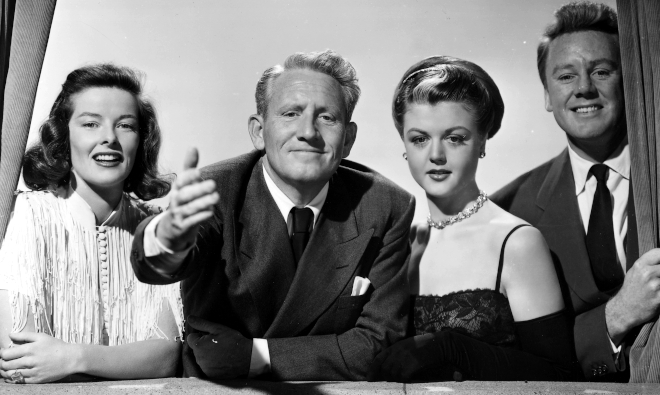
In his effort to keep ‘Liberty Films’ alive after It’s a Wonderful Life, Frank Capra made a deal with MGM that gave him the studio facilities plus three of Louis B. Mayer’s top actors. In some ways the show is an attempt to revive Capra’s top-of-the-industry standing in the 1930s, when he felt he had an obligation to do ‘important’ pictures. From a Pulitzer Prize-winning Broadway hit by Howard Lindsay and Russel Crouse that wades into then-current Presidential politics, the polished production takes the attitude that Frank Capra is here to tell America what is needed to right all political wrongs. It shows Capra’s directorial talent but also displays the deceit and condescenscion built into his ‘Capracorn’ attitude toward society at large.
The 1945 play State of the Union is about a businessman who becomes a Republican dark-horse candidate, reportedly modeled after Wendell Wilkie. The film’s title card proudly proclaims it to be Frank Capra’s State of the Union. Capra had a habit of taking credit for the work of his writers, and this is the second time that he assumed authorship for the work of Pulitzer-winning playwrights.

The movie is expertly acted, and directed with Capra’s expected pace and precision — it’s clear that he was the boss on the set. The political divide of 1948 is reflected in the casting of both liberal and conservative performers, but Capra made sure everyone stayed professionally apolitical between takes.
Just before filming began, the show’s talent lineup changed. Signed star Claudette Colbert bowed out in a dispute over her work hours. Spencer Tracy helped decide that his lover-frequent screen partner Katharine Hepburn would step in, with just two days notice. Although it’s not the most appropriate part for Hepburn, she carries herself well, as do all of the actors in State of the Union. It’s the show’s politcial pitch that feels over-insistent and politically dubious. The excellent commentary on Powerhouse Indicator’s disc suggests that Frank Capra aimed tilt the Lindsay/Crouse play toward the old pre-war ‘political movie’ formula seen in his Mr. Smith Goes to Washington and Meet John Doe. The show decries the terrible corruption and hypocrisy in national politics, and suggests that the solution is an idealist ‘man of the people’ whose sentimental greeting card homilies are taken as patriotic wisdom.
Who is the hero to deliver America from ruin? Hearty, honest, humble aviation industrialist Grant Matthews (Spencer Tracy) has attracted national attention through extensive press coverage conveying an image of decent, responsible American values. After Grant becomes Time’s Man of the Year, media publishing mogul Kay Thorndyke (Angela Lansbury) becomes convinced that she has found her ticket to power in Washington. Kay presents Grant to her close associate Jim Conover (Adolphe Menjou) as an ideal dark horse Republican presidential candidate. The shrewd kingmaker Conover is skeptical because Grant simply says what he believes in his popular speeches — a viable candidate needs to follow a party platform. But Thorndyke thinks Grant will play ball. With the clever, opportunistic columnist ‘Spike’ McManus (Van Johnson) along to handle publicity, Matthews increases his popularity and newsworthiness on a speaking tour.
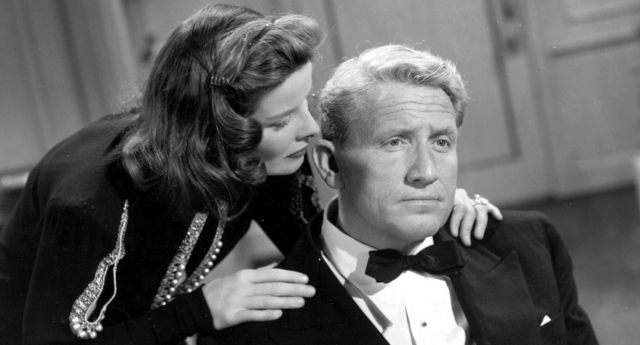
Matthews’ wife Mary (Katharine Hepburn) is aware that Grant and Kay are close associates, and may be lovers as well. Mary dutifully holds her objections in check as Grant makes the decision to run, to do good for the country. Conover and Thorndyke groom their candidate to win, eventually convincing him that he must limit his speeches to party-approved messages, and allow Conover to handle the shady back-room dealing to obtain the necessary endorsements from labor leaders, special interest groups and party delegate brokers. When Grant acquiesces to all this, Mary is dismayed — she feels her once proudly independent husband ought to see that he’s on a very slippery slope.
Tensions rise until the big night for the candidacy announcement. Conover has all the political hacks lined up for a gala to be televised live right from Matthews’ house. Mary and the children will introduce Grant with the blessing of Conover’s gang of ‘necessary’ political crooks. Spike McManus talks Mary into inviting Kay to the gala affair, to quiet the rumors of infidelity. But even with everything so carefully rigged, the night does not go as planned.
State of the Union is a fuzzy wad of political chewing gum, a strange artifact from Election Year 1948. It’s packed with topical references to actual political figures, especially the Democratic candidate Harry Truman. Spike scoffs at Truman’s chances for the Presidency, only partly as a joke. It’s assumed that the Democrats must be defeated. Everyone we see is a Republican, and Capra’s notion is that America could become a Utopia if the GOP would just nominate a ‘natural everyman savior’ like Grant Matthews. The original Lindsay-Crouse play is described as a comedy-drama, but the tweaked film adaptation takes itself entirely seriously, except for the Van Johnson character’s sarcasm, and occasional clowning by a supporting bit player.

Grant and Mary are surrounded by political hacks and opportunists, and several players are hateful vipers. Kay Thorndyke is revealed as a warped personality, turned into a power-mad petty tyrant by the malign influence of a ruthless father figure. Did John Frankenheimer find his Eleanor Iselin for The Manchurian Candidate here? Capra’s film could almost be a prequel for Frankenheimer’s. Adolphe Menjou’s Jim Conover epitomizes the conniving politico, a two-faced bully who whips cronies into line by shouting threats over the phone. Straddling the angel/devil line is Spike McManus, who happily takes Kay’s money while sniping at her and Conover from the sidelines. Charmingly played by Johnson, Spike expresses good-sense misgivings about everything that happens. He may do Thorndyke’s bidding, but he honestly understands the Matthews’ dilemma.
The curse of ’30s Capracorn is revealed in the condescending attitude to the ‘little people’ of the story, who are by turns amusing or cute, but always unimportant, not to be confused with the anointed main players. Many are played by familiar character actors that project the Capra ‘seal of authenticity’ as real Americans; some just have trustworthy faces. But the director’s once-prized agility with supporting characters seems on the wane here. The use of stereotypes is so flagrant, we’re tempted to think that Capra has a certain contempt for average people. Waiter Carl ‘Alfalfa’ Switzer is a dimwitted Bellboy. Italian-American Tom Pedi (The Taking of Pelham One Two Three) is a soulful comedy relief barber. Matthews’ butler Buck Swenson stays aloof to the circus swirling around his employers. Tom Fadden’s goofy but honest waiter has to be shooed away by Conover when ‘important’ people begin talking.
Mansplainer-in-Chief?
Amusing minor roles are of course a familiar part of most every farce. The difference is that Capra doesn’t embrace his happy ensemble equally. There is no crossover between the consequential leading players, and the hoi polloi, yahoos that are nice in small doses and best when laughed at. They’re mainly suited to follow the lead of the wise and knowing Capra hero. Staring at the White House as might Jefferson Smith, Grant suddenly spouts ‘inspirational’ wisdome to a cute little professor/old crank character (Maurice Cass); they suddenly become friends. We don’t buy this as a natural relationship, but a contrivance to make Grant seem magnanimous, an excuse to allow him to pontificate. Grant charms some ‘little people’ with his earnest patriotism, and others fixate on his speeches as if he were the Messiah: an Important Man is talking.
Capra’s broad comedic approach to secondary character ‘types’ is equally outmoded and condescending. Audiences surely responded positively to the entrance of Margaret Hamilton — the Wicked Witch of the West — as the eccentric housemaid Norah. We’re thinking, ‘aww, how nice to see Ms. Hamilton get such a standout part,’ until Capra makes her the butt of ‘ugly’ jokes. Silly and clueless, Norah moons after handsome Van Johnson, fluttering her eyes. She also socially incompetent, inadvertently providing Mary with a clue that Kay and Grant may be lovers. When his movies didn’t strive for such ‘importance,’ Capra used his minor characters much more thoughtfully: we happily recall the delightful faces of bus riders singing ‘The Man on the Flying Trapeze’ — a scene with zero import beyond the joy of being human and happy.

The film’s credited screenwriters are long-time Frank Capra associates. His autobiography The Name above the Title frequently mentions Myles Connolly as a dependable advisor and story consultant all through the 1930s. Connolly contributed to all three of Capra’s overtly political movies. But he also shares writing credit on Leo McCarey’s hysterical My Son John, Hollywood’s most notorious piece of Red-baiting propaganda. The other writer Anthony Veiller has many prestigious credits, including several good pictures by John Huston. He was a key writer on Capra’s highly effective WW2 propaganda series Why We Fight. But Veiller also co-wrote the screenplay for Red Planet Mars, a movie even more ideologically rabid than My Son John, if such a thing is possible.
Those associations are puzzling because Capra’s reputation is that of a Hollywood liberal — he reportedly was investigated for ‘anticapitalist leanings’ in his It’s a Wonderful Life. But biographer Joseph McBride has revealed that Frank Capra secretly testified as a friendly witness to HUAC. McBride suggests that Capra was not politically committed, but held strong grudges against the (often liberal) screenwriters that accused him of taking credit for their work.
Working with his screenwriters, Capra shoe-horned the prizewinning play into the Capracorn mold. Capra’s main addition is a comedic aerial stunt sequence conceived in Hal Roach slapstick terms. Grant Matthews can’t be a boring company president; he has to be a mischievous nut, too. He takes the pilot’s seat in his company plane to perform dangerous, impromtu aerial maneuvers, competing with a second aircraft piloted by one of his factory chiefs. It’s wild and crazy, folks — Grant even parachutes out to win a $10 bet that he will land first. Never mind that he jettisons the plane’s exit door, which a) likely costs $500 to replace, and b) could easily kill some unlucky citizen below.
Later on, when Grant Matthews has aligned with the slimy politicos, a second opportunity for aerial hijinks arises. This time he has no patience for horseplay, and tells the other plane’s pilot to ‘knock it off.’ Grant is no longer his free-thinking, socially irresponsible self, but part of the dreaded political insider club.

The schematic posturing of the villains is overstated. Angela Lansbury is introduced in a prologue pitched at the level of Greek Tragedy with a family curse. She now strikes poses with her cigarette holder, like a femme fatale nemesis in a superhero tale. Adolph Menjou grins with glee at every sign that Grant has become more malleable, obedient. His collected Republican cronies are pegged with individual creep attributes — a wishy-washy judge (Raymond Walburn), a scheming Senator (Pierre Watkin), a double-dealing labor boss (Charles Dingle). Most disturbingly, the ‘ethnic hate expert’ Grace Orval Draper (Florence Auer) has been made up to look like some kind of evil pervert. When Grant Matthews finally blows the whistle on this scurvy crew, they clump together in trembling guilt, like vampires caught in a beam of daylight.
(Cheap shot) Well, they are Republicans.
Reviews for the original, very successful Broadway play described it as equally dramatic and comedic. The film adaptation is weighted heavily toward self-important seriousness. But its main failing is that Tracy’s Grant Matthews seems false — if he’s so wise and capable, why is he taken in by such transparent Blue Meanie politicos? More directly, how can Grant have any integrity while playing footsie with the Ice Queen Kay Thorndyke? What perverse appeal does Kay have for Grant, anyway? She’s more sinister than Helen Walker in Nightmare Alley. The script asks too much of even Spencer Tracy.
Grant Matthews is given three or four ‘inspirational’ speeches meant to prove that he’s the equal of Abraham Lincoln. All are generic patriotic happy’ talk about ‘greatness’: if we only followed our better natures, the blessings of America could create Heaven on Earth. We’re told that Mary Matthews’ brief final speech is a new addition as well. But the real Mark of Capra is the transformation of the final scene. Grant can’t just make a decision, it has to become a giant public 3-ring circus. Capra put that signature scene into his every ‘important’ show since at least Mr. Deeds Goes to Town.
The unavoidable public confession trauma.
Spoiler: We’re told that the original play did not end with Grant Matthews delivering a big mea culpa public apology. Tracy’s Grant aborts his campaign on the air, condemning himself and his crooked associates, and dispensing more ten-cent homilies about ethics and citizenship. Excellent editing jams in scores of witness reactions — shock, disappointment, concern. Conover quietly seethes, while Thorndyke withdraws into reptilian paralysis. Mary is overjoyed and Spike grins at the irony of it all.
The audience response to this is dissatisfaction. Grant Matthews has only added to his problems — he’s now also a quitter. Had he just waited until after winning the office before double-crossing the crooks who thought they had him in his pocket, he could have accomplished some good. Now Grant is powerless. Thorndyke will use her media clout to demonize him. She and Conover will simply activate a backup candidate … how about that Junior senator Iselin? State of the Union basically says that Washington belongs to the vultures and jackals, and that no decent candidates need apply. That’s supposed to be a positive patriotic message?
Spencer Tracy handles all this expertly, even if Grant Matthews doesn’t add up to a coherent character. Katharine Hepburn gets a good drunk scene, although she unaccountably becomes tipsy-happy in about ten seconds flat. Angela Lansbury is terrific as usual in an entirely thankless role. And Adolphe Menjou is excellent as a repellant opportunist, eager to gain power through his puppet candidate. Van Johnson’s Spike is cheerfully cynical throughout, making us smile. He steals the show, mainly because his is the character we look to, to escape from the movie’s oh-so important non-message.