
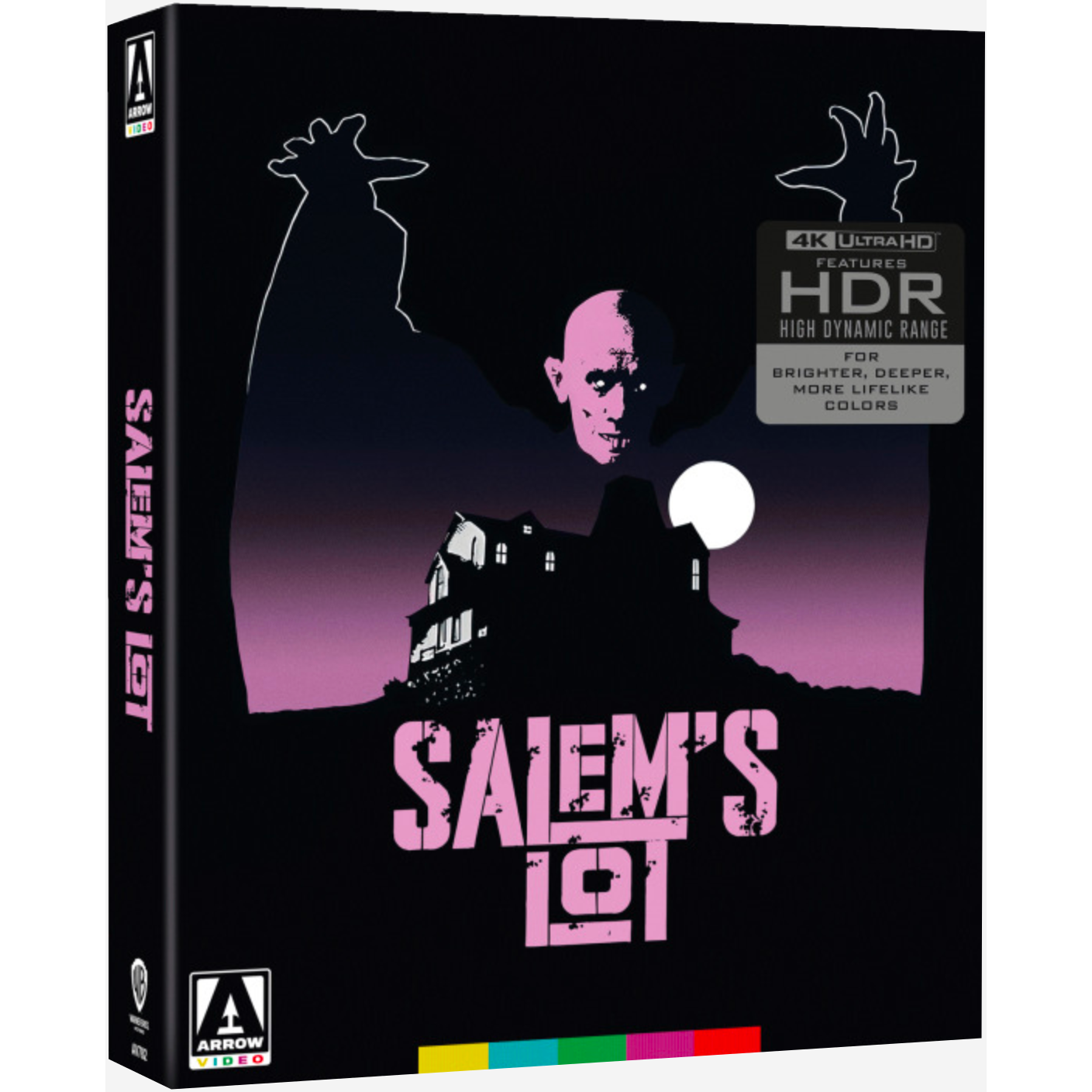

No matter how hard we tried to see some movies back in the ’70s and ’80s, the trivial issues of staying employed and raising a family got in the way. That’s how I happened to miss out on 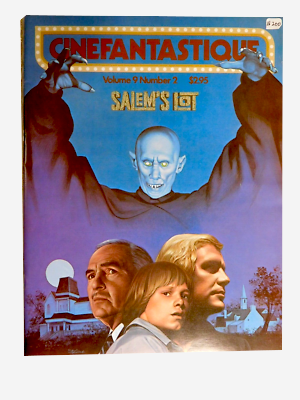 the TV premiere of Stephen King / Tobe Hooper’s Salem’s Lot. There was a good making-of article in an issue of Cinefantastique, at least. I picked up a not-bad Warner BD a few years back, but now Arrow Films has come up with a release we like much better.
Salem’s Lot gets so much right for a TV movie of 1979 that it feels ungrateful to say what isn’t good about it. Technically a miniseries, it screened across two consecutive nights. With all the bumpers, recaps and commercials removed the running time boils down to just over 3 hours. But as is the custom with TV movies on disc, the pauses for commercials are still there, leaving breaks in odd places.
What’s the big draw with Arrow’s new 4K disc? It includes the foreign theatrical release version, also in full 4K Ultra HD.
Purchased as soon as it was published, the Stephen King novel went through three script attempts, including drafts by Stirling Silliphant and Larry Cohen. The next big news was the signing of director Tobe Hooper, whose little Lone Star horror item had made him a household name in horror. The signing of star James Mason was a coup as well … had he ever before made a TV movie? Hooper’s helming of this major TV event led to his stellar association with Steven Spielberg.
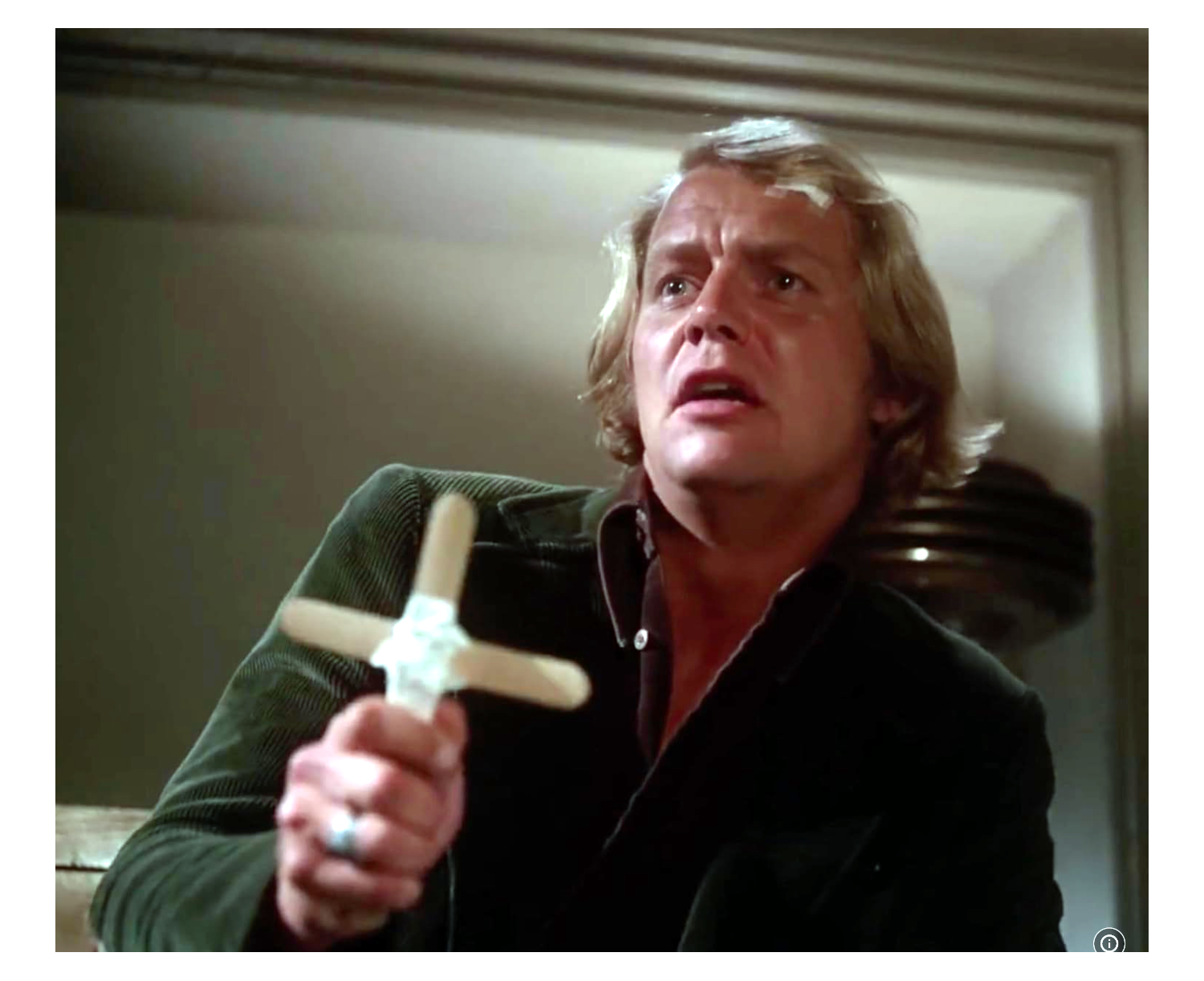
Instead of compressing King’s sprawling narrative, the screenplay by Paul Monash keeps the general story and character framework, combining a few characters here and there. Things had to be changed for ‘broadcast Standards and Practices.’ Eliminated were a grotesque situation or two — like a morbid scene with a vampire-zombie mother and baby. King’s major villains have been re-thought. Instead of a cultured vampire, the head bloodsucker is a rat-like ghoul, a direct homage to F.W. Murnau’s classic Nosferatu. It’s a non-speaking role. The vampire’s human qualities are transferred to his protector-enabler, giving James Mason an especially rich character to play.
Author Ben Mears (David Soul of Starsky & Hutch) returns to his childhood town of Salem’s Lot to research the spooky reputation of the Marsten House, an old wreck on a hill above the cemetery. He makes contact with his high school writing mentor Jason Burke (Lew Ayres) and strikes up a romance with Susan Norton (Bonnie Bedelia), a graphic designer and art teacher. Ben finds that the Marsten House has been purchased by the English art dealers Richard Straker and Kurt Barlow. The formal, eccentric Straker (James Mason) is preparing to open an antiques shop, one far too pricey for the little town. Barlow is nowhere to be seen. Straker has hired the local trucker Cully Sawyer (George Dzundza) to haul a large crate up from Portland.
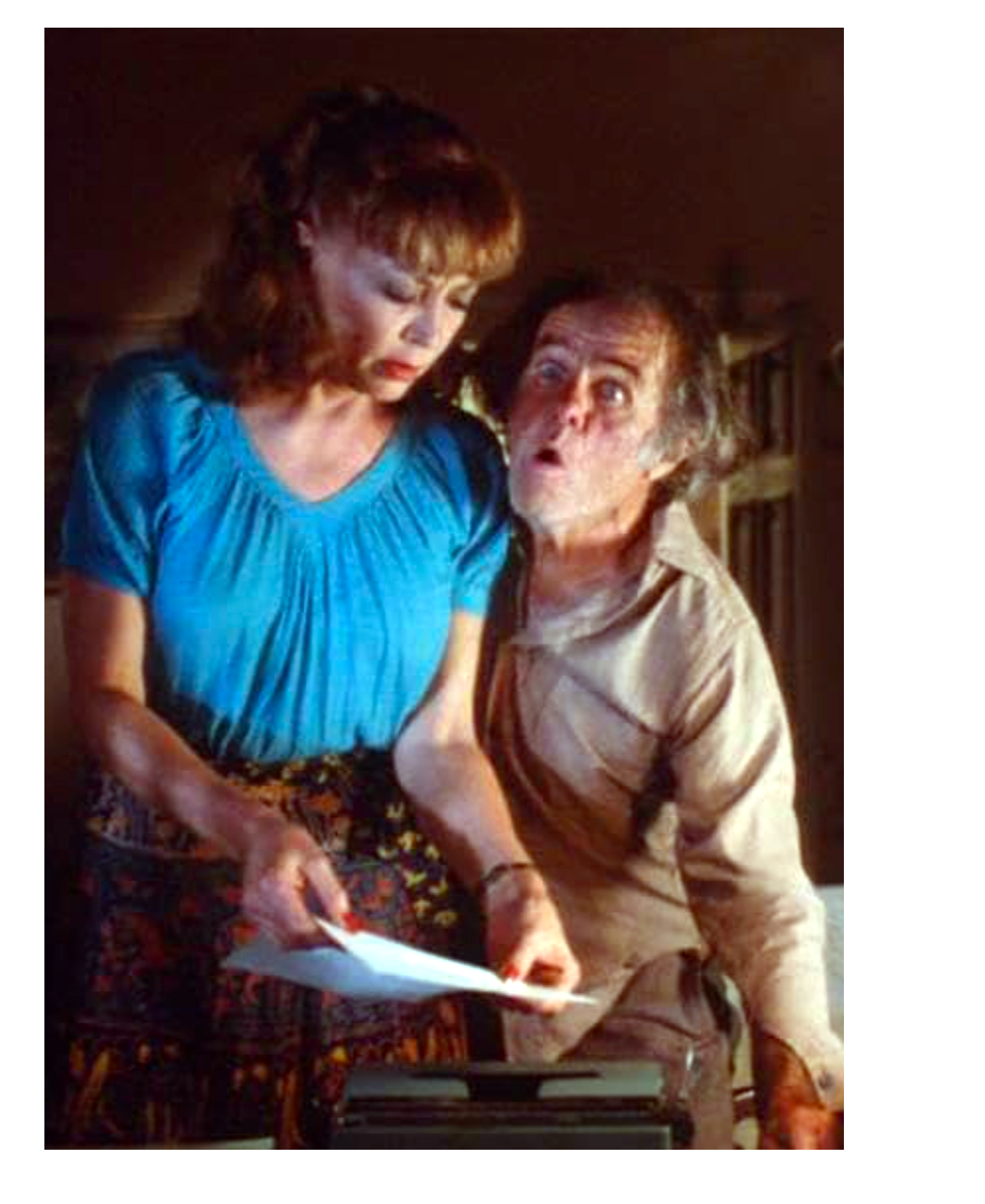
The arrival of the crate heralds a wave of mysterious illnesses and disappearances. Ben is convinced that something occult is afoot, but balks at sharing such flaky theories with Burke or Doctor Norton, Susan’s father (Ed Flanders). Burke’s young students Danny and Ralphie Glick (Brad Savage & Ronnie Scribner) are early victims, but their young friend Mark Petrie (Lance Kerwin), a devotee of magic, monsters and the supernatural, has the fortitude to resist . . . at first.
The vampire plague spreads quickly. Bodies disappear, baffling Constable Parkins (Kenneth McMillan). Outsiders Straker and Mears are suspects, but some parents choose to blame young Mark Petrie’s unhealthy, ‘Satanic’ interests. Ben and Mark alone go on the offensive, with a nervous assist from Dr. Norton.
After years of audience exposure to vampire pix from Universal and Hammer, it’s fun to see a big-scale picture revving up old barnstorming horror thrills, without some gimmick getting in the way. One would hope that the 3-hour format would aid in the adaptation of Stephen King’s multi-character storyline, but the extra time is not used well. Almost an hour goes by before Straker’s delivery arrives and the vampiric action begins. Significant time is devoted to a dull marital infidelity subplot between Cully Sawyer, his straying wife Bonnie (Julie Cobb) and the randy real estate agent Larry Crockett (Fred Willard).
Bonnie Sawyer’s enthusiasm for sex is the closest the film comes to comedy relief. As both Joe Dante and John Landis were proving, audiences welcomed mixes of horror and humor — Dante was especially skilled in using comedy to set up Big Scares, in his excellent The Howling. Tobe Hooper plays most of Salem’s Lot straight and sober, using pages straight from the ‘how to direct horror’ handbook. We see a stylistic nod to Alfred Hitchcock here and there, as when subjective/objective camera angles take Susan closer to the Bates Marsten house, and when Arbogast Dr. Norton climbs the grotesquely icky staircase inside.
Veteran composer Harry Sukman’s music score is an intentional sound-alike revisit of classic Bernard Herrmann scare themes. Almost every cue in the show mirrors something in a memorable score by Herrmann. The distraction pretty much ends after the main titles, when we have more to think about than the music.
The real locations are in the beautiful woodland country of Northern California. Stephen King’s setting reminds us a little of The Return of Dracula, with its attempt to portray small town family life. At three hours, the full TV version of the show feels a little poky. With the added commercials, it probably played that way to the original TV audience, too. The perhaps five minutes of actual violence and vampire action is well done, occasionally reminding us of our favorite Hammer hits.
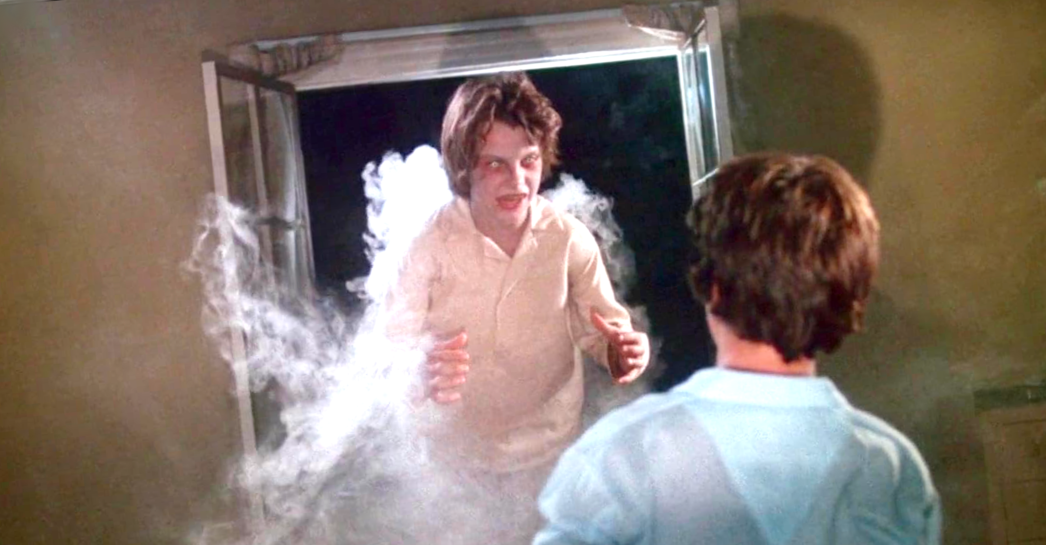
Tobe Hooper makes good use of a moving camera in scenes in the Marsten House, at the gravesite, and in the truck carrying the inexplicably cold shipping crate. Especially effective are a series of scenes seemingly inspired by Mario Bava’s Black Sabbath. Clouds of mist gather at windows as people sleep, revealing ‘child ghost vampires’ that tap at the glass for permission to enter. The Warner execs may have worried that Hooper would start filming chain saws and outright gore. They surely welcomed the window scenes as censor-proof replacements for Exorcist– like bodily fluid horror. Just Say No to pea soup.
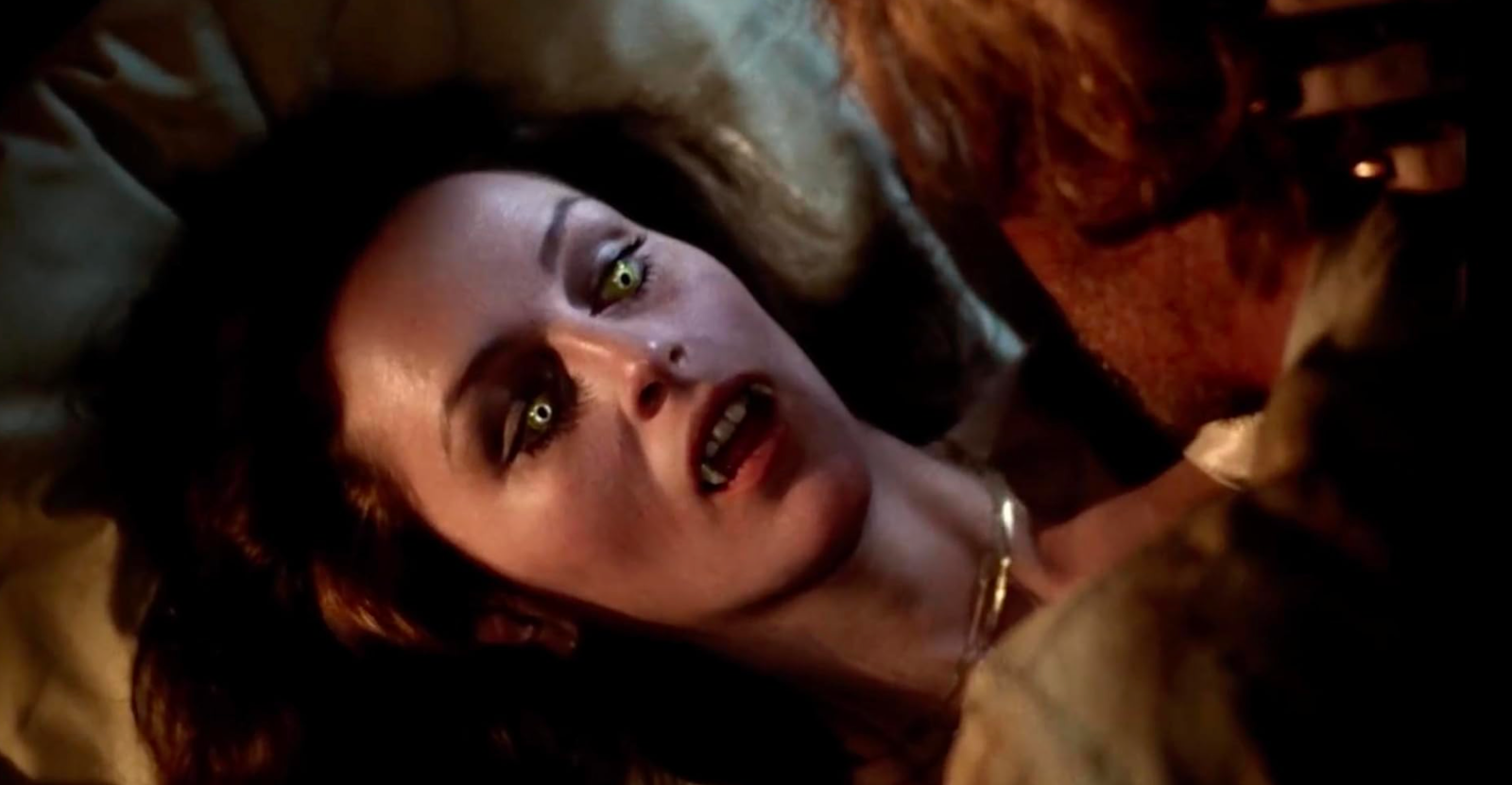
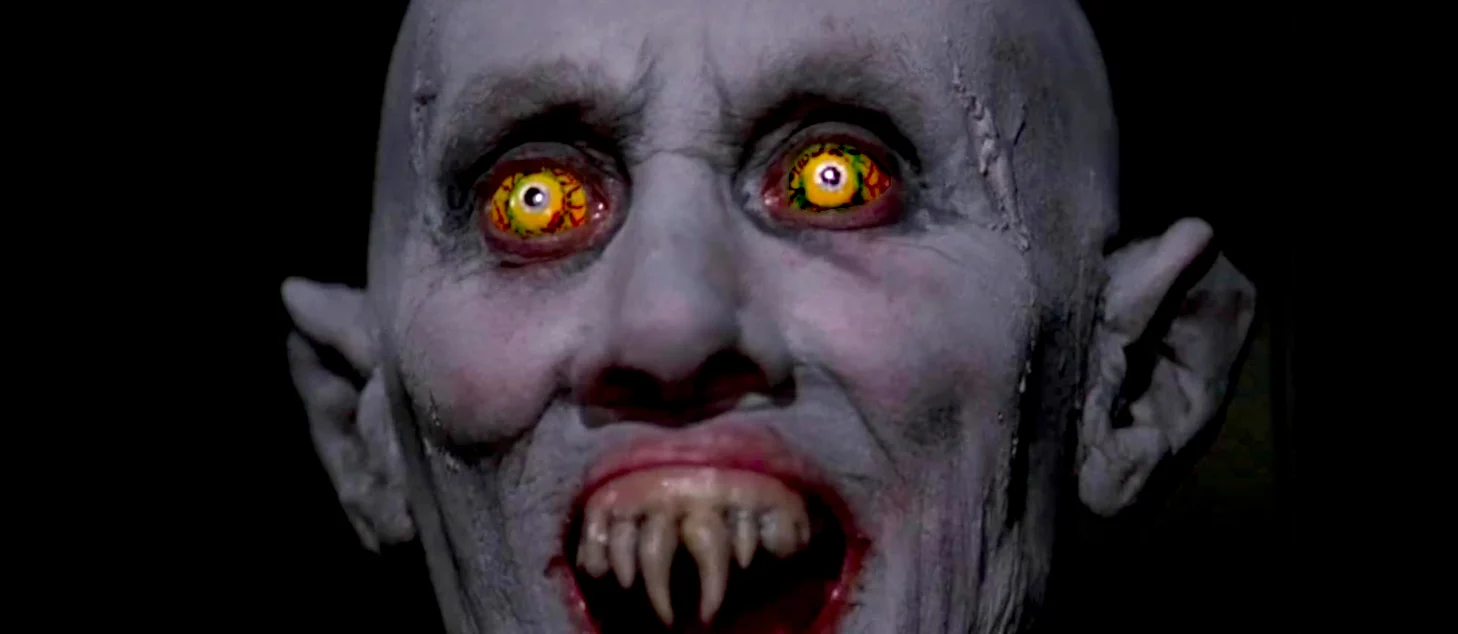
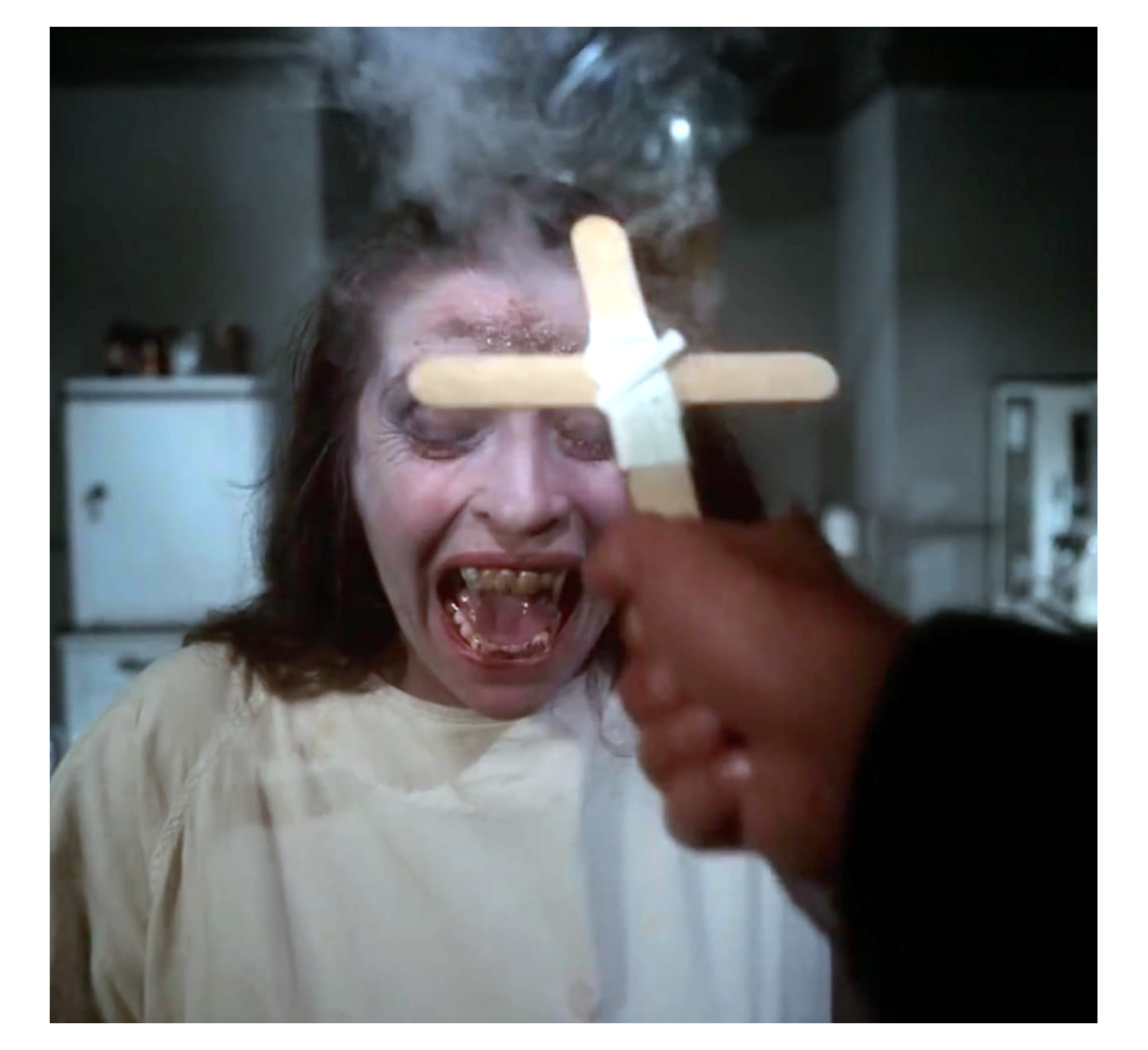
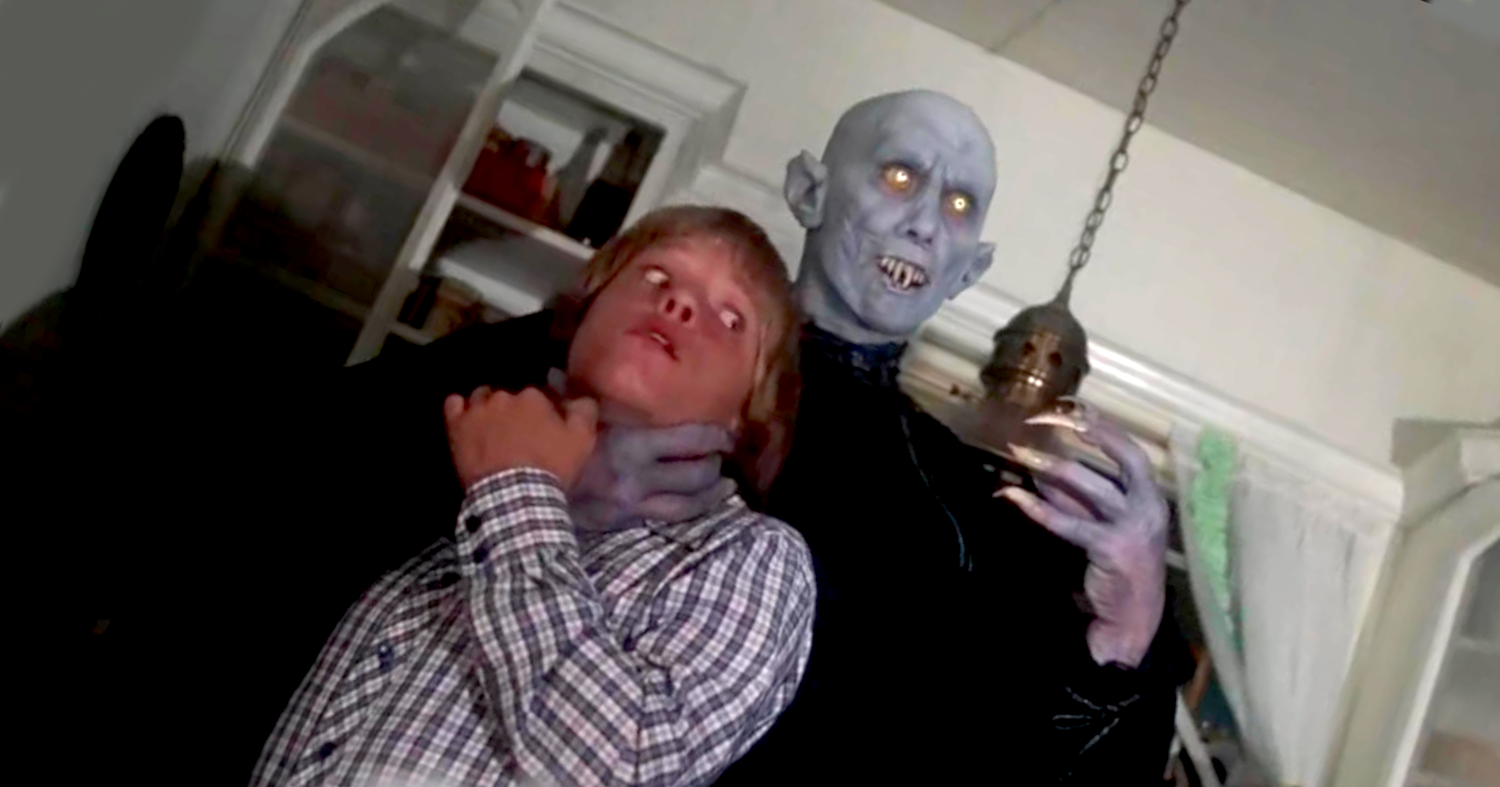
Distinctive actor Reggie Nalder is a close re-creation of the legendary Max Shreck Nosferatu — with bright blue skin, golden contact lenses and yellow rat fangs. He’s quite a jolt when jumping into the frame without warning. King’s story includes the notion that vampires can be subdued by the power of Catholic iconography — that’s Bram Stoker 101 lore.
Allowed on screen only for a bare minimum of shots, Reggie Nalder’s Barlow is really used as a ‘Boo!’ special effect. His least effective scene is in the Petrie kitchen, when he attacks full-on. The lights dim for a moment, but come back to full brightness and stay that way. Two killings and the kidnapping of a Priest play out under full flat light, diminishing the monstrous impact.
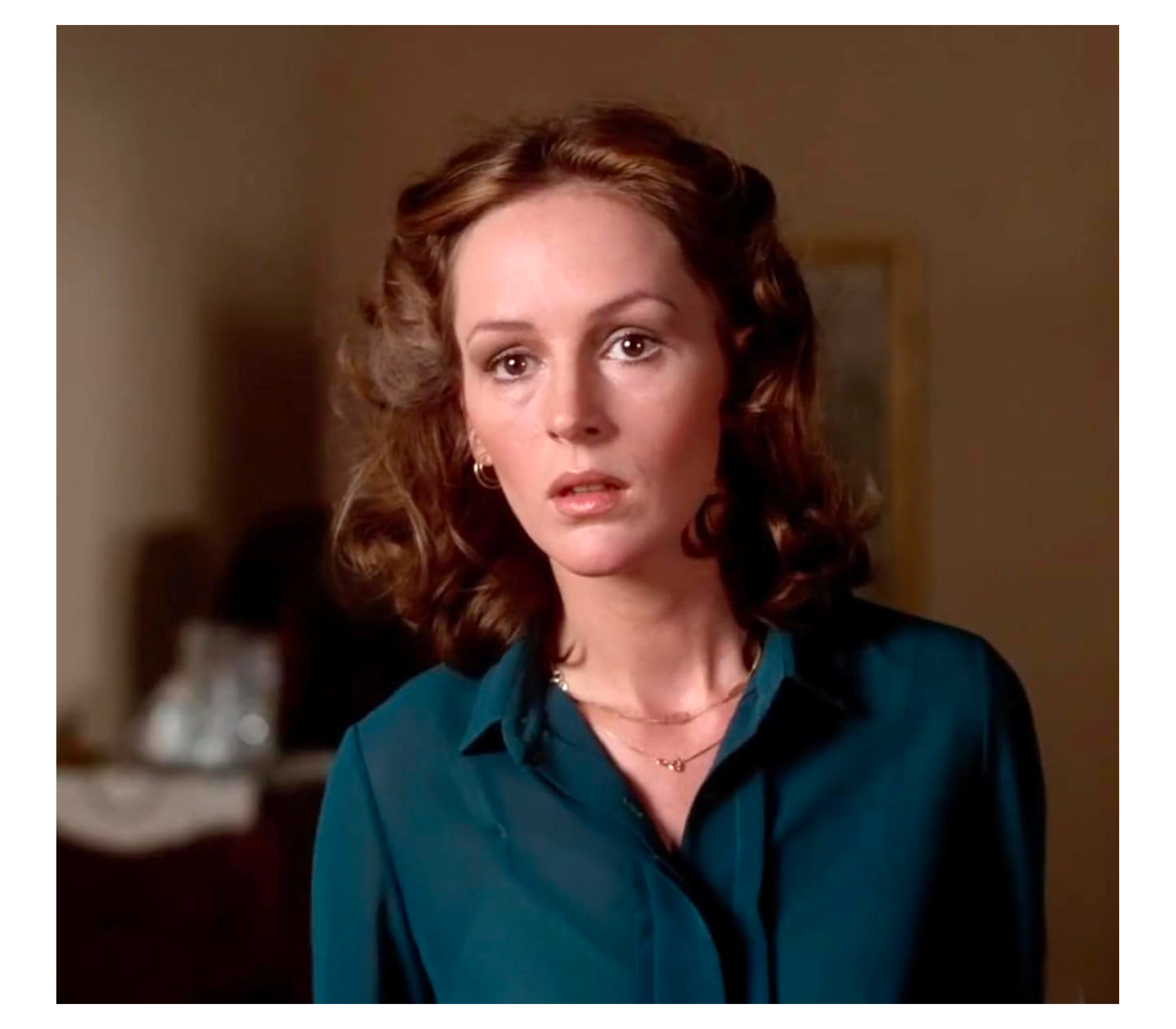
The TV Cut takes its time introducing the 15 or so main players and developing the romance between Ben and Susan. The actors are good, but we must wait to get to material with more horror content. Star David Soul is not bad, but neither does he bring anything special to his role — we now fixate on his dated hairstyle. There isn’t much Soul can do with lines like, “Can a house be Evil? Can that Evil affect people who live there?” The Marston house is yet another dead end, as its dark past is only touched upon in dialogue. We have to accept that Barlow and Straker chose the crumbling mansion because its history welcomes their brand of concentrated Evil.
Favorite Bonnie Bedelia (They Shoot Horses, Don’t They?) is made the focus of some irrelevant jealousy between Ben and the local plumber Ned Tebbets (Barney McFadden), but otherwise her task is to play a generic girlfriend character. She ends up just as someone to be put in jeopardy when the third act needs a boost of tension, and she doesn’t even get the reward of staying with Ben.
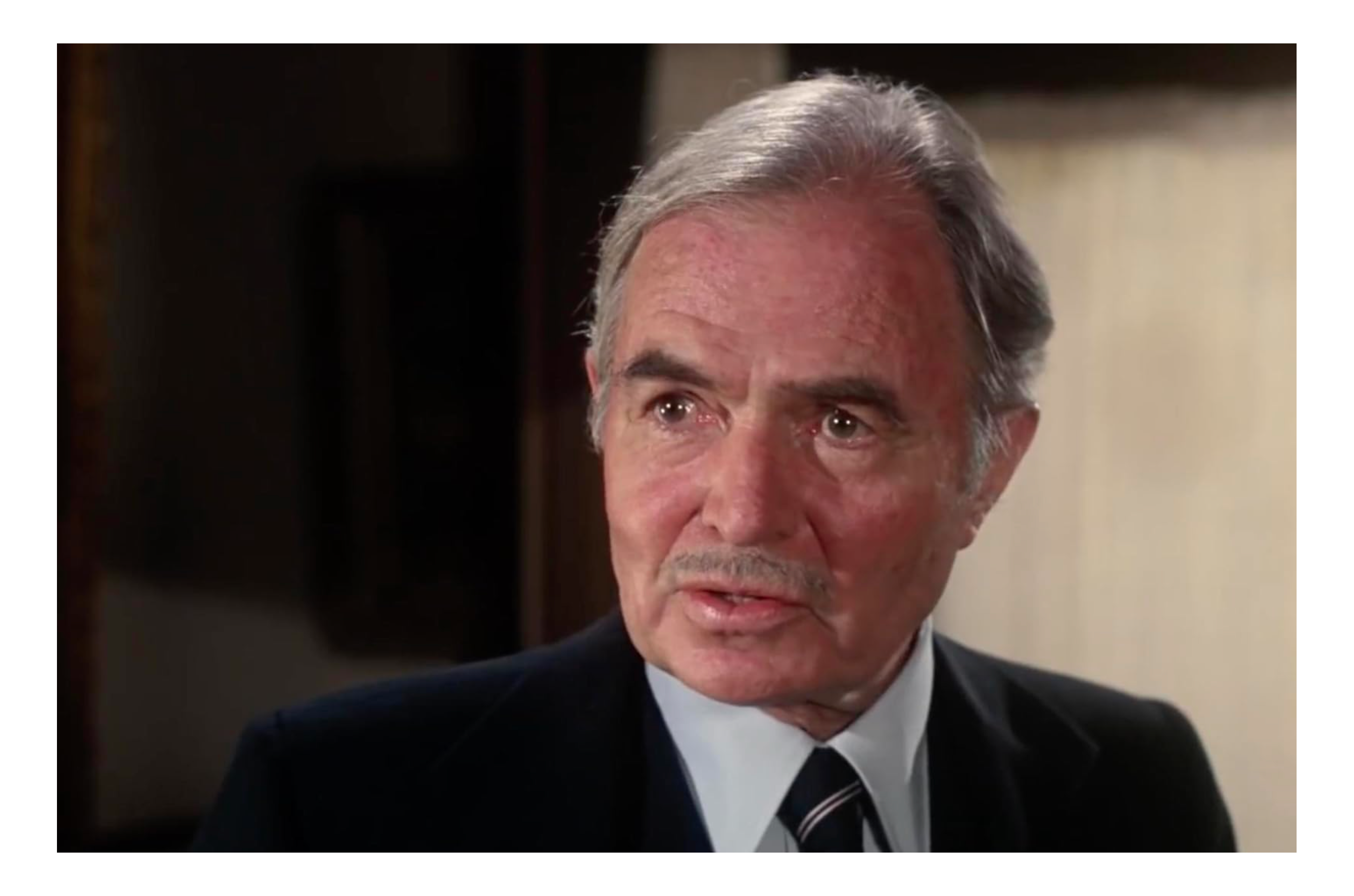
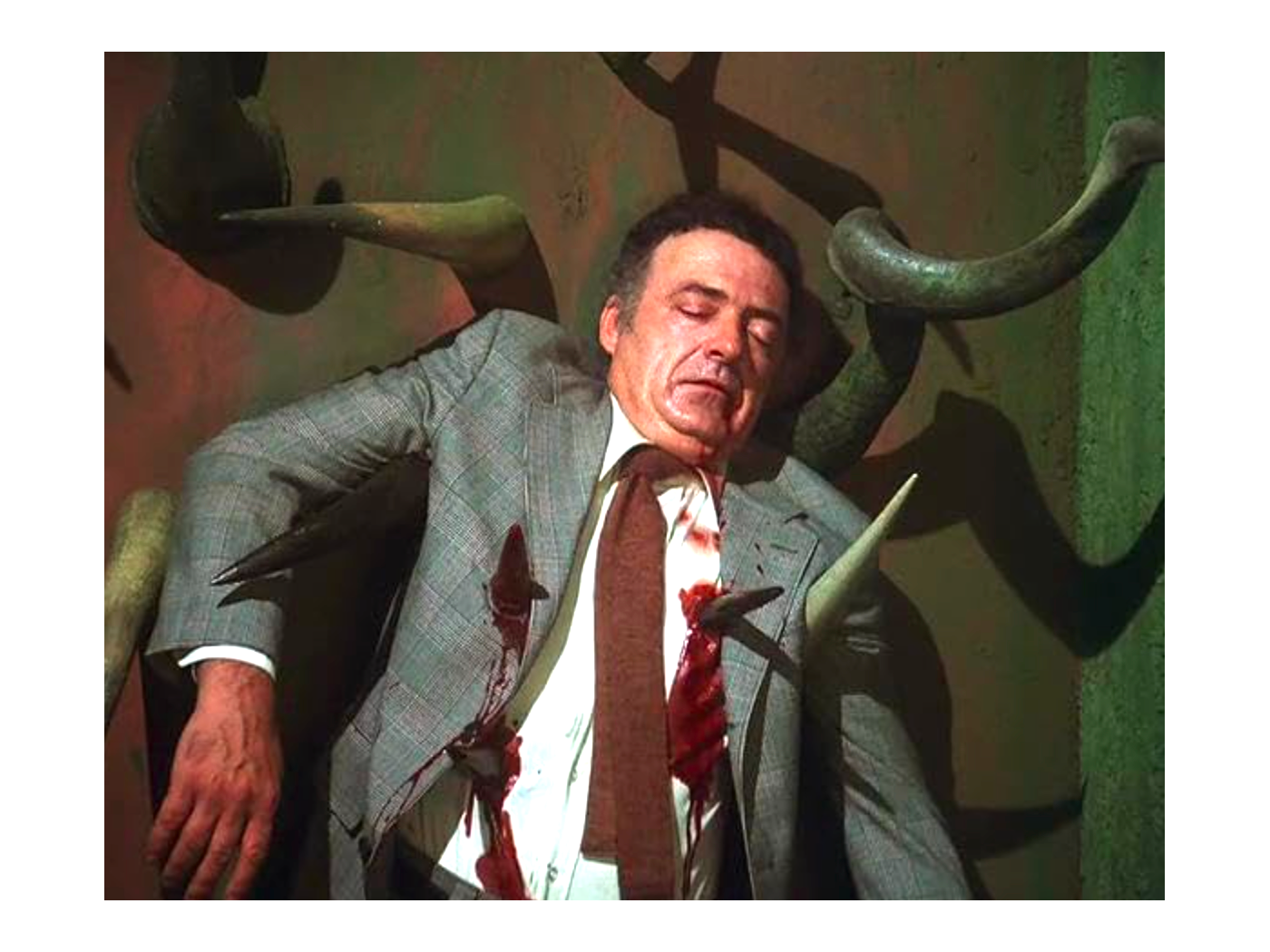
The best reason to see Salem’s Lot is James Mason, period. Given mostly neutral dialogue to recite, the respected star is an entertainingly original menace. Straker glides through scenes like a formal butler, and cruises about in a black Cadillac. His villainy is never obvious. He cooperates fully with Constable Parkins, with a mix of formal sincerity and veiled condescension. Mason underplays ‘telling’ dialogue. His presence energizes his every scene, even in the TV movie context. We remember seeing video footage of Mason visiting Stanley Kubrick on the set of The Shining … we wonder if he discussed this role with his former director.
Kenneth McMillan shares several excellent scenes with James Mason. Doing well in smaller parts are Ed Flanders and gravedigger Geoffrey Lewis (The Wind and the Lion). Favorites Marie Windsor and Elisha Cook Jr., the odd couple from Kubrick’s The Killing, are given marginal/functional roles. It’s somewhat frustrating to see Cook wasted yet again as a gibberish-spouting drunk. Most of the supporting characters prove unrewarding — once the vampire plague spreads, cast members not already eliminated just disappear offscreen.
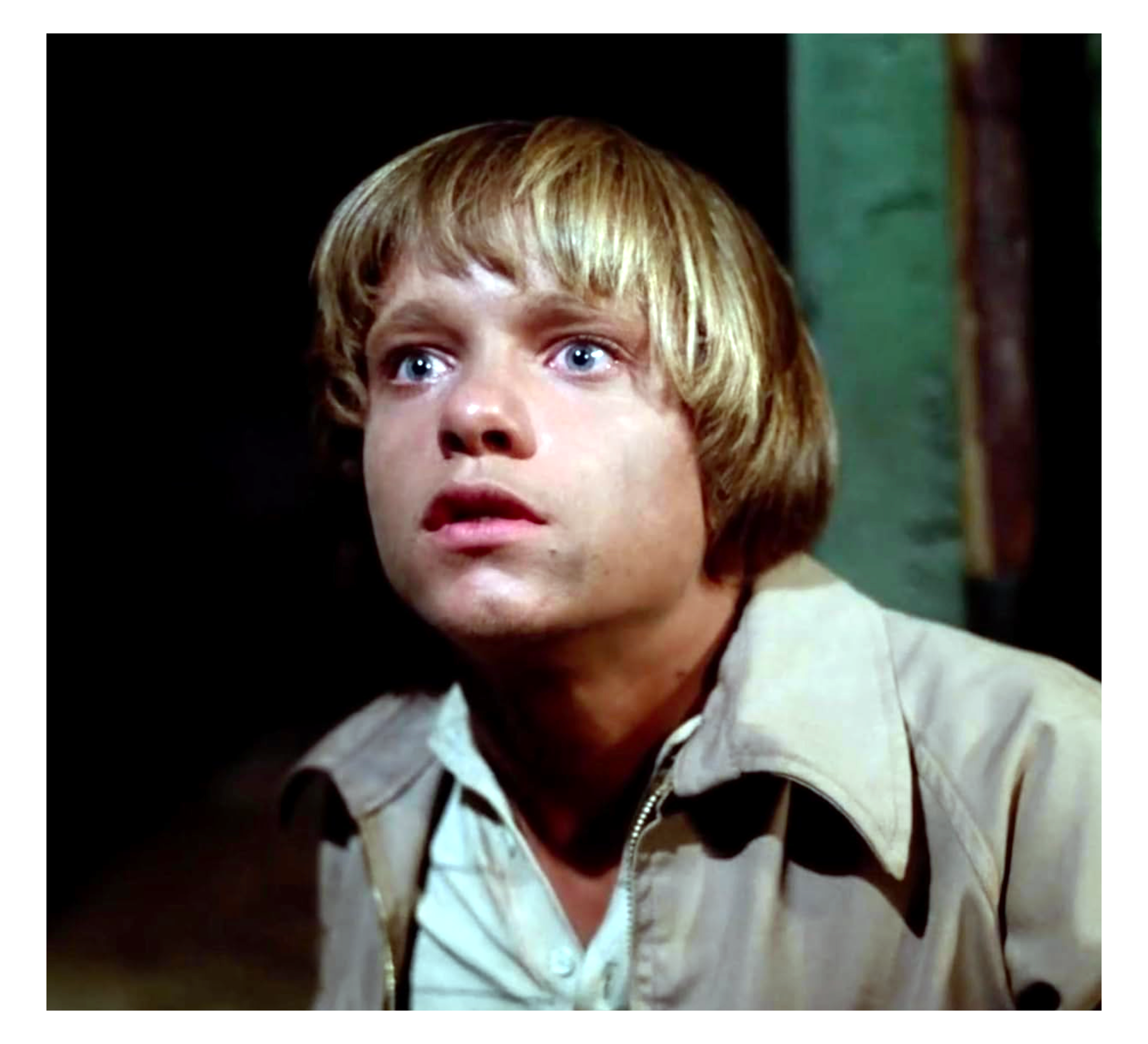
Young Lance Kerwin isn’t bad as the teen vampire killer, although his long hairstyle makes him look like a mini-me version of Ben Mears. He has some effective moments, as when his Mark Petrie musters the strength of will to repel a vampire threat face-to-face. Mark’s family situation is a little flaky, though, a throwback to ’50s conventions. The art director has made Mark’s room into a museum of masks, posters and monster models, that looks too neat and pat.
By the third act the miniseries’ storyline has leapfrogged into defeatist Invasion of the Body Snatchers territory (no spoilers). Saving anyone seems impossible. The filmmakers retain King’s flashback bookend structure, with Ben and Mark on the run in Mexico and still dodging those damn vampires. They now suddenly have ‘magic bottles’ of holy water that glow when vampires are near. We begin to fear that the romantic leading lady has been dropped from the story with no explanation of where she went, but that gets cleared up. Brian De Palma’s big Stephen King hit Carrie had by this time been out for two years, so Salem’s Lot makes sure to punctuate the epilogue with a horror sting.
We’re told that there was a sequel in 1987 and a remake in 2004 . . .
I watched this for the first time last year. It starts off well, but slowly disintegrates into one big “meh”. The mini-series TNT aired in 2004 isn’t great, but it’s better than this.
Glenn – James Mason had a major role in the excellent 1973 TV movie “Frankenstein: A True Story,” directed by Jack Smight and written by Christopher Isherwood and Don Bachardy.
Disappointing this release featuring the original TV edit and the theatrical European edit is only being offered in UHD only. Seriously, what gives, Arrow? One can only hope Warner Archive will do a release of both versions on Blu-Ray down the line, but this whole ‘we’ll release it exclusively on UHD only’ concept is very disappointing and, last time I checked, the Blu-Ray market is still going strong.
I really loved James Mason in this too and it seemed a million times better than most of the TV stuff back then.
The 2004 remake was okay, but oddly it was made in Australia (in a town not far from me) with loads of Aussie actors. There was also a movie made a couple of years ago which only went for just under two hours, and which you wonder why it was made.
“We’re told that there was a sequel in 1987 and a remake in 2004 . . .”
There was another remake in 2024, but it was practically buried by WB and is not avaliable on physical media.
Who would’ve expected a vampire movie to have Hutch from Starsky and Hutch?