


Movies, it was once said, can enlarge our view of the world and enrich our humanity by showing us what we have in common with people we know nothing about. Moviegoers that only want to escape into the familiar and comfortable, or that just want to see what’s current and popular, are fully justified in their choices. But it’s also good to see films that touch us on a human level, and perhaps reassure us that all the struggle in life is worthwhile. Personal nostalgic reveries are a luxury enjoyed by only the most successful filmmakers. At a certain point Federico Fellini pretty much left narrative melodrama behind, to pursue introspective stories about his random memories and feelings. Fellini made a half-docu, half-fantasy with the title Roma, that could easily have been named, What I think Is Important and Also Amuses Me.
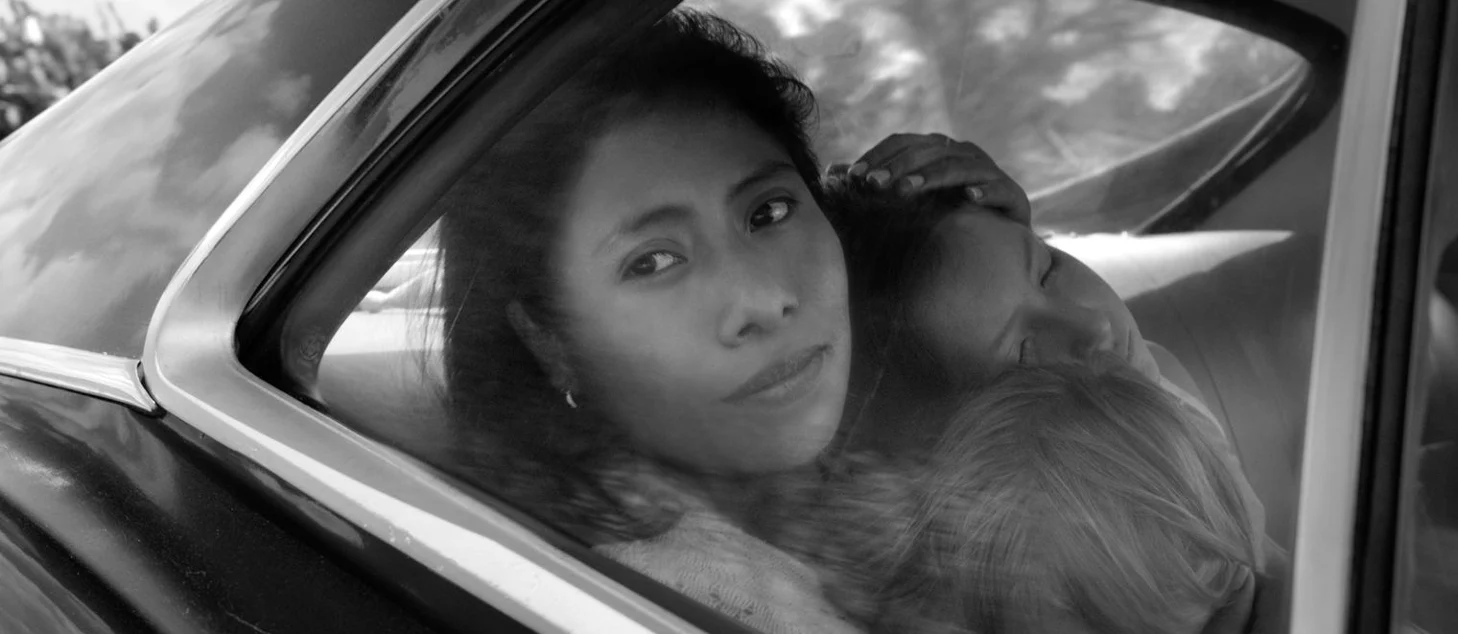
The fine director Alfonso Cuarón isn’t quite as self-obsessed, but for years he had been gathering up a very personal story about another Roma, the well-to-do Mexico City neighborhood of Colonia Roma. Rather than a scattershot image of his personal opinions and eccentricities, Cuarón immerses us in the day-to-day life he knew as a child, in a family undergoing a crisis. Even more interesting, the center of the story is an ordinary maid, an indigenous Mexican whose first language isn’t even Spanish, but the older tongue Mixtec. The director leads with the information that in his upbringing, his family maid was as close to him as any member of the family. Roma could be called a Mexican ‘cultural epic’ — not about ranchero life or the battle of Puebla, but a recognizable image of how people live.

It is 1971. A Mexican husband and wife, both professionals, live on a ‘good’ street in a ‘good’ neighborhood with their four children — until the father makes an exit. The wife Sra. Sofia (Marina de Tavira) knows it’s a serious separation, that he’s off with a lover. Even before the emotional upset, Sofia leaves the running of the house and caring of the children mostly to the two maids, Adela (Nancy García García) and Cleo (Yalitzia Aparicio). The kids are sheltered and noisy but not brats, and they accept the servants as their minders, even if Adela and Cleo are on a different social level. Both of the maids have boyfriends that they see on their days off, to walk downtown or perhaps watch a movie at a grand cinema. Cleo is submissive and sweet to her Fermín, who talks about little but his martial arts training. But Cleo can’t depend on Fermín for anything; although she receives the affection of Sofia’s children, her effort to find a mate is not likely to be a success.
Episodes include a grand visit with country relatives at a large hacienda in a forest, Cleo’s journey to find the absent Fermín, and a harrowing experience downtown during a lawless crackdown on a student demonstration. When the husband wants the kids out of the way so he can remove his books and furniture from the house, Sofia takes her brood and Cleo to the beach for a couple of days.

I haven’t seen a movie that so immerses us in a wholly credible vison of somebody else’s life. We get to know well the inside of Sofia’s house and the work that Cleo and Adela do, especially when they must climb three floors of a staircase to the roof, to hang the laundry of six people out to dry. Cuarón definitely wants us to soak in the atmosphere. The pace often stops still to highlight visual and audio presences, like the view from the country hacienda at dusk, when the lights are being turned on and sounds of party preparation can be heard. Director Cuarón seems obsessed with parking issues in his childhood home, and for me it was strange to concentrate on an interior driveway/garage that’s also used as a bathroom for the family dogs (who likely function as security monitors). Sofia’s husband drives a VW Bug, but she ends up with a large Ford Galaxie that’s really too big for the narrow parking space. Perhaps too much emphasis is placed on her non-existent parking skills, or the film is saying that Sofia’s frequent fender scrapes are caused by stress over her marital issues.
As in real life, dramatic things do happen; they just haven’t been fully arranged to impose an author’s dramatic meaning. Some incidents remain isolated. The oldest boy spots his father, who he’s been told is in Toronto, cavorting with his lover on a downtown street. Cleo’s trip to the country to find Ferm&icute;n has a sad ending, especially knowing that Cleo hasn’t the luxury of anyone close with which to share her problems. The most dramatic episode is Cleo and Sofia’s mother’s close call at the student demonstration, where they witness a targeted political murder. In this otherwise apolitical movie, we suddenly get a striking glimpse of an historical event known as El Halconazo. A paramilitary group, set free by the government and police, attacked and killed over a hundred peaceful demonstrators. Fermín’s training can be assumed to be part of the black ops program Los Halcones, which was run by the C.I.A.. The specific event depicted is also called The Corpus Christi Massacre: June 10, 1971.

Roma’s depiction of El Halconazo is a brave act — the truth of oppressive politics in Latin America isn’t seen much outside of documentaries by filmmakers like Patricio Guzmán, that have unjustly been marginalized as ‘radical.’ Cleo’s life and fate only touches on that moment of suppressed history, but she doesn’t come out unscathed.
It’s been pointed out that the camera in Roma often moves left and right, but rarely if ever pushes inward toward the action, or a character. By not pointing out details of special significance, we must choose our own in the broad canvas before us. We observe and we witness. Moreover, the film doesn’t claim a magic ability to divine The Truth about the people we see, the author’s judgments seen in conventional storytelling. The characters don’t explain their motivations or self-debate their problems. We can only guess that the husband is leaving because his wife’s emotional reaction is so strong. At the end, when Sofia finally tells the kids what’s happening, she does it as gently as she can, when it’s time for dessert at a restaurant.

Alfonso Cuarón’s sets are planned to an Erich von Stroheim level of accuracy, something we learn in the eye-opening featurette-docus. He at all times uses the wide screen to stress spatial context. Crammed with noisy sidewalk vendors, the city streets bustle with life and vitality. Just walking around eating snacks would be a good evening’s outing. Rural Mexico is rough and unpaved; Cleo passes a circus performance on her way to where at least 300 young men are doing Japanese martial arts drills with long poles. Adela and Cleo bring the kids home from school. We have plenty of time to observe the interiors of Sofia’s house, and the country mansion with its hunting trophies. The kids eat ice cream while a large wedding party celebrates just a few feet away, without imposed irony. Life is being lived all around. In both the first and last shot, a jet passes overhead, seen first as a reflection in water for mopping the patio floor.
Director Cuarón doesn’t go in for show-off visuals, but he does indulge some impressive un-cut mastershots. Children of Men uses digital technology for bravura scenes in a moving car, and in the middle of a military skirmish in a migrant detention camp. That show and his Gravity contain unbroken effects shots that dwarf the achievement of this year’s 1917. But the director’s strongest suit has always been the human connection, in all of his films from Sólo con Tu Pareja through A Little Princess (where we first discovered him), the Harry Potter movie and his later superb science fiction movies.

In Roma Cuarón gives us a scene of suspense and potential tragedy all in one un-ostentatious five-minute cut. It tracks Cleo from a picnic bench on a beach, way out to the ocean’s first breaker waves, and back again. The simplicity and clarity of the shot rules out a cheap appeal for distress-sympathy. Cleo cannot swim, and her actions show her character commitment on an elemental level. When her emotions connect the experience to a previous tragedy, our empathy with her, and with Sofia’s whole family, is complete. She’ll forever be one of those people that remains in prayers of thanks, the rest of one’s life.
I’m as impatient as anyone when I read some critic telling me that if I don’t love this-or-that kind of movie, that it proves I really don’t love movies at all. Roma is of course not for everyone, but I will say that during my time I’ve many times connected with entire categories of movies that I had no use for when I way younger. Roma is not something you want to see on a cell phone, that’s for sure. But it comes across extremely well on a large-ish monitor (properly adjusted). If it didn’t grab you on Netflix last year, and it should again come your way in the future, giving it another try is a good idea.


