

The late-night Los Angeles movie scene was hopping in the early 1970s. Many theaters on the West side had midnight shows, and for a dollar and change you could stay up ’til 3 a.m. with other cinephiles, sometimes breathing in their marijuana smoke. Popular midnight fare that kept coming back were King of Hearts, Women in Love and Harold and Maude; someone named Harriet Diamond frequently booked theaters in Westwood and Santa Monica for revivals of more arcane titles. This is where we first saw the then-obscure Danger: Diabolik in Technicolor, and The Horror Chamber of Dr. Faustus in grimy 16mm.
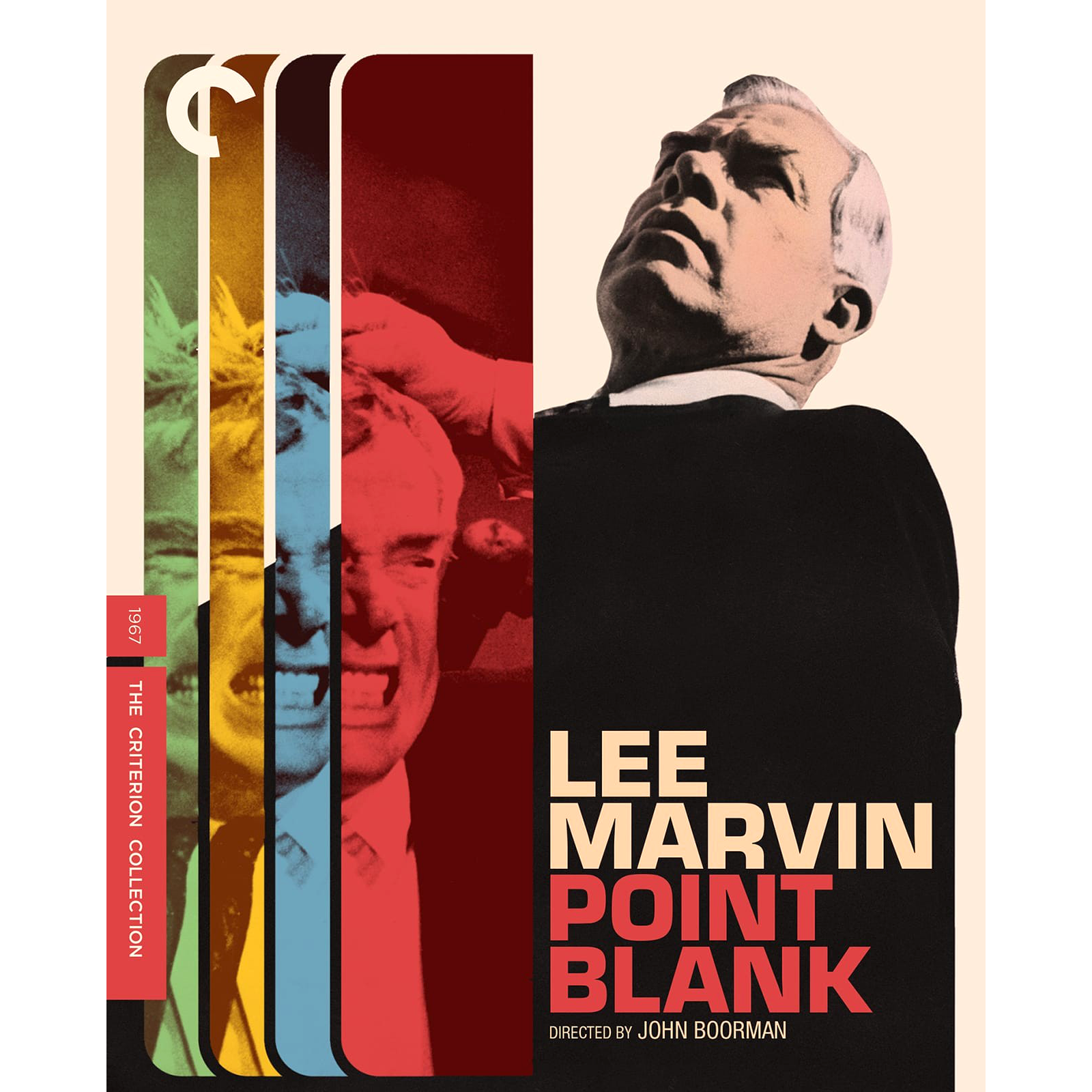
A six year-old MGM picture played frequent second bills and midnights in the summer of ’73. The crime story had Lee Marvin action appeal, but it also brought in the far-out types that lit up as soon as the house lights dimmed. John Boorman’s Point Blank was a gangster tale crossed with Last Year at Marienbad. We wondered if it could have influenced the editing of 2001: A Space Odyssey.
1967 was the year that violence bloomed on theater screens. Roger Corman’s The St. Valentine’s Day Massacre was sold with the promise of a horrific killing; its political statement compared gangland violence to wars between nations. Arthur Penn’s Bonnie and Clyde spiked the level of screen ferocity, becoming the most talked-about picture of the year. Boorman’s Point Blank got the attention of college film studies, which by 1967 was ‘the coming thing.’ The picture’s hallucinatory visuals and fragmented editing were given importance equal to that of the storyline. It certainly offered star power; between this show and the same year’s The Dirty Dozen Lee Marvin’s superstardom was assured.
A director’s movie.
The style and power of this essential L.A. gangster film can be chalked up to an English director whose only previous feature had been a musical about the Dave Clark Five. Aspects of Point Blank feel like a classic-era noir: the dockworker hero pulled into crime by an old buddy, the two sisters seduced by the same mobster. But the gangsters have solidified into a faceless corporation, and the hero is a vengeful juggernaut.
After a robbery gone bad in the abandoned Alcatraz Penitentiary, longshoreman Walker (Lee Marvin) is betrayed by his wife Lynne (Sharon Acker) and his best friend Mal Reese (John Vernon). He is shot and left for dead in a prison cell, yet turns up alive and well a year later. Now behaving like an unemotional automaton, Walker is determined to make Reese or ‘The Organization’ pay him 93 thousand dollars he’s decided he’s owed. He accepts an undefined partnership with a man named Yost (Keenan Wynn), who wants a bunch of syndicate middlemen eliminated. Using a lead provided by Yost, Walker locates Lynne on the Sunset Strip, but no reconciliation results.
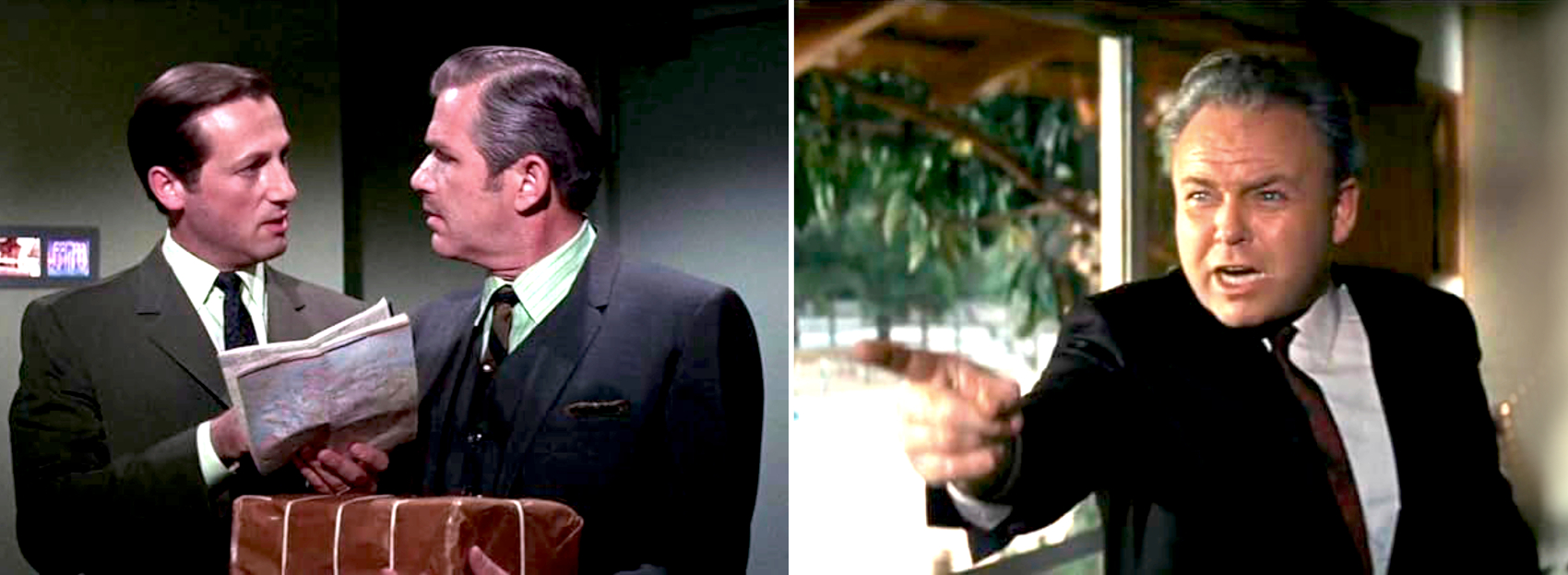
Walker seems unstoppable. He uses Lynne’s sister Chris (Angie Dickinson) to track down one Organization hood after another: the treacherous Mal Reese, car salesman Big John Stegman (Michael Strong), corporate executive Fred Carter (Lloyd Bochner) and finally the ‘CEO’ Brewster (Carrol O’Connor), who promises to help Walker nail the Top Man, Fairfax. Chris knew and hated her sister’s husband Mal Reese. She tries and fails to connect with the uncommunicative, monomaniacal Walker, who acts almost like a zombie. The way Walker behaves, he indeed may be some kind of a ghost.
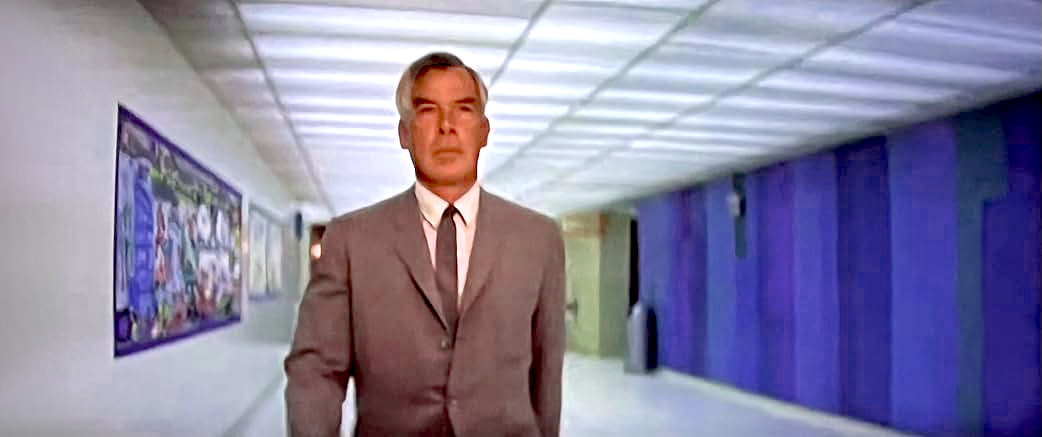
When he was on his game, John Boorman’s storytelling skill was unbeatable — he had a knack for distilling action and character into single, indelible images. The key spectacle in Point Blank is the sight of the massive Lee Marvin striding down the old LAX corridors like a robot on overdrive, his hard footsteps echoing on the sound track. ↓ This cadence is jarringly inter-cut with intimate shots of Sharon Acker’s Lynne applying makeup. The fractured editing jumps back and forth in time, repeating key moments.
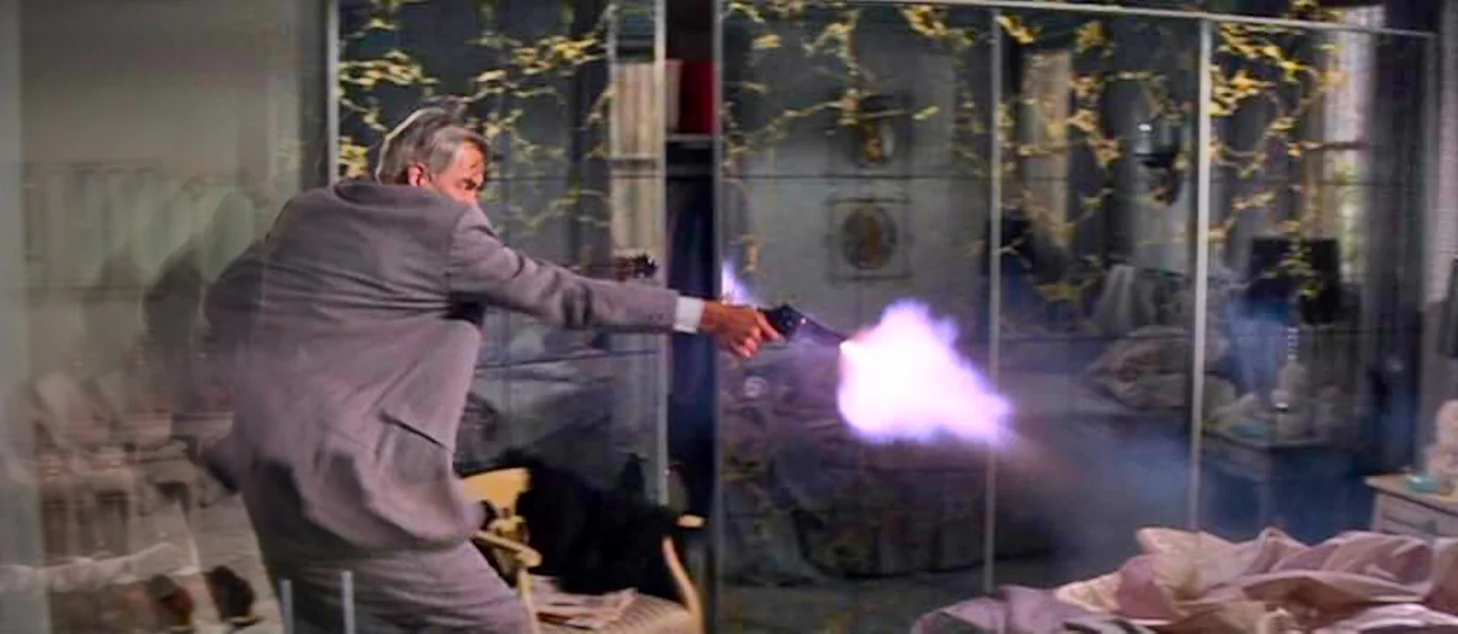
Some extremely effective key action was filmed in slow-motion. Surely Sam Peckinpah was watching. Marvin’s Walker crashes through a doorway, strong-arms his wife Lynne and shoots big black holes in her empty bed, where he thinks Mal Reese ought to be. It plays like a ballet yet is one of the more violent actions in any movie of the 1960s. It also distills a prime toxic fantasy of possessive men. It seems downright prophetic, considering the level of domestic gun violence in America.
Point Blank boils a simple revenge and payback story down to its existential essence, and then re-inflates it with a visual treatment that resembles the work of Frenchman Alain Resnais (Muriel, Je t’aime, je t’aime). It’s interesting that just five or six years after Resnais’ Last Year at Marienbad, ordinary American audiences would have no trouble following the time-fractured exploits of a (possibly) ghostly hit man. The moment of Walker’s shooting in Alcatraz is repeated at least four times. Jump cuts leap ahead in time. When Walker moves around Lynne’s apartment, successive shots show it fully furnished, then barren, then furnished again. Scene after scene melds a weird limbo with everyday Los Angeles reality. Many L.A. residents have always felt that way about their city.
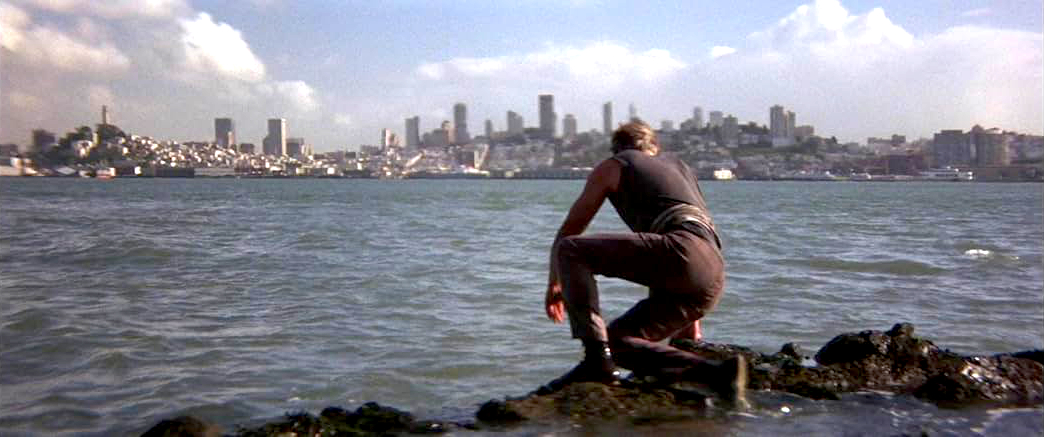
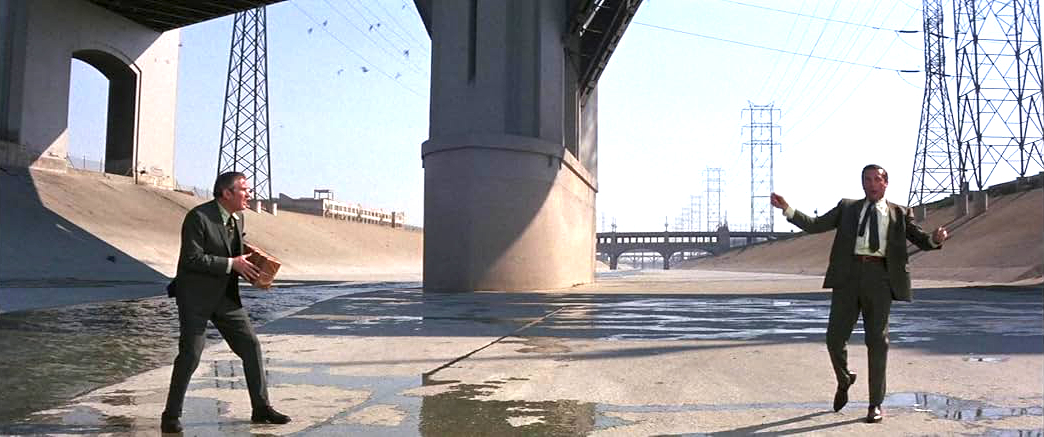
On the literal level the story makes no sense. Walker is twice shot point-blank in an Alcatraz cell. He then hobbles painfully into the San Francisco Bay, into currents known to sweep the strongest swimmers out to sea. ↑ He unaccountably turns up a year later with a full wardrobe of undefined origin, and a new ultra-cool but robotic personality. Only once are we given a flashback look at Walker as he was pre-Alcatraz. Wooing Lynne on the wharf, he’s fun-loving and warm … and more evidence that the post-Alcatraz Walker is some kind of cinematic abstraction.
Is he a zombie, or a ghost? Walker stares calmly as a drug-numbed Lynne carries both sides of a conversation, without making eye contact. ↓ She answers her own questions. It’s like experimental theater.

After a classic crash-’em car ride with John Stegman, Walker works his way upward through the mob hierarchy, terrifying one powerful executive after another. There’s great fun to be had watching Walker turn the tables on the hoods. He suckers Lloyd Bochner’s Carter, an unlikable bully, into stepping into his own death trap.
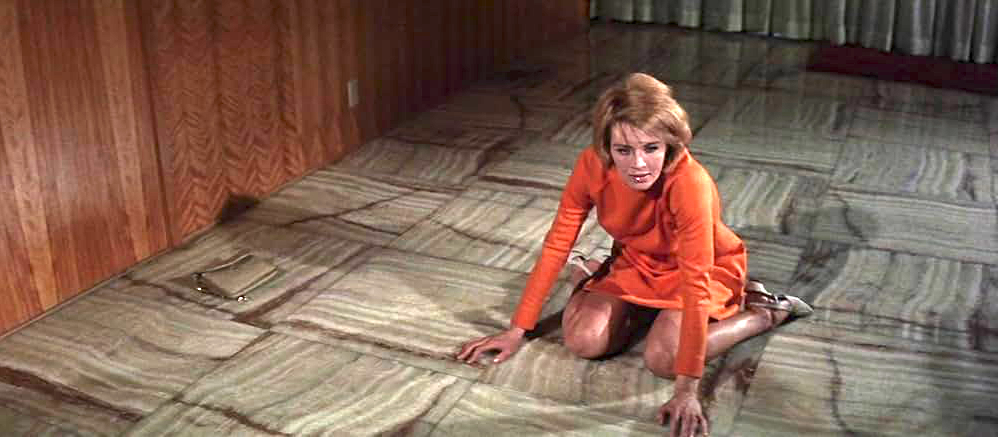
Point Blank flirts with nudity as regards Angie Dickinson, whose Chris helps Walker but is frustrated by his lack of feeling. The show’s second most iconic spectacle takes place when Chris finally gets him alone. Expecting to be seduced, she blows a fuse when Walker just continues his imitation of a granite statue. For thirty seconds she flails at him with her arms, hitting, slapping and slugging as hard as she can. When she collapses in exhaustion, he’s still standing like an immovable rock. ↓
It’s an abstract master stroke that feels authentic. Furious that Walker isn’t putting the make on her, Chris’s pent-up energy just has to be let free, if only to protest all those movies where actresses are present just to look good and kiss some male hero. When direct violence doesn’t work, Chris resorts to the Betty White maneuver: distract the bastard with annoying kitchen appliances.
Boorman frames a steady stream of bizarre visuals through Philip Lathrop’s wide-angled Panavision lens. Perfumes and unguents mix in the bottom of a bathtub, another weird image oddly paralleled by 2001. Images are diffracted through gratings and curtains, and a disco nightclub’s psychedelic light show is a backdrop for a brutal fistfight. Boorman will also cut to a still photo now and then, backed by Johnny Mandel’s melancholy music. The only semi-psychedelic cliché is a mannered camera angle on characters posed ‘just so’ in a shattered mirror. And what did Roger Corman have to say about the lovemaking trick, where the partners on a bed keep changing, a la The Tomb of Ligeia?
Marvin’s Walker is a silver-haired Golem with a magnum pistol, wearing an unchanging mask-like expression. John Vernon stands out as the treacherous mobster, begging Walker for help in a roomful of loud men. Carroll O’Connor and Keenan Wynn are also equally effective as the top dogs that Walker has more difficulty pushing around. James B. Sikking is a mob sniper and Sid Haig one of Mal Reese’s goons; favorite Kathleen Freeman gets two quick cuts at a political reception. We wonder if Freeman originally had a longer scene with Roberta Haynes, who plays Fred Carter’s wife but barely has 5 seconds on screen. Ms. Haynes interests us because she long before starred opposite Gary Cooper in Mark Robson’s Return to Paradise, a movie that may never be properly restored from Technicolor elements.

The Karloff Connection.
Does Walker actually kill anybody? It looks to this reviewer as if he merely precipitates accidents with his presence, or watches as other people do the actual killing. With that in mind Point Blank could be classified as a genuine gangster-horror hybrid about a vindictive ghost working out a curse from beyond the grave. We’ve already floated the intriguing theory (not mine) that Point Blank is a quasi-remake of Michael Curtiz’s 1936 crime-horror hybrid The Walking Dead … in which Boris Karloff, a murderous reanimated corpse, also doesn’t actually kill anybody, despite an impressive body count. We offer more discussion in that 2024 review.
Spoiler: Action movie fans have always been puzzled by the strange ending, in which a helicopter lands in the narrow confines of Fort Point under the Golden Gate Bridge. Instead of a violent payoff, Boorman gives us deep-dish symbolism. When he accomplishes his goal, Walker appears to cease to exist, to dematerialize. Perhaps he’s finally become conscious of the contradiction of his own existence, as might a character invented by author Luis Borges. The miracle is that Boorman’s artsy approach works so well — Point Blank is a conceptual original. *


Correspondent Wade Sowers tells me there is a 4K disc of CATCH-22, released just last year. I wasn’t aware. Thanks, Wade !
I just got the Catch-22 4K (directed by Mike Nichols) yesterday and watched half of it. I thought it looked great. I can barely find one review of it, for some reason.
I got it as well and plan to review it soon. Thanks Chas and Wade.
Another explanation for Walker’s abstracted demeanour, as some critics have suggested: he was fatally shot by Lynn in Alcatraz, and everything that follows is simply his dying fantasy of revenge. Will this be one of Trump’s opening night movies when he puts Alcatraz back in business?
Ah yes, the Luis Borges — Ambrose Bierce interpretation! Thanks, Fred