

Few plays equal the simple emotional impact of Thornton Wilder’s Our Town. It cuts to the heart of small town existence of an earlier generation, when there was a consensus for what a Good Life should be: defined gender roles, marriage and children, a house for each family, a linear predictability of events, relative security. People collected photo albums to remember ‘the good times.’
The fact that fewer of us live with that template, or even want to, doesn’t mean that it isn’t part of our makeup. We replicate our parents’ values, and countless old movies reinforce them. Nostalgia is a blur. As dramatized in TV’s Mad Men, an old Kodak sales pitch with a song called “Turn Around” struck a vital chord of emotional nostalgia. Thornton Wilder’s fantasy doesn’t exploit nostalgia, but uses it to make a deeper statement.
As we get older, it finally sinks in that that there’s nothing permanent about Being Alive.
The play Our Town was regularly performed in high schools, but will it become a target for Cancel Culture? Thornton Wilder doesn’t reinforce the social status quo. He marvels at the commitment of men who fought and died for their country but remains mum on the subject of patiotism. His afterlife is a strange limbo apart from Judeo-Christian models, where the dead contemplate eternity while allowing memories of their lives to fade away. No wonder the Hollywood studios didn’t snap up the movie rights — the Production Code would have wanted a less ambivalent endorsement of Christian values. The play rings with honest truth and sentimentality, but it also feels very, very Dark.
Wilder’s small New Hampshire town no longer aligns with a majority of Americans’ personal experience, yet many of us can still identify with the play’s glimpses of the fleeting joys of day-to-day life. Not everyone is prepared for the dark vision of Act Three and its cold wisdom from beyond the grave.

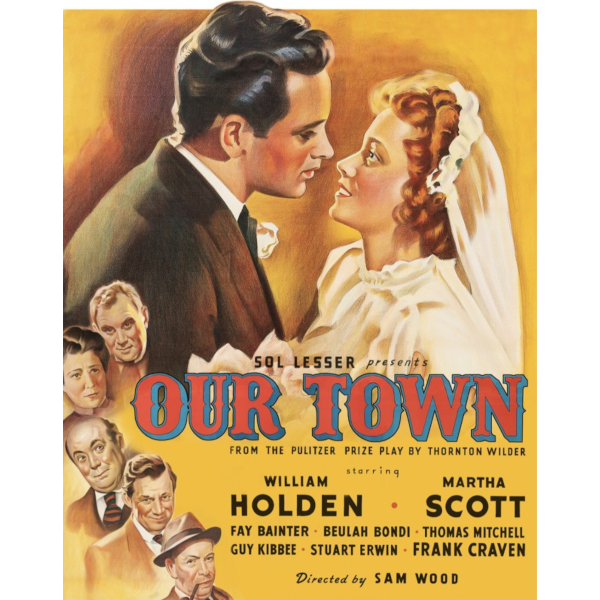
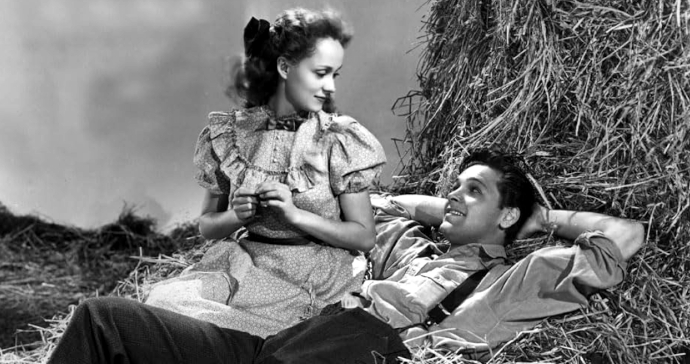
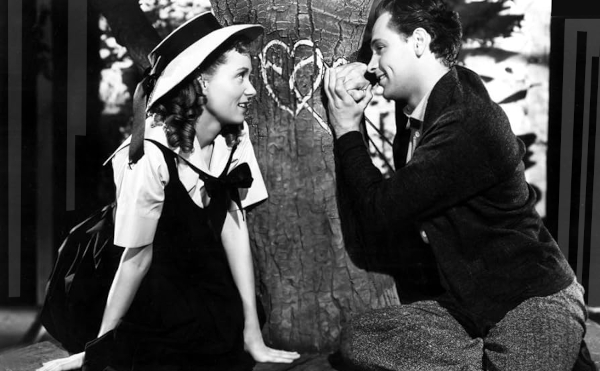
New Hampshire, May 7, 1901 begins as a small town vision both mundane and idyllic. The stage manager (Frank Craven) reveals to us how the Gibbs and Webb families live in Grover’s Corners in the first two decades of the 20th century. We hear talk about the cycles of life, and the miraculous gift of being alive. Teenagers George Gibbs (William Holden) and Emily Webb (Martha Scott) fall in love and marry, following tradition, their blind emotions, and hopeful optimism. For the Third Act, the Stage manager jumps forward to see events nine years later — and we get a glimpse of eternity.
Is Our Town no longer taught or studied? Has it been invalidated in the light of today’s social revisionism? Its emotional basis is universal: life can be innocent, beautiful, stressful or intolerable, of any combination thereof. The tactful stage manager leads us through chosen scenes in the history of Grover’s Corners, where the beauty of family life is distilled into a few mundane moments. When Emily is allowed to relive a single chosen day, she’s advised to pick an ordinary one, one where nothing exceptional happened. Even that is too painful to bear: it hurts to see parents young and lost relatives alive again, going through the day’s routines with a complacency that now seems tragic.
Our Town doesn’t feel like Dickens’ fantasy A Christmas Carol. Our bucolic host is something of a mystery: his story is sentimental, but the storytelling framework feels more experimental. The Stage Manager exists Outside Of Time, on a different plane of existence than the other characters. With a folksy, friendly attitude, he promotes the appreciation of everyday existence, and reminds us that most everything we see and know is impermanent. What is his exact personal stake in all this? A more lightweight film blanc would make him an amusing, benign emissary from the afterlife. Is the Stage Manager a more competent, experienced Clarence Oddbody?
Daily Life, Love and Marriage, Death and Eternity
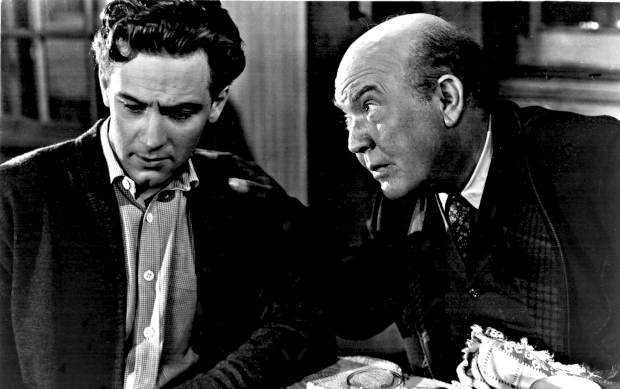
Sam Wood’s movie version of Our Town retains the play’s ‘outside view’ that encourages the audience to look beyond George Gibbs and Emily Webb’s specific problems, to a broader context of existence. The omniscent Stage Manager interrupts scenes to add comments. He introduces minor characters with facts about their futures, including how some of them die. Fay Bainter’s Mrs. Gibbs is a picture of health, but we hear that she’ll be taken by pneumonia in just a few years. These pre-obituaries initially sound macabre, like Kurt Vonnegut’s refrain of ‘‘so it goes.’ The Stage Manager’s folksy candor is not exactly reassuring.
On the stage, actor Frank Craven also played other incidental characters, a common theatrical convention. The doubling of roles is more confusing in a movie context. Craven only plays one additional role, the druggist Mr. Morgan. The druggist doesn’t appear to be the Stage Manager ‘in disguise.’ Morgan offers a warm speech, indulging George and Emily’s shy romance at the soda fountain.
Martha Scott retains a girlish/womanly charm as Emily Webb, communicating both innocence and maturity. Ms. Scott earned a Best Actress nomination for the role. She handles the line, “My, isn’t the moonlight terrible?” in a way that could indeed come from a bright small-town girl. Although some critics might take Our Town to task for not expressing 2023 attitudes on women’s roles, Wilder makes it clear that Emily has the intelligence and discipline to earn high grades. Yet she’ll likely become a housewife like her mother. By contrast, George is a dolt in school and even wants Emily to feed him homework answers.
The film’s ensemble places Broadway carry-overs alongside the well-chosen Hollywood character actors Fay Bainter, Beulah Bondi, Thomas Mitchell, Guy Kibbee and Stuart Erwin. Young William Holden was the only big film name, having starred in Golden Boy the year before. In acting ability he’s also the film’s weakest link. Holden has charm and can ‘play young,’ but he doesn’t fully flesh out Wilder’s slightly immature George, who is also a little pig-headed and selfish. Holden settles for passive niceness — he doesn’t resist his father’s somewhat manipulative lecture, or really engage with Emily’s full-of-life romantic gestures. Holden may not have yet had the range, or perhaps he didn’t want to play gawky, and risk being compared to radio’s Henry Aldrich.

The darker side of Grover’s Corners creeps in through the character of the alcoholic choirmaster. Simon Stimson (Philip Wood) is an obvious tortured soul, and all seem to know it. He’s agitated when directing the choir, and is seen stumbling about in the dark by Constable Warren (Spencer Charters). The women gossip about him. Stimson’s exact troubles remain unnamed and it’s assumed that they aren’t for public consumption. Granted privacy in his misery, he’s a reminder that we mostly see the happier parts of Grover’s Corners. The Webbs and Gibbses’ are middle-class people, even though they are professionals, a doctor and a newspaper editor. Neither is inordinately wealthy, so we wonder what the low-rent district looks like.
ClassicFlix’s audio commentary by Ray Faiola answers many pertinent questions. Overall, Our Town’s somber tone did not fit in with the vision of small town life Hollywood was selling in the second half of the 1930s, the warm and reassuring Andy Hardy fantasy. Producer Sol Lesser encouraged the author’s direct participation in adapting the Pulitzer prizewinning play. It was Thornton Wilder that suggested that the ending of the film be changed, that Emily’s fate be reversed. Wilder had decided that the play’s dark finale would be too brutal for the mass film audience.
They all agreed that Our Town on film would have to fully visualize the world of Grover’s Corners. On stage it was a minimalist experience, with no sets and just a few chairs for props — George and Emily’s window-to-window talk had been performed with the actors standing on ladders.
An unofficial second director.
Director Sam Wood was then riding high on the success of Goodbye, Mr. Chips. Wood took charge of the actors but delegated the film’s entire visual aspect to the esteemed production designer William Cameron Menzies — design, camera direction and visual effects. Every shot in the film was storyboarded. Menzies had been a legend since the early 1920s. His current achievement was the visual masterminding of David O. Selznick’s Gone With the Wind, binding the work of multiple directors into a coherent whole.

It’s often commented that, before its altered finale, the film of Our Town mostly adheres to the letter of the play, only abridging a few scenes. The adaptation also adds details that can’t have come from the play, as when a cat climbs through a window sill. At one point Emily’s little sister (Ruth Tobey) exaggerates her walk, after Mrs. Webb (Beulah Bondi) tells her to pick up her feet. Wood and Menzies then cut directly to an extreme low angle of a hen walking away from the camera with an almost identical strutting motion. It always gets a laugh.
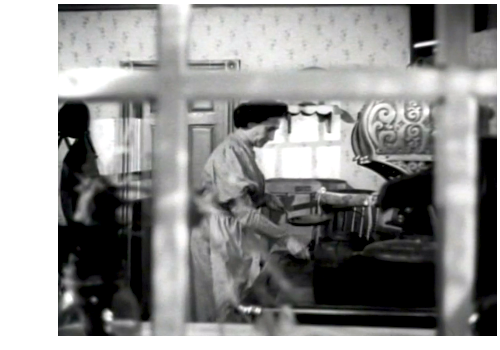
Several of Menzies’ favorite visuals are present. Wood and Menzies show The Stage Manager entering on a set of a steep hill, with a split-rail fence like those that mark Gone With the Wind, Kings Row and Invaders from Mars. Images alternate between giant close-ups and exacting, often unusual camera angles that accentuate spatial depth. We frequently peek through windows. The side-by-side homes of the Gibbses and Webbs are two giant, realistic sets, with crowded interiors designed by Julia Heron. Many have ceilings, dictated by the frequent low angles. Gregg Toland was not the only cameraman to shoot ceilings before Citizen Kane.
Effects composite artist Jack Cosgrove contributes many matte paintings and even some miniatures to expand spaces around the houses. Menzies’ unusual angles divide the screen space both horizontally and vertically, often tucking human figures into the extremes of the frame. Often, much of the screen is a dark, masked area. When the town drunkard Simon Stimson staggers away from the constable and Mr. Webb, he disappears into the darkness behind a brick wall, as if leaving hope behind.
Thornton Wilder Goes Metaphysical.
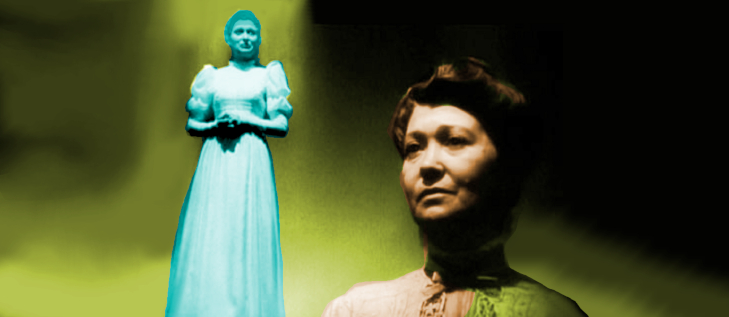
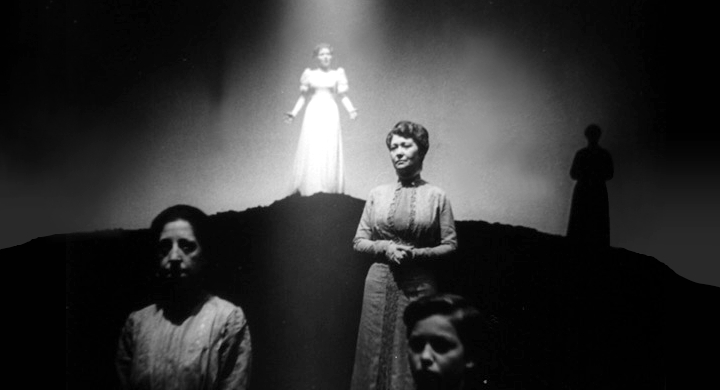
The play’s third act, ‘Death and Eternity’ takes off into altogether new territory, almost like Kubrick’s ‘Jupiter and Beyond’ in 2001: A Space Odyssey. This eerie, disquieting last movement follows immediately after the wedding. We enter a ghost world less reassuring than the one shown to Ebenezer Scrooge. Instead of a humanitarian afterlife, Thornton Wilder gives us a kind of featureless limbo, perhaps a purgatorial waiting-room. Although statistics are given citing Grover’s Corners’ Christian supermajority, the pervasive sadness of life makes a glorious eternity seem doubtful. Wilder’s dead appear to retain individual consciousness, but seem beyond joy. Happiness is a fleeting illusion for the living.
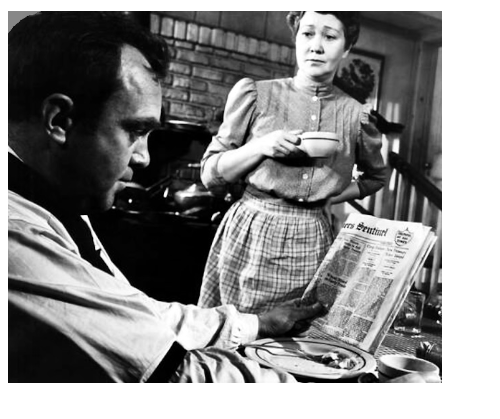
Here’s where the film diverges the most from the stage play’s funeral. The morbid-ethereal emotional experience is heightened with visual effects that amplify without distortion. The graveyard ‘limbo’ is given a stark theatrical design, which includes an uneven cyclorama. Menzies and his visual effects cohort Jack Cosgrove run with Thornton Wilder’s direction to alter the finish. Emily’s return to to the Webb household is now a fever dream following her fading protest, “I want to live.” Using complex rotoscoped mattes, a spectral Emily witnesses a breakfast scene, and finds that even an ordinary day is emotionally overpowering. She eventually begs to return to the cemetery hill.

The adorably plain Doro Merande is the town gossip Mrs. Soames, who took special note of Emily’s happiness on her wedding day. Mrs. Soames’ presence in the graveyard has a somber chill — she represents all those relatives and acquaintances we took for granted when they were alive. Nobody forgets Ms. Merande’s unique line delivery, the way she stretches the last syllable of words. We remember how Billy Wilder featured her in three of his comedies, The Seven Year Itch, Kiss Me Stupid and The Front Page.
This viewing raised a few additional thoughts about Our Town.
The Grover’s Corners of May 7, 1901 may be some viewers’ idea of Eden. With no overpowering media onslaught the town seems protected from the crushing influence of the outside world . But the world we knew was much smaller — some of the local boys that died for their country, had only known fifty or so miles of it. And who wants to be limited to the medicine available in 1901? Just a few years later into the 20th century, Emily’s danger of dying while giving birth would be much smaller.
“What if?” fantasies were surely part of theater 2,000 years ago, but we still react to the universally-felt heart tugs in Our Town. A couple of examples come to mind. Horton Foote’s East Texas play trilogy shares some of the same anguish-nostalgia, especially the play about the Flu Epidemic. In Francis Coppola’s Peggy Sue Got Married, Kathleen Turner experiences an Emily Webb-like emotion bomb, hearing the voice of her departed grandmother.
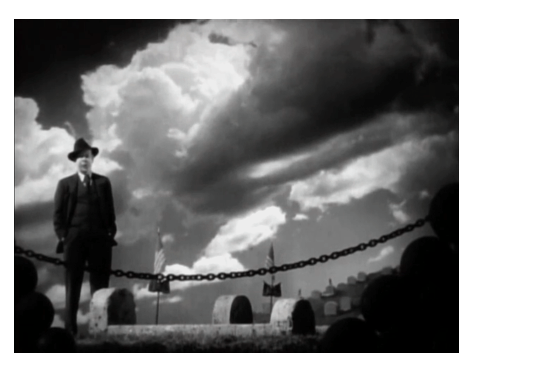
Some purists dismiss the Our Town film adaptation in favor of the original staging, in which the actors perform everything without scenery, even miming drinking coffee out of invisible cups. I’d argue that the visual endistancing effects created by Wood, Lesser and William Cameron Menzies serve some of the same purpose. The realistic scenery is merely a remembered past that the Stage Manager manipulates at will. He enters on a hill, but the view from that hill morphs, as if he were in control of a cosmic Powerpoint presentation. The Stage Manager chooses when to fade away. He also skips from one highlight to the next, erasing years from the narrative. Everything we think we know soon becomes a fading memory. Only the eternity to follow is real.
We wanted to avoid bringing Menzies’ Invaders from Mars back into the discussion, but a look at the restored final reel of Our Town shows us that Menzies and Cosgrove were heavily influenced by their work on the earlier movie. The town’s graveyard hill is very much like the sand pit hill in Invaders, minus a split-rail fence, with a crooked footpath to the top. The hill is also a reverse-forced perspective job — it looks like a shallow stage set, until the tiny figure of the Stage Director appears at the top.
In her ghostly ‘ordinary breakfast’ revisit to her childhood, Emily loses her emotional equilibrium. As she begins to despair, the entire background behind her begins to shrink and fade away, as if that conjured memory was withdrawing, relinquishing its hold over her. The same visual device occurs at a key point in the weird final montage in Invaders from Mars. When his nightmare reaches ‘critical mass,’ the visual dreamscape undergoes the exact same ‘conversion’ — with a music change, the boy’s active dream begins to pull away, with figures moving in reverse, away from us. The superimposed starfield begins to withdraw, just as had Emily’s breakfast room. The dreams are ‘losing their grip.’
And when stuck for a wrap-up ending for Invaders, the filmmakers opted for setups identical to those that end Our Town, with a character in bed, observed lovingly through a half-closed doorway. Menzies fell back on visual structures he knew would work.

Sounds like it’s definitely worth a look. I have very vague memories of seeing a different version in school, with Hal Holbrook as the Stage Manager.
Just watched an awful unrestored print on Amazon Prime. Even in that condition it’s enjoyable but the altered ending is jarring if you’ve ever seen the play performed on stage.