

![Plus the full feature Fallout, Viavision [Imprint] #147](https://cinesavant.com/wp-content/uploads/2022/05/6750imprint0522.png)
“It may be that someday we can say that ‘On the Beach’ is the motion picture that saved the world.”
— Linus Pauling, Nobel Prizewinner for Chemistry
“Too many Americans have an ‘On the Beach’ attitude that all we can do is throw up our hands, take a suicide pill, and die.”
— Edward Teller, Father of the Hydrogen Bomb
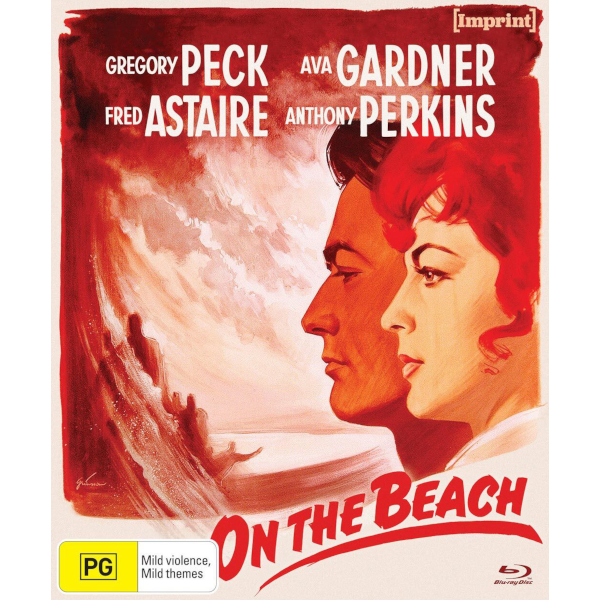
Around eight years ago American and English Blu-rays appeared for Stanley Kramer’s On the Beach, one of them with an out-of-sync soundtrack and the other restricted to Region B playback. Now Australia’s [Imprint] company brings us friendlier a two-disc special edition, in deluxe packaging.
Australian Nevil Shute’s enormously influential 1957 novel On the Beach chronicles the end of the world as experienced by a number of atom war survivors in Melbourne, Australia. The date is January 1964. The entire Northern Hemisphere has been wiped out, and when seasonal winds bring the radioactivity South most warm-blooded life on earth will be extinct. Shute’s book became a controversial best seller. The Eisenhower administration declared that no nuclear exchange could end with the extermination of humanity, but dissenting scientists affirmed the basic premise. Some went so far as to say that the issue was not ‘if,’ but ‘when.’
Stanley Kramer’s expensive film adaptation of On the Beach split the critics along political lines. Kramer claimed that his noble anti-nuke film might save the world. His advertising called it ‘the biggest story of our time’ and ‘the most important picture you will ever see.’ He enlisted the endorsement of the famed scientist Linus Pauling, providing publicity both for the film and for Pauling’s campaign to halt aboveground nuclear testing. For a simultaneous global premiere, nine of the film’s stars were dispatched to different world capitals. If one wants to give On the Beach credit for turning public opinion and helping President Kennedy push through 1963’s Limited Test Ban Treaty, Kramer’s film indeed had an impact.

The movie may be Stanley Kramer’s best job of directing. Many critics were impressed and some dismissed the show as a glossy soap opera. Glamorous movie stars were cast as author Shute’s ordinary people– Ava Gardner and Gregory Peck generate considerable romantic chemistry. Whereas the characters in the novel reacted to doomsday “not with a bang but a whimper,” John Paxton’s script gives each victim a grandstanding soliloquy, a morbid crisis moment, or both.
Australian naval officer Peter Holmes (Anthony Perkins) must deal with the necessity of committing suicide, and taking his wife Mary (Donna Anderson) and his baby daughter with him. Nuclear scientist Julian Osborne (Fred Astaire, in his first straight acting role) grapples with professional guilt for helping develop the bomb. Embracing his feelings of impotence, Julian rejects the advances of beautiful Moira Davidson (Ava Gardner) and tries to commit suicide with other fanatics in a big car race. The desperate Moira begs for comfort from American submarine commander Dwight Towers (Gregory Peck), only to discover that Towers is in denial over the demise of his family back home. A straight-arrow sailor, Towers follows the Navy book to the bitter finish. Moira must reconcile herself to a lonely death.
Considering the film’s gloomy message, it did well at the box office. Daily Variety: “The spectator is left with the sick feeling that he’s had a preview of Armageddon, in which all contestants lost.” The melodramatic crises take place in a well-established post-apocalyptic ‘normal.’ Horse-drawn buggies and bicycles crowd the streets; people go about their business as best they can.
The second act sees Captain Towers’ submarine sailing the Pacific in search of signs of life. It makes an eerie entrance to the now-dead San Francisco Bay. A homesick sailor (John Meillon) jumps ship at Market Street, preferring to die where he was born. The film’s most suspenseful set piece occurs in San Diego, where a lone crewmember dons a radiation suit to locate the source of a mysterious telegraph signal. Ernest Gold’s previously gentle score becomes thunderingly bold during the investigation of the dead Californian cities.
The adapted script changes how World War 3 began, replacing a political clash with a technological dilemma — we couldn’t control our own machines. Stanley Kramer did preserve Nevil Shute’s overriding sense of fatality. The third act witnesses several couples bidding each other farewell with a disturbing solemnity. The descending blanket of radiation spares nobody.

Stanley Kramer had the reputation of a pushy producer who chased controversial material and promoted his movies with must-see admonitions. Kramer ‘resolved’ one social issue after another: medical ethics (Not as a Stranger), race prejudice (The Defiant Ones, Guess Who’s Coming to Dinner?), evolution vs. creationism (Inherit the Wind), German war guilt (Judgment at Nuremberg). On the Beach does indeed take on a big, thorny topic. Kramer approaches scenes with what was for him an unusual sensitivity. Nobody forgets the long lines of citizens picking up government-dispensed death pills. The Grand Prix race, with sports cars crashing in an insane frenzy, offers a taste of the violent madness of post-apocalyptic movies to come. Is On the Beach the civilized ancestor of Mad Max?
Kramer’s directing may seem improved because of his choice of cameraman, the Italian cinematographer Giuseppe Rotunno of The Leopard and Toby Dammit. ‘Pepe’ Rotunno lends On the Beach stylistic refinements not seen in other Kramer pictures. The images are economical and graphically clean, with storyboarded sequences much better organized than in Kramer’s earlier epic The Pride and the Passion.

Although Australians had little patience for Anthony Perkins’ accent, the domestic scenes between Perkins and Anderson are probably Kramer’s best-directed material. He progressively tilts the camera to create a feeling of insecurity. Dwight and Moira’s impassioned embraces carry real power. The only lapse of director’s judgment comes when Kramer goes nuts with a kissing scene, adding emphasis by racing around the lovers as if they were on a carnival ride. Today, it looks as though Kramer were imitating the 360-degree embraces between James Stewart and Kim Novak in Alfred Hitchcock’s Vertigo.
On the other hand, the final kiss is a knockout. Backlit in front of bright water, Gardner and Peck’s faces glint and sparkle in a huge close-up. The filtered backlight ‘dissolves’ their silhouettes, working as a visual correlative to the lethal radioactivity eating into their bodies. ↓
The final scene on a windy knoll over the ocean is an icon of doomed isolation: the camera finds Moira Davidson standing by her Austin-Healey, watching the Sawfish sail away. Kramer was lucky not to have to use miniatures, as the U.S. military refused to cooperate with the production. Kramer’s request for assistance was answered with a letter that outlined necessary changes — the world can’t be destroyed and Communists should be blamed. Luckily the Australian politicians stepped in with a submarine and an aircraft carrier.

On the Beach did influence public thinking to stop believing that nuclear bombs are practical weapons, helping to kick-start the anti-nuke debate of the 1960s. Even if Nevil Shute thought it a betrayal of his novel, it’s a fairly daring picture. Stanley Kramer could have avoided the Peck-Gardner love affair as Shute wanted, but the audience would have been cut in half. Perhaps to placate the Catholic-dominated production Code, Kramer invented new inserted scenes of a Salvation Army public vigil, with speeches by churchmen. The dwindling public doomwatch solves the problem of how to suggest the mass suicide underway: even if Kramer had wanted to, the Office would never let him depict the business of the suicide pills more directly. Kramer stayed true to the novel’s basic thrust, and didn’t mute its ‘everybody dies’ message.
Critics did have a point when complaining about the glamorous, un-messy demises dished out to the all-star cast: nobody dies puking up their insides. But no American audience was going to put up with an utterly miserable realistic finish. Peter & Mary’s baby remains almost entirely off-screen, because showing it in close-up would be devastating. Ava Gardner gets to be statuesque watching a ship go out to sea. Had Moira and Dwight rejected the government pills, they could have ended up like the awful romantic couple in H.G. Clouzot’s Manon.
Incidentally, if a ‘sweet dreams’ sleepy-time Kill Pill as depicted in On the Beach really does exist, why was there ever a controversy and debate over the mode for lethal injection executions?
In the end we’re left with many haunting and poetic images. The desolate oil refinery resonates with the imagery of science fiction movies like Quatermass 2. A lone man is dwarfed by the huge chemical installation, expressing his vulnerability to a frightening technological future. America has been converted into a sterile land suited only for creatures that can live in highly radioactive conditions. The fatalistic phrase, “When the time comes” keeps cropping up, looking forward to the perverse survival scheme of Joseph Losey’s These Are the Damned.
The authority figure in Losey’s film flatly asserts that nuclear war is inevitable, a public position professed by more than a few notables, like former Prime Minister Winston Churchill. Eisenhower and the Pentagon decided that the show was just more anti-nuclear testing ‘propaganda,’ and not helpful to America’s effort to counter the Soviet threat. But On the Beach is an honest warning against nuclear proliferation, that made a significant impact on the Cold War.

