
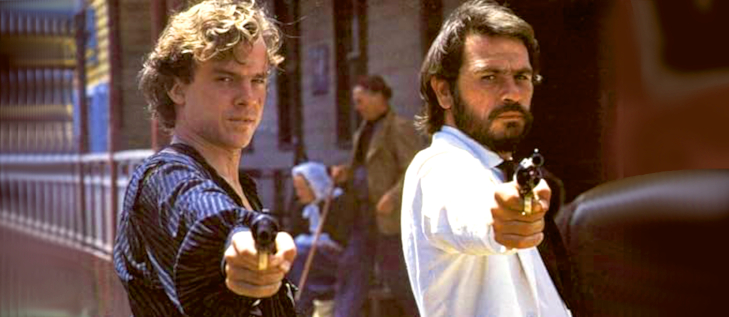


Seeing the upswing in production from ‘down under,” Paramount made a deal with a New Zealand outfit for a swashbuckling but budged-minded pirate adventure on location in the South Seas. Ferdinand Fairfax’s action picture is old-fashioned and somewhat corny, yet appeals thanks to energetic direction and an engaging cast. Michael O’Keefe had made an impact in the well-reviewed drama The Great Santini and Jenny Seagrove would break hearts in the sleeper hit Local Hero. The upcoming star Tommy Lee Jones was looking for a breakout action hit after scoring big in movies like Coal Miner’s Daughter and TV shows like The Executioner’s Song.
Cute, fast and familiar, Nate & Hayes was all but shelved by Paramount Pictures. The story that persists is that it was back-burnered so as not to interfere with the rollout of Spielberg’s Indiana Jones movies, which may be true. It was mostly made with New Zealand money, so Paramount was not on the hook for a major loss. Most of us caught up with it on cable TV, where gems from ‘down under’ like Starstruck had much more impact than they did on theater screens. But the show looks and sounds great, has a cheerful spirit and isn’t too violent for kids over ten or so — unless a cannibal’s basket of human heads is too gross to confront.
Was it deserving of its negative reputation? We don’t think every action thriller should have to top the $50 million dollar Hollywood blockbusters. Roger Ebert certainly didn’t find much to like in Nate and Hayes, and his negative review may have set the tone for other reviewers’ coverage.

Tommy Lee Jones fans will flip. He’s very young, very fit and very much into his role. The movie aims for the spirit of enthusiastic play-acting, as seen in those old Burt Lancaster sweat & muscle adventure movies from the early 1950s – lots of running, jumping and clobbering bad guys with blunt instruments. Jones is no circus dervish like Lancaster, but as an action guy he has good moves.
The script includes early writing input from the later teen film master John Hughes. There were many attempts to re-launch the pirate picture, and most were failures — shows by James Goldstone, Roman Polanski and Renny Harlin. We think this one works at a juvenile action level unappreciated in 1983. It’s true, by the time the last act comes up the movie has regressed to a series of action scenes. Kids love that.
The South Seas of the 1880s is a messy playground for competitive colonial powers. Captured and sentenced to death by the Spaniards, ‘Bully’ Hayes (Tommy Lee Jones) recounts to a journalist his adventures as a South Seas freebooter … Hayes had formerly partnered with Ben Pease (Max Phipps) until Pease became a ‘blackbirder’ (slave trader) and blamed his crimes on Bully. Bully delivers young missionary Nathaniel (Michael O’Keefe) and his bride-to-be Sophie (Jenny Seagrove) to his parents’ mission, and returns with the intention of wooing the bride for himself. He instead finds that Ben has raided the island, enslaved its people and kidnapped Sophie. Bully finds young Nathaniel marooned on a reef in the middle of nowhere. Although seldom in agreement on anything, the two set out to free Sophie and put an end to Ben Pease’s treachery.

The escapist adventure has a shaky connection to South Seas history. William Henry Hayes was a real 19th century pirate. Born in Ohio, he started with smuggling, did some slave trading work and also filibustered — a fancy name for using armed force to seize a region for profit or political gain. In Byron Haskin’s His Majesty O’Keefe, an adventurer played by Burt Lancaster founds a private South Seas empire by defeating a local villain, a loutish thug named Bully Hayes. Nate and Hayes recasts Bully as a romantic rogue in the Errol Flynn mold. His reputation as a slaver is a slur and a lie, although he runs plenty of other illegal scams.
Tommy Lee Jones is a great Bully Hayes; those that disagree may grumble that he underplays and throws lines away, in imitation of Harrison Ford. Re-dubbing has given Hayes a few unwelcome 007-like quips but otherwise he’s a charming character who shows good humor and a strong romantic bent for the beautiful leading lady. Jenny Seagrove’s Sophie is betrothed to one man but clearly pines for another, providing just enough romantic tension to undercoat the action. Although Bully was a-fixin’ to steal Sophie outright, the two competitors soon adopt an old-fashioned truce: first rescue Sophie, and then let her decide which man she wants. Yes, the movie is fundamentally as simpleminded as the wonderful old Republic thriller Fair Wind to Java. Must every movie present a cynical world outlook?

The production design is simple and elegant, and the South Seas scenery makes for relaxing vistas. Rotorua and the islands of Fiji and Urupukapuka are listed as major locations. For its last act the movie introduces an iron-plated German gunboat as a plaything for the cartoonish Count Von Rittenberg (Grant Tilly). As Bully has supposedly emasculated Ben Pease at some point in the past, the ship’s big cannon becomes, uh, a compensating device. Pease has the best lines while happily submitting Sophie to a sacrificial roasting, or giving the Count grief for his numbskull mistakes in battle. Naturally, Bully’s pirates save the day with swordsmanship and old-fashioned Moxie.
Nate and Hayes is basically a New Zealand production, which accounts for its occasionally crude non-P.C. attitude. Bully’s native foes are pulp novel savages through and through. Adventurers like Bully and knaves like Ben Pease are small-time operators in an area where Spanish and German Imperialists are competing for power and influence. Bully’s first mate Mr. Blake (Bruce Allpress) notes that European business practices (cheating, double-dealing) have spoiled these simple people. When the queen of a hostile tribe decides to double-cross our heroes, she has no qualms about taking Bully’s goods and chopping off his head in the bargain.


Never more than a few minutes away is some breathtaking ocean vista with a ship at sail, accompanied by the sweeping music of Trevor Jones (Excalibur, The Last of the Mohicans). There does seem a strong influence of Indiana Jones in the many chases, frightening booby traps and gruesome killings; our only complaint is that Bully and his crew sprint down two too many lengthy piers. The action-oriented dialogue is strictly matinee stuff: Supposedly dead Sophie screams and runs away, leaving a startled Ben Pease to remark: “You just can’t trust a woman, even to stay dead!”
Michael O’Keefe is sort of a Luke Skywalker substitute, what with his relatives getting killed and all. He’s good in some scenes and weak in others. Nate doesn’t convince as a missionary but his conversion to piratical adventurism is believable. Unforgettable as the ‘mermaid’ Marina in Local Hero, Jenny Seagrove is a vision with clear eyes and a pleasant charm, just the dreamy partner to have on a South Seas adventure. She plays an excellent damsel in distress and puts up a good fight when necessary. Only near the end does the director stretch things out a bit too far. The finale sets up a too-cute, anachronistic ‘escape by zip line.’ The prison flashback wrap-around is resolved with a not-too-creative lift of the old rescued-from-the-gallows gag.

Our only point of reference to director Ferdinand Fairfax is a memorable English TV series called Danger UXB; nobody singled out his work on this picture. First assistant director Bert Batt has sterling credits on major action epics, so we wonder if Batt’s expertise and some good storyboards are what give Nate and Hayes its excellent comic-book action thrills. The first assistant director on the action second unit was none other than Lee Tamahori, who would later begin a noted directing career.
Only now do we read that Nate and Hayes was filmed as Savage Islands and released with that title in most U.K. countries. With the knowledge that John Hughes was brought on to revise the script, should we decide that it was originally conceived as more serious, and that Paramount asked that it be given more ‘Indiana Jones’ comedy?


A ripping good yarn which, for me, recalls some of the better Euro-westerns.
Come to think of it, I caught 1976’s ‘Swashbuckler’ on a double bill with ‘My Name Is Nobody’. 🙂
I always loved this film and saw it in the theater. I remember Siskel and Ebert were asked by David Letterman, what was a bad recent film and the two of them looked at each other and said “Nate and Hayes”. I knew I had to go and see it. A local critic had raved about it and said the film was being dumped by the studio and you should rush and see it fast before it closed. It is so much better than more recent “pirate” films that made billions.