


Several years ago David Lynch’s TV return to Twin Peaks proved without question that he was still relevant, that his highly personal style of filmmaking was still valid. The show contained episodes more experimental than anything ever seen on TV, teasing the audience’s willingness to stay on Lynch’s conceptual wavelength.
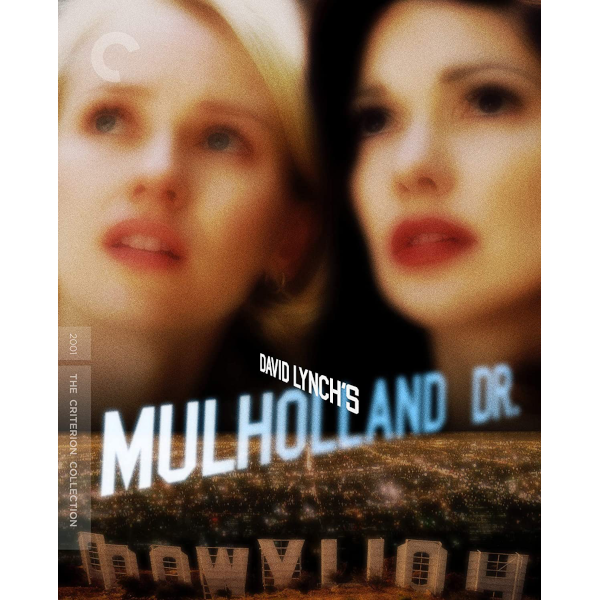
The advent of the new Ultra HD format gives Criterion a good reason to reissue Lynch’s Mulholland Dr., a picture that was remastered in 4K six years ago. The rest of the presentation and extras seem identical to the excellent 2015 Blu-ray release.

Conceived as a TV show, Mulholland Dr. had a rough start. The pilot was revised and rejected several times until Lynch expanded it into a feature film. It solidified the director’s departure from the orbit of anything predictable, even though it subscribes to his familiar personal world of directorial obsessions and themes. The non-Lynchian mainstream audience might found little to hold their attention, what with all the impenetrable games-playing. But the unfolding of this dream vision can be a cinematic pleasure. To its credit, Mulholland Dr. is not an in-your-face shock-fest like his extreme yet tepid Wild at Heart. Some of it almost plays like a Nancy Drew mystery . . . if Nancy had a strange doppelgänger girlfriend even sexier than she.
Lynch pulls us into his story as does any narrative filmmaker, with characters that connect with our emotions. Canadian acting hopeful Betty Elms (Naomi Watts) arrives in Hollywood and moves into her Aunt’s apartment while she’s away. But an amnesia-stricken woman known only as Rita (Laura Herring) has already sneaked in. Instead of calling the police Betty tries to help Rita recover her memory and discover her identity. In the first of several stories told in parallel, film director Adam (Justin Theroux) is being forced to use an actress he doesn’t want, by shadowy forces that freeze his bank accounts and make him a veritable fugitive in just a few hours. Rita and Betty grow closer as they collect clues that eventually lead them to the bungalow apartment of someone named Diane Selwyn. Corpses, a weird homeless man, lesbian sex, a phantom nighttime stage show, a mysterious ‘whatzit’ box, and ‘incredible shrinking’ relatives are only surface symptoms in a puzzle that recasts the women in strangely shifting identities.

I saw Mulholland Dr. with an ideal audience that absorbed it as we once did old-school art films, patiently accepting the mysterious weirdnesses. Rightly or wrongly, we studied every scene for clues to decode what is essentially a dream narrative, a psychological puzzle. Original reviews weren’t so tolerant, with some critics objecting to the film’s refusal to make linear sense from one minute to the next. A fairly straightforward mystery is left unresolved, and is instead fleshed out with tangential subplots that deconstruct its characters and relationships.
If the puzzle aspect of Mulholland Dr. is a good one, it’s because the original TV concept was clearly developing hints that would have been addressed as the miniseries went on. The characters dress up like one another. As in the old Ingmar Bergman head-scratcher Persona, at one point Rita and Betty seem interchangeable, an idea interestingly timed with their sexual collision. The theme is nicely echoed in the semi-interchangeable actresses Adam is trying to cast for his lip-synching pop-song scene.

The film soon turns in upon itself, reorganizing its relationships and creating a slippery sensation of narrative plasticity. Betty ‘becomes’ Diane Selwyn, and Rita ‘becomes’ Camilla Rhodes. The shifting identities and relationships could be alternate realities, alternate possibilities, dreams of potential realities — who knows? Reality shifts just as if God said, “What if the mystery woman were already a big star and the neophyte actress a lesbian hanger-on who’s being dumped? Make it so.” Lynch does a great job of handling the way one plane of reality appears to intersect with another. Camilla is the object of a hit ordered by Diane Selwyn (I think). She then transforms into Rita, who can’t remember her identity. Some events definitely happen in a specific timeline. Others, like the dead-of-night performance of the Roy Orbison song in Spanish, are isolated experiences that seemingly occur in a limbo outside the story we are watching. At times we can see Lynch reaching into his old bag of surreal tricks, but his odd visions find traction in our subconscious. In some dark corner of my mind, I can see myself dreaming about wandering into a damp alley, searching for a magic door to open.
The trick is to resist the urge to demand concrete interpretations. This isn’t a video game with a clue map that, once found, will explain everything. David Lynch isn’t trying to weed out non-hipsters not privvy to his Big Secret, but of course some frustration is possible. Lynch can be annoying, when we suspect he’s asking us to find things significant only because they are thematically linked to earlier work. The tiny squeaking Aunt and Uncle seriously gripe my patience. The ‘everything is an illusion’ mantra at the Club Silencio also seems trite, yet the scene generates an hypnotic mood, as if the girls were witnessing some kind of occult miracle. Where the two women are concerned I eagerly follow because, shame on me, I’ve been given an emotional anchor. The other truncated dead-end subplots can be a nuisance. Yet one greatly admires the fact that a Real Film Artist is getting his personal demons up on the screen.

Mulholland Dr. makes few stabs at weird jokes, which is a good thing. Some perplexing plot turns increase our curiosity. What works best are the interesting, sensual characters. The performances are mostly fine, although Ann Miller’s catty landlady just seems detached and false, without falling into a mode that could be called engagingly weird. Strangely, Naomi Watts’ Betty is even more convincing when acting in a scene-within-a-scene, than she is playing herself, the naive newcomer in Tinsel Town. Lee Grant, Chad Everett, James Karen, Robert Forster and Dan Hedaya are just a few of the bits and just-bigger-than-bits that fill out the scattered plot sidebars.
That a movie this un-commercial could get a major release in 2001 is impressive in itself. Lynch became less enjoyably obscure in a couple of features that followed, but eventually bounced back with the popular Showtime revisit of Twin Peaks. This one remains my personal favorite.

