


Until perhaps the 1990s, the American film market was a place where even small movies could find real national distribution, and compete right up against pictures from the majors with big stars and big budgets. But they had to be just what a distributor thought would sell. A Sam Raimi or Tobe Hooper could come up with a small budget item, but some moneyman would have to sweat out the risk of spending 10 times more to get exhibitors to book it.
New York-based filmmaker Abel Ferrara came up the hard way, making short subjects and even a porn item where he apparently had to perform as well. We first learned of him through The Driller Killer, an icky horror item shot in 16mm. I remember The New Beverly Cinema owner Sherman Torgan saying he didn’t understand the film’s appeal, even when it sold out.
An aspiring ’70s would-be director lacking major cred had to do what he could to get noticed in the 1970s, which mainly meant being shocking in, as we said, just the right commercial groove. Wayne Berwick and Jackie Vernon tried to get rich being gross with his Microwave Massacre, which catered to the crossover audience of lame vulgar comedy, a known standup comedian, and silly gore. Abel Ferrara had youthful rage and a conduit to the angst of from-the-gutter Manhattan filmmaking. A lot of creative film footage came through New York’s Du-Art lab, which specialized in 16mm blowups.

Ferrara gave his backers confidence. His producer Arthur Weisberg, often billed as Rochelle, stayed with him through his first three features and hit the jackpot on the third. Released in 1981, the New York vigilante saga Ms .45 was destined for. more than just grindhouses. We saw TV spots for it in Los Angeles. One could tell it would be an instant hit, as it gamed the exploitation formula to ‘T.’

Seamstress Thana (Zoë Tamerlis) is quiet and passive, but pleasant and friendly with her coworkers, who adjust to her situation as a mute. They are garment workers for the small-scale independent fashion designer Albert (Albert Sinkys) who is considerate to all his ‘girls’ and especially sensitive to Thana’s needs. The horror begins when Thana is raped in an alley by a masked assailant holding a gun. When she stumbles home she’s attacked by burglar, who also threatens her with a gun. Thana manages to stun her second attacker, and then smash his head in with a steam iron.
Instead of getting help, she stashes the corpse in her bathtub. Instead of telling her coworkers, she acts erratically at work; Albert gives her some time off, which she uses to dismember the burglar’s body. Thana’s personality change is radical … at night she puts on alluring makeup, dresses provocatively, and walks the dangerous streets. Armed with the burglar’s .45 automatic, and coldly blows away men that harass her.
The film’s pitch would impress any exploitation distributor looking for surefire hit. It’s a cross between Taxi Driver and Death Wish with a dash of the Margaux Hemingway picture Lipstick. The leading character is a gorgeous woman victimized in two awful sex crimes. The psycho-trauma transforms her into a killer, striking back against predatory males. We imagine that audiences cheered to see her blow away potential attackers, but she acts out of panic, fear and no small amount of derangement, which means that not all of her victims deserve what they get.

The movie shows director Ferrara and his screenwriter N.G. (Nicholas) St. John distilling a sure-fire exploitation formula. But is also allows for a deeper response to the carnage — Thana can be seen to be Striking Back against a world that victimizes women. The only thing keeping the show from cheerleading for male-haters is that our killer dame is a genuine loose cannon. When out of control, she’s a menace to inoffensive men and women as well.

We saw Ms .45 on the fledgling Los Angeles cable innovator The ‘Z’ Channel, where it didn’t look all that good. But unlike Driller Killer it was filmed in 35mm, with an effort to find a style. Ferrara and his skeleton crew (future director Veronica Rocket handles Art Direction, Set Decoration, props and wardrobe!) manage an okay look in the interiors. They do much better on the night exteriors, the sidewalks and alleys where the more showy violent confrontations take place. That’s important: brief advertising clips of Thana brandishing her gun surely motivated exhibitors to sign on the dotted line. Some probably asked ‘what’s this nasty kid making next … does he need investors?’
Ferrara is in no way the whole show here, as 98% of the movie is carried by his 17 year-old star, Zoë Tamerlis (later, Zoë Lund). She had the looks of a model; by all reports she was smart and opinionated and a good writer. Tamerlis would collaborate with Ferrara again — she’s credited as the co-writer of Ferrara’s major hit Bad Lieutenant.

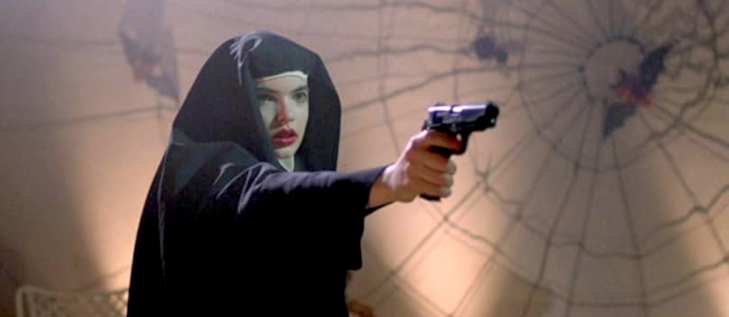
Ms .45 conforms to the Jean-Luc Godard quip that claimed that ‘all you need to make a movie is a girl and a gun.’ The difference is that this time the girl is wielding the gun. On one level Ferrara and Tamerlis exploit the ‘sexy psycho runs amuck’ angle for all it is worth. The advertising soars with a single confrontation pitting Thana against four obvious rapist wanna-be’s, composed for attack in a setup resembling a Sergio Leone stand-off. ‘Meek’ Thana quick-draws and shoots all four before they can take a step: cue audience approval.
The filmmakers were smart to make Thana a mute. The arrangement removes the need for dialogue responses, let alone quality dialogue and precise acting. It also renders Thana as a symbol, an objectified ‘alluring’ female who behaves contrary to the norm. If only Roger Corman’s The Wasp Woman reached for a statement this radical. Women (in general) have such an unjust deal in this world, that it’s not difficult to trump up justifications for random reprisals against the world’s males. At, least, not for a crazy person.

Story logic remains loose, improvised. Thana doesn’t seem to have a plan to dispose of the chopped-up burglar, but we don’t have enough detail to really know what she’s doing. A certain amount of business shows Thana’s nosy neighbor Mrs. Nasone (Editta Sherman) pushing her way into Thana’s apartment, and snooping around with her troublesome dog. Her acting is pretty thin, but we’re more interested in watching Thana’s subdued reactions. She spends most of the movie as if under an hypnotic spell.
Ms .45 develops its premise only as much as it needs to, and it has the good sense to get done and finished in about 80 minutes. A great many New York movies put all their production values in one set piece, and Ferrara’s is a typical rockin’ party scene, a costume party. Someone thought to have Thana show up costumed as a nun. In search of an iconic image, Ferrara poses killer close-ups of the gorgeous Tamerlis, wearing a nun’s wimple, applying makeup.

Ferrara and Tamerlis show considerable sensitivity in who Thana blows away with her trusty .45. More than one victim is simply in the wrong place at the wrong time. That Thana is totally deranged is indicated when she draws down on her boss Albert, a positive pitched counter to the stereotype of the exploitative, abusive garment industry creep. Albert is genuinely kind to his ‘girls.’ He’s somewhat effeminate but apparently bisexual; near the end we see him and a woman getting it on, without sarcastic comment. One good thing is that the final confrontation at the Halloween party does not introduce a slick narrative twist; Thana’s fear-aggression stays consistent. The cops will have quite a puzzle to put together.
The movie won’t score well on anybody’s credibility scale. Thana’s instant personality change gives her the pistol packin’ skill of Annie Oakley. Unless I idiotically missed a scene, Thana fires that .45 automatic indefinitely without worring about ammo or reloading. Did the burglar happen to be carrying an extra box of shells with him? Did he pop back to life for a couple of minutes, to teach her how to load the weapon? In any case, that’s not what the movie’s about at all.


Regardless of how it came to be, this film is a minor masterpiece.