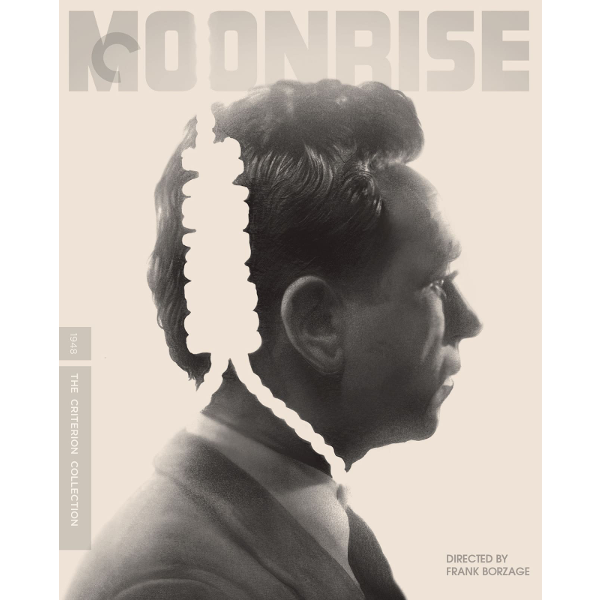

Frank Borzage’s 1948 Moonrise is a critic’s delight, especially among aficionados that like to point out the artistic margins of traditional Hollywood filmmaking. A film noir that undercuts most of the tenets of the style, the murky and morbid tale of a guilty conscience also insists on the power of the human values of trust and love.
I have to admit that I sometimes attribute Borzage films to Gregory La Cava, and vice-versa. Frank Borzage’s best pictures tend to be intense intense romantic stories, often about the soulful problems of quiet people in love. He’s especially good with actresses, as witness the 20 year-old Janet Gaynor in the silent 7th Heaven. His pre-Code A Farewell to Arms is one of the best Hemingways and by far the best film of actress Helen Hayes. Borzage obtained exceptional, different performances from Sally Eilers (Bad Girl), Loretta Young (Man’s Castle), Joan Crawford (Manniquin and Strange Cargo), Jean Arthur (History is Made at Night) and Margaret Sullivan (The Mortal Storm). The director had been in films since 1915, and the only thing to slow him down was the changes in taste that came with the war years. He apparently wanted no part of tough and cynical stories, and even the grim noir Moontide is infused with soft Borzage values. That doesn’t mean that it doesn’t have a bite, story-wise or visually.

At a dance in rural Virginia young Danny Hawkins (Dane Clark) is attacked by Jerry Sykes (Lloyd Bridges), a spoiled banker’s son who has been tormenting Danny ever since they were children. Danny fights back, Jerry is killed, and Danny hides the body. More angry than repentant, Danny roughly takes schoolteacher Gilly Johnson (Gail Russell) away from the dance, and cracks up another boy’s car. Nobody is hurt, and the opinionated townspeople quietly blame the event on Gilly, who as the ‘responsible’ party, ‘should have done something.’ Danny continues to stalk and hound Gilly, trying to claim her as his own, even though she promised herself to Jerry. When Jerry stays missing, Sheriff Clem Otis (Allyn Joslyn) and Danny’s black friend Mose (Rex Ingram) see through Danny’s disturbed behavior. He is a mess, and when Gilly breaks through his silence, he talks about the grief he’s suffered all his life because his father was executed for murder. It’s only a matter of time before the truth comes out, with all the circumstantial evidence against Danny. And when the body is found, the circle of suspicion closes in.

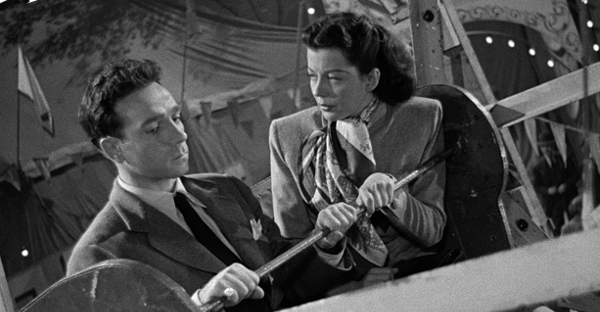
Moonrise is definitely noir. The haunted & guilty psychology is there, and Borzage makes frequent use of expressionistic visuals to pull us into Danny Hawkins’ clammy world of resentment and anguish. The most celebrated sequence is the near-abstract opening, with experimental effects that verge on the nightmarish. Using rear projection with inverted negative images, we’re treated to swirling abstractions that look almost like modern CGI, only organic. Shadows, silhouettes and shots of feet walking to the gallows haunt Danny’s child-nightmares, as do scenes of bullies tormenting him. The adult Danny’s state of isolation and bitterness is thus fully backgrounded. Later on, odd subjective shot choices highlight the adult Danny’s paranoia. He sees a vision of his attacker Lloyd Bridges superimposed in car windshield, repeatedly raising a rock to strike. After a fall from a carnival Ferris Wheel Gilly appears in giant close-up, hovering over Danny. Just the use of shallow focus points out Danny’s feelings of self-consciousness, his fear of making eye contact with people.

The whirlwind of abstract shots up front may have confused the literal-minded viewers of 1948. Some of the effects are blatantly artificial, such as when the camera tracks right off the 2-D rear projection screen, onto a group of legs trudging to the scaffold. The images are so arresting that we might not pay attention to their actual content.
Most of the movie is a conventional drama set in the sticks, with many exteriors shot on elaborate interior sets, glowingly photographed By John Russell. A train at the station is represented by shadows flashing by. Gilly and Danny meet in abandoned houses, one of them introduced with a long crane-in on a remarkably believable miniature. Republic’s able effects men the Lydeckers pull off several impressive miniature and matte illusions.
The expressionist touches would seem to be Frank Borzage’s only concession to modern taste, even if they’re really stylistic throwbacks. His core influence is on the performances, where he maintains a slightly dreamy but romantically vivid tone. Danny’s obsession with inferiority and culpability is countered by Gilly’s understanding and love. At first we figure that her interest has to be maternal, as Danny is such a miserable behavior problem, bullying and threatening not only Gilly but others that can’t fight back, like the feeble-minded Billy Scripture (Harry Morgan). But we can tell that Gilly is also strongly attracted to Danny, which to some extent redeems him. He’s trying and failing to expiate his own sordid Original Sin.

Dane Clark is the film’s weak link. Technically he does nothing wrong, but his hang-dog gloom doesn’t generate audience sympathy or project a particularly likable personality. Considered a second-string John Garfield during his Warners contract player years, he doesn’t get to use his winning smart-alecky persona here, and thus just looks miserable and undeserving throughout. Danny’s bitterness about his parentage makes sense but he’s still a weakling, and doesn’t seem good enough to win the leading lady.
The marvelous Gail Russell more than compensates. She already has haunted eyes and a smoldering beauty that seem both knowing and innocent. She was spooky-vulnerable in Night has a Thousand Eyes, a fine Latina in The Lawless and a pragmatic pioneer wife in 7 Men from Now. It’s dismaying to hear that Russell was a reluctant, unhappy actress, as she’s a natural with an amazing warm presence. Her western with John Wayne, The Angel and the Badman is a delight. We’d do anything not to hurt this women, so Daniel’s bad treatment of her in Moonrise is unwelcome. Gilly appreciates Daniel because as a teacher she’s drawn to the problem pupils. In Daniel she’s found a real case study.
This may be character actor Allyn Joslyn’s best picture. He’s great as the principled sheriff. Everybody’s a bit too concerned about decency in the picture, but Sheriff Clem has a good practical side to his kindness.

The legendary Rex Ingram is unfortunately the ‘magic negro’ studied in the revisionist books on blacks in film. His Mose Jackson is the regulation sage who knows all and intuits all, and has nothing better to do than serve as a conscience for a conflicted white guy. That’s the template, but Mr. Ingram makes it feel wholly fresh.
Both Mose and Billy Scripture are there for Daniel to be friendly with, which is a good thing for otherwise we’d like Danny even less. Harry Morgan has some great reactions to Daniel’s hot & cold treatment. He appreciates Daniel even after the hothead has choked him. The only comedy relief is provided by an ancient, near deaf old-timer. He always approves of Danny, ” ’cause he ain’t no Yankee!”
The predictable story looks headed for a noir-inflected grand-doom finish, as in most Loser Noirs. A notable comparison would be The Long Night with Henry Fonda. Borzage instead at least gives Daniel a chance to do the right thing. But is surrender another path to doom? Danny’s atonement feels good, but we worry about his chances with a jury, local or not. He’s the son of a convicted, executed murderer, and his victim was a rich banker’s son. Borzage directly contradicts the Rules of the Noir Universe, when Mose makes a speech about blood not being bad, but I’m not sure the old man would be an effective character witness.

The presence of Ethel Barrymore seems an afterthought, slotted into the picture at a point when things should be rushing to a finish. Thus the film drags a bit in the last lap; it’s too bad that her scene couldn’t have come earlier on.
This is one of the last films of the historical footnote actress Lila Leeds, and she’s not on camera very long. In an event reinvented for the cop saga L.A. Confidential, Leeds was the starlet involved with Robert Mitchum in the highly publicized 1948 Pot Bust. Publicists made Hollywood history by magically spinning the career-killing arrest into a career booster, increasing Mitchum’s popularity. Ms. Leeds spent her sixty days in the County Jail and her film career came to an abrupt end.
This is not a happy popcorn picture! Although we love it, we can see why Moonrise wasn’t an audience pleaser. It has been often compared to Night of the Hunter for superficial reasons. But the two films shared a sense of artfulness that ticket buyers don’t appreciate when looking for more conventional thrills. The hero is not likable, there isn’t much action and the mood is grim, as in Goldwyn’s ultimate downer noir Edge of Doom. Let’s go see a guilty guy suffer in an intense, sobering art picture.