

As enthusiastic as we are about classic Gothic Eurohorror, we never quite made the jump into full-on appreciation of Italian giallo thrillers. The random use of women as objects for murder ran out of interest early on, and we could only respond so far to the specialists that focused on deliriously beautiful imagery and imaginative, sadistic refinements. We didn’t mind the absurd storylines with terrible mystery plotting and narrative cheats. But gialli also tended to run short on characterization.
That doesn’t mean we don’t go nuts over every frame of Blood and Black Lace, or admire certain situations in The Bird with the Crystal Plumage and the audio-visual onslaught of Suspiria. But too many shows are like Torso — bits of travelogue in between opportunities for the director to indulge in the turn-on of destroying hyper-sexualized women. We try to resist the socio-political interpretations that are frequently imposed on genre films … but the general run of Italian gialli seem firmly based in misogynnistic degradation.
Of course, these concerns seem less bothersome when one considers the sadistic poverty of most post-millennial horror. Slaying girls with sharp knives? Not sick enough.
What’s amusing is that Torso, aka I corpi presentano tracce di violenza carnale, was written by Ernesto Gastaldi, whose career we much admire.
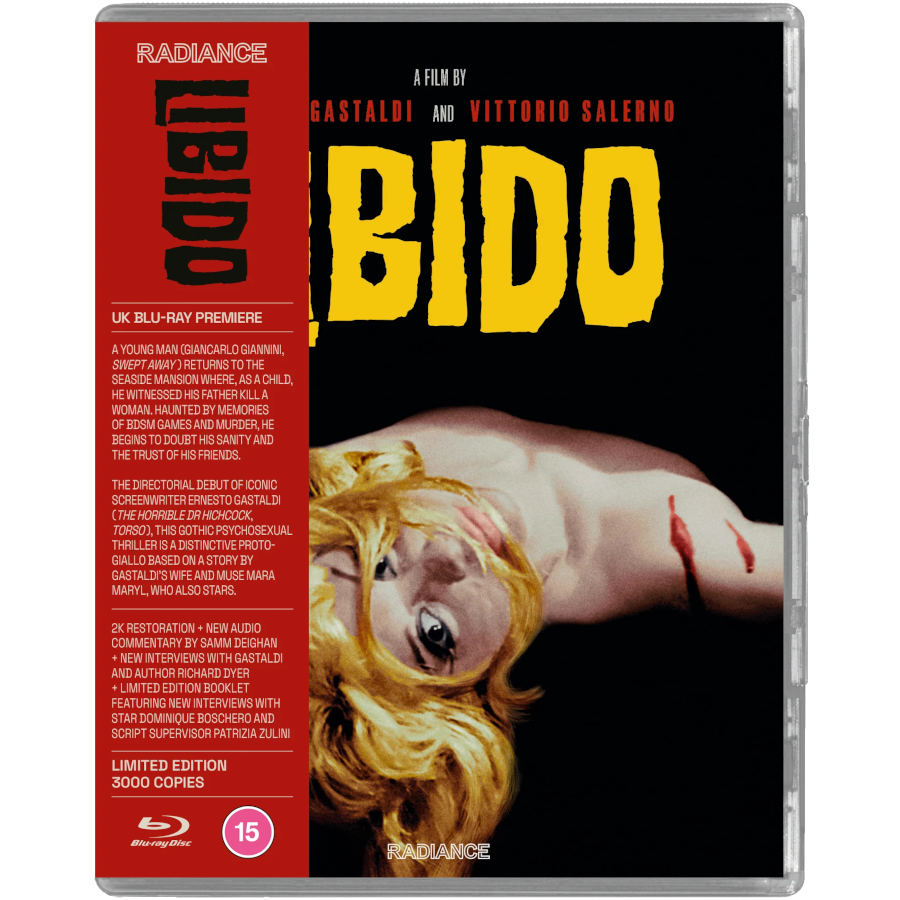
Signor Gastaldi gets a well-earned showcase on Radiance Film’s new Blu-ray of Libido. The Region B disc apparently uses the same excellent video master prepared for Severin Films’ domestic disc of 2022. We weren’t able to review that release, but the new Radiance interview of Gastaldi adds extra interest to this somewhat overwrought thriller, that’s also co-directed by the writer.
Libido is commonly classified as proto-giallo, but audio commentator Samm Deighan is quick to liken it to Hammer’s psychological murder thrillers, the ones cobbled together by Jimmy Sangster. The advertising amplifies the movie’s claim to being a profound study of twisted psychology. But what we see is the old pseudo-psycho gimmick exploited by the Corman / Poe adaptation The Pit and the Pendulum. Little Vinnie Price witnesses his father at work in his torture dungeon, so he naturally becomes a similar warped maniac when he grows up. Or at least, that’s what the character fears.
The movie is a very small fabrication by writers-friends as a way to move up in the Italo film world: Gastaldi, Luciano Martino and Vittorio Salerno. Lacking big star names, it relies instead on the promise of its provocatve title. As it turned out, Libido does feature a big star. It’s the first film of Giancarlo Giannini, billed under an assumed name. This is 1965, and the filmmakers are still Anglicizing many of the names in the credits.
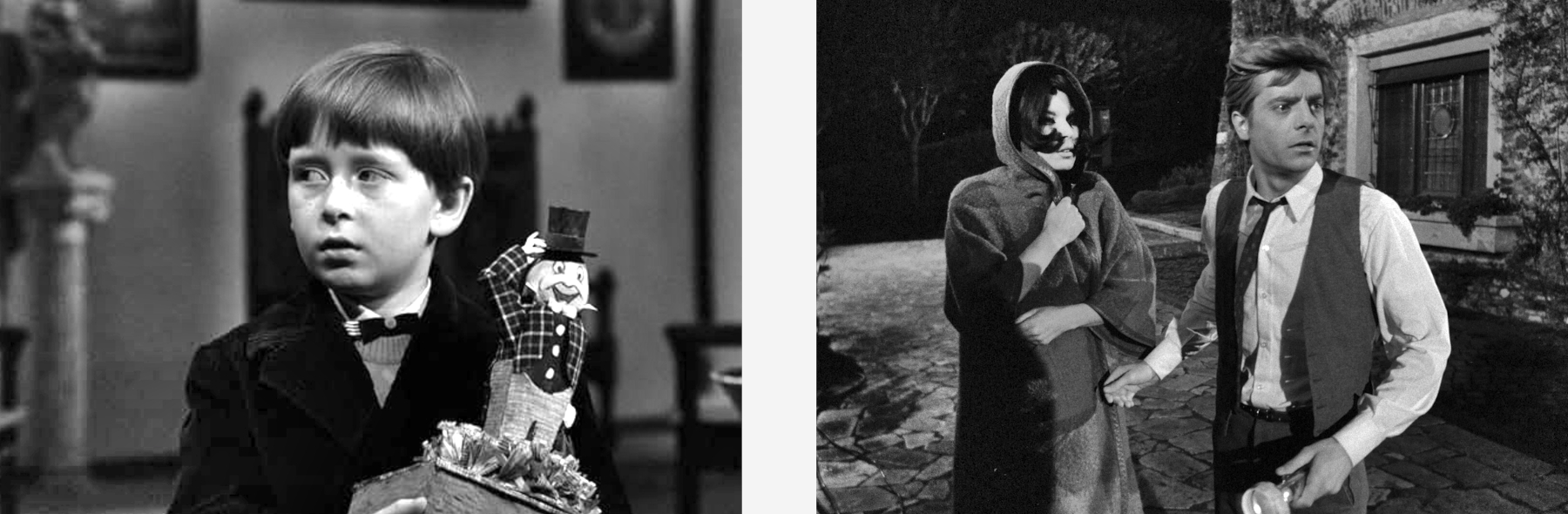
Wealthy heir Christian Coreau (Giancarlo Giannini, billed as John Charlie Johns) returns to his family’s seaside chateau in Brest. He’s accompanied by his doting wife Helene (Dominique Boschero) plus two others, Paul Benoit (Luciano Pigozzi aka Alan Collins) and Paul’s wife Brigitte (Mara Maryl) a sexy exhibitionist. Paul is the caretaker both for the mansion and Christian, who has a history of mental instability linked to a horrible childhood incident that occurred in the chateau. This is Christian’s first time back after twenty years — how will he handle the psychological shock?
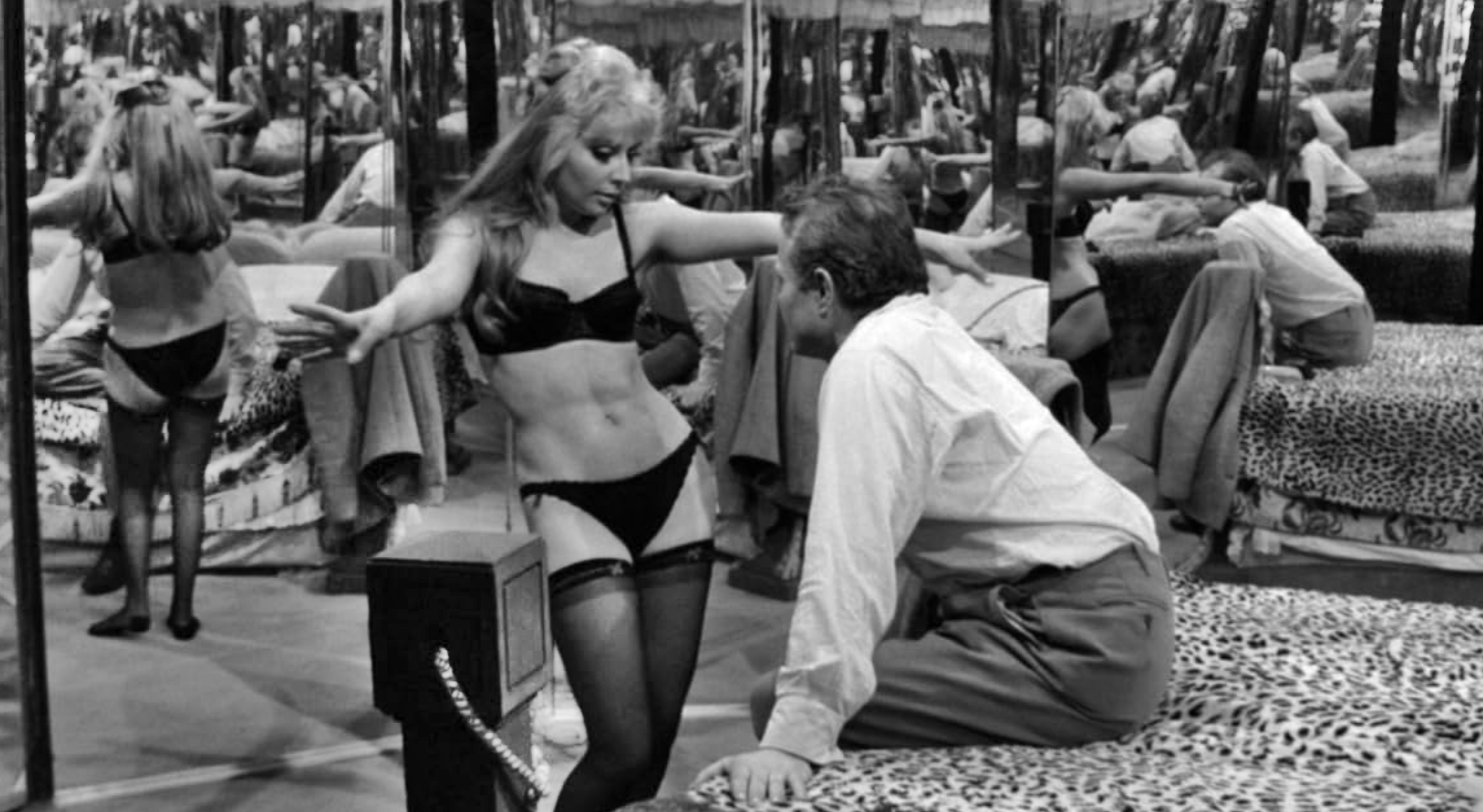
Not very well, is the answer. Christian is disturbed at seeing the scene of the crime, a bedroom mirrored as if in a sideshow fun house. The thoughtless Brigitte goes through his childhood toys, including a ‘Grillo Parlante’ (Jiminy Cricket) music box that Christian was holding long ago, when he saw his father George Coreau murder a sexy blonde. Things happen to make Christian think that his father’s ghost is prowling about — someone is smoking his father’s pipe, for instance. Brigitte comes on to Christian — or is he confusing her with his father’s long-ago murder victim? He then thinks he sees his father on the cliffside terrace during a thunderstorm. Helene sends for the doctor just as Christian begins to think that she and Paul Benoit are lovers, conspiring against him. Is Paul’s protective concern a devious mask? Has he a plan to seize Christian’s inheritance by having him declared insane?
Libido wasn’t exported much outside of Italy. It’s not at all bad, so the reason may be that it’s in B&W and was handled by a minor distributor. It was the first of six films directed or co-directed by Ernesto Gastaldi, none of which were big hits. But it plays as well as many more-celebrated Italo thrillers. We expect Libido to attempt some clever plot twists. Stage actor Giancarlo Giannini is an excellent presence, putting theatrical spin onto Christian’s nervous anxiety. He became an international star through his pictures for Lina Wertmüller, like Love and Anarchy.
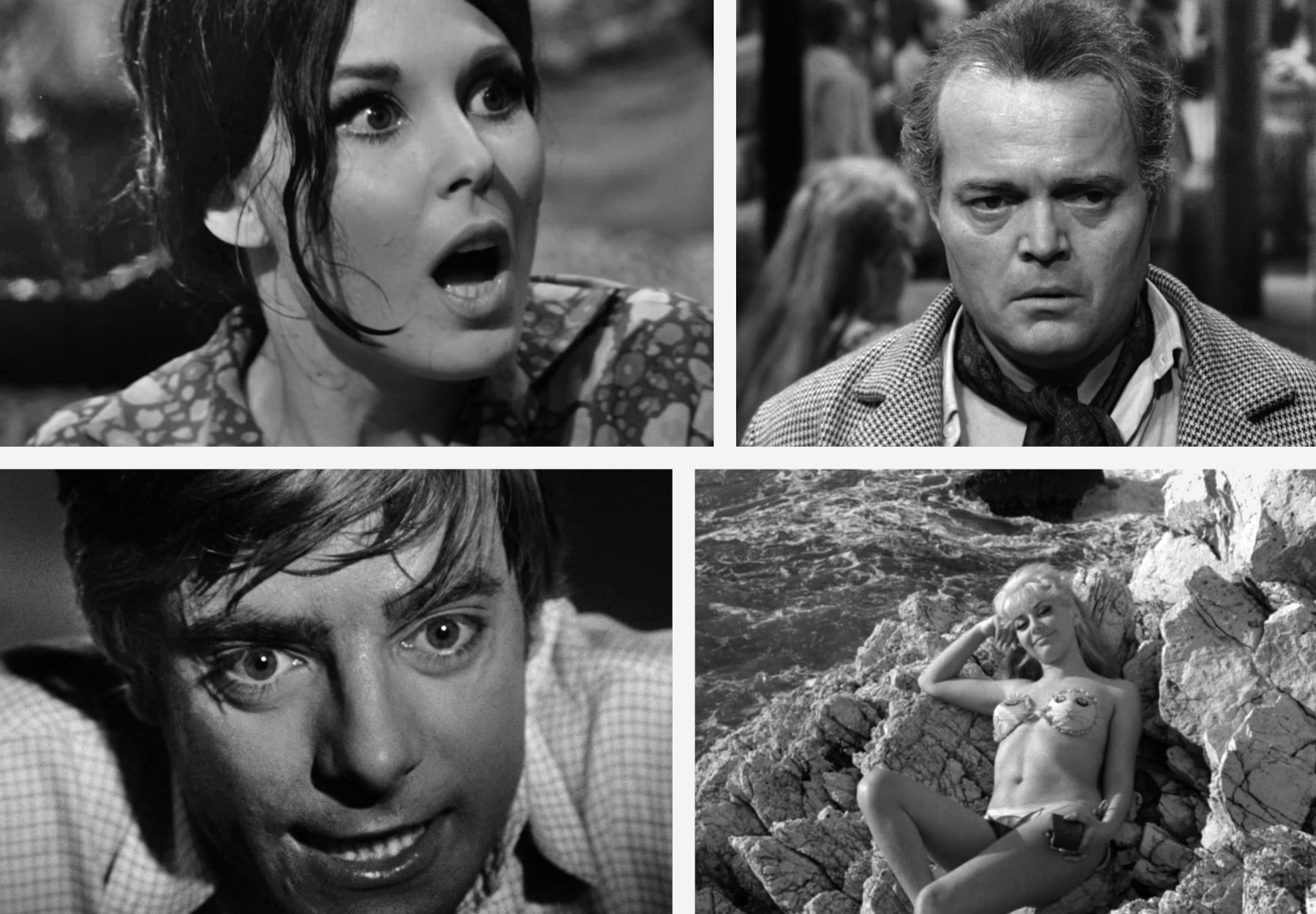
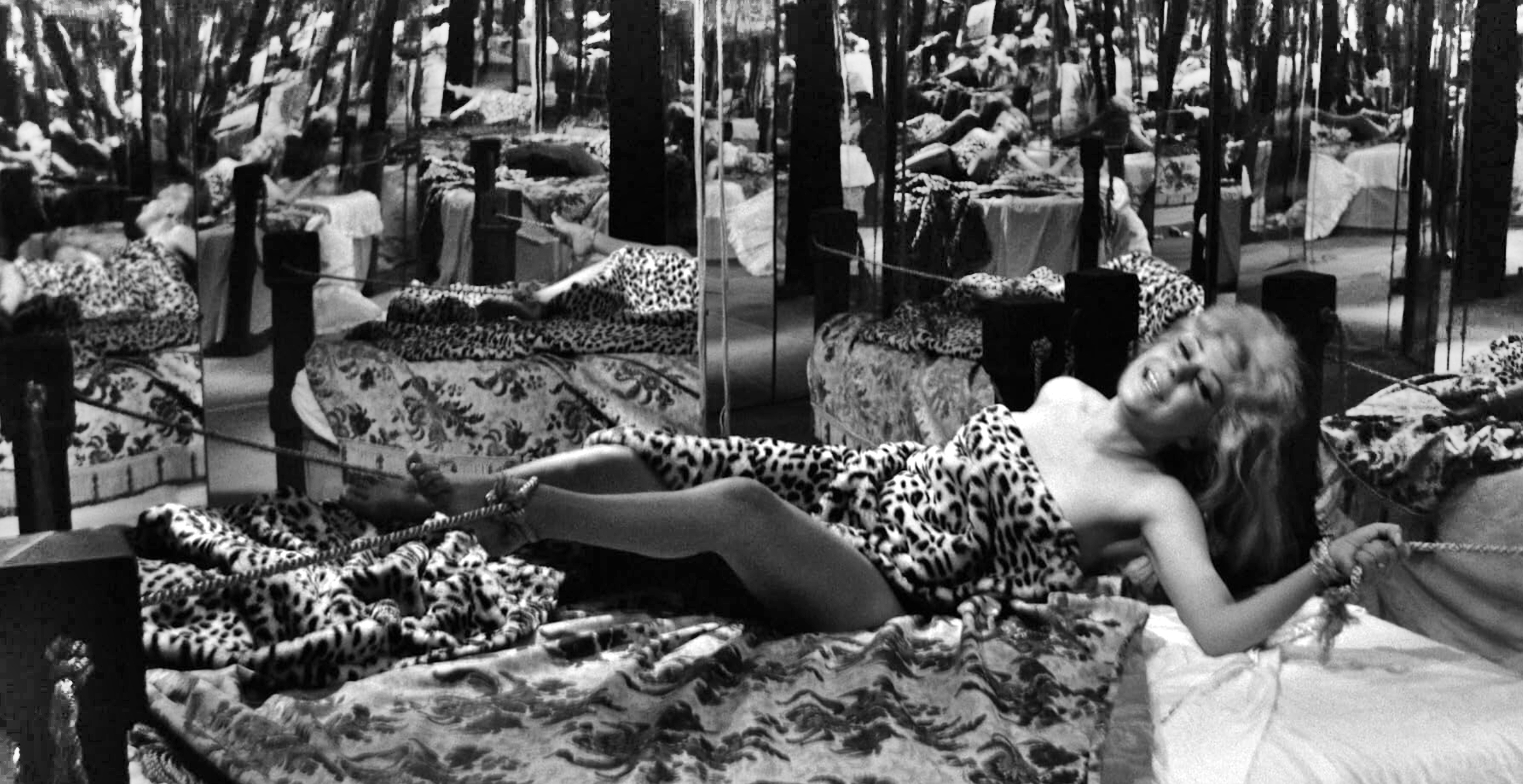
At this level of credibilty, the other three players contribute acceptable performances. First-billed Dominique Boschero is concerned but distant, keeping her on the list of possible schemers. Mara Maryl carries the commercially sexy content, seducing her husband in the mirror room, and wearing a tasteless cat-themed skimpy bikini to sunbathe. She affects a ‘dumb blonde’ act, but we suspect that she’s smarter than she looks. Luciano Pigozzi is appropriately ambiguous — he might not be sincere in his concern for Christian, as a clean bill of mental health for Christian will finalize the inheritance of the full Coreau estate. Pigozzi is known to Eurohorror fans as the Italian Peter Lorre.
The Coreau chateau – castle backs right up to some craggy cliffs overlooking the sea; the filmmakers do a good hiding the fact that the house and the cliff are two different locations. When young Christian sees his father’s crime, he’s carrying that Jiminy Cricket music box. Any critic should see that as a lift from Luis Buñuel’s black comedy Ensayo de un Crimen. Buñuel uses a boy and a music box as an identical motivator of psycho-maniacal murder. As for the mirrored bedroom, it’s there both for eye candy for the trailer — multiple sexy images of Ms. Maryl — and to serve as an instant ‘room of nightmares and memories,’ as in the film noir Fear in the Night and its remake Nightmare. The mirrored room appears to be very near the house’s front door. Why would George Coreau live on a sea cliff with a beautiful view, yet sleep in a room with no windows.
In his commentary Ernesto Gastaldi admits that the film ran short and that the editor found ways to pad the running time. A prologue ‘explains’ the title, and some driving scenes are a little stretched, maybe. Because the entire film was post-dubbed, the editor reportedly repeated some footage in conversation scenes, and then had Gastaldi invent additional dialogue for the people to say.
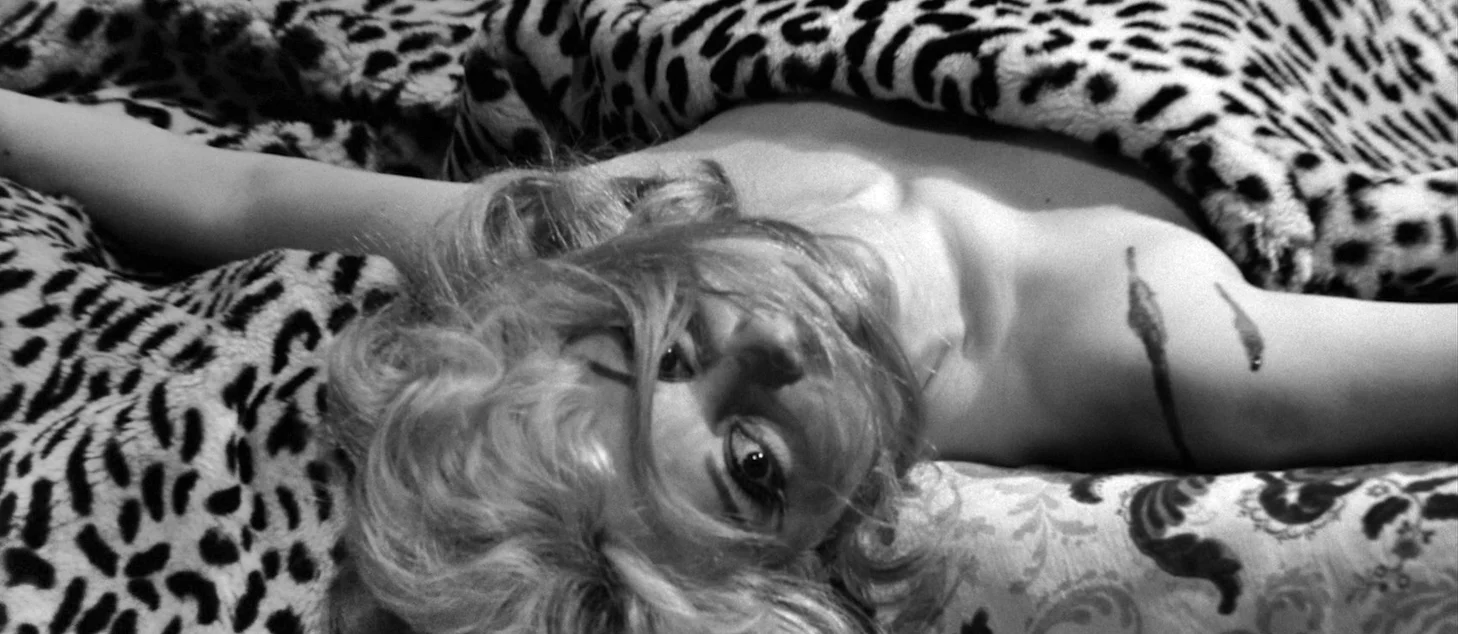
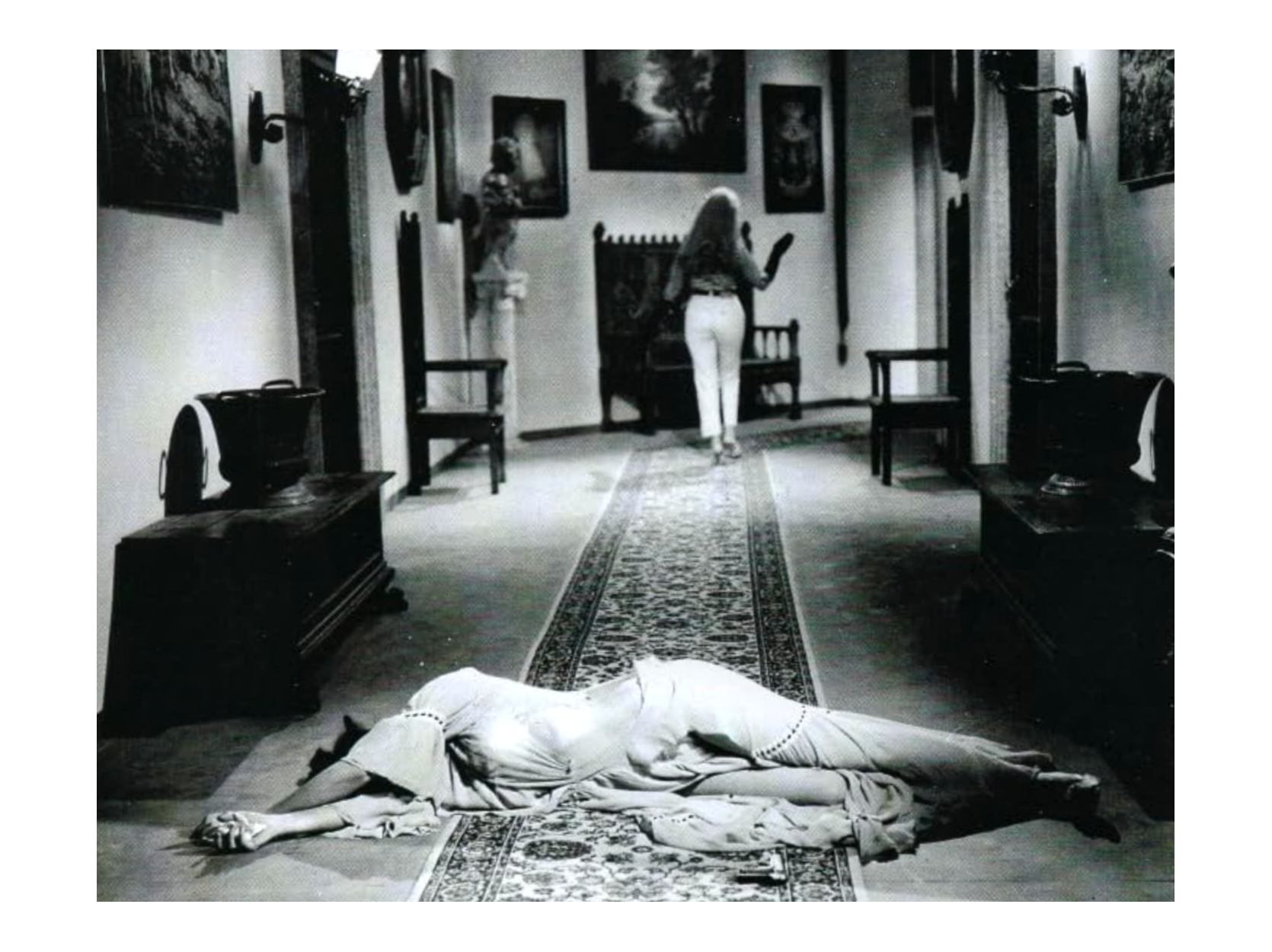
Libido was nowhere to be found when we were college-age horror fans. We could find nothing on it save for the same two or three photo images. One showed Ms. Boschero lying on the floor with blood on her face, draped in a nightgown neatly arranged for censorship purposes. That photo came to mind when we saw Roman Polanski’s Repulsion. The only ‘false’ composition in Polanski’s entire movie is a similarly-posed image of the nude Catherine Deneuve, carefully covered by a similar nightgown. You can easily imagine Polanski standing to one side, allowing some Compton-Tekli representative set up the shot, to serve as publicity bait for the film’s advertising.
The direction is sound, aided greatly by excellent B&W camerawork. At one point Ernesto Gastaldi and his co-director Salerno borrow directly from Riccardo Freda … the scene in which Christian sees his ‘father’ lit up by lighting bolts in a big storm, is a straight lift from The Horrible Dr. Hichcock, right down to camera angles. But is it a steal if Gastaldi wrote both pictures?

I’m a giallo fan, so I’m biased. But, I disagree about the majority of giallos being an excuse for “misogynistic degradation”. Yeah, most of the victims are women…BUT, occasionally a male gets brutally offed as well, so there is equal opportunity here-and-there in the giallo genre. But above all, these are just movies, plain and simple.
Some giallo do seem to cross the line from “pretty girls being stalked” to “let’s enjoy watching the naked woman get slaughtered/raped”. It’s especially weird when Dario Argento does it with his loved ones!
And yet, from what I can recall, some actresses that worked for Dario Argento playing the victim characters have positive things to say about his work, so figure that one out! But, I do find the whole “directors of giallos being misogynistic” a streatch; that’s like saying Phil Karston liked making brutal crime movies because he is “pro-crime”. We really can’t crawl inside our fave directors brains to discover their true intents. Rather, the filmmakers behind the giallos most likely upped the ante because of audience demand: what the audience wants, they get! Plus, these movies were aimed at a more “male” clientele; sorry ladies, if you want a softer movie, I’ll point you towards a melodrama instead.
” as in the film noir Fear in the Night and its remake Nightmare”
Funnily enough, both were also the titles of Hammer films written by Jimmy Sangster!