


English producer-director Victor Saville had a sterling record of success in the silent days, and was often named as the main competition of the ambitious Alfred Hitchcock. His Hollywood career wasn’t as bright, what with big but ungainly MGM pix like Green Dolphin Street and his ‘Waterloo’ flop The Silver Chalice. But Saville made big news in 1952 by licensing several detective stories by Mickey Spillane, America’s then number-one selling author. The first hardback edition of Spillane’s I, the Jury came out in 1947, but by the time the film version was in theaters, the Signet pocketbook paperback was in its 33rd edition, with 3.5 million copies sold at 25 cents apiece. The film was produced in 3-D, near the beginning of the short-lived but popular 3-D phenomenon.
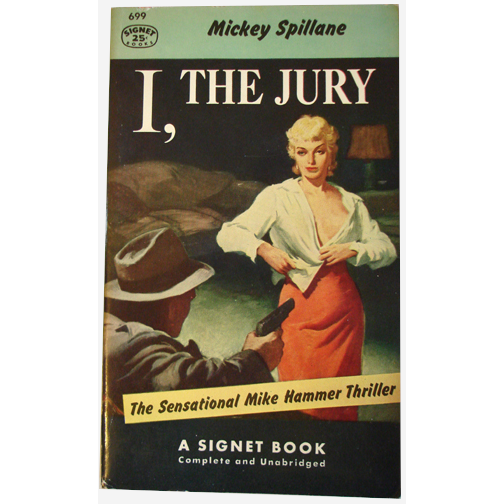
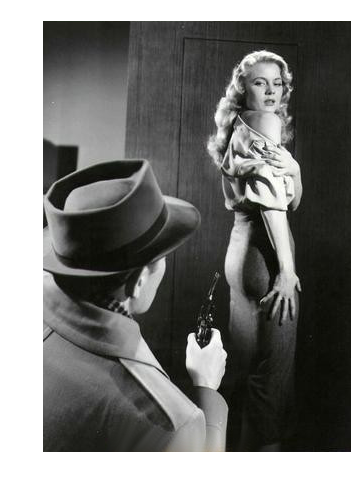
Saville would later direct two of his followup Saville properties, but Jury was written and directed by Harry Essex, likely riding his association with Universal’s It Came from Outer Space as a ‘3-D expert.’ Seeing Spillane’s Mike Hammer on the posters was enough to guarantee the film’s success, and the 3-D novelty sweetened the attraction. Original artwork ( ↘ ) pictured sexy Peggie Castle in the act of undoing her blouse, with graphics suggesting that viewers would be treated to a 3-D striptease. The poster directly mimicked the cover of the best-selling pocketbook. ←

To our knowledge I, the Jury has never been on home video; it sold out screenings at two gala 3-D extravaganzas at Hollywood’s Egyptian Theater. ClassicFlix’s new multi-format disc set, restored by The UCLA Film and Television Archive, shows off the film’s fine B&W cinematography by John Alton, one of the most celebrated cameramen of the noir style. The 4K disc is a full-resolution 4K Ultra HD presentation, and a second Blu-ray disc has a standard Blu-ray encoding plus one for Polaroid Blu-ray 3-D, a fantastic format for which considerable content is still being produced, despite the decreasing availability of 3-D players and monitors.
“I’ll kick your teeth all over the floor!”
Private detective Mike Hammer (Biff Elliot) all but goes ballistic when his best buddy, one-armed Jack Williams (Robert Swanger) is shot dead in his apartment. Jack saved Mike’s life fighting in the Pacific, and leaves behind a sickly girlfriend, Myrna Devlin (Frances Osborne). Mike refuses to stay out of the investigation. Police Captain Pat Chambers (Preston Foster) gives the hot-head detective inside information, and tells the press to play up his involvement. Mike pushes his way into places he’s not wanted, to be sneered at by gangsters and threatened by thugs. His pals-on-the-street are the punch-drunk ex-boxer (Frank Richards) and Bobo, a mentally impaired softie (Elisha Cook, Jr., unbilled). Mike figures that the devious ‘art importer’ George Kalecki (Alan Reed) and Hal Kines (Bob Cunningham) are behind it all, but his inquiries yield nothing. Offering help is the sophisticated psychiatrist Charlotte Manning (Peggie Castle), to whom Mike feels genuinely attracted. But is Charlotte hiding information of her own?

It’s no surprise that the lurid, antisocial adventures of Mike Hammer would be incompatible with 1953 censorship. Although an entertainingly hardboiled read, Spillane’s book is an indigestible wad of ugly attitudes. He’s a tough-guy emotional volcano, exploding in violence when those he cares about are threatened, like his secretary Velda. Other women throw themselves at him, and sometimes he takes what they offer. Mike despises drug pushers, ‘pansies’ and commies, and relishes opportunities to kill the crooks that come after him. The self-righteous avenger is given almost total freedom by the cops, especially his buddy Pat Chambers, who stands aside when Mike runs wild.

← The movie’s Mike Hammer is nowhere near as extreme. Biff Elliot talks some of the talk from the book, but doesn’t mutter to himself how he’s going to torture a Commie dope dealer. He’s not good at collecting information, and instead steps in at the right moment to tell people off and knock a few heads together. At one point Mike does indeed shoot someone, in self-defense. He spends a night in jail without so much as filling out a questionnaire. Pat Chambers then lets him out to continue working ‘behind the scenes.’
A key reason noir fans will want to see I, the Jury is to admire its impressive cinematography, whether in 4K or 3-D. The movie itself is not at all good. Harry Essex’s screenplay is a confusing muddle with terrible dialogue. His direction of actors rises above TV work only in the way every character nuance is grossly overstated. Even the music track is gratingly over-sold, as if the ace composer Franz Waxman were instructed to jar the audience’s nerves — we yearn for the reasonably overstated cues of Albert Glasser.
The main FAIL with I, the Jury is its Mike Hammer, Biff Elliot. He’s a major bit of Hollywood miscasting. Elliot brings very little to the role. Despite his background as a boxer he isn’t physically intimidating — he’s not tall or imposing. His overcoat looks oversized and padded, halfway to David Byrne ‘Big Suit’ dimensions. When this Hammer snarls and acts tough there’s no command, authority or genuine toughness to his voice . . . he sounds like one of the Bowery Boys with a slightly lower register. It’s difficult to account for this casting — Elliot is just the wrong guy, period.
Most everybody else is decent but unfocused. Character actors John Qualen, Nestor Paiva and Elisha Cook Jr. come off as essentially undirected and make less of an impact than they ought. Preston Foster basically just says his lines and moves on. Alan (Fred Flintstone) Reed doesn’t seem an appropriate Mr. Big-type gangster, and key characters played by Bob Cunningham, Frances Osborne and especially Mary Anderson (Lifeboat, The Underworld Story) just don’t connect well. Just a few scenes in, we’ve lost track of the investigation and its undistinguished suspects.

“Boy that Mickey Spillane can really write.”
Mickey Spillane’s books were never Production Code Friendly, and I, the Jury’s storyline about drug dealers had to be jettisoned. Kalecki and Kines’ college numbers racket is confused with talk of smuggled jewelry. At one point we wonder if ‘Carlos and Bonita’s Dance Academy’ is some kind of substitute for a brothel. Almost all of the killings happen off-screen. Hammer only roughs up a couple of guys — very unimpressively — and engages in one decent fistfight on a staircase in Los Angeles’ famed Bradbury Building (although the setting is New York City). In a strange bit of violence, one bad guy hits Hammer over the head with an ordinary coat hanger. Mike is knocked out cold.
Although it is not openly stated Essex presents big clues to suggest that Kalecki and Kines are (gasp) homosexuals, especially a series of laughable paste-up photos of them taking a European vacation together. Hammer acknowledges no awareness of this. In the books Hammer would likely sneer some derogatory crack about pansies and move on.
The film’s attractive, seductive women come off as parodies of oversexed nymphos. This Mike Hammer is nobody’s idea of Woo-Bait — he’s sloppy, sweaty, and exudes little self-confidence. The women are the ones that play sexually aggressive, slinking up to touch Mike’s cheek, etc.. We don’t believe a bit of it. ↑ Margaret Sheridan’s Velda has a platonic relationship with her boss, with only a hint of romantic interest in him. Ms. Sheridan’s film roles are few and far between, but we’ll be seeing her again soon in another 3-D release, The Diamond Wizard.

“Too many times naked women and death walked side by side.”
— from the book Survival Zero.
The ‘Seitz’ twins Tani Guthrie and Dran Hamilton are present, but we mostly see only one of them. Dran (Seitz) Hamilton is an excellent choice, with an eccentric toothy smile that says ‘let’s play.’ The book’s Hammer beds one of the twins, but Biff Elliot’s detective behaves more like Ozzie Nelson or Ward Cleaver. Nothing vaguely sexually untoward occurs — Hammer either retreats or is interrupted by a phone call or a doorbell. Ms. Hamilton holds up her side admirably. She was harrowingly convincing twenty years later, in a small part in Robert Aldrich’s Ulzana’s Raid.
Beautiful Peggie Castle ended up as a second-string siren of the 1950s, shoehorned into unrewarding parts in science fiction movies about nuclear war and giant insects. She comes of particularly well in this show, mainly because the screenplay and dialogue grant her Charlotte Manning some space to perform with dignity. Ms. Castle looks like an accomplished man-killer, and has enough poise to survive crude scenes where she must watch Mike swill beer and wave fried chicken in her face. She also turns on the heat when it comes time to go full femme fatale on Mike.
“Go on, Mike,” she murmured, toying with the buttons of her blouse. “Ride your imagination. Get it all out . . .”
The infamous finale — so lovingly recited by Joe Mantell in Paddy Chayefsky’s Marty — at least follows the spirit of Spillane’s text. Manning of course cannot even begin the book’s striptease. Mike Hammer can also not be allowed to act in 100% cold blood, playing judge, jury and executioner. But Ms. Castle comes off well, and her little bit of heat saves the finale.
I, the Jury has some good location work, with the aforementioned Bradbury Building coming across particularly well in 3-D — all those iron railings and grilles hovering in the foreground. John Alton’s B&W images are so good in 3-D, you’ll not want to have subtitles getting in the way. The cinematography is if anything too good for the movie. A breathtaking light effect on a corridor or alleyway is never more than a few shots away.
Strangely enough, the movies’ most accurate parody — an affectionate parody — of the Spillane-Hammer ethos is offered up in a big Technicolor musical that followed I, the Jury into theaters only a few months later. Vincente Minnelli’s The Band Wagon climaxes with ‘The Girl Hunt Ballet,’ an effortlessly sublime send-up of Mike Hammer. Fred Astaire is ‘Rod Riley,’ and his femme fatale is luscious Cyd Charisse. Rod Riley’s hardboiled voiceover narration is hilariously accurate; overall, Astaire’s extended dance ballet beats out anything by Gene Kelly for sheer wit and style. And it delivers an admirably faithful ‘Mike Hammer’ vibe, too.

Just saw this for the first time in the theater in 3D at the Alamo and was blown away. This is the best looking 3D film ever made. If it comes to your town don’t miss it.