


When we reviewed an earlier Blu-ray of this horror picture in 2011 — wow, time flies — we were generally pleased. Previous to that the only copies available were Public Domain eyesores. ‘HD Cinema Classics’ ran an intact print through a digital sieve and made it look pretty good… by comparison.
But this horror picture happens to be the first (acknowledged) feature film written and directed by Francis Coppola, who remembers it with justifiable pride. Vestron-Lionsgate’s newly-remastered Dementia 13 Director’s Cut refurbishes what Coppola says is ‘his vision’ of the show, before Roger Corman made a few commercially-mandated changes. We approve of the revision-restoration as well as Coppola’s new audio commentary. Instead of telling hero stories about himself, one of our best film students-turned film directors waxes nostalgic and remembers the talented fellow students that joined him in Ireland to film the movie.
Before Francis Coppola’s screenwriting breakthrough on This Property is Condemned, the enterprising UCLA Film School graduate signed on for hazardous duty with Roger Corman. He re-edited a Russian Science Fiction epic and despite having little experience operating a Nagra tape recorder volunteered as a soundman on a film to be made in Europe, The Young Racers. When Corman found himself with sufficient funds to make another picture, Coppola came up with a script and a production scheme in a big hurry. That story of the genesis of Dementia 13 has been handed down over the years; on this disc we finally get the details straight from Coppola himself.

Filmed at an Irish manor house and on a tiny insert stage at Ardmore Studios, Dementia 13 neither looks nor sounds like a cheapie. Coppola has a firm grasp on horror movie essentials. His rather distinguished cast is more than up to the task of playing a dysfunctional family “held in the clutches of an unexplainable curse.” Coppola freely admits that it’s a copycat picture, made in the wake of Alfred Hitchcock’s Psycho. His story leans heavily on psychology yet avoids the sleazy excess of William Castle’s Homicidal and the clumsy trick plotting of some of the Hammer thrillers written by Jimmy Sangster. The ugly original poster art makes this Filmgroup production look like cheap goods, but it’s one of the better horror efforts of the early 1960s. Although Coppola augmented his budget with some sideways dealing (as he proudly explains), no other Corman acolyte had made a picture anywhere near this polished: Wyott Ordung, Jack Hill, Monte Hellman, Bernard Kowalski, Joel Rapp.
The screenplay is tailored to fit the commercial slot of a psycho-thriller that could be sold as a horror item. The unhappy Haloran family orbits around the eccentric Lady Haloran (Ethne Dunn), who worships the memory of Kathleen, a daughter who died as a child ten years before. Convinced that she still feels her daughter’s presence, Lady Haloran won’t permit Kathleen’s three brothers, now grown, to complain about the funerals and other compulsory-attendance rituals she holds for the long-dead girl. Oldest brother John Haloran (Peter Read) dies of a heart attack. To avoid exclusion from Lady Haloran’s will, John’s greedy wife Louise (Luana Anders) hides his body and tells everyone that he’s left on a long trip.
Meanwhile, brother Billy (Bart Patton) still obsesses about being the last person to see Kathleen alive. Temperamental artist Richard (William Campbell) sulks when he’s not sculpting with his welding torch. Richard’s fianceé Kane (Mary Mitchel) arrives just in time to witness more mysterious happenings. Local Doctor Justin Caleb (Patrick Magee) hovers about, poking rudely into family business. Realizing that John’s disappearance will soon raise difficult questions, Louise takes steps to put undue stress on Lady Haloran’s own weak heart. Little does she know that someone is creeping around the estate at night… with an axe.

Ronald Stein’s creepy music and Paul Julian’s uncanny title artwork give Dementia 13 an appropriately eerie launch, along with the nifty ‘director’s touch’ of a transistor radio still playing music as it settles at the bottom of a pond, next to a corpse — shades of The Night of the Hunter. The acting might be a little uneven but all of it is competent — the cast mixes Irish pros, Coppola’s fellow students from UCLA and cast members staying on from The Young Racers. Top-billed William Campbell had been an MGM contract player and had the most experience. He was also the brother of R. Wright Campbell, a regular Corman writer. Married actors Mary Mitchel and Bart Patton knew Coppola from UCLA’s Theater Arts Department; never did ‘hiring pals’ pay off as well as this.
With Roger Corman having returned to the U.S.A. to film multiple projects for A.I.P. Coppola was free to use his meagre resources as he saw fit. He may have learned a trick or two from Menahem Golan, who was Corman’s main assistant on The Young Racers; Golan had acted as an advance man, securing great deals in several cities with the story that Corman’s movie was a prestigious production. Besides obtaining good rates from the Ardmore studios, Coppola secured actors from the Abbey Theater. He even brokered a foreign release deal for the movie, doubling his working capital… although Roger would have preferred to pocket the money.
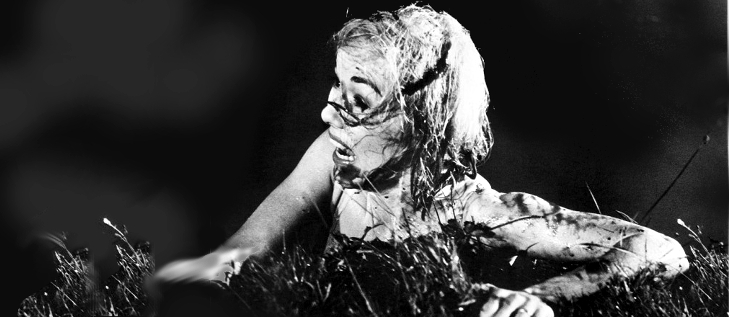
The locations equal those of any studio picture. The large stone house representing the Haloran spread has all manner of exploitable dank corridors and atmospheric architecture. Cinematographer Charles Hannawalt’s camera work is excellent — he was a key grip on many Corman pictures but this is his only credit as Director of Photography. Coppola’s main effort is directed at depicting the work of a mystery killer without giving away the secret of his identity. His key horror scene is a real keeper, a gruesome axe slaying that comes out of nowhere. One brief but eerie shot shows the beautiful victim dragged through the mud and grass on a dark, dank night — an image as expressive as moments in Kaneto Shindo’s Onibaba, made a couple years later.

Although the film hasn’t the body count of a giallo thriller what we see is choice. A child’s wind-up monkey toy swings an axe, an excellent foretaste of things to come. Coppola delivers a couple of drive-in-approved makeout scenes between Kane and Richard Haloran, including one in a hayloft right after their wedding. And what exotic horror attraction would be complete without at least one scene with the imperiled heroine wandering the creepy mansion in a flimsy nightgown?
Mary Mitchel and the always malevolent Patrick Magee give standout performances, while Luana Anders offers several good moments perfecting her sly ‘I don’t know where my husband is’ charade. For his flashbacks to the fatal childhood accident Coppola places diffusion filters over the camera lens, perhaps aiming to echo the eerie mood of Jack Clayton’s The Innocents. The writer-director’s dialogue scenes aren’t dull and his scary moments deliver some impressive shocks. Dementia 13 is a feature debut to be proud of.
When Francis later needed stock footage he considered Dementia 13 open season. Along with shots from Corman’s The Pit and the Pendulum Coppola’s You’re a Big Boy Now repurposes this film’s axe murder as a movie being watched by Elizabeth Hartman’s naughty schoolgirl, the one who terrorizes an ‘albino hypnotherapist with a wooden leg.’ That was Francis’s non-PC period.
Here’s Mick Garris on Dementia 13:


