
![Viavision [Imprint]](https://cinesavant.com/wp-content/uploads/2020/08/6350viavision0820.png)
Just when did the general run of fantasy fans become aware of Mario Bava and Dino De Laurentiis’ Danger Diabolik? I think it wasn’t until the near-simultaneous breakout of the Internet and DVD, which made film culture news easy to disseminate and the films themselves more easily seen. In the decades previous almost the only way to discover new and exotic films was to participate in some kind of academic film culture. Remember the proliferation of mimeographed fanzines? The interest was there, big-time.
Alain Silver and James Ursini’s 1970s writings on Mario Bava in the long gone but much appreciated magazine Photon put down for the first time in English many revelations about Bava’s style and directorial approach. But those seminal genre writers stuck to Bava’s gothic horrors, skipping this futuristic comic book romp in the maestro’s filmography. Diabolik initially breezed through U.S. theaters in 1968 as a minor release, hitting few small markets and more or less remaining invisible. I first heard about it through John Baxter’s 1970 book Science Fiction in the Cinema, and caught it by accident at a midnight screening in Santa Monica in 1972 or so. It was Paramount’s studio print and the music and the color completely blew us away.

So I guess I was hooked. In three years at UCLA I must have rented Film Incorporated’s slightly edited version three times, foisting it on (appreciative) ‘dormie’ audiences. Much later, when Greg Jein showed me fliers advertising collectors’ prints, I ended up buying a 16mm print, and then swapping it for another of slightly better quality.
I spread the word about the film as best I could. It was perhaps 1995 when a cheap VHS and a laserdisc appeared, with an altered soundtrack ( ←). In my first (1998) ‘MGM Video Savant’ appreciation of Diabolik I explained that a number of voices had been replaced for the laserdisc.

All that was corrected in 2005 with Paramount’s DVD produced by Kim Aubrey at Zoetrope (→). Just this year, a domestic Blu-ray fixed the last complaint on CineSavant’s gripe list — the relative volume of Ennio Morricone’s sensational music score was raised to its proper high level. Those great cues now function like Morricone’s music for Sergio Leone: when the music plays, it stands out front and center.
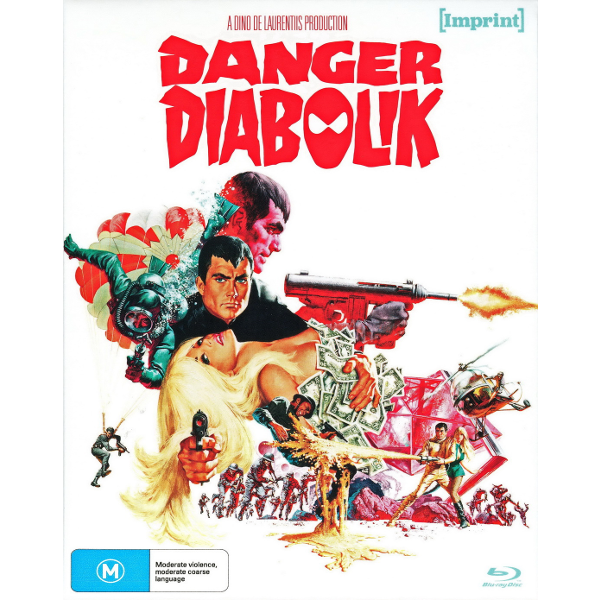
So, since I’ve reviewed Danger: Diabolik two or three times already, this time instead of covering the same ground, let me link new readers to my review of the U.S. disc from April of this Year. It has some pretty pictures, too.
I will repeat one excerpt from the April review because it commemorates the way we ex-film students would run into celebrities and actors here and there, in editing rooms, drugstores, at Pink’s Hot Dogs on La Brea, and sometimes recognize them and say an appreciative ‘hi.’ Some of those memories are real highlights.
This particular story is second-hand: my friends Steven Nielson and Wayne Schmidt spent the summer of 1981 in Salt Lake City editing some horror movies for Philip Yordan. One of the pictures starred John Philip Law, who was around Yordan’s editing shop quite a bit. One day Law passed Steve & Wayne’s editing room and did a double take when he saw the Danger: Diabolik poster that Steve had pinned to the wall. Wayne remembers that Law shouted, “Great!” and stopped by to talk. He was jazzed that his movie was remembered and liked. Either that, or like-minded film nuts were few and far between in Salt Lake City. Just as in the commentary, Law praised Mario Bava’s camera genius. Wayne remembers that Law told them:
“On the first day, Bava called me over and
said, ‘I’m a dog with actors. You’re on your own.’”
When the subject changed to The Golden Voyage of Sinbad, Law became self-effacing:
“Oh, you have to play that kind of role big.
Otherwise nothing happens on screen but
a bunch of guys
standing around, whining, ‘What do ya wanna do now, Sinbad?’”


