


By the early 1970s the Good Ship Hammer Films had definitely lost their compass and rudder. Nothing went their way, starting with the general disinvestment of U.S. studios in U.K. pictures. But what remained of the old Hammer magic was also fading fast. No longer the front-runner in startling, daring horror, their pictures now looked cheap and out of step with the times. Attempts to go ‘mod’ or add R-rated nudity didn’t compensate for the lack of fresh subject matter.
We’re told that the biggest success of Hammer’s Hollywood co-productions had been One Million Years B.C., which combined breathtaking Canary Islands scenery with Ray Harryhausen dinosaurs, and helped make a star of Raquel Welch. The Fox release surpassed the good box office of the previous year’s She with Ursula Andress. The follow-up When Dinosaurs Ruled the Earth reportedly did okay. Director Val Guest complained that Hammer’s Aida Young re-edited the show, and the Jim Danforth effects took longer than the studio wanted — but they’re some of the best non-Harryhausen stop-motion work ever done.

To stretch their production funds Hammer recycled sets and costumes from One Million and filmed Prehistoric Women aka Slave Girls. Despite the presence of Martine Beswick, the show about an Amazon tribe and its rhinoceros god is near unwatchable. Michael Carreras wrote and produced One Million, Slave Girls and a fourth prehistoric adventure, the ill-fated 1971 Creatures the World Forgot. It turned out to be Hammer’s final co-production with Columbia Pictures. The long-running team-up had produced some of the studio’s most interesting features, ever since 1958 and The Camp on Blood Island.
Creatures the World Forgot came at at time when Hammer was making plenty of product but having difficulty selling anything without Christopher Lee as Dracula. Producer Aida Young had been associated with the first three prehistoric pictures and was full producer on When Dinosaurs, but is absent for Creatures, which seems to have been produced as an afterthought. Producer Michael Carreras must have found bargain rates to film in Namibia, and gave the competent director Don Chaffey (The Three Lives of Thomasina, Jason and the Argonauts) a free hand with a small crew. Cameraman Vincent Cox appears to have been a South African pickup, and some of the cast of relative unknowns were likely South African as well. Creature shapes up as a runaway production of the kind that Harry Allan Towers had been making, using the tax credits offered by whatever country was desperate to stimulate production.

Director Chaffey may have happy to film Creatures without dinosaurs. After the successful One Million Years B.C., he likely wasn’t excited to yet again watch all the attention go to a special effects wizard. Directing out in the wild with a game crew, far away from studio interference, might allow Chaffey to discover something different,something good. He could build on those ‘Dawn of Man’ scenes in 2001: A Space Odyssey, perhaps.
All we film fans wanted to know about was the dinosaurs. The storyline of When Dinosaurs Ruled the Earth held our attention less than the sexy bikinis worn by Victoria Vetri’s cavewoman crew. But every dinosaur sequence was greeted with total approval. The 1970s was the apex of Ray Harryhausen worship, and we were anxious to see more stop-motion magic. That’s why small-scale pictures like Laserblast, The Crater Lake Monster and The Day Time Ended took the trouble to include stop-motion monsters.
Creatures the World Forgot’s bad reputation begins with its title, which leads one to expect some kind of monster action. The project was in development while Hammer rejected other stop-motion projects, surely because of the money and time factor — studios have never shown patience with drawn-out post production schedules, waiting for effects to be done. An early production painting featured regulation Hammer nude cavewomen, but also an intriguing human skull with three eye sockets, conjuring notions about a supernatural element . . . Cthulu the World Forgot?

The final film sticks to a straight caveman-on-caveman conflict. The least interesting parts of the earlier shows were scenes of cave tribes sorting out internal leadership problems — who gets to play Alpha male with the sexiest mate?, etc. That’s the entire content of Creature. A bit of possible sorcery is thrown in. There is no real dialogue, not even the six-word vocabulary of the previous films.
The storyline is a real muddle. A ragged, foraging tribe of very modern-looking humans struggles to catch enough game to eat. They steal women from another tribe. One man dies, wounded by an animal in a hunt, and his ceremonial tooth necklace is given to his widow and children. Individuals form loyalties and special relationships, but those are often interrupted by violence.

The entire first forty minutes establish the prehistoric world without a strong character conflict. THEN twin boys are born, who grow up to engage in a last-act duel for leadership of the tribe. Blonde Raquel Welch substitute Julie Ege is Nala, the main interest of Toomak (Tony Bonner), the ‘Fair’ twin who also has primitive notions of fair play. The ‘Dark’ twin Rool (Robin John) is a predictable bad boy, a brute who cheats and treats ‘The Dumb Girl’ (Marcia Fox) poorly.
Julie Ege’s brunette got top billing and the bulk of Hammer’s promotion, mostly in girlie photo shoots showing her in and out of her revealing costume. ↙ But her character doesn’t even show up until the second half of the movie. As pointed out in the audio commentary, ‘The Dumb Girl’ Marcia Fox has more screen time and a marginally more interesting part to play. She’s also given the blonde hairdo. ↑

The capable actress Rosalie Crutchley ↓ must have been an adventurous trouper. She plays ‘The Old Crone,’ performing bits of primitive rituals and offering her approval for big tribal decisions. It doesn’t bode well for a drama when characters are listed only with names like ‘The Dumb Girl’ and ‘The Old Crone.’ Goodness is indicated by being named ‘Fair’ or ‘Dark.’
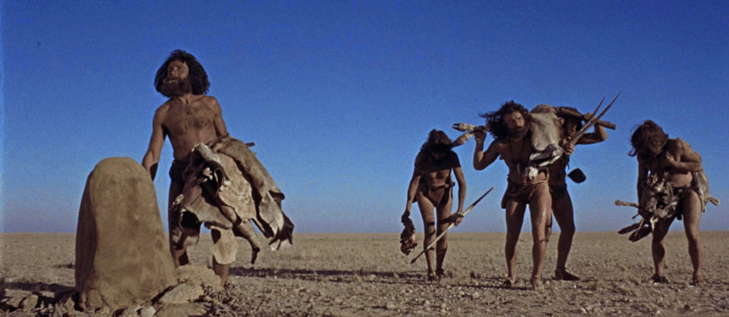
Some scenes of killing and eating animals are unpleasantly graphic and gruesome — only a little less off-putting than the post-apocalyptic Czech feature The End of August at the Hotel Ozone. 90% of the film follows a raggedy pack of nomads stalking around the desert, exposed to the elements. We soon feel concern for the actors, forced to work in the blazing sun. Was physical stamina a factor in hiring actors? Performing in the wild in little more than a loincloth had to result in myriad scratches, bruises, sores, not to mention serious sun ailments. Almost everyone is constantly climbing, running and jumping among jagged rocks. So hats off, as they say.

Unlike the rigorously designed One Million and When Dinosaurs, with their standard camerawork and formal compositions, Creatures has a ’70s look with a lot of hand-held camerawork and a constant reliance on a zoom lens. No sunset can pass without a dramatic ZOOM. The filmmakers exploit the strange stone formations on the Namib Desert, enormous wind-rounded boulders that seem precariously balanced.
Don Chaffey’s camera angles are quite good for action scenes; elsewhere we tire of seeing grimy sunburned faces shoved in the lens, rape attempts in the dirt, and dining details featuring whatever shreds of raw animal gore are being carved up. Whether by design or budget, Chaffey abandons the previous pictures’ attempts at caveman glamour. The young women still manage shampoo hairstyles, but nobody attempts to match Ms. Welch’s iconic ready-for-the-cover-of-Vogue cavegirl impact, nor Ms. Vetri’s fold-out appeal in a gravity-defying fur bikini. Creatures has much more actual skin, but without Hammer’s girlie-show approach. Some original posters give the film a GP rating (the original PG), possibly because the incidental bits of nudity are not directly associated with sex.
Augmenting the spectacle-challenged Creatures are a dozen or so volcano special effects shots lifted from One Million Years, B.C., with cavemen falling into lava-filled cravasses opened up by the eruption. Like so much in the show, it feels like filler for a 95-minute movie that had enough story for perhaps an hour.


Vincent Cox was one of South Africa’s foremost cinematographers and the second South African to win the ASC award: he was hardly a South African pickup!