

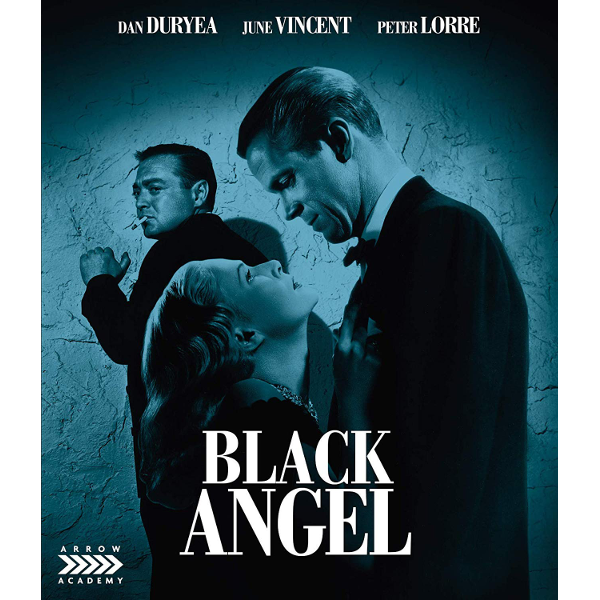

The many movies made from Cornell Woolrich’s novels and stories can be a chore to sort out — he used other names for some of his books, and so many of the titles were changed that one needs a reference to see which film came from which story. The remarkable noir Black Angel is an exception that credits Woolrich and uses his original title, just dropping a ‘The’ up front. By 1946 a ‘fad’ for hardboiled, pessimistic crime stories had finally morphed into a popular film style, with thrillers that experimented with visuals, tone and story structure. At first glance Black Angel’s story may seem rather generic, but revisiting it on Arrow’s Blu-ray reminds us of how superior a Woolrich adaptation it is. It’s a narrative masterpiece compared to the same year’s The Chase, a confused and compromised tale of amnesia and murder that barely makes sense. Black Angel is much more satisfying.

The show at first seems a permutation of another Woolrich tale. 1944’s Phantom Lady uses the same story basis of a woman racing to clear a man of a murder charge before he’s executed in the gas chamber. The two films immediately diverge. This time around the man is a philandering husband, a minor character. The leading role is not the wife but the husband of the murder victim. The film is rich in character and in associations with its author, and it’s directed with uncommon style and taste by Roy William Neill, who is now known mostly as a genre specialist. The extras on Arrow’s disc include an Alan K. Rode commentary that offers in-depth backstories about the cast and crew.
Role-typed as a cowardly, woman-hating villain, star Dan Duryea plays Martin Blair, a songwriter with a serious drinking problem. Martin has an alibi for the murder of his ritzy estranged wife Mavis Marlowe (Constance Dowling of GOG), because his caretaker-friend Joe (Wallace Ford) had locked him in his room to dry out from a drunk. Police Captain Flood (Broderick Crawford) instead pins the murder on Kirk Bennett (John Phillips), a philandering husband. Martin was turned away from Mavis’s apartment by the doorman, but both Kirk and the shady nightclub owner Marko (Peter Lorre) were admitted to her rooms on the night she was murdered. When Kirk is sentenced to die, his wife Catherine (June Vincent) enlists Martin in trying to find the real killer. Attracted to Catherine and impressed by her loyalty to her husband, Martin joins with her to audition as a singer-piano team at Marko’s nightclub. They hope to find out if Marko has a missing brooch associated with Mavis’s slaying.

Everything about Black Angel bespeaks extra effort to do a good job. Duryea reportedly learned to play the piano for the musical sequences, and June Vincent does her own singing. It’s a special assignment for both — Vincent makes her one starring appearance in a solid vehicle, and Duryea gets a chance to play a positive, warm character. Director Neill and cameraman Paul Ivano’s expressive visuals emphasize fluid trucking shots and creative camera angles, and include some impressive directorial touches. With the help of optical whiz David S. Horsley, the camera swoops up from street level to peer into a window in a tall building. An entire memory reveal flashback is processed with a ‘wavy distortion’ optical, giving the impression of an indistinct dream.
There’s even a startling substitution of actresses at one point, a brief subjective accent similar to effects in Roger Corman’s stylish horror film Tomb of Ligeia. The improved HD image really helps in the appreciation of these details.

The film’s surprise finish was fresh in 1946, although it soon became a gimmick — I believe Humphrey Bogart undergoes the same self-realization character arc in 1945’s Conflict… or was it The Two Mrs. Carrolls? The twist works in Black Angel because it retains the overall alienation and disorientation of the Cornell Woolrich original. The mystery author was noted for unexpected narrative digressions that may or may not have a bearing on the story’s outcome. The characters here are so interesting that we don’t care that a good half-hour is spent pursuing a thread that doesn’t pan out.


Readers aware of Woolrich’s chaotic personal life easily equate him with Dan Duryea’s Martin Blair as an artist with an acute drinking problem, who doesn’t play well with others. Blair may be Duryea’s most sensitive role, and he generates much more sympathy here than his other noirs. Blair’s cautious, delicate relationship with June Vincent’s Catherine is more subtle than we expect for a ‘gimmicky’ noir potboiler, and the way their musical teaming affects their feelings is completely credible. The story remains resolutely noir, however. On some level Martin seems aware that his relationship with Catherine isn’t going to work out, that the ultimate outcome is pre-set, and unavoidable.
Viewers will make note of June Vincent’s off-the-shoulder dress, which is distractingly low-cut for something approved by the Production Code (top image). Critics like to play up the supposedly homoerotic tension between Peter Lorre’s Marko and his aide and bouncer, Lucky (ex boxer Freddie Steele). Lorre performs his entire role with a cigarette dangling from his mouth, a feat admired by actors that have enough trouble saying their lines without such impediments. Marko is meant to dominate the confrontations in the club and its swanky office, but the screenplay doesn’t let him steal too many scenes. Unlike the overly stylized nightclubs in so many noirs, Marko’s Rio Club is a practical place, even with its regulation office commanding a view of the Sunset Strip.
Black Angel stays tight with the characters and avoids big emotional scenes, adding to its credibility factor. It’s one noir that relies on relationships and not violence to keep the story moving. Top moments include Martin and Catherine’s audition, a revelation at Marko’s safe, and Martin’s complex reaction when he finally solves the mystery, in a way that gives him no satisfaction whatsoever. Not all of Martin Blair’s love songs point to a bad ending, but his tune ‘Heartbreak’ fits the movie well. Nobody talks about fate but everything in Martin’s life has prepared him to accept bad news.
