

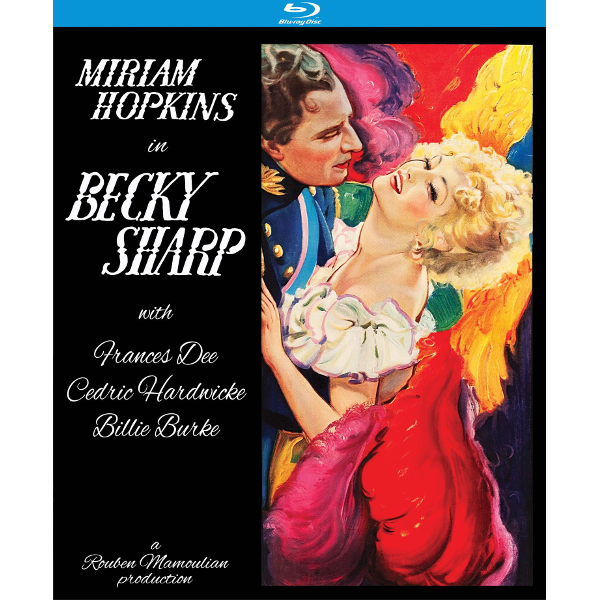

(Note: the illustrations seen here do not reflect the image quality of Kino Lorber’s Blu-ray.)

Becky Sharp is a definite milestone movie, the kind that shouldn’t be allowed to fade away. Only a few years after it was made, the little company that produced it sold it off to a second-tier distributor, who cut it down and made prints in the two-color Cinecolor system. I was happy to see Bob Epstein’s name in the restoration credits for this new disc presentation. Bob was a favorite instructor at the UCLA Film School, an associate professor who split undergraduate screening classes with ex-director David Bradley. He also ran the UCLA Film Archive while I was there, and through him we ‘participated’ in the restoration of Sunrise and It’s a Wonderful Life. We were told that the industrious, little-seen Robert Gitt was working on Becky Sharp as well, but that the title was plagued with difficulties. The work apparently went on for decades. A part-restoration was premiered around 1984, but not until 2016 did the truly attractive, screenable version we now have come to be.
All that a short version of this review would need to do is refer readers to a UCLA restoration demo viewable online. But the review format gives me the opportunity to go further into the issue of preserving all of film history that we can. Hollywood is finally building a gigantic film museum down on Wilshire Blvd’s Miracle Mile; I’ll be curious to see exactly whose history it will tell, from what POV. Right now the main memory minders Turner Classic Movies are keeping ‘those old movies’ alive, a very good thing indeed even with TCM’s growing corporate mentality. In practical terms film itself is becoming extinct for exhibition. ‘Going to a show’ to take in movie entertainment with a large audience is no longer the norm, when most people would rather stay home and binge-watch. And some people say that the advent of new interactive entertainment formats will eventually make ‘the movies’ obsolete.

That’s why it’s amazing to see the loving care applied to film restoration work in the last twenty years. They’ve even done work on the unwieldy three-panel Cinerama features. Most films in that format hadn’t been screened since the 1960s, and nobody under sixty knows what the original experience was like. In 1989, Robert Harris’ massive restoration of Lawrence of Arabia reminded us how amazing were films shot in 70mm. IMAX is certainly impressive, but it is not quite the same. The last time I was floored by a demonstration of Giant Screen Wonder was a 70mm screening of Ryan’s Daughter. All those beautiful shots of extreme weather — you’d think God was the director of photography.
Becky Sharp isn’t quite the same experience. The kinks weren’t quite worked out of the still-experimental Technicolor system. Rouben Mamoulian’s show got mixed reviews, even if most notices gushed to report that a new future of color movies had finally arrived. 3-strip Technicolor could finally present a full range of hues, but the process made filming much more difficult. A bigger, more complex camera had to be tuned much more precisely and monitored by a specially trained crew. It was heavy and noisy, and when blimped for sound needed a heavy-duty dolly. It required much more light, and giant arcs were used on the set. Some crew wore dark glasses and actors’ eyes were literally burned. Actors can be seen sweating under the light.

The older two-color Technicolor was falling from popularity even as sound came in, and it wasn’t until 1933-34 that 3-strip experiments showed up. At UCLA Bob Epstein screened for us an original nitrate print of the Technicolor finale of The House of Rothschild, which was definitely in color but not exactly overwhelming. Then there was La Cucaracha, an extended Mexican flavored musical short subject that ‘Pioneer Pictures Corporation’ produced to raise money. To us the color went beyond lush, into garish. Backgrounds are so busy with color that they fight for attention with the performers. The singers’ makeup is overdone, almost like thick greasepaint for a circus. The idea must have been that faces had to be unnaturally painted to benefit the Technicolor palette. Some work would have to be done, or a new standard of taste established.
Becky Sharp begins with a group of characters bustling at a girl’s school sometime in the early 1800s. Unless we just became accustomed to the overdone makeup, it looks that they pulled back a bit as shooting went on; the faces in the first reel do indeed look like an unattributed critical description on the IMDB — with skin tones ‘resembling over-boiled lobsters in mayonnaise.’

The show opens with a dull blue curtain parting to reveal a full-color scene behind, a sort of precursor to the big curtain reveal of Cinerama eighteen years later — an endeavor produced by the principals of Pioneer Pictures. Becky Sharp is all interiors on fairly large sets and a much bigger ballroom set, all bathed in a blast of high-key light that likely melted makeup and wilted flowers in a matter of minutes. The art directors do their best, and Miriam Hopkins is given a big selection of dresses displaying a variety of subtle hues and interesting color contrasts. But the bright red military costumes overpower some scenes anyway. It was clear that a new kind of art director would be needed, probably checking and re-checking each set, each costume, each hairstyle by shooting color stills (Kodachrome film first became available in 1935).

Who was paying attention to the story? Thackeray’s novel Vanity Fair was filtered through Langdon Mitchell’s 1899 play, which toned down some of heroine Becky Sharp’s extreme behaviors. It’s still a rather muted story of a social climber whose luck mostly runs bad in the years of the Napoleonic Wars. Thanks to her loyal girlfriend Amelia Sedley (Frances Dee), Becky keeps a number of men wrapped around her finger, including Amelia’s own husband. But the ones she connects with all turn out to be losers. Amelia’s overweight brother Joseph (Nigel Bruce) is a fool and coward, who can’t hold on to money. The more substantial Rawdon Crawley (played by the un-romantic Alan Mowbray) marries Becky, fumbles his inheritance and gets in trouble with both the law and the powerful Marquis of Steyne (Cedric Hardwicke), who also sees through some of Becky’s schemes. Having missed the brass ring several times, Becky finally ends up broke, and connives to cheat some relatives out of money.
The classic book was a satire about the pursuit of money and position in a corrupt society, with unsubtle name choices suggesting character traits. Becky is ‘sharp,’ while an obnoxious society woman goes by the name Lady Bareacres (Billie Burke). Other family names sound like ‘crawl’ or ‘stain.’ The Cliffs Notes’ take on Vanity Fair characterizes it as modern in the sense that foolish and selfish people are rewarded or punished for their deeds, without a traditional moral or religious sermon attached. The movie distills this attitude into a flippant gesture Becky aims at a schoolmistress who disapproves of her uppity nature. She tosses back a book she’s just been gifted, with a sarcastic “Words are but little thanks!” A repeat of this verbal kiss-off to decent society serves as her her exit line for the finale.

The movie is now very watchable but still imperfect. Two or three reels survived only in the two-color Cinecolor simplification. With the blue register missing, blues turn black, even with color manipulation to make things match. At the very end no good material seems to have survived, so the quality drops radically for a minute or so. Elsewhere the restorers have attempted to replicate the look of original Technicolor prints, rather than modify or improve the color — doing so would spoil what is primarily a historical restoration. I know color fans that write me every year to ask if Warners is re-transferring the two-color Mystery of the Wax Museum — when the company transferred a surviving print thirty years ago, the colorists tweaked everything to ‘improve’ the color, losing the film’s original look.
Entire books exist detailing the history and processes of Technicolor, so we won’t get too technical for fear of overstepping our base of knowledge — I have many thoughtful readers to correct me. But I have seen original prints of a number of Technicolor pictures made between 1937 and 1939 — Garden of Allah, A Star is Born, Nothing Sacred. By the time of The Adventures of Tom Sawyer the process had been greatly refined. Gone With the Wind remains an overpoweringly impressive demonstration of Technicolor fully utilized.
In a nice gesture, the print on this new disc includes two sets of restoration credits, to also commemorate the team that that worked so hard back in the 1980s, when film restoration was in its infancy.

They did use greasepaint for the film; that was the industry standard, but the lighting requirements made the actors’ faces reflect the environment too much so they looked very red.