

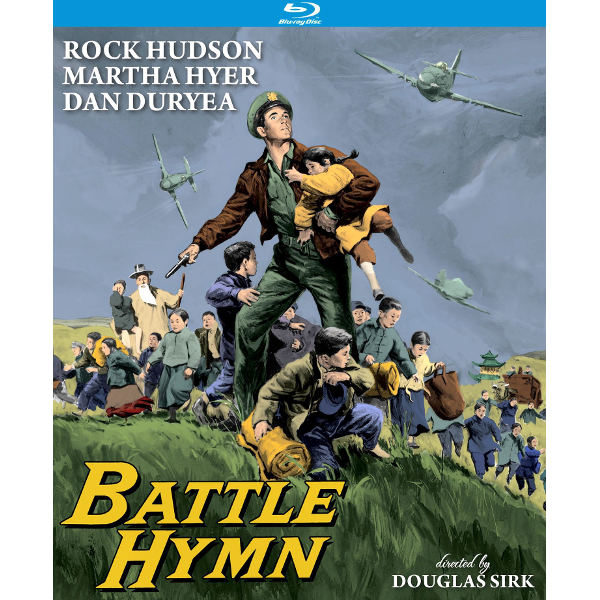

To what degree can we trust director interviews? Douglas Sirk had a pretty amazing career in theater and art before he became a filmmaker, first in Germany and then the U.S.. I’ve read articles that assert that when Sirk was given a project with a faith-based theme — The First Legion, Thunder on the Hill, Magnificent Obsession — he quietly subverted their content, using his visual skill to undermine the heavy-handed religious themes. Sirk’s status as a cultural subversive was once the fallback interpretation for his overheated soap opera films as well, expanding the problems of Barbara Stanwyck, Jane Wyman etc., to massive dramatic proportions. Reading Sirk’s own words, it seems more accurate that he liked those themes, believed in them and even asked for them. He welcomed the chance to film Battle Hymn, a project led by his main man at Universal Ross Hunter. Sirk wanted to get out of the studio to film an aerial epic with those shiny P-51 fighter planes. But he was also fascinated by the reverend-pilot-author Dean Hess, seemingly in the same way that director John Huston was intrigued by war hero-turned actor Audie Murphy. Hess was a man of contradictions, known in WWII as ‘Killer Hess’ and later on as a savior of children.
Colonel Hess was involved in the relocation of hundred of Korean orphans to an institution he helped found on the Korean Cheju-do (now Jeju) island. He published a spiritually-inspired autobiography in 1956, which was immediately snapped up for filming. Hollywood was on a big recruiting and PR push for the armed services in the 1950s. MGM signed up James Stewart to play Carbine Williams, about a moonshiner convict who invented the M-1 rifle. Warners made The McConnell Story, a CinemaScope biography of Captain Joseph McConnell, the top air ace of the Korean War. Like McConnell, Sirk’s Battle Hymn has a prologue in which a general addresses the audience. Hollywood’s biggest USAF recruitment epic was likely Strategic Air Command, which wasn’t biographical but starred Air Force officer James Stewart, doing his thing for personnel retention.
Colonel Dean Hess was somewhat a different case — being both a preacher and a self-promoter, he wasn’t the Alvin York type that wanted no part of fame. Hess was much later accused of stealing the credit for the noted ‘Kiddy Kar Airlift’ that evacuated almost a thousand orphans from the path of advancing Red forces. Hess reportedly donated the profits from his book to the orphanage and continued to promote it.

Douglas Sirk said that he wanted to further fictionalize the movie version of Battle Hymn but Colonel Hess wouldn’t permit it. As it is almost everything in the movie is made up along the same lines as a Hollywood musical biography. Sirk’s Magnificent Obsession certainly impressed Universal, Ross Hunter and filmmaker Sirk with the profit potential in gaudy inspirational melodramas. Battle Hymn brought in a war theme as well, and would surely be the ultimate feel-good faith-based movie. What could be more inspirational than a ‘killer pilot’ who both shoots Communist enemies and saves little children?
Charles Grayson and Vincent B. Evans’ screenplay makes Hess’ story fit the inspirational mold. After the war, former fighter pilot Dean Hess (Rock Hudson) decides to quit preaching because he can’t shake his guilt for accidentally bombing a German orphanage in 1945. Hess takes leave of his wife Mary (Martha Hyer) and re-enlists in the Air Force to train South Korean pilots on-site in Korea. While getting a disused air strip into shape he takes an interest in the Korean refugee orphans that wander into camp for handouts. When a North Korean saboteur uses the kids for cover, Hess has to get them off base, so he enlists the beautiful En Soo Yang (Anna Kashfi) and the wise old Lun-Wa (Philip Ahn) to found an orphanage. Hess’s top Sargent Herman (Dan Duryea) ‘scrounges’ Navy supplies for the kids. Hess visits often. The kids love him and Lun-Wa offers nuggets of wisdom, but En Soon Yang is disappointed to learn that Dean is married.

The training unit is told to avoid combat so as not to lose planes, but Dean’s old buddy Captain Skidmore (Don DeFore) breaks that rule and attacks an enemy column. Lt. Maples (James Edwards) unfortunately repeats Hess’s error by strafing a truck carrying civilian children. Hess doesn’t preach — he even avoids saying grace — but he provides an uplifting example for all. After Hess helps Maples deal with his guilt, he himself is traumatized when he must shoot down an enemy plane to save a buddy.
On the day he is to be transferred Col. Hess discovers that Red troops will overrun his airfield and the little orphanage. When efforts to find transport fail, he joins En Soo Yang and En-La in evacuating the orphans, hoping that his superiors will come to the rescue.
Depending on the viewer Battle Hymn is either mildly diverting or an insult to the intelligence. Critics of the 1950s couldn’t risk calling this kind of film spiritually bogus; even Bosley Crowther limited his review pan to charges of terminal cliché corniness. When confronted with his crisis of conscience, Hess blocks out his wife and climbs a high, photogenic hill to seek an answer from God. You know, like Alvin York. Col. Hess’s superiors come to the rescue with a score of cargo planes. Of course it was a great thing to do, but the USAF also accepts a halo for generous philanthropy (in CinemaScope and Technicolor).
Sirk’s film often plays like a satire of stories that warp reality to serve faith-based aims. The awfulness of war is reduced to simple formulas: when Americans kill civilians it’s always ‘accidental.’ Our wonderful soldiers are men of conscience who must wrack their souls to reconcile themselves with their deeds. Dean Hess took part in WW2 fighter-bomber campaigns, as shown in the rather bloodthirsty William Wyler/John Sturges film Thunderbolt. That documentary doesn’t pussyfoot around the nature of the search-and-destroy missions. To use up ammo on the way home, the planes shoot at any target opportunity available, even civilian farmers. The bombing of the German orphanage in Battle Hymn is presented as a tragic fluke, sidestepping the fact that bombing campaigns couldn’t always be precise.
Forget mistakes. WWII’s strategic bombing often targeted cities, statistically measuring the effect of different bombing strategies. It’s obvious that Hess is not personally responsible. He’s traumatized by his personal moral deficit, when his colleagues are incinerating big chunks of German and Japanese cities? The ugliness of Battle Hymn is its refusal to acknowledge the necessary barbarity of war, even when fought by the ‘good’ side. It’s the American Denial Machine: the fantasy must be perpetuated that our warfare is humane, a cultural hypocrisy that goes way beyond movie entertainments.

But this is Hollywood moviemaking so it’s all so personal for Col. Hess. By re-writing him to be a plaster saint, Battle Hymn turns a complex man into an unpleasant public relations hero. In spiriting hundreds of Korean children from danger, Hess cleanses himself of the curse of killing 37 German children. There’s no denying that the movie’s visuals dramatize this well. Douglas Sirk maximizes the conflict with his typical brilliance — his key shot is a low angle of a mob of tykes running like the Dickens for the haven of a row of Skymaster cargo planes, angel transports sent from heaven. The dynamic shot is an instant Reynold Brown painting — it’s impossible not to be emotionally captivated.
The storytelling choices Sirk uses elsewhere are jaw-droppingly unsubtle. The presence of a stained glass window lets cameraman Russell Metty frame preacher Hess in a rainbow of color, a halo of piety. Preacher Dean Hess just announces to his wife Mary that he’s gotta go fight, leaving her in the lurch. She has no problem with this, as if she secretly knows Dean can walk on water and then turn the water into wine. About halfway into the movie she reveals that she’s pregnant, so I guess we can agree that Dean hasn’t been gone more than nine months.

Battle Hymn received good marks for sensitivity to the Koreans, but it’s still exceedingly condescending. Anna Kashfi’s presumably destitute but beautifully attired and utterly gorgeous En Soon Yang is still a ‘China Doll’ character who quietly lusts after the handsome, gentle American. She thinks that she and Col. Dean have a destiny together until he blurts out ‘My wife and I are having a baby!’ Rather than declare herself, En Soon Yang relates the tale of two trees that intertwine in perfect harmony, a come-on line if there ever was one. Hess ignores it. He’s too virtuously focused on saving the orfinks. In filmic terms, this mainly means hugging one or two ‘special’ kids every time he drops by, flashing his disarmingly sincere smile.
En Soo Yang falls prey to the unacknowledged Production Code dictate regarding mixed-race relationships. It’s 1957 but the axiom still stands: if a Yankee falls in love with a woman of a different race, it’s curtains for one or both of them, usually the woman. Having our flawless Col. Hess be married is even more of a guarantee of a bittersweet finish to the compartmentalized En Soon Yang subplot. Dean Hess’s virtue is upheld yet the audience gets its quota of quasi-romantic meetings and a sad farewell that says ‘romance.’
Philip Ahn’s casting would win the approval of activists that insist that every Asian character be played by an actor of the correct ethnicity. He’s Korean-American and a very good performer. Ahn’s Lu-Ahn is a mostly inoffensive example of the ‘magic Asian’ who has a handy aphorism for every problem. He even intuits the White Hero’s romantic issues. Ahn looks great in his traditional costume too — his Lu-Ahn keeps saying goodbye but keeps showing up to help out those little orphans. *

Unlike the reality of war (or violence of any kind), death in Battle Hymn is always inspirational, poetically appropriate and morally instructive. Co. Hess holds a buddy in his arms while he dies. Lt. Maples can’t deal with his refugee-killing mistake, although it’s absolutely not his fault. In the most irrational bit of aerial combat ever filmed, a dogfight seems to take a pause while Col. Hess forces himself to break his promise and shoot down an enemy fighter plane — ‘only to save another flier,’ mind you. This movie invention has nothing to do with the real Hess, who had a very honorable combat flying record.
The thought that any pro pilot would go into combat with a plane loaded with bullets and then balk at shooting them, is total screaming BS. Hess’s outfit massacres enemies by the score in their convoy attacks, but Hess draws the line at pulling the trigger himself? The Bind Moggles, as we used to say.
Nobody expects a 1957 movie about Korea to cut through the moral issues of ‘killing for peace’ and ‘fighting for the Lord.’ To its credit Battle Hymn never plays the card of ‘praying for permission to kill’ that crops up now and then in movies both good and bad. The movie doesn’t even make a direct Christian statement — Hess never preaches at anybody. Sirk is more interested in effective storytelling symmetry. He bookends his movie with orphanages — one blown to bits, and another established to take care of dispossessed refugees. We learn that a whole bunch of orphans from Jeju Island were shipped here to make the movie, all the way to Arizona. We don’t know the details — were they paid? Did the studio contribute to the orphanage? Who transported the children, Universal or the USAF? I’d hate to think that that they were imported to avoid the cost of hiring American children. Out in Arizona, Hollywood filming rules for the protection of minors might not even apply.
(What makes me so suspicious about this?)

One very good reason to see Sirk’s movie is to admire the flying scenes. The Texan Air National Guard maintained a wing of P-51 aircraft, that Sirk’s experts direct in well-planned, photogenic action. There’s much more good air combat here than in other Korean War movies, most of which concentrate on jet fighters. The crystal clear aerial photography is just as well designed as Sirk’s live-action — even though we’re told that Sirk broke his ankle and was in a wheelchair for much of the film.
Dan Duryea does yeoman’s work lightening up the story — he flashes a wickedly mischievous look when swiping candy and bubble gum from a Navy supply depot. Don DeFore’s Captain Skidmore gets to call the hero ‘Killer Hess’ for his record back in Germany. This is not a terrific role for DeFore (but he’s GREAT in a western called Ramrod, check it out). James Edwards gets a fully realized character to play for once, free of ‘racial exceptionalism.’ Jock Mahoney and Alan Hale Jr. are more or less along for the ride, as is second-billed Martha Hyer. The great James Hong plays a Korean Major but gives the part a good one-of-the-boys USAF spirit, without a heavy accent.
Hong goes un-billed, but the Korean orphan Jung’ Kyoo Pyo, a chubby little tyke who does a great cute act, is credited on screen. According to the AFI catalogue, an issue of Life published around the time of the film’s premiere featured a story about the adoption of the cute little guy by an American couple, Harold and Terry Friar.


