
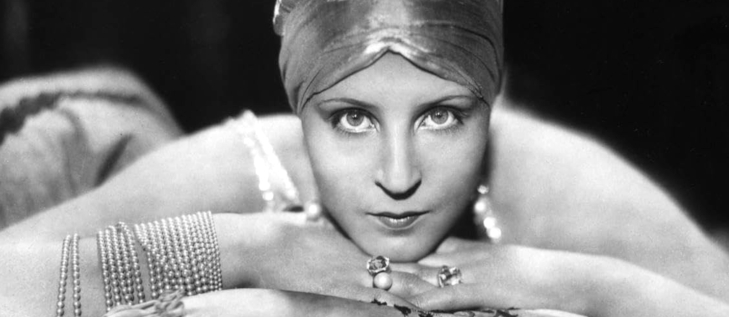


Here’s an unexpected treat straight from the Munich Filmmuseum — two silent classics of German Expressionism. Alraune (1927) and The Student of Prague (1926) are masterpieces by writer-director Henrik Galeen, the writer of F. W. Murnau’s original Nosferatu and Paul Leni’s Waxworks. He’s often listed as the author of the 1920 classic The Golem, but authority Stephan Drössler refutes that claim in this disc’s extras.
We’re told that the talented Galeen started as a journalist and for a time worked for the highly controversial Hanns Heinz Ewers, whose novels provided the story basis for both of Galeen films presented here. he then wrote a trilogy of horror novels featuring an amoral ‘hero’ based on himself. The horror premise of Alraune still feels decadent, ‘sick.’ * Ewers is said to have been an agent of the Kaiser in Mexico. He later kissed up to the Nazis, and even won a commission from Adolf Hitler to lionize the ‘martyr’ Horst Wessel in a biography. But influential Nazis also thought Ewers’ work to be too decadent, and for a time banned his books.
The films are classics of fantasy & horror, and not political — unless one thinks the excesses of the Weimar Republic are symptomatic of a nation losing its soul. We’ll stick to cinematic delirium.

Alraune
1927 / 110 108 min. / A Woman of Destiny, A Daughter of Destiny, Mandrake, Mandragore, Unholy Love
Starring: Brigitte Helm, Paul Wegener, Iván Petrovich, Wolfgang Zilzer, Louis Ralph, Hans Trautner, John Loder, Mia Pankau, Valeska Gert, Georg John, Frida Richard.
Cinematography: Franz Planer
Art Directors: Max Heilbronner, Walter Reimann
New music score: Sabrina Zimmerman, Mark Pogolski
From the novel by Hans Heinz Ewers
Produced by Helmut Schreiber
Written and Directed by Henrik Galeen

Once upon a time there were subjects described as ‘unprintable,’ and the premise of Alraune is one of them. Yet the second novel in Hanns Heinz Ewers’ ‘Frank Braun’ horror trilogy was a big hit in Germany of 1911, when all manner of superstitious, irrational ideas were being reinforced by popular media. The perverse myth behind this story is that a magical root called a Mandrake, or Mandragore — or Alraune — grows beneath the hanging gallows, birthed by the semen of hanged men.
The film Alraune mostly restricts this not-ready-for-Kindergarten notion to a poetic reference. Some release versions of Galeen’s much-censored film apparently make changes to the storyline. The synopsis of one version conjures up even the even sicker mental image of the creation of ‘unholy life’ by inseminating a woman with a Mandragore root itself.
The Hanged Man and the Harlot.
The restored Alraune seen here keeps the magic element in the margins, as poetic visual asides. The obsessed Professor Jakob ten Brinken (Paul Wegener of The Golem) is experimenting with artificial insemination. He entreats his young nephew Frank Braun to procure a prostitute (Mia Pankow), and arranges for the delivery of the body of an executed murderer (Georg John). Ten Brinken believes he will create a person with no soul, and therefore no morality. He adopts the child that is born, gives her his name, and does not tell her of her ‘tainted’ heritage.

17 years later, young Alraune ten Brinken (Brigitte Helm) is in a Catholic boarding school, but not for long. She entertains the other students with cruel jokes and forbidden things like lingerie and perfume. The foolish young Wölfchen (Wolfgang Zilzer) sneaks over the wall for kissing sessions with Alraune. Under her influence he steals money from a courier for his father’s bank, and they run away together. No sooner are they on a train than Alraune begins attracting unattached men. She catches the eye of the slick Variety magician Torelli (Louis Ralph).
By the time word reaches ten Brinken that Alraune is missing, she is assisting in Torelli’s act; Wölfchen has become a circus flunky. The alluring Alraune also has the lion tamer (Hans Trautner) wrapped around her finger. To prove her power over both men, Alraune walks into a cage of fierce lions, and comes out unscathed. Her influence motivates fights and causes at least one suicide.
Ten Brinken finds Alraune in the circus and takes her back to live with him, abandoning his dark house for a sunny Italian casino resort. He dresses Alraune in silk fashions, which of course surrounds her with eager suitors. She becomes fairly serious with a Viscount (John Loder of Hitchcock’s 1936 Sabotage). Ten Brinken reacts in possessive panic. He declares her too young to see men; he wants her to live with him indefinitely.
But Alraune finds a ‘development diary’ kept by ten Brinken, learns about her real parents and is horrified. Instead of running away with the Viscount, she begins a campaign of psychological vengeance against her false father. Her primary weapon is ten Brinken’s own semi-incestuous obsession.
It is said that Alraune cemented the stardom of Brigitte Helm, establishing her as one of the last of the aggressive vamps of the silent screen. Although her character is inconsistent, Helm’s erotic allure never flags. At first exhibiting the pure meanness of a bad child — placing a large beetle on a nun’s back — Alraune refines her ‘evil’ in dozens of reaction shots, mocking her victims and pridefully displaying her own sense of sexual invincibility.

The thematic misogyny operating here hardly needs pointing out. Every culture has it but German books and plays provided poisonous examples with this myth and that of Franz Wedekind’s Lulu, of Pandora’s Box. Marlene Dietrich’s Lola-Lola in The Blue Angel is a spin-off of the same notion. Women are cursed with the sin of vanity and are faulted when male lust becomes destructive. The culture repeatedly Puts the Blame on Fräulein Mame.
Ms. Helm’s performance is powerful. Alraune is a willful, conniving brat from the first, and she continually confirms her power to control men. Writer-director Galeen concocts numerous moments that visually express Alraune’s ‘magic’ power, as when she stares down the roaring lions. In a powerful image, she blows cigarette smoke in the lions’ faces, like a sexual dare.
Each male is a stepping stone, starting with the hopelessly lovestruck boy that she corrupts and then abandons. Alraune holds a half-dozen tuxedo’d swains in thrall in the casino. Strong men like the Viscount bow to her will. This being a silent movie with very few inter-title cards, little details can become big. The spectacle of Alraune directing a hotel bellboy to wipe her shoes, displays her attitude toward men in no uncertain terms.

In the book, Professor Ten Brinken has all kinds of crooked deals going; that’s how he’s able to procure the body of a condemned prisoner. He isn’t even called a medical doctor, and none of the insemination business is depicted. The luckless prostitute is ushered into a room adorned with weird masks and wallpaper featuring grotesque faces, decor that likens ten Brinken to a necromancer, an alchemist. Star Paul Wegener has what looks like an enormous head over a barrel-like body. Ten years before he was tall and fit as the Golem; he at times moves so stiffly here that we suspect he’s wearing a compression corset.
The scene in which Alraune psychologically emasculates ten Brinken has been described as an erotic highlight of silent cinema. Sex was alive and well in Weimar: in a gleaming gown, she reclines on a settee and entices ten Brinken down to ‘her level.’ The act of lighting a cigarette becomes a sexual tease. Henrik Galeen’s camera direction has prepared us well for Alraune’s revenge. Helm’s performance strikes expressionistic poses. We also get a couple of Nosferatu– like shadow games, that conclude with a Full Caligari angle showing shadow-hands reaching for the sleeping ten Brinken, ready to strangle him.

Ewers’ story is also described as a variation on Frankenstein, with ten Brinken an usurper of the sacred power of sex procreation. Playing God, he sets himself up as the owner of his creation. A good essay by Walter Chaw compares Galeen’s Alraune to the sex robot Ava in Alex Garland’s Ex Machina. Both are eventually set free to roam the world. Jakob ten Brinken must content himself with a gnarly Mandragore root. For one of its final images, this beautiful restoration gives us a strikingly effective, color-tinted comparison of the root and Alraune herself.
The German word for Mandrake appears to be ‘Alraune.’ The English subtitles translate Alraune’s name as Mandrake as well, which becomes a little confusing.
Plain titles explain the absence of a couple of early scenes. One of them was a dance by the legendary Valeska Gert, in a lane outside a bordello. The execution scene at the gallows was also truncated by censors. We are told that some territories cut the entire ten Brinken seduction scene, which must have left Alraune an undecipherable mess.
Brigitte Helm reprised the role three years later in a talkie remake, but this is said to be the best film version of the story. We previiously reviewed a 1952 German remake. It has some good scenes, but dilutes the basic story idea with sidebars about greed and political corruption, not to mention a menacing ape-creature. It stars Hildegard Kneff, and Erich von Stroheim.

The Student of Prague
1926 / 133 140, 110 min. / Der Student von Prag, The Man Who Cheated Life
Starring: Conrad Veidt, Werner Krauss, Elizza La Porta, Fritz Alberti, Ágnes Eszterházy, Ferdinand von Alten, Erich Kober, Max Maximilian.
Cinematography: Günther Krampf
Production Designer:
Art Director: Hermann Warm
New music score: Stephen Horne
‘Book’ by Henrik Galeen from the novel by Hanns Heinz Ewers
Produced by Harry R. Sokal
Directed by Henrik Galeen

Two years before Alraune, Henrik Galeen adapted Hanns Heinz Ewers’ The Student of Prague, a less controversial story reworked from Edgar Allan Poe’s William Wilson. A version had been filmed in 1913, produced by its star, Paul Wegener. Years later, a direct adaptation of William Wilson was directed by Louis Malle for 1968’s Histoires extraordinaires, starring Alain Delon and Brigitte Bardot.
The Ewers-Galeen adaptation betters the Poe original about a sinister doppelgänger. After a slow beginning, elements of the fantastic and uncanny take hold. Some of the direction seems unfocused, but every scene with a fantastic element is beautifully worked out. What takes the picture over the top is the powerful performance of actor Conrad Veidt. His Faust-like protagonist is deeply flawed, yet always sympathetic.
The popular student Balduin (Conrad Veidt) is also the best fencer in his class, giving scars instead of receiving them. But is is also very poor, and discouraged. This sadness is noted by the flower girl Lyduschka (Elizza La Porta), who loves the student from afar. Balduin rebuffs the business proposal of the moneylender (?) Scapinelli (Werner Krauss of The Cabinet of Caligari) but jokes that he’d like Scapinelli to deliver a beautiful heiress for him to woo. Scapinelli wastes no time, using magic to redirect a fox hunt in Balduin’s direction. When the beautiful Margit von Schwarzenberg (Agnes Esterhazy) falls from her horse, Balduin is there to catch her. Her father the Count (Fritz Alberti) thanks Balduin and invites him to his country mansion.

Balduin takes a bundle of Lyduschka’s posies to the Schwarzenberg party, only to discover that Margit is engaged to Waldis, a wealthy Baron (Ferdinand von Alten). He retreats in utter defeat. Then Scapinelli shows up with a transactional offer — atop Balduin’s table he pours 600,000 gold florins, all out of one small purse. The deal is finished in a few seconds — Scapinelli exchanges the fortune for ‘one item in the room’ … which turns out to be Balduin’s reflection in the mirror.

Having thus sold his soul, Balduin is soon living in a big house with servants, and foolishly throwing his money around. When he pursues the engaged Margit, his doppelgänger reflection keeps showing up, like a ghost. Acting independently, the ‘reflection’ commits a terrible act that ruins Balduin’s reputation and his relationship with Margit. Try as he might, Balduin cannot destroy his ‘evil’ double.
Some of the direction is slack in dramatic scenes, but every fantastic sequence brings forth a new composition or special effect that knocks us out. This picture is 99 years old, yet its ‘double’ scenes work beautifully using clever visual tricks of the era. Split scenes are obviously employed, along with look-alike body doubles. But Henrik Galeen’s direction has us accepting the fantastic as real — when we’re so fully engaged in the story, we aren’t trying to reverse-engineer the trick-work.
The demonic power of Werner Krauss’ Scapinelli is fully demonstrated when he climbs a hill overlooking the fox hunt and takes control of the wind. He then ‘steers’ the fox in Balduin’s direction. Scapinelli’s ‘dignified’ Devil is alive with amusing gestures and gleeful smirks. We can’t help but think that he had an influence on RKO’s later film All that Money Can Buy. Its director William Dieterle was in the German film industry at this time; we’ll bet that he and actor Walter Huston viewed Galeen’s silent film for ideas on how to portray Huston’s Devil, the infernal Mr. Scratch.

Star Conrad Veidt commands our full attention at all times. His Balduin goes the way of all corrupted Faust characters, yet retains our sympathy. The crucial tragedy revolves around a sword duel between Balduin and Waldis. Balduin has given his word of honor to Margit’s father that Baron Waldis will not be harmed. But the diabolical Scapinelli is in control of Balduin’s ‘ghost’ self, the uncanny doppelgänger.

It is said that by 1926, overt expressionist art direction was giving way to more realistic visual depictions, even in fantasies. Director Galeen plays with a couple of ‘shadow mime’ setups, but they’re as sparingly applied as in Alraune. The key fantastic spectacle is when Balduin’s reflection walks out of a mirror before our very eyes, without a cut. The show-stopper is a realistic, not expressionist. ↑
For one elaborate scene Balduin attends the Schwarzenberg’s gala ball. He is terrified to see the absence of his reflection in the hall’s mirrors — but nobody else seems to notice. Is the premise more sophisticated than we thought … does only Balduin not see his reflection, due to a guilty psychological block?
A Roman Polanski connection.
The choreography for a formal ballroom dance is a match for one filmed by Roman Polanski 40 years later, for his superb horror comedy Dance of the Vampires. Roman Polanski ‘copied’ characters from the horror classics Nosferatu and Vampyr, and it now looks as if he borrowed from The Student of Prague as well. Polanski took the mirror motif to its logical conclusion — his entire company of non-reflecting vampires ends up facing a giant mirror. It’s a bravura visual illusion.
Alraune is the more perplexingly weird movie in Deaf Crocodile’s disc set but The Student of Prague is the more satisfying show overall. It rates high among the scores of good ‘Faust’ iterations we’ve seen; the fantastic content is elegant and the characterizations are compelling. With the exception of Scapinelli, this story has no villains … and in fact, Scapinelli’s Devil only gets his way because Balduin is such a self-absorbed fool, whose flaws are laid bare. We feel sorry for Margit, but we care more for Lyduschka, a poor girl with a good heart. Actress Elizza La Porta’s film career lasted all of four years and maybe a dozen pictures. Wikipedia tells us that she died here in Los Angeles in 1997. Did her friends and associates know about her film work in long-ago Weimar, or did she leave all that history in the distant past?


