


William Dieterle cemented his Hollywood reputation as an artistic film director with Warner’s gloriously beautiful A Midsummer Night’s Dream. After his prestigious success with RKO’s 1939 The Hunchback of Notre Dame, he produced and directed a film version of a short story from The Saturday Evening Post. Stephen Vincent Benét’s The Devil and Daniel Webster is an all-American spin on a deal with the Devil. It wasn’t Dieterle’s first film on the subject: as an actor back in Germany, he had played a major role in F.W. Murnau’s silent classic Faust.
With a style somewhere between Hollywood, D.W. Griffith, and UfA, Dieterle’s film fantasy All That Money Can Buy is a classic in its own right. Borne out of the Depression, it’s a morality tale from a time when at least half of the U.S. still derived a living from working the land. The ‘Americana’ setting is a stage for a socially-conscious tale about greed, self-deception and The Evil that Men Do.
The production of All That Money Can Buy was so troubled, one would think a devil had put a curse on it. Actor Thomas Mitchell suffered an auto accident after filming most of his part, requiring an extensive re-shoot with a replacement, Edward Arnold. The added expense all but guaranteed that the movie couldn’t earn a profit at the box office. RKO had difficulty finding a final title for the show. It was filmed as The Devil and Daniel Webster, previewed as Here is a Man, released as All that Money Can Buy and a couple of years later reissued back with the The Devil and Daniel Webster title. Years later, RKO chopped it down for another reissue, and didn’t save the original version.
In 2003 Criterion reconstituted for DVD most of the original cut of The Devil and Daniel Webster. We were happy to see so many minutes restored, even if the image was patchy and the sound variable. Fifteen years later, a full UCLA restoration tapped newfound sources to bring the presentation back to full quality. William Dieterle’s classic is more impressive than ever, especially with Bernard Herrmann’s superb music score now at full fidelity.
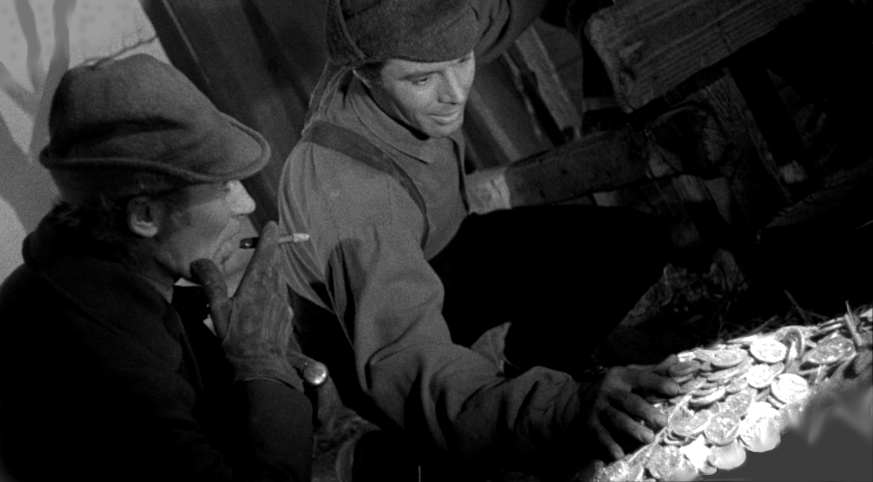
Pitting Solid New England values against the Forces of Darkness.
The story begins on a run-down farm outside Cross Corners, New Hampshire. Jabez Stone (James Craig) is plagued with an undending streak of bad luck to his crops, livestock and farm equipment. Sliding further in debt to Miser Stevens (John Qualen), Jabez must sell assets just to keep going. He gets moral support from his Ma (Jane Darwell) and his wife of two years, Mary (Anne Shirley of Murder, My Sweet), but nothing seems to do any good. That’s when the malevolent Mr. Scratch (Walter Huston) comes calling, like the Ultimate Carpetbagger. Scratch uses magic to show Jabez a fortune in gold coins buried under his barn. A hasty deal gives Jabez seven years of good luck in exchange for his immortal soul. His crops flourish while those of other farmers are ruined by bad weather; within no time his neighbors are all working for him. Stone is rich but despised by his friends and alienated from Mary and his mother (Jane Darwell). He takes on the live-in maid Belle (Simone Simon of La bête humaine), an alluring beauty who seems to be devil-sent. Prosperity so changes Jabez, he doesn’t even remember his profane bargain.
Sure enough, when the seven years come round, Jabez Stone is in desperate need of help. A contract is a contract, even if it’s burned into the trunk of a tree by hell-fire from Mr. Scratch’s cigar. Jabez is lucky that he’s an upstanding New Hampshire man: coming to his defense is the accomplished statesmen and attorney Daniel Webster (Edward Arnold). Can the wily courtroom legend free Jabez from a signed and sealed Deal with the Devil?
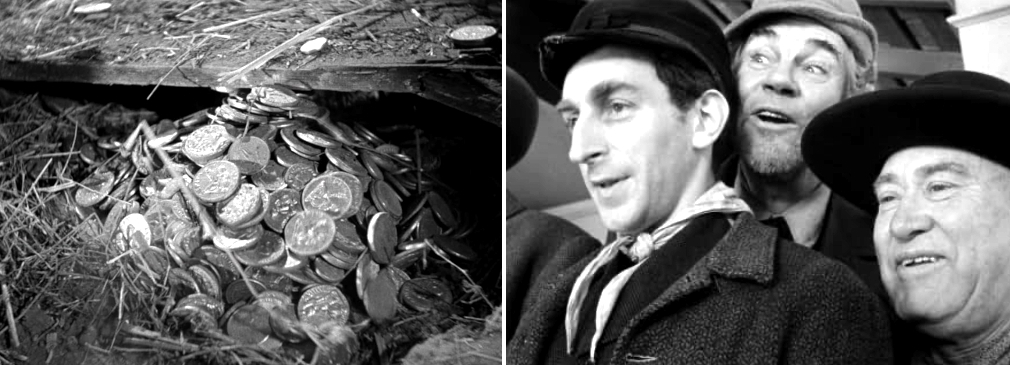
Just like Citizen Kane, All that Money Can Buy carries unusual collaborative titles. To some the film may look old-fashioned; it has the kind of rustic directness we associate with D.W. Griffith-like direction in Charles Laughton’s disturbing The Night of the Hunter. Wide masters collide with giant close-ups and frequent odd angles. Many scenes are shot against artificial backdrops. The art direction borrows the graphic clarity of the Americana painting tradition. Lyrical montages alternate with jarring visual effects.
A great evocation of sex as sanctioned by the Bible.
There are also plenty of new-fangled cinematic devices. The pace slows for a series of dissolves in the sequence where Jabez’ wheat grows and matures. Jabez already embraced his wife, talking about ‘growing things,’ and the final shot of a vast field of wheat slowly dissolves to Mary Stone lying on her bed, now pregnant. The Earth is the highest value in this agrarian society, and by associating Mary with the fecund fields, it’s as if she underwent some kind of immaculate conception.

Semi-experimental scenes abound. The introduction of Mr. Scratch and his minion Belle are heralded by gloriously overdone backlit angles, with creepy audio effects. The RKO optical department worked overtime on many shots with complicated visuals — like the gauzy filtering on shots of Belle at the party. Also restored are several insert close-ups of Mr. Scratch laughing at Jabez’s misfortunes. They’re rendered in negative, something seen only in avant-garde or experimental films of the 1920s.
James Craig’s Jabez Stone is the film’s central role, but the good actor comes in 12th in the cast billing, behind Anne Shirley. Craig lacks the charisma to make us sympathize with Jabez, who is a whiner before his deal with the Devil, and an intolerable Jerk afterwards. Bad luck is one thing but Jabez is just a fool. He purposely gets reckless with his desperately needed wheat seed, just so he can throw his hands up in guiltless defeat after spilling it. Frankly, he doesn’t deserve being defended by Daniel Webster.

Anne Shirley’s compelling character compensates somewhat for Jabez Stone’s unlikability. Mary Stone comes off as a less forceful but equally virtuous Olivia De Havilland. She’s backed by Jane Darwell, who after her great role in The Grapes of Wrath is perhaps a bit too neatly cast as The Salt of Wisdom. Both know that something is about Jabez’s prosperity, but being good obedient women, they defer to his authority. Ma and Mary mainly stand virtuous and wait.
The big draw is the powerhouse casting of Edward Arnold and Walter Huston. We always remember Arnold’s great work in Howard Hawks & William Wyler’s Come and Get It, another core Americana story. After twice assaying villainous blowhards in Frank Capra’s moral fables, Arnold gets the showcase role of a noble politician, a man of the people who champions agrarian reform and the rights of working farmers. He knows his constituents by name and takes a personal interest in Jabez Stone’s plight.
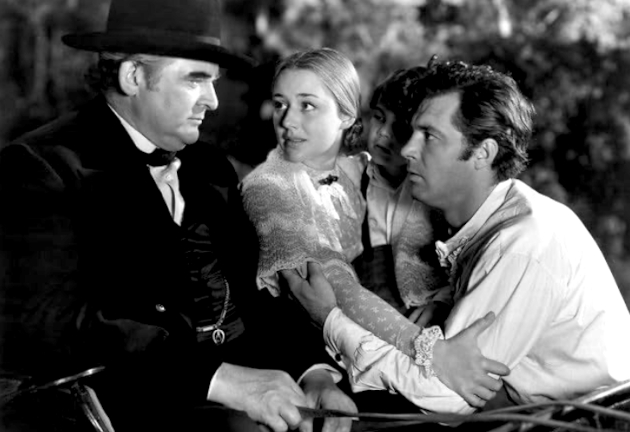
Stephen Vincent Benét’s original story carries the conceit that only the personal vengeance of The Prince of Darkness could account for Daniel Webster not being elected President of the United States. In his liner notes, Tom Piazza offers that the historic Webster didn’t fulfill earlier hopes of greatness once he became embroiled in Washington politics. For instance, he came down firmly on the wrong side of most slavery issues during the years leading up to the Civil War.
Were some 1939 audiences put off by All That Money Can Buy’s pro-New Deal rhetoric? The co-op agricultural model is repeatedly touted as the solution for the rural economic mess. A Grange is essentially a commune in which the farmers of a region share the risk and the reward of their labors so as not to be victimized by predatory money lenders. I can’t see conservatives of 1941 going for that sentiment: a few years later, movies that cast bankers as villains (Stagecoach, It’s a Wonderful Life) would be accused of Communist influence.
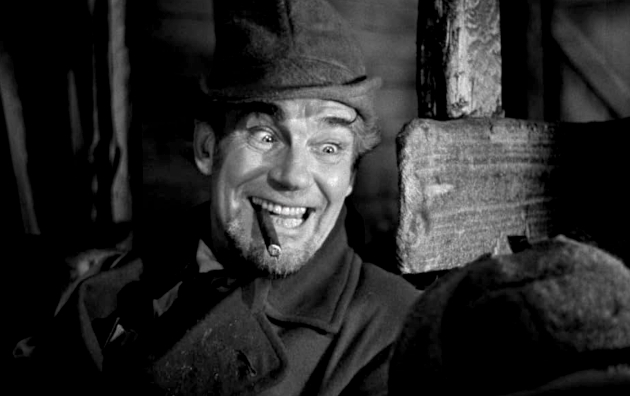
The most entertaining Devil that ever was.
Walter Huston triumphed in numerous standout movie roles, characters that transcended stereotypes. ‘The Devil Incarnate’ has been portrayed memorably many times over * but never was an actor more appropriate. This Mr. Scratch may be the most original Devil of them all, instigator of everything evil. He is no dark brooder or threatening arm-twister, but the perfect devil for the stix, a mischievous, grinning life of the party. His huge grin and laughing eyes mock all around him, even as he feigns concern.
Scratch’s dialogue abounds in clever allusions and asides. He’s a barroom ‘influencer’ and a heckler at public meetings. He assures Daniel Webster that he’s on both sides of elections. He also beats the drum for the band; surely this Mr. Scratch would be a patriotic War booster.
But the fantasy has teeth sharper than that of most horror movies. The devilish fun turns extremely creepy for an uncanny moment taken directly from the short story — when Mr. Scratch shows that he’s ‘collected’ the soul of one of his contractees by wrapping it in his handkerchief. The soul appears in the form of a moth, a visual given teeth in a later horror classic by Jonathan Demme.
The RKO special effects department supports Mr. Scratch with clever optical tricks, often associated with Hell Fire. He carves an indelible date into a tree with his cigar. An excellent optical effect is used when Jabez tries to murder Mr. Scratch with a thrown axe – it freezes in mid-air, and is instantly incinerated.

A Sex Kitten before there were Sex Kittens.
Simone Simon was a star in France and had made a few Hollywood movies, one of them opposite James Stewart. Here her Belle is the picture of demonic enchantment. Belle captivates Jabez Stone with the twinkle in her eye and a seductive accent. She is soon belittling the faithful Mary and encouraging Jabez to spoil his brat of a son. Belle says she ‘doesn’t come from anywhere,’ and then says that that nowhere is ‘over the mountain,’ apparently a place where damned souls dwell. With her feline self-confidence and her slightly curled smile, Simone looks downright perverse when standing opposite Anne Shirley’s prim farm woman.
Ms. Simon makes the hint of a smirk into something uncanny — did William Dieterle perhaps remember the bizarre, demented look of vampiric hunger on the face of Sybille Schmitz in Dreyer’s Vampyr? The performance so captivated new producer Val Lewton that he brought her back for three films, including her most famous movie Cat People. Even when she plays virtuous innocents, as in Lewton’s Mademoiselle Fifi, there’s something in Simone Simon’s face that would have no problem destroying any man.
Dastards, Liars, Traitors, Knaves. Americans all.
The big speechifying guns come out at the conclusion, when All that Money Can Buy convenes a jury of the Damned. Jabez Stone is of course as guilty as Hell; Daniel Webster defends him with show-stopping oratory and an appeal to patriotism. That’s ironic, considering that politicians are usually at the top of the list of people we think might sell their souls to Mr. Scratch. Whenever a public speaker employs absolute concepts like Good and Evil, Freedom and Democracy, we ought to be thinking of Deals with the Devil.
(spoilers from here forward)
There’s something essentially crooked about the story’s ironic sense of values, something common to many films blanc. Daniel Webster defends Jabez simply because he’s a New Hampshire man, but what makes the deeply flawed Jabez more deserving of rescue than Miser Stevens? We certainly don’t mind Jabez being saved for the sake of his deserving wife Mary, but if you ask me, that greedy SOB Jabez Stone gets off pretty easily.
When Mr. Scratch tries to be magnanimous about his loss in the courtroom, he gets a firm kick in the pants. Old Ma finds a way to keep Scratch from ruining a feast, but there’s no getting rid of Evil. Scratch lost the battle, but he’s still in fine form, ready to deal. He could be Uncle Sam’s evil brother.
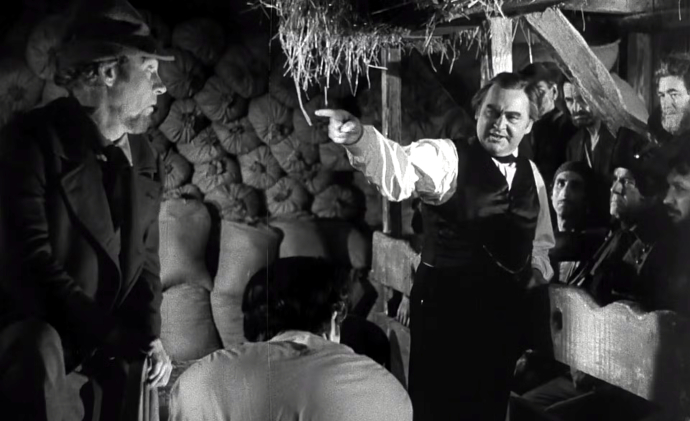
Walter Huston owns the movie at the finale, a humorously uncomfortable intimate moment between Mr. Scratch, and US, personally. A wholly-earned dynamite close-up shows Scratch checking the audience for new ‘clients.’ Anybody who ever went to Sunday School will feel uneasy when he finally finds ‘us’ and points his finger. The movies’ weak ad campaign sold the movie all wrong: the one-sheet posters should have shown Huston’s grinning face and his pointing finger:
“I want YOU for the fires of Hades!”

Here’s Joe Dante on All That Money Can Buy:

I don’t buy many Criterions, having rented their DVDs from Netflix over the years, but this Blu-ray is going on my want list because it’s a vast improvement over the DVD & a classic movie that impressed me!
This one is an absolute all-time great
I note the only other time I have seen the strange negative effect was in the F.W. Murnau film Faust from 1926. There it is also used to show the actions of a figure understood to the devil delighting in his dark machinations. Of note, apart from the ‘bargain with the devil’ similarity between the stories Faust features an actor in a fairly major part, William Dieterle, many years before he directed the subject of the review. It would be fair to assume he remembered Murnau’s creepy effect from 15 years earlier and decided to try and duplicate it.
Interesting — I didn’t remember the effect in ‘Faust.’
A shame that the original title has been replaced by the much inferior release title though. Bad move, Criterion.