

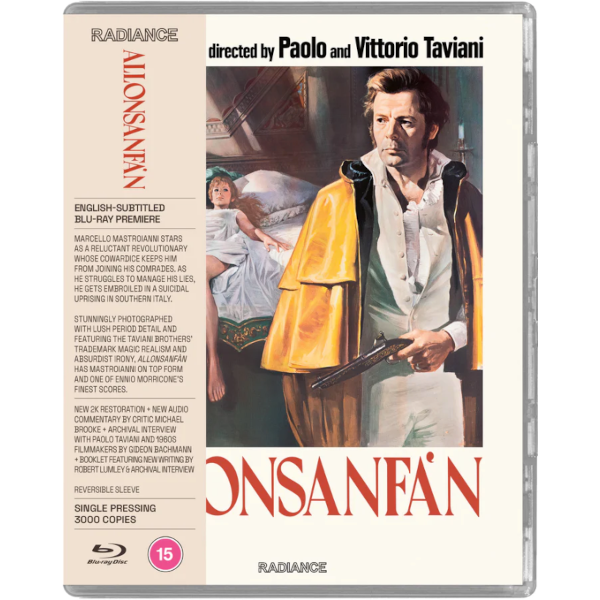

Can a single Blu-ray release revive an overlooked masterpiece? Here’s hoping. The Taviani Bros. Paolo and Vittorio followed no trends in political filmmaking, even as they collaborated with left-committed actors like Gian Maria Volontè. The films they made before their 1977 breakout Padre Padrone are in need of reevaluation. In The Man is for Burning, Volonté’s revolutionary fails to inspire Sicilian peasants to rebel against an oppressive, Mafia-run government. Under the Sign of Scorpio also sounds interesting: uprooted by a volcanic eruption, an entire island community tries to ‘move in’ with another tribe on the mainland. Even when international success arrived, they continued with socially conscious themes. Their well-known WW2 The Night of the Shooting Stars sees an entire Italian town under German attack taking to the road to seek the protection of the Allies. It’s a communal picture, with a group conscience.
It’s from the first lyric line of La Marseillaise…
The Tavianis’ Allonsanfan, sometimes spelled Allonsanfàn, is a political tragedy told in an upbeat, spirited fashion. The political upheavals of 1968 resulted in a surge of leftist themes in Italian filmmaking, even if mainstream audiences didn’t find many of them entertaining: Bernardo Bertolucci’s Partner., Liliana Cavani’s I cannibali, Marco Ferreri’s Dillinger is Dead, Francesco Maselli’s Open Letter to the Evening News. Italian westerns weathered a vogue for political themes, sometimes using the Mexican revolution as a background. Political thrillers with more on their mind than rhetoric fared better: Elio Petri’s Investigation of a Citizen Above Suspicion and The Working Class Goes to Heaven.
Allonsanfan goes directly to the history books to dramatize the actions of a reluctant revolutionary in post-Napoleon 1815, when dozens of scattered revolutionary movements were stymied by the return of harsh monarchies. The French revolution remains the glorious sentimental ideal, and the Italian Risorgimento is decades away. Much of Italy is occupied by the Austrian Habsburgs, which are helping the local municipalities round up and eliminate the radical ‘sects’ that refuse to die down. One of these is the Sublime Brotherhood. After almost 20 years of subersive activities, most of their members are approaching middle age.

One imprisoned Sublime Brother is the aristocrat Fulvio Imbriani (Marcello Mastroianni). Fulvio is surprised when the Milanese auhtorities suddenly release him. They hope to use him to capture the rest of the Brothers, who instead spirit him away from the policemen put on his tail. Fulvio doesn’t let on that his aim is to quit and reunite with his estranged family. ↑ The sect’s Grand Master commits suicide, which gives Fulvio the excuse to go home. He shows up at the Imbriani estate disguised as a monk. His sister Esther (Laura Betti) ↙ is married to a Habsburg officer, an Austrian. She sees through the disguise. Fulvio has a new nephew who has been named after him, which reminds him of the son he abandoned years ago.
The lazy days at home end with the arrival of Fulvio’s Hungarian lover, Charlotte (Lea Massari of L’Avventura). ↘ She has brought funds collected to buy arms for the Sublimes; Fulvio tries to convince her to take the loot and run away with him to America. Charlotte says that the rest of the Brotherhood is arriving the next day to regroup. Esther overhears, and alerts the local guard …
Subsequent chapters confirm Fulvio as a self-contradictory mess. After twenty years of ‘seeing dreams turn to ashes,’ he wants to walk away from the Sublime Brotherhood and take their arms money … but he also wants to pretend he’s done nothing wrong. He attempts to assuage his conscience by visiting the son he abandoned. Fulvio no longer identifies with the Brotherhood, whose idealistic members sing and dance while they march, like young seminarian priests. Loyal comrade Lionello (Claudio Cassinelli) is incapable of seeing Fulvio in a bad light, no matter what the evidence. commits a series of betrayals, some passive and others not.

A Fools’ Parade.
Fulvio’s plan is to flee to America, but the happy troupe of comrades keeps relocating him; finding Fulvio is the one thing they do well. He’s obliged to accompany them on a sea voyage to Southern Italy. They have the foolish notion that they can foment revolution among the peasants, as if the local authorities aren’t ready for them. A comrade’s widow, Francesca (Mimsy Farmer) has discovered one of his crimes, but he seduces her and brings her into his confidence. Fulvio isn’t the only one who can betray a trust, however.
Their trip to start a grassroots revolution is undermined before it even begins. On their boat South, Fulvio awakens to discover they have brought him along, that his is a prisoner in his own scheme. They discover they have no guns and no money, just the red shirts that identify them as rebels. Their only member who can speak the local dialect is their guide Vanni (Benjamin Lev). They haven’t been told that Vanni’s nickname is an outlaw called ‘Vanni the Plague’: he went crazy when his wife succumbed to cholera, and went on a murder spree. Yet the brothers persist in thinking that high spirits can win the day, that the Southern peasants will welcome them. Only Fulvio sees it all as blind madness.
Most ‘revolutionary’ films share grim finales that make social progress seem a lost cause: Sacco & Vanzetti, Joe Hill, even Matewan. The Tavianis’ approach is essentially comedic. The opening titles suggest an Opera, with the sound of an orchestra warming up. A red curtain parts to reveal the scene of Fulvio’s release from prison. The frequent interruption of songs bring the spirit of a musical. Choirs sing, and the Imbriani household is at one point filled with a ‘happy’ nonsense song, sung in turn by several family members. The ambiance momentarily reminds us of Rouben Mamoulian’s Love Me Tonight. Morricone’s main march theme of course represents the Brothers’ fervor; when combined with an adapted Southern Dance, the theme illustrates the Brothers’ illusion of revolutionary glory.

Commedia dell’ Fulvio.
Even as bad things happen, the absurdities involved feel comic. Fulvio is so preoccupied with the problem of escaping the Brotherhood that he can’t make love to the very eager Charlotte. Esther says that Fulvio as a child saw people in primary colors, and the Tavianis’ camera responds with a view of one relative in green, another in orange. etc.. Later on, Fulvio’s main betrayal takes place during Carnival, which creates bizarre scenes such as a rescue boat crowded with passengers dressed like characters in an opera. In the Carnival crowd, an intense scene of a woman in labor is suddenly is revealed to be an elaborate charade. If life is such a joke, what’s so wrong with Fulvio looking out for Number One?
But Fulvio is visited by guilty visions, as when he tells his son a scary story about a monster frog. The Tavianis end the episode with an image of a giant frog watching through a window. Fulvio’s guilt is also expressed in scene in which a dead man seems to come back to life.
The show is a nicely produced period piece despite the absence of the resources of an epic filmmaker like Luchino Visconti, whose Senso takes place in the same era. Excellent costuming and set dressing puts us in the middle of the Imbriani household. Fulvio lounges about in his bedclothes, as the elderly maid who raised him goes about her business, smiling at Fulvio’s female companion. The action scenes are modest but not threadbare. The Tavianis make do without a lot of extras, but manage an okay skirmish or two with uniformed soldiers, black-garbed police, and the Brothers, who foolishly wear white tunics, or those bright red shirts.

Politically speaking, Allonsanfan is in no way a Call to Arms. Nor does it settle for the simple mottos of Sergio Leone’s one foray into political drama — Duck You Sucker, aka Once Upon a Time … The Revolution. The setup is much more sophisticated than the statements ‘class war just kills all the poor people,’ or ‘faith is a more worthy value.’ Isolated by their own idealism, the Sublime Brotherhood seems to subsist on virtuous dreams, unaware that they will be perceived as an enemy of the people. Afraid to ‘break their spirit,’ their own leaders feed them optimistic lies. But their is hope for the future. The youngest rebel in the group has been named Allonsanfan. He’s the next generation of revolutionary. Perhaps he will have the qualities needed to succeed.
1815 is a time removed for all but students of history … which goes far to explain why a hero-challenged revolutionary tragedy, no matter how brilliant, was doomed to failure. This viewer’s limited scope of reference brings up thoughts of Che Guevara’s ill-conceived mission to overthrow Bolivia, based on little more than his own charisma. Southern Italian peasants surely already blamed rich, cultured Northerners for their problems. That lesson is very well taught in Francesco Rosi’s Christ Stopped at Eboli, where time and politics stand still.

The finale is as bleak as anything we’ve seen, yet is compellingly satisfying, correct. A final betrayal leaves the brothers in a ‘tough spot.’ The leader’s nicely worded greeting isn’t much good against a mob with pitchforks. The final irony is that Fulvio’s guilty panic causes him to experience his own hallucination of revolutionary glory. The Tavianis’ once again blend cruel reality with delirious fantasy, with Morricone’s music as the binding agent. It’s simple but effective basic cinema.
At almost two hours Allonsanfan never becomes dull. Marcello Mastroianni is an excellent choice for the leading role — audience accept both his introspective serious heroes while remembering his playful comedies. Fulvio is conflicted idealist. We can’t hate him — the world on view is so cruel, his crimes almost make moral sense. We want somebody to get out alive. At one point Fulvio reveals that he’s a musical artist: he picks up a violin in a crowded restaurant and starts playing, beautifully. He’s convinced that his life’s energies were misplaced — is revolutionary fervor a sickness that steers people away from happiness?
Equally distinct are the portraits of the women in Fulvio’s life. Laura Betti figures in great movies by Federico Fellini, Mario Bava, Bernardo Berolucci and Pier Paolo Pasolini, and championed the search for the truth when Pasolini was murdered. Her Esther represents an aristocratic sell-out to the powers that be, in this case the occupying Austrians.
The highly sensual Lea Massari brings a vital energy to the committed Charlotte, who smuggles a fortune across Europe ‘for the cause.’ But women gravitate to Fulvio at their own peril — she’s walked halfway across Europe for him, and he doesn’t appreciate her half as much as he should. The most ‘together’ woman in Fulvio’s life is Mimsy Farmer’s Francesca. The equally passionate Francesca is also focused on self-preservation, but doesn’t share Fulvio’s self-doubt. Well before the finish, Fulvio is revealed to be less than admirable in almost every situation. He’s too chicken to perform as an efficient villain. If he were truly ruthless, he’d walk away with the loot alone, and never be seen again.

Mimsy Farmer? She’s become something of a cult name, known for arresting roles in a range of American exploitation (Hot Rods to Hell) before establishing herself in Europe: Four Flies on Grey Velvet, The Master and Margarita, and especially Barbet Schroeder’s mysterious More. She’s a key player here, making Allonsanfan an even more desirable title to see.
Even without the analysis offered by Radiance’s extras, Allonsanfan presents one of the best all-round portraits of the pitfall of revolutionary fervor, of political dreamers in an unforgiving world. The Taviani Brothers’ film expresses an older era of revolution through intrusions of theatrical imagery and sequences making a creative use of music. Even better, its cruel ironies never come off as cynical or gratuitous — the conflict isn’t a matter of heroes and villains.
“We’re both too early, and too late.”
The foolhardy revolutionaries are not entirely without vision. Even they know that their timing is off, even if they have what the Future needs. Like Fulvio, the best of them are pushing 40, and too desperate to make something happen while they’re still alive.


3 comments