

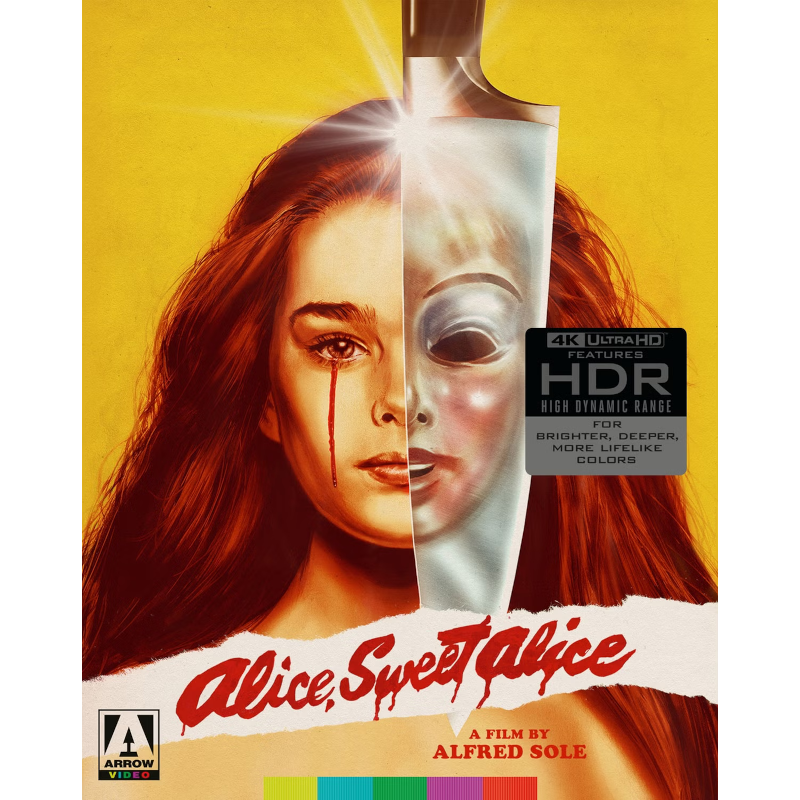

Originally screened at festivals and released in the U.K. under the title Communion, this intense thriller was delayed in the U.S., retitled Alice, Sweet Alice and for a later reissue heavily publicized as ‘introducing’ one of its actresses. Brooke Shields was nine years old during filming, and her agents reportedly had to stop Allied Artists from using advertising implying that she had a starring role.
That’s just one of the unusual stories behind this worthy psycho thriller from Alfred Sole, who wrote or directed several films before settling into a busy career as a production designer for television. The carefully constructed and filmed Alice, Sweet Alice was made in New Jersey on a budget, perhaps hoping to catch the wave of horror pictures that exploited the monster success of William Friedkin’s The Exorcist. The story has its share of shocks related to church matters, but no spinning heads or green vomit. It also has a lot to say about the realities of faith-based family life, which in Sole’s vision is underpinned with old-fashioned Catholic disillusion, guilt, and fear.
Arrow’s 4K Ultra HD release is a new remaster, and comes with a battery of extras that make the case for its status as a quality adult horror item. As is Arrow’s policy, no Blu-ray is included; the other format has its own separate release.

Although the opening image is a little girl in a First Communion dress holding a dagger, Alice, Sweet Alice is reasonably tasteful. Original Allied Artists posters emphasized the image of a knife, aping Italian giallo thrillers before the advent of the teen terror epic Halloween. The violence has no genre cookie cutter ‘slasher’ pattern. Sin and repression create a lot of bad situations in a dysfunctional Catholic family. Director Alfred Sole did his homework, designing his movie in cinematic terms. He generates considerable suspense while developing interesting, unusual characters.
A horrible murder ruins a First Communion ceremony run by Father Tom (Rudolph Willrich). It devastates the unhappy Spages family of Paterson, New Jersey. Single mother Catherine Spages (Linda Miller) favored young Karen (Brooke Shields) over her surviving older sister Alice (Paula Sheppard). Mother and daughter live in a rotting apartment building. In the wake of the killing, Alice’s unpleasant Aunt Annie (Jane Lowry) moves in and makes everyone miserable. Catherine’s ex-husband Dom (Niles McMaster) arrives to help straighten things out because the troubled, precocious older sister Alice is suspected of the crime. Annie is attacked on the stairway by someone wearing Alice’s scary mask and yellow raincoat, which results in Alice being remanded to psychiatric observation under the caring Dr. Whitman (Louisa Horton). Almost everyone is convinced that Alice is the killer except her mother, who is plagued by prank phone calls . . .

Movies that subjected kids to outrageous jeopardy proliferated after William Friedkin’s sensational hit from the William Peter Blatty best seller. It was a bad time for audiences that didn’t think killing children was positive movie fare. In addition to foreign rip-offs there was The Little Girl Who Lives Down The Lane, The Omen and the confused Audrey Rose. Alice, Sweet Alice can pride itself on not being just another exorcism clone. Actually, it feels more like a serious thematic hijack of Nicolas Roeg’s ethereal creepshow Don’t Look Now. Sole’s central image is of a tiny attacker in a plastic raincoat, wielding a knife.
Before Allied Artists stepped in to distribute the independently produced Alice, Sweet Alice , Columbia Pictures appears to have taken a pass. It’s not the kind of movie that would be green-lit by a studio committee. Rosemary Ritvo and Alfred Sole’s script churns up a sordid tale that, at least on a thematic level, blames the Catholic Church for numerous modern ills. The issue isn’t child molestation, at least not directly. The thesis is that the Church’s repression of human sexuality creates and encourages psychological problems driven by fear and frustration.

Several characters suffer from feelings of guilt. The Spages parents are divorced, yet are still attracted to each another. The mother inadvertently favors one daughter over the other, setting into motion what could be a Cain & Abel situation, between sisters instead of brothers. With the men either missing (father) or emasculated (Uncle Jim, played by Gary Allen), only the ‘sexless’ Father Tom remains. He may be too much of an emotional focus for several women. All trust and adore him: Catherine, young Karen (Brooke Shields) and his housekeeper Mrs. Tredoni (Mildred Clinton).
Alfred Sole’s organized direction has a Hitchcock-like focus on editorial relationships between shots, yet the film emphasizes people over cinema mechanics. The story takes place in the early 1960s. The Jackie Kennedy look is in vogue, and a Catholic is in the White House. The choice of period suggests that the writers of Alice, Sweet Alice are either sincerely bitter about the Church or are amusing themselves with a thorny Catholic theme, the kind that almost defeated the great Alfred Hitchcock.
Sole keeps the drama on its feet with taut situations and people we care about. The willful pre-teen rebel Alice likes to scare people with her mask, and she has a habit of retreating to a secret hideout in the basement. A vague atmosphere of repression is in force. Family communication breaks down whenever sex is is an issue. Catherine assumes that Alice is still an innocent; we know there’s been no motherly sex counseling because she must be told by a psychologist that Alice is menstruating. Catherine also doesn’t know that Alice carries on a teasing, insulting discourse with the apartment manager. The obese, unsavory Mr. Alphonso (Alphonso DeNoble) lives just one apartment away. If Catherine knew about Alice’s visits, she’d have a fit.

Is Alice emotionally disturbed as a result of parental guilt and recriminations? Catherine was unmarried when she became pregnant with Alice. For some reason the younger, more obedient Karen has received the bulk of her motherly love. The absent father Dom is also gulity, especially when a phone call from his wife catches him kissing Catherine. Alice needs her parents but also resents them. Adding fuel to the fire is the harpy-like Aunt Annie, who orders everyone about and escalates every issue into a big problem.
(spoilers from here on in; there’s no other way)
As it turns out, a repressed maniac is responsible for everything. The killer sees Catherine Spages as an unclean whore who must be punished. Even in this odd horror film the blame is assigned to a woman. The men in the family never get a chance to solve anything. As soon as they see the records of Alice’s disturbing school behavior, the police stop looking for a culprit. In the movie’s most elaborated horror scene, the male figure working hardest to solve the crime is trapped, and subjected to a horrible torture and death.
Director Sole does well with his cast and script. His direction never shows haste or undue economizing. Angles are expressive and characters’ emotions well-covered. The various murders are stylish but not fetishized; the scary mask and Alice’s creepy two-faced doll achieve their intended effect. Sole is apparently a major fan of Alfred Hitchcock, as Stephen Lawrence’s good music often channels Bernard Herrmann’s music score for Psycho.

A couple of the performers have limited abilities but most of the New York-based cast comes off well. Linda Miller and Niles McMaster are especially good, as is young Paula Sheppard, who looks a bit like an underage Karen Allen. Sheppard’s only other IMDB credit is 1982’s Liquid Sky, where she plays an even more disturbing character. Paula was 19 during filming but is completely convincing as a 12 year-old.
Mildred Clinton had played Al Pacino’s mother in Serpico. The once-notorious Lillian Roth has a small part as a morgue pathologist; it’s a kick to think she’s the same party girl who parachuted from a dirigible in the bizarre pre-Code comedy Madam Satan. The top-billed Linda Miller had been married to actor Jason Miller, of you-know-what.
The original on-screen title Communion makes the film seem even more anti-Catholic; the replacement Alice, Sweet Alice has the cadence of horror films with titles like What’s the Matter with Helen? and Hush… Hush, Sweet Charlotte. Alfred Sole’s film works for us because the characters are so compelling; anybody with complicated family issues can identify with Alice’s mother and father, trying to react properly under awful circumstances. The story has too much integrity to become a ‘hate Catholics’ tirade, and the violence is too personal to make us feel we’re watching a by-the-numbers slasher picture. It really doesn’t want to be included in that subgenre. In terms of iconography, it’s more like an Italian giallo.


