

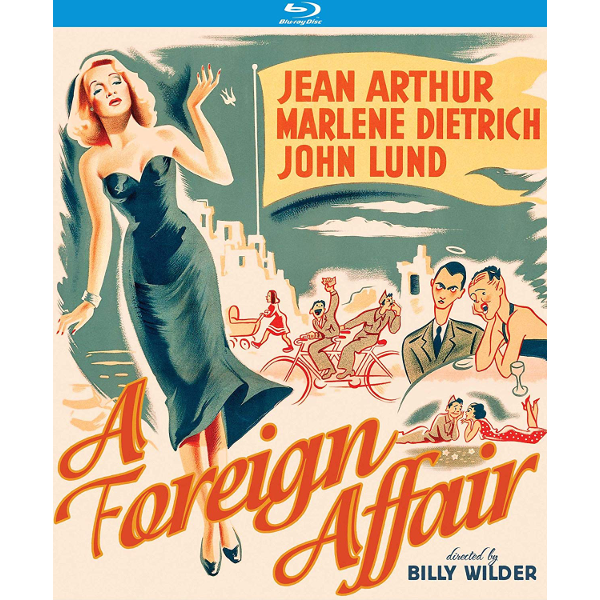

Isn’t it interesting that the directors that made the most important, insightful Hollywood movies about postwar Germany were German émigrés? Both Billy Wilder and Fred Zinnemann had been part of a group of filmmakers that made the popular ‘city symphony’ comic romance People on Sunday in 1929. Both lost close family members in the Holocaust. Always the realist, Zinnemann beat the Italians at their own game, making an overpowering humanist statement about dislocated refugees with The Search, filmed in the ruins of Berlin.

Zinnemann wasn’t alone. Billy Wilder took part in the de-Nazification of the German film and theater in the American Zone, but he’d return to Berlin twice more, to make highly political movies. Everyone remembers his later film One, Two, Three, a raucous comedy with scattershot jokes about the divided city of Berlin. What makes the film amazing today is that Wilder was tossing around satirical spitballs about the Cold War, while the world was edging closer to a nuclear confrontation. But most people have forgotten an equally impressive Billy Wilder film made in the thick of the postwar reorganization of West Germany. Having graduated to the directing big-time with his Oscar winner The Lost Weekend, Wilder filmed some of 1948’s A Foreign Affair in the bombed-out city, even at the partly destroyed Brandenburg Gate.
A Foreign Affair is almost as daring as One, Two, Three, considering the situation. Berlin was a divided city, just as was Vienna in the later The Third Man; not only was the Iron Curtain coming down and talk of a new war escalating, back home in Hollywood anybody not waving the flag was considered suspect. Billy Wilder defuses these concerns (to a point) with comedy and satire, even though the supposed comic target is the hanky-panky fraternization and black market activities that were giving the military occupation of Germany a black eye. Wilder’s mentor Ernst Lubitsch had become somewhat controversial for making Hitler and concentration camp jokes in his 1942 To Be or Not To Be; Wilder steps on the same sore toes when he makes similar jokes in A Foreign Affair. A ‘de-Nazification’ officer interviews a father with a delinquent son, a little Hitler Youth punk who chalks swastika graffiti wherever he goes. The father wants the boy punished, to which the Army officer says, “what do you want me to do, throw him in a gas chamber?” Played as broad comedy, the scene has a pretty high potential to offend… but Wilder’s acid sense of humor couldn’t be suppressed, not even by his sophisticated writing partner Charles Brackett.

Wilder and Brackett shared credit for the wild but beautifully sculpted screenplay with Richard L. Breen. The highly conservative, stickler-for-detail congresswoman Phoebe Frost (audience favorite Jean Arthur) joins a committee visiting the American Sector of Berlin to investigate charges of immorality and black-market corruption among the occupation force. She’s bamboozled by the womanizing Captain John Pringle (John Lund), a fellow Iowan who is guilty of all the indecent transgressions Phoebe is out to stop. Pringle is protecting German national Erika Von Schluetow (Marlene Dietrich), a nightclub performer wanted by the U.S. Army for her previous romantic connections with the Reich high command, in particular an SS Commandant named Hans Otto Birgel (Peter von Zerneck).
Phoebe takes in Von Schluetow’s racy cabaret performance, and, alerted that an ‘Army bigwig’ is shielding Erika for amorous reasons, she suspects Pringle’s pragmatic commanding officer, Colonel Rufus J. Plummer (Millard Mitchell). Then newsreels surface of Erika hobnobbing with Hitler, which makes Captain Pringle reassess everything he’s done. Discovering that a romance is cooking between the congresswoman and her American officer, the devious Erika finds a way to compromise them both. But the big surprise comes when Plummer orders Pringle to make his dalliance with Erika public: the possessive Birgel is alive and well, and will hopefully come out of hiding to kill the Army’s ‘Love Commando.’

A Foreign Affair has a ball sending up foolish popular assumptions about the occupation and the behavior of soldiers far from home — soldiers from any country. Wilder takes direct aim at the BS message in wartime movies like The Human Comedy that G.I.’s spend their time eating boxes of cookies from home and singing songs around the campfire. He instead gives us an Abbott & Costello-like pair of dumpy dogfaces (Stanley Prager, William Murphy) who ride around Berlin on a bicycle, looking for die fraüleins to pick up, with candy bars as bait.
Wilder’s cynical comic sense comes through strong. Pringle and Erika share what passes for a rough sex life — she spits toothpaste in his face and he talks about beating her up. Erika lives in a bombed-out ruin; she’s nailed Pringle as her source for impossible-to-find items like soap and nylons, and hopes that he’ll take her to America. Erika laughs at Phoebe Frost, with her ugly hairstyle and lack of makeup, shooting merciless insults about hopelessly drab American women. It’s the only ammunition Erika has in her six-year fight for survival:
“Can you even imagine what it was like to be a woman in this town when the Russians came in?”
Erika is big trouble for Captain Pringle and Phoebe Frost, but Wilder doesn’t soft-sell anything as he alludes to wholesale rape and mass murder.

Wilder doesn’t quite balance his official message — the occupation is sane and constructive, so butt out, critics — with jabs at Phoebe Frost’s prudishness, and the much more exciting images of high times at the Lorelei nightclub. Russian soldiers take breaks from drinking to toss people at the ceiling, including Marlene Dietrich. Friedrich Hollender contributes three excellent songs for Dietrich to sing in full Weimar Cabaret style: Dietrich never looked or sang better. One song “Black Market” extolls the seductive necessity of corruption in a city where people are starving. The tune “The Ruins of Berlin” is a post- Twilight of the Gods anthem. Wilder makes it rise to a high dramatic pitch as the SS fugitive Birgel emerges from the shadows to shoot his rival John Pringle.
Wilder and Brackett’s ability to make jokes pay off, or repeat, or be echoed by similar jokes, gets a good workout. We also see some nifty transitional touches, like the ‘target’ that Col. Plummer traces onto a foggy window, to show Phoebe that Pringle is in grave danger. Wilder allows the image of the target to linger across the dissolve to the nightclub, to float right above Captain Pringle’s heart. For a crucial dramatic scene in his later Sabrina, Billy Wilder will make some elevator lights perform a similar symbolic transition.

A Foreign Affair is no less brilliant than any of Billy Wilder’s other comedies, but it had some problematical issues. Wilder’s coarse humor and refusal to mollify Hollywood gossip mavens was well known, and the whole town listened when Jean Arthur complained that the director had cruelly made her look terrible against the fashion-plate Dietrich. Sensitive about her age, Arthur backed away from acting and made only one more movie, George Stevens’ visually glorious Shane. Even though Arthur took back her protest when she saw the movie (and she’s supposed to be playing a sexless woman named ‘Frost’, after all) Hollywood critics pegged this as an early example of Wilder of being cruel and brutal to his leading ladies. Wilder’s heroines frequently go through terrible emotional ordeals and several try to commit suicide. Idiot critics couldn’t separate Wilder’s scripts from his often tasteless wisecracks, and it’s true that some of his devastating zingers were uncalled-for. The truth is that when actresses Audrey Hepburn and Shirley MacLaine were supposedly being brutalized by a sadist, Wilder was giving them some of their best roles. In this film, Phoebe Frost’s rendition of her campaign song “Ioway” is just as arrestingly good as Dietrich’s cabaret act.
A Foreign Affair was considered a failure and was once a hard-to-see title in the Paramount library. It was part of the pre-1949 Paramount library sold to MCA in the mid-’50s, so has been controlled by Universal all this time. Was it too hip for the house in 1948? Or was its political attitude too flippant? The movie slams the German reconstruction and hints at the survival of the Nazi past, a movie theme that was discouraged when Hollywood went conservative and decided to tow the line in the Cold War propaganda effort.
Following Zinnemann and Wilder, writer-director George Seaton made yet another in-the-ruins drama, a Fox picture called The Big Lift. A GI working the Berlin Airlift is taken for a ride by a needy but equally predatory German woman, who wants to use him to rejoin her husband, a German POW in an American prison camp (four years after the victory? I thought only the Russians did that). Seaton’s film has become relatively obscure as well, despite starring Montgomery Clift. The sticky issue of the survival of Naziism suddenly disappeared from screens, replaced by Cold War fantasies about sneaky Russians. At least one already-finished movie about a postwar Nazi conspiracy was re-shot to swap out the German villains for Russian communists. Wilder’s comedy about morale in the conquering U.S. Army reached a lot of people with no sense of humor about such things. What about our image abroad?

Lovers of Billy Wilder like to point out ‘Wilderisms,’ defined as little jokes or themes that repeat from movie to movie. The key thrown from a window in A Foreign Affair is only partly connected to the two kinds of keys in The Apartment, while a telltale chocolate cake is a brilliant ‘Lubitsch touch’ that develops both the romantic and black market themes. Phoebe’s frigid ritual of putting away her pens and notebooks in nested valises, reminds us of the ‘lady with the alligator purse’ in Hitchcock’s Marnie, but also the marvelously ritualized funeral clerk in Avanti. At one point John Pringle criticizes Erika’s doubtful compassion, saying “That’s mighty white of ya.” We’re accustomed to frowning at that archaic racist remark, but is Wilder using it on purpose, to comment on the Nazi character?
A ‘win the war but lose the peace’ wisecrack shows up again in One, Two, Three but the story of Phoebe, John and Erika doesn’t pull in cultural references for their own sake… except when we discover that a childlike Russian soldier both knows and worships Mickey Mouse. For all his fun with Love Commandos and wicked Nazi seductresses, Wilder never lets go of the grim reality of his subject matter. The extended opening, with the congress committee flying over what seems an endless landscape of skeletal Berlin ruins, is so awful as to make Phoebe Frosts gasp in disbelief:
“Golly.”

