


Noir crime pix can be a terrific nostalgia machine for Los Angeles. Our City Hall is an unchanging monument in hundreds of shows, but the legendary Angel’s Flight can only be appreciated in pictures like Kiss Me Deadly or Criss Cross. André de Toth’s noir thriller Crime Wave grabs us from a half-dozen different angles. But, location-wise, the scene that always gets a loud response at noir festivals was taken at midnight in Burbank, just a few blocks from the Warner studio: a shot of a lonely prowl car, with the original Bob’s Big Boy restaurant in the background. The iconic building was then just a couple of years old. 72 years later, we see that shot and want to stop in for a double-decker.
The relatively obscure Crime Wave is now a favorite crowd pleaser, with everything desirable in a 1953 film noir. Director De Toth gives us a full dose of action, intense characters and genuine noir angst. There is not one slack moment to be found in its tight 74 minutes; every character, setting and plot point is nailed with admirable efficiency. Sterling Hayden is almost scary as the relentless cop putting pressure on Gene Nelson’s tough hero. The issue at hand is whether or not an ex-con always slides back into criminal activity. All indications are that staying clear of trouble is a difficult proposition for anyone fresh from prison. You don’t meet the nicest people there.

Escapees Doc Penny, Ben Hastings and Gat Morgan (Ted De Corsia, Charles Bronson & Nedrick Young) bust out of San Quentin and commit a string of petty robberies on their way south. In L.A. they knock over a filling station. They put the gas attendant Gus Snyder (lovable Dub Taylor) in the hospital, and gun down a motorcycle cop in cold blood. The wounded Gat stumbles to the doorstep of ex-con Steve Lacey (Gene Nelson of Oklahoma!) and his wife Ellen (Phyllis Kirk of House of Wax), with the demand that they help him reach Dr. Hessler (Jay Novello), a criminals’ sawbones now working as a veterinarian. The all-business Det. Lt. Sims (Sterling Hayden) tracks Gat to Steve’s door. He comes down hard on the parolee, accusing Steve of being part of the gang. Steve and Ellen think that Sims might believe their story, when Doc and Ben show up to continue the terror. Using Ellen as a hostage, the crooks force Steve to serve as wheel man for a big bank holdup in Glendale.
Now Lt. Sims will never believe Steve and Ellen. What can they possibly do?
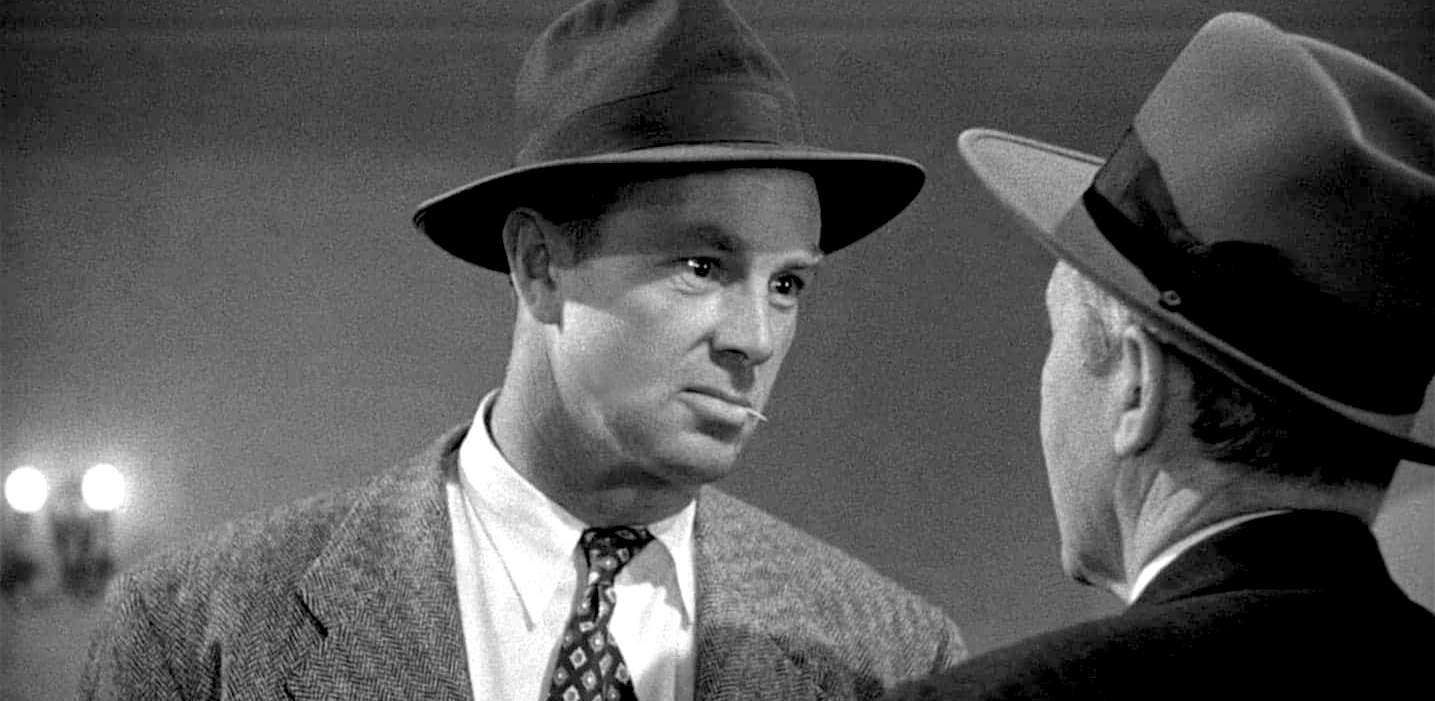
It didn’t take long for Crime Wave’s storyline to become a weekly fixture in TV episodes of Dragnet and Highway Patrol. Yet André De Toth and his expert cast turn out a gem of a show. Sterling Hayden chews on toothpicks, and looks like he’d rather be stomping every crook he sees. We’re genuinely surprised to see his Lt. Sims offer a fair shake to one of his stoolies. Gene Nelson’s, Steve Lacey is a good hardboiled hero, neither an idealistic chump nor an embittered cynic. Like the best of noir protagonists, Steve must go it alone, trusting neither the cops nor the murderous ‘friends’ he met in prison.
Life in California ought to be heaven for Steve and Ellen. He’s a parolee with a tainted record, yet can hold down an aircraft job. He earns enough to buy groceries, and he has the loyal Ellen by his side. Steve may not be able to afford a new car, but he and Ellen look great in his genuine Hot Rod. California road culture is booming, and the many street exteriors stress that that Los Angeles is the fun car capital of the world. If only Steve didn’t have this little problem with thieving murderers.

De Toth circumvents the Production Code, ‘getting away with murder.’
De Toth’s direction is remarkable. Excellent part-subjective camera work puts us within the action, as when Bronson’s brutish Ben Hastings assaults the veterinarian in his surgery. Some scenes were filmed in the actual LAPD offices. Low angles make Sterling Hayden seem enormous as he bulls his way under the glaring fluorescent lights. One scene begins with Hayden bursting into a dark room, gun drawn. The moment is timed and staged so sharply that it’s almost frightening.
De Toth’s audacious bedroom scene must have earned him slaps on the back from other directors. The prudish Production Code saw to it that most married couples in Hollywood movies were shown using twin beds. When the Laceys decide to ignore a late-night phone call, we see only a close-up of Ellen’s hand restraining Steve’s, from below as he reaches for the receiver. The angle features her wedding band, and strongly suggests that she must be underneath him on the bed. ↖ In the next cutback shot they are already smoking. We don’t know of an earlier Hollywood noir with such a direct suggestion of sexual activity. Well, since I was born around that time, I have concluded that sex definitely existed.
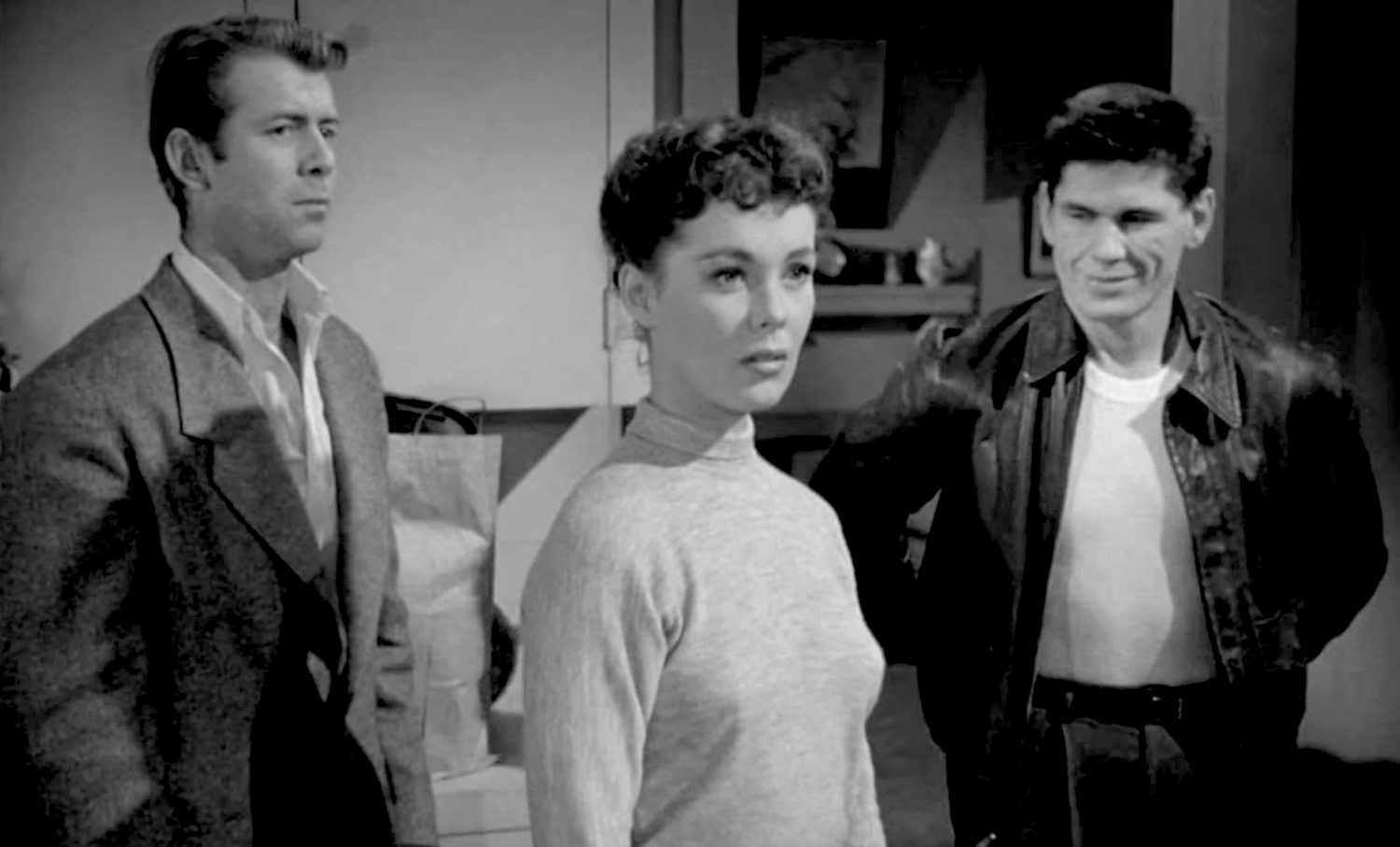
The crooks are slick and mean, with Ted De Corsia (The Killing, The Naked City) leaning on Steve just enough to get him to play ball with his crooked scheme. Nedrick Young is a luckless cohort (more on Young below) and Timothy Carey is Johnny Haslett, a leering goon enlisted to babysit the terrorized Ellen. We fully expect Haslet to rape Ellen the moment they’re left alone. He instead invites her to play gin rummy!
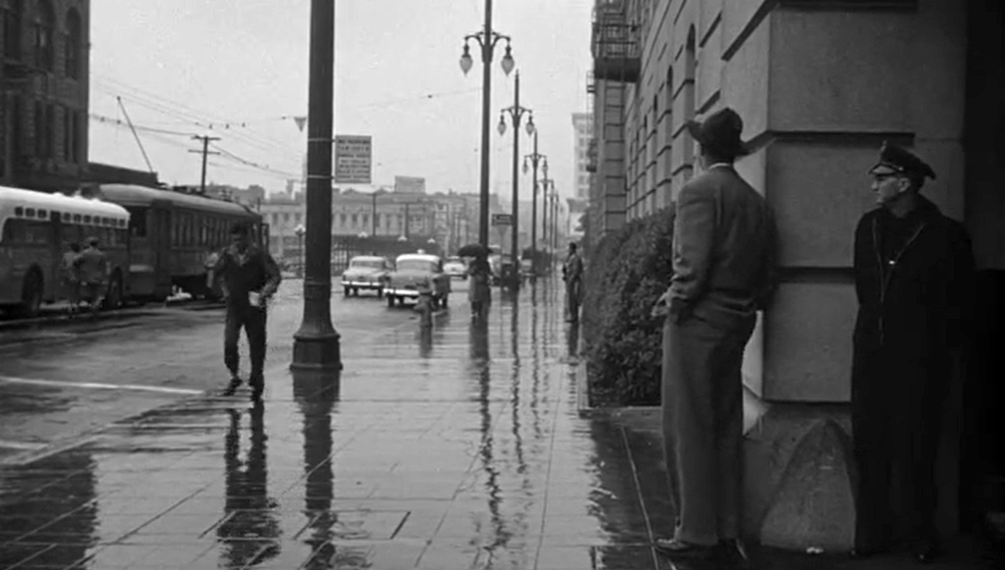
Crime Wave evokes a great atmosphere of endless night in Los Angeles. Bert Glennon’s expert photography takes us into a time tunnel to the streets of Glendale in 1952. In addition to Bob’s Big Boy, we see L.A.’s Chinatown and a lonely stretch of San Fernando Road. Upscale movie patrons might have wanted more fanciful escapism, but the authentic settings in films like Crime Wave and Without Warning! now give us an up-close look at the way things were. We get a good look at the Red Cars on Glendale Blvd., the transporation system that would be discontinued only a few years later.
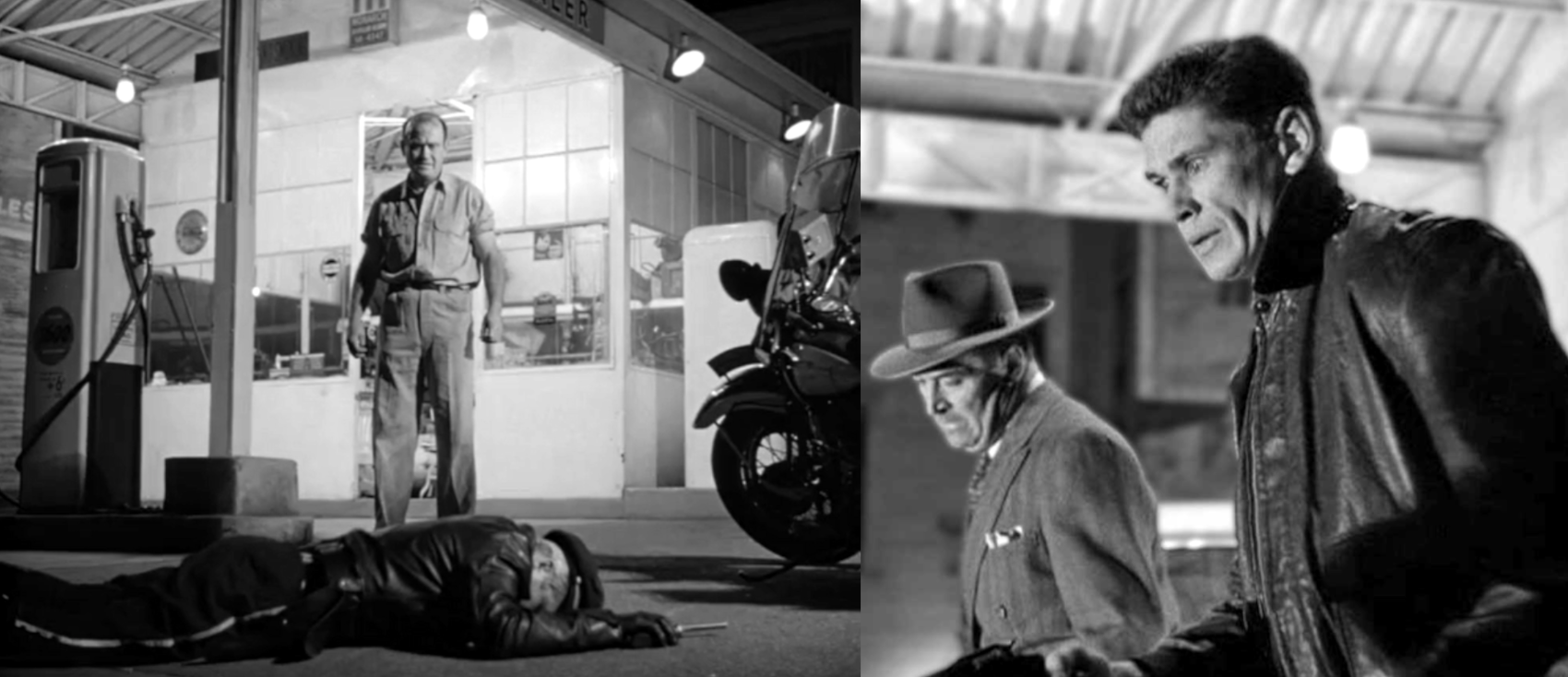
Instead of giving in to Warner’s casting suggestion of a star the studio thought more bankable, André de Toth held out for the dependable Sterling Hayden. The line-up of villains compensate in impact for what they lacked in marquee power. Menacing Ted de Corsia doesn’t care who dies. Psycho Timothy Carey is allowed to snarl and grimace like a fiend. Later on, director Stanley Kubrick had to be tough to keep Carey from running amuck. ↘
Gat Morgan, the least lucky holdup man, is played by the actor-writer Nedrick Young. By the time Crime Wave was released Young was blacklisted. Warners was denying him most of his screen credits, even on House of Wax. Young fell back on his writing, contributing to the hits Jailhouse Rock, The Defiant Ones and Inherit the Wind. Being blacklisted, he had to use a fake name. This created problems when the non-existent Nathan E. Douglas won the Oscar for The Defiant Ones. Nedrick Young was placed in the insane position of accepting the award under a different name. Many in the big audience must have known exactly who he was. We can see how it went down!
Crime Wave gives the rough-looking Charles Buchinsky (Bronson) his biggest part yet. The talented Phyllis Kirk also has a showase role as the worried parolee’s wife. She plays opposite De Toth’s inspired casting choice Gene Nelson. At this time Nelson was almost completely associated with lightweight musical comedies. A top-notch dancer, Nelson’s film acting career would both peak just a year later with Fred Zinnemann’s 65mm & Todd AO roadshow colossus Oklahoma!
The violent bank robbery leads to a convincing car pursuit from Glendale to Chinatown, culminating in a satisfying surprise ending. De Toth gave Warners a hard-driving thriller, delivered on a very short shooting schedule. At 74 minutes, we’re wondering if it was perhaps shortened even more in editorial. Did the studio want to present it as a ‘programmer’ fit for double-bill use? The concluding robbery shies away from opportunities for additional violence. Did more violent material need to trimmed? Crime Wave is the perfect 50s noir: realistic, fast-moving and unpretentious.


I really enjoy this movie. Charles B. shows himself an excellent, naturalistic actor – always watching and reacting to his scene partners, and changing from affability to menace on a dime. Plus, the “d’you like to play games?” fake-out from Timothy Carrey has one of the funniest payoffs I have ever seen.
In my neck of the woods, Northern New Jersey/New York, Crime Wave went out on the bottom half of a double bill with Duffy of San Quentin, shot in 18 days on location. It was a misfire while Crime Wave made the day.
One of the few “noirs” I can tolerate.
Why do movies like to show it raining in LA?