

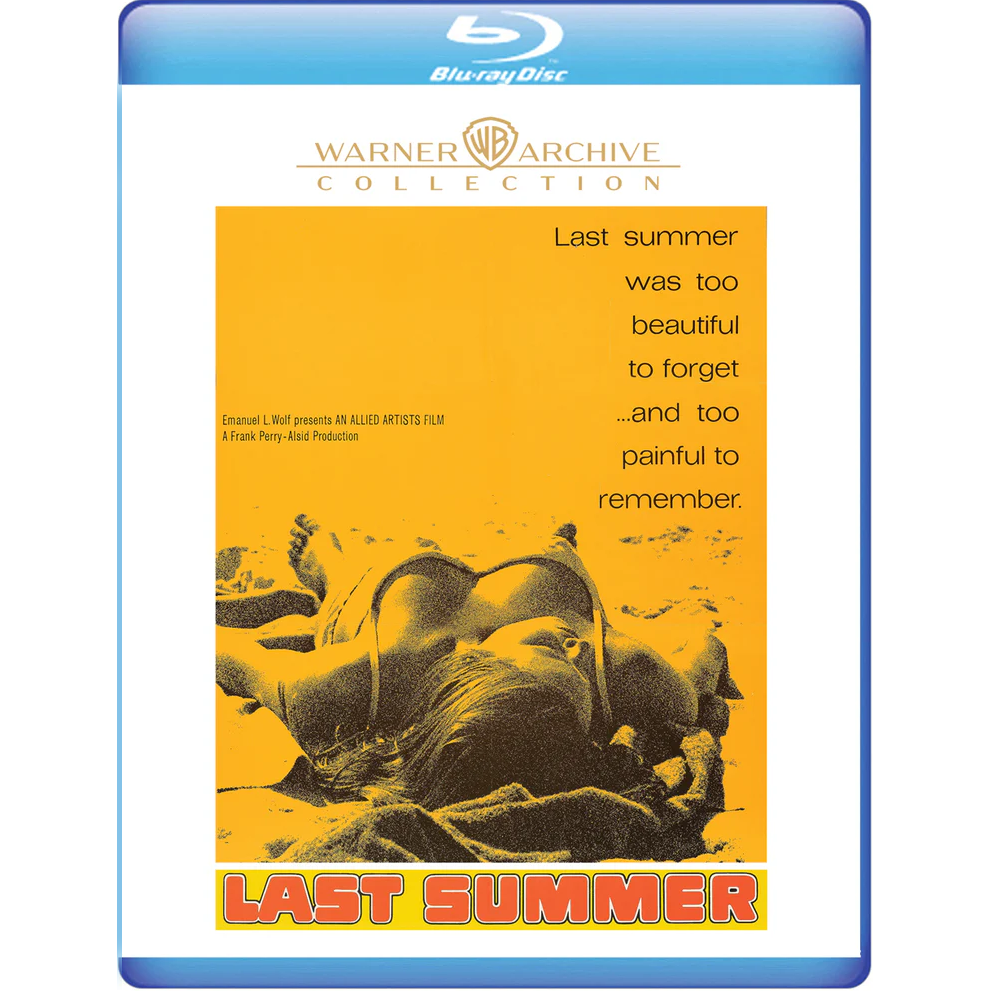

This review is by frequent correspondent “B.”
A few months back, the kind proprietor of this site posted an announcement regarding the long awaited Blu-ray debut of Last Summer. Glenn respects and even admires the film — he saw it several times back in the day — but admits that he has mixed feelings about it. With tongue half-in-cheek, he described it as “the FEEL BAD movie of the decade!” * He added that in 1969, he and his girlfriend, both teenagers, were quite impressed by the picture, “and somewhat depressed as well. It certainly doesn’t present a favorable view of people… We hadn’t run into such malevolent personalities, and it probably put us on the lookout for them.” I appreciate that observation, Mr. Erickson.

Yet Last Summer was likely one of the most critically acclaimed films of ’69, receiving accolades out of the gate like “The best picture about young people I have seen!” (ABC), “Frank Perry’s newest and best film… the most realistic portrait of upper-middle class fifteen and sixteen year olds to have come to the screen!” (Judith Crist, who cited the film as #3 on her 1969 ten best list), Hilarious, tender, amusing and shocking… a classically great American film, no one can afford to miss!” (Cosmopolitan), “…so achingly real, so sensitively written, so sharply directed and amazingly acted, it stands as one of the finest films of the year!” (Gannett News Service).

Hm. A dichotomy. Naw, not really. It’s both — all of these things. Like Certs: a candy mint and a breath mint, if you will. [Or, as the old SNL sketch put it, Shimmer: a dessert topping and a floor wax.]
Because Last Summer is about young people. Adolescents yet to fully mature, awash in hormones, lightly (or perhaps loosely) parented, maybe never quite properly introduced to the world we live in. Nonetheless, here — thanks to the inspired cast and the Perrys’ deft writing and directing — the teenagers are engaging, charismatic, even beguiling. Also, mercurial. Turn on a dime. Turn on you for even less. After all, they’re still… kids. It’s hard to tell why they do certain things that they do; it’s hard to say whether they know why.
It isn’t easy to describe the effect — oh, heck, let’s call it a wallop — this intense, singular-until-that-time picture about young people had on audiences back in the day. As screenwriter Larry Karaszewski, instrumental in abetting the restoration of the film, notes in an essay included with the disc:
“Today it may be difficult to understand just how groundbreaking the film was when it was first released… The youths of Last Summer felt real in a way not seen onscreen before the new Hollywood freedom of the screen of the late ’60s. These kids drank beer, smoked marijuana, and obsessed about sex. They had no meaningful adult supervision and were capable of startling savagery.”
Back in ’69, in many ways — almost too many ways — a lot of it felt like the most piercing, penetrating, realistic feature film ever made about young people. Both good and bad. Seen today, perhaps the film seems a little less subtle in its exposition, maybe the story’s inevitable turn to darkness is more evident from a distance. I don’t know. Its punch feels no less striking for that, anyway.
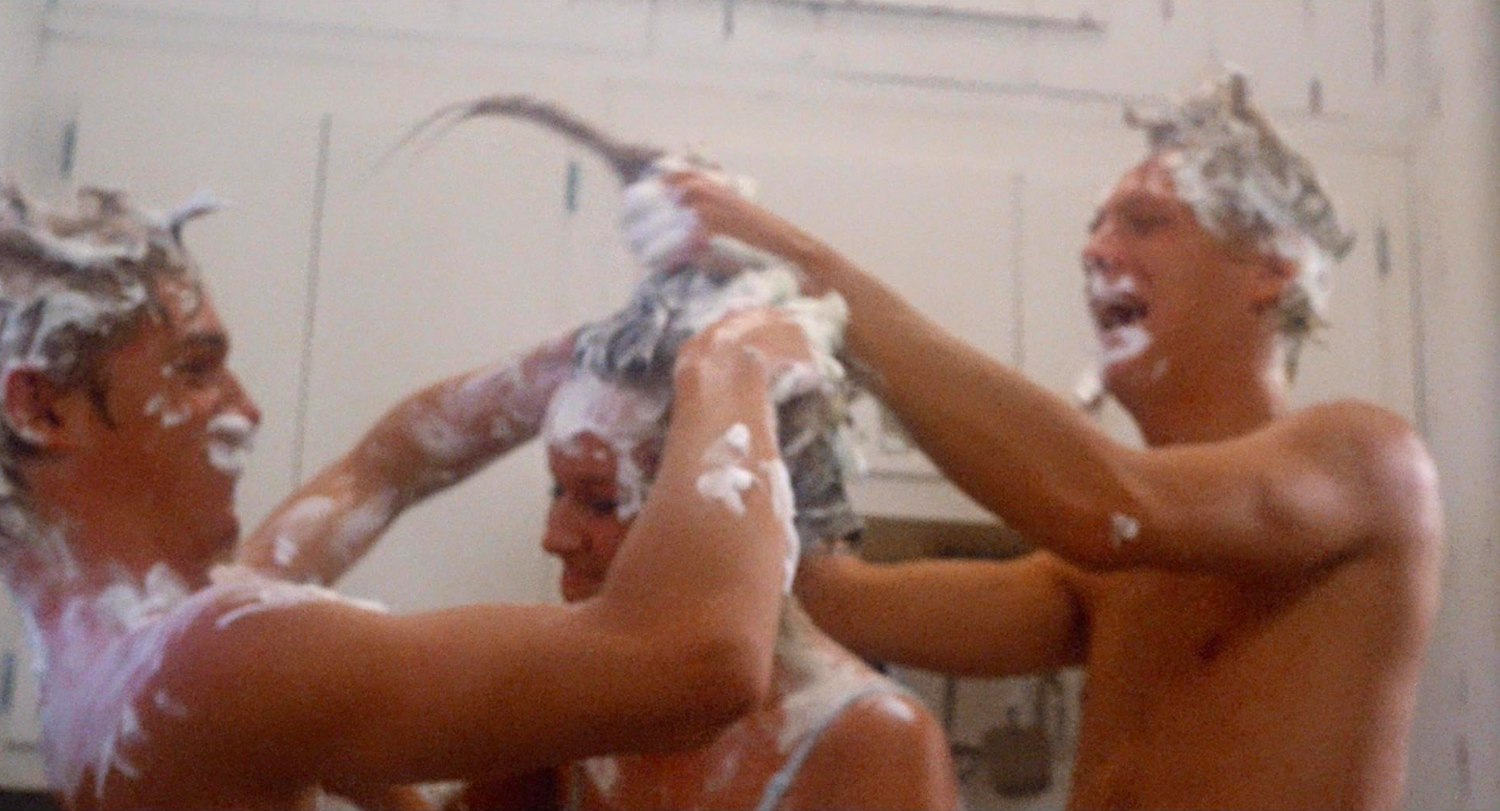
The picture remains memorably immersive. We spend a lot of time with these kids — the whole movie (no parents and very few adults are seen, though we do hear the voice of Sandy’s mom at one point) — and for most of that time, they’re surprisingly personable; we enjoy their company.
It’s a hot summer in the late ‘sixties. Peter (Richard Thomas) and Dan (Bruce Davison) are bright, upper middle class sixteen year olds vacationing with their families on Fire Island, off the southern shore of New York’s Long Island. Walking the beach one day, they encounter Sandy (Barbara Hershey), another teenage vacationer who is trying to help a wounded sea gull she found on the beach. Peter manages to remove a fish hook from the gull’s throat; the bird begins to recover; the three bond and become friends. While the trio care for the gull, swim and sail among other beach activities, both Peter and Dan are more than a little attracted to the very pretty Sandy and they timidly flirt with her. The three go off-island to the movies and each boy ends up slowly, awkwardly inching one of his hands up inside the blouse of a (mostly) breathless Sandy in an uncommonly memorable scene. ** A later sequence in which the trio gets high (with pot swiped from Dan’s parents’ stash) and decide to wash each other’s hair in the kitchen sink is wild, mad, exuberant (and very soapy).

The three grow increasingly close until one day they meet Rhoda (Catherine Burns), a slightly younger teenage vacationer from Cleveland, who is smart but lonely and needy. [She’s also chubby, and wears a dowdy one-piece bathing suit.] The trio can’t decide what to make of her at first, but Peter finds her intelligence and spirit interesting. But they tease her and keep her at a bit of a distance; Peter offers to teach her how to swim. Meanwhile, Sandy, trying to train the mostly recovered gull, is getting frustrated with it, and when the bird bites her, she becomes enraged. For only a moment. Then she smiles and forgives the gull. Later, Peter and Dan, who have discovered the bird bashed to death by a rock in the island’s forest, confront Sandy, asking why she killed the gull. An embarrassed Sandy can’t quite explain her actions, other than to say, “it was just a stupid bird.”

On a rainy day — actually, later in the afternoon when the trio got high and washed each other’s hair — a lonely Rhoda comes over and wants to talk. She’s envious — jealous, I think — of their tight friendship. The three talk about how they’ve shared confidences, secrets — each has told “awful things” about themselves. Rhoda can’t think of any “awful things,” except that her mother’s dead. And she haltingly begins to tell the curious, tragic story of how her mother died.
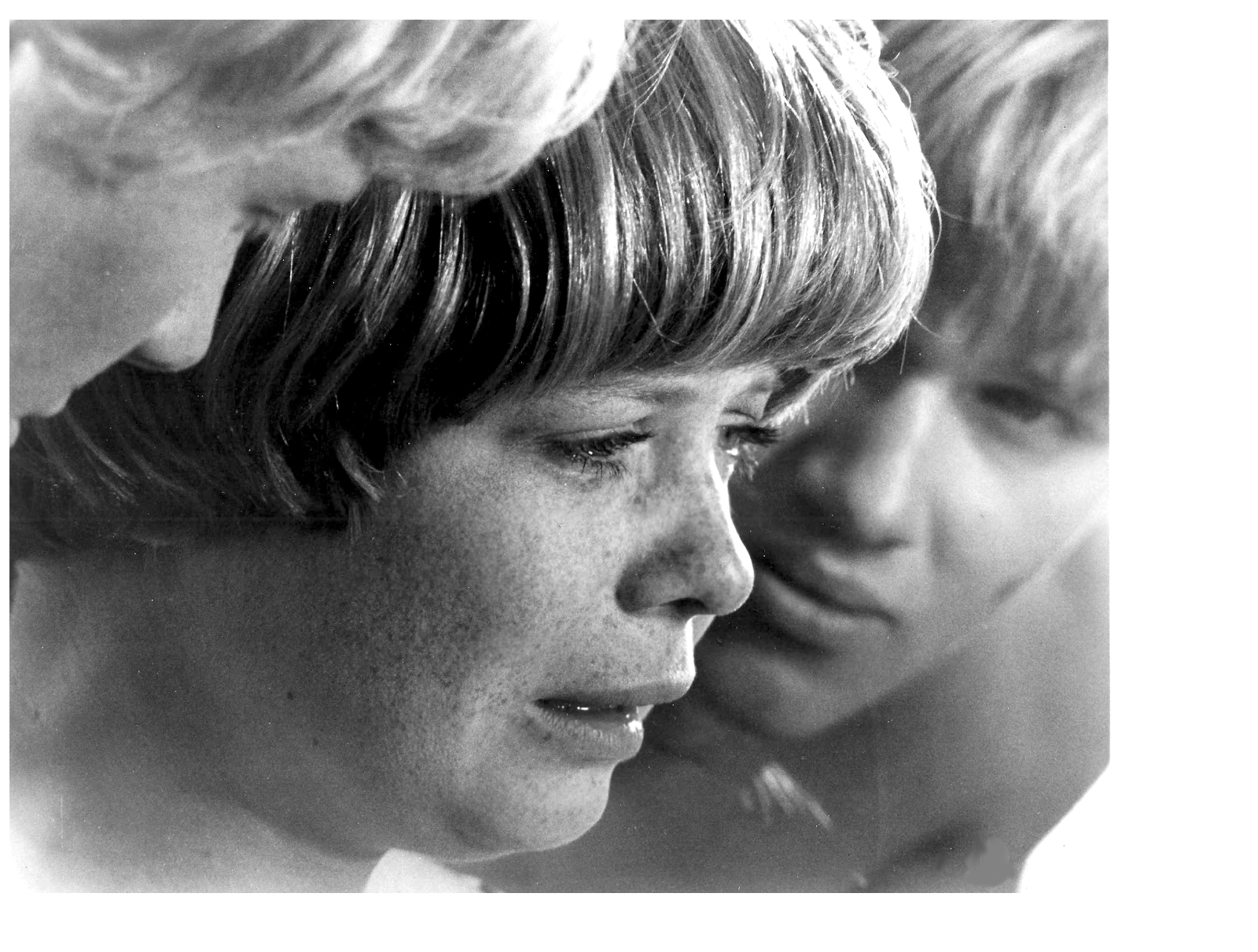
It’s a lengthy monologue, but it is absolutely mesmerizing, brilliantly acted and interpreted by Catherine Burns. Many colors, many shades, many emotions. [This doesn’t stop the show; it deepens it.] The performances in Last Summer are uniformly fine, but Catherine Burns’ work — particularly in this monologue — is especially noteworthy. She really should have won the Oscar.
After this, Peter begins to spend a little more time with Rhoda, and succeeds in helping her be a bit less afraid of the water. He also starts to develop some feelings for her; it’s fairly clear that Rhoda already has some strong feelings for him.

Sandy gets a response from a computer dating service; weeks ago she and Peter and Dan had filled out an entry as a larkish joke. Sandy and Dan decide that she won’t be the ‘date’ — they’ll talk Rhoda into being the ‘date’ (Sandy assumes she’s never had one before, anyway), and the three will go along as chaperones. This takes some persuasion and peer-wheedling, but they manage to get a very reluctant Rhoda, who wants so badly to be part of the group, to agree.
The date is as disastrous as Rhoda had feared. The male date, an adult named Anibal (Ernesto Gonzalez) is friendly and out-going, but from the start at the restaurant Sandy, Dan and even Peter are determined to keep the whiskey flowing in his direction and get him drunk; they find this hilarious. And after leaving the restaurant, a group of local toughs approach them. Sandy, Dan and Peter dart away; an hysterical Rhoda wants to stay and try to do something while Anibal is being viciously attacked, but the others spirit her away. Sandy puts her hand over Rhoda’s mouth to keep her from screaming; Rhoda bites down on Sandy’s hand, which momentarily enrages her, and she slaps her.
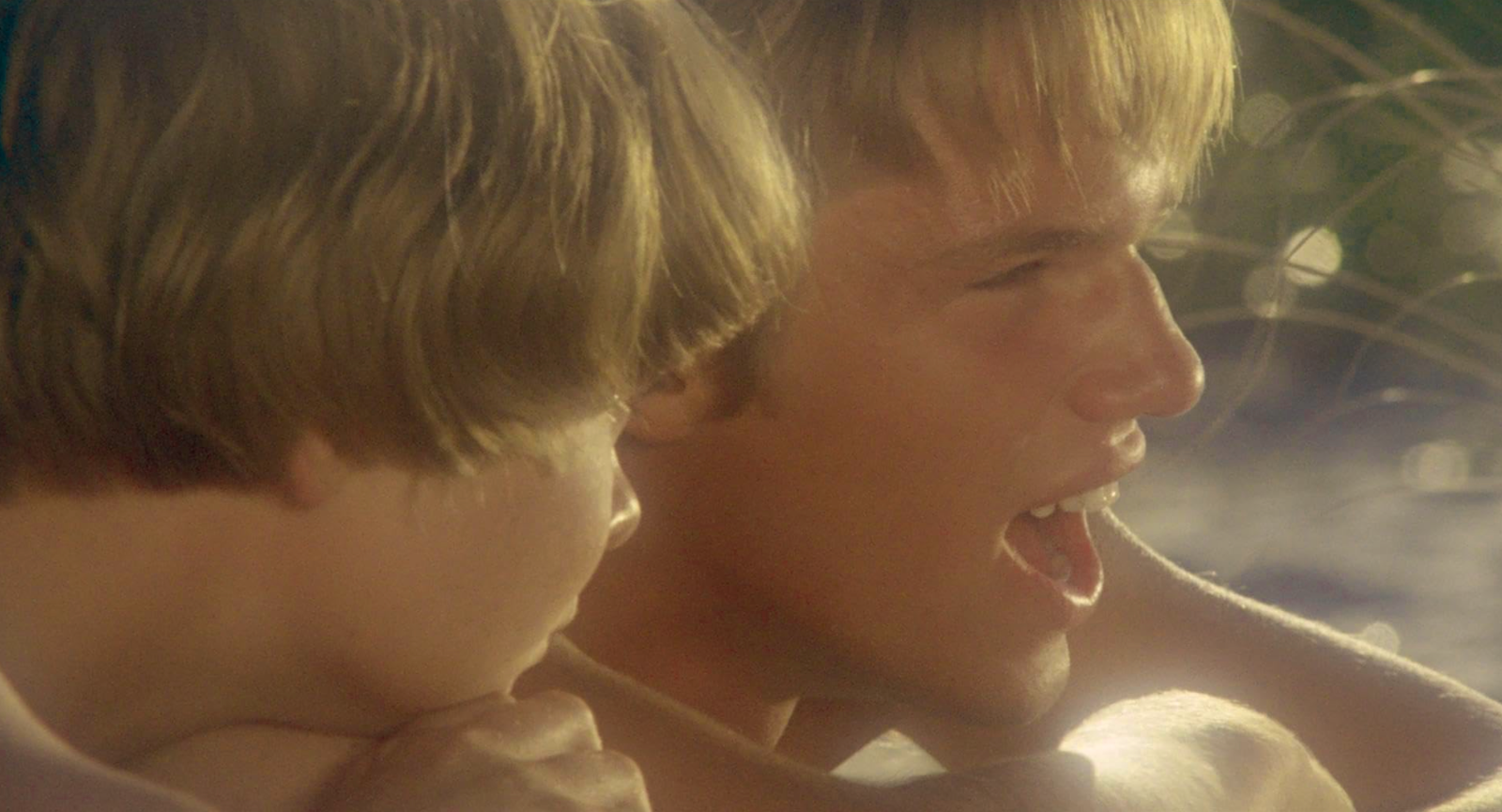
The next day is relentlessly hot. All four meet on the beach. Sandy and Dan go off to swim while Peter and Rhoda talk about the previous evening.
“Listen, I’m very sorry about last night. Really very sorry.”
“Why did you get him drunk?”
“I don’t know.”
“I asked you to stop — I begged you to stop –”
“Look! I really can’t explain it! Huh. I really can’t explain it.”
Peter, unable to justify his actions to Rhoda or to himself, gives up on the conversation after a while and joins Sandy and Dan in the water. When they emerge, Sandy suggests that since it is so hot, they get out of the sun and picnic in the island’s forest. Rhoda, who seems to have had enough of the trio for the moment, demurs. But she follows along after a few minutes; she has the sandwiches for the picnic. . .
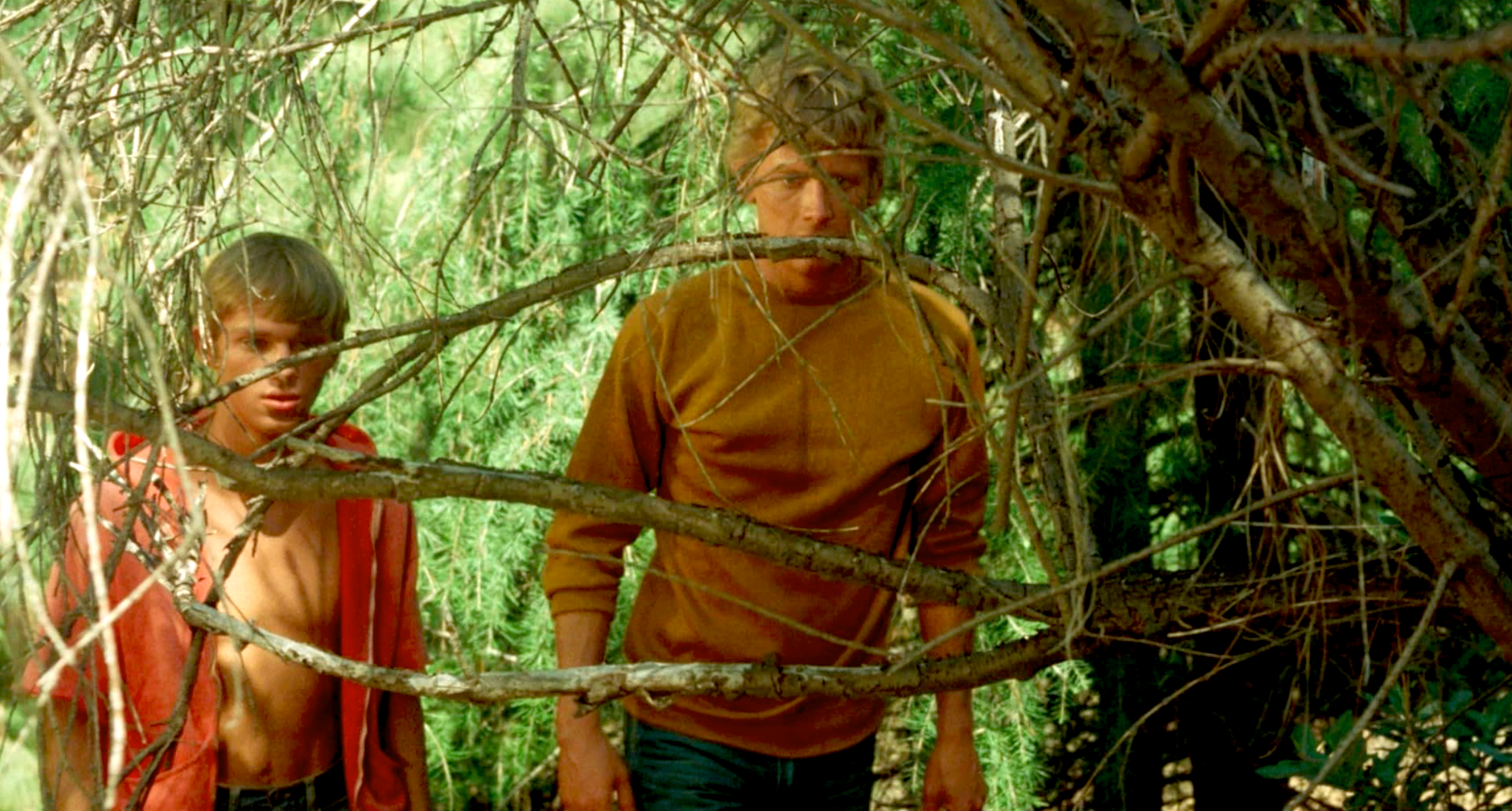
In the forest, we see in full the “malevolent personalities” Glenn Erickson was musing about as well as the “startling savagery” Larry Karaszewski noted. The climax of Last Summer is practically a concussive jolt. I remember the stunned near-silence in theatres. And I vividly recall the pensively searching face of Peter (Richard Thomas) as he paused atop a sand dune, trying to figure out why or how he could have been a willing part of such a monstrous deed. We could practically hear him say to himself, “I don’t know — I really can’t explain it.”
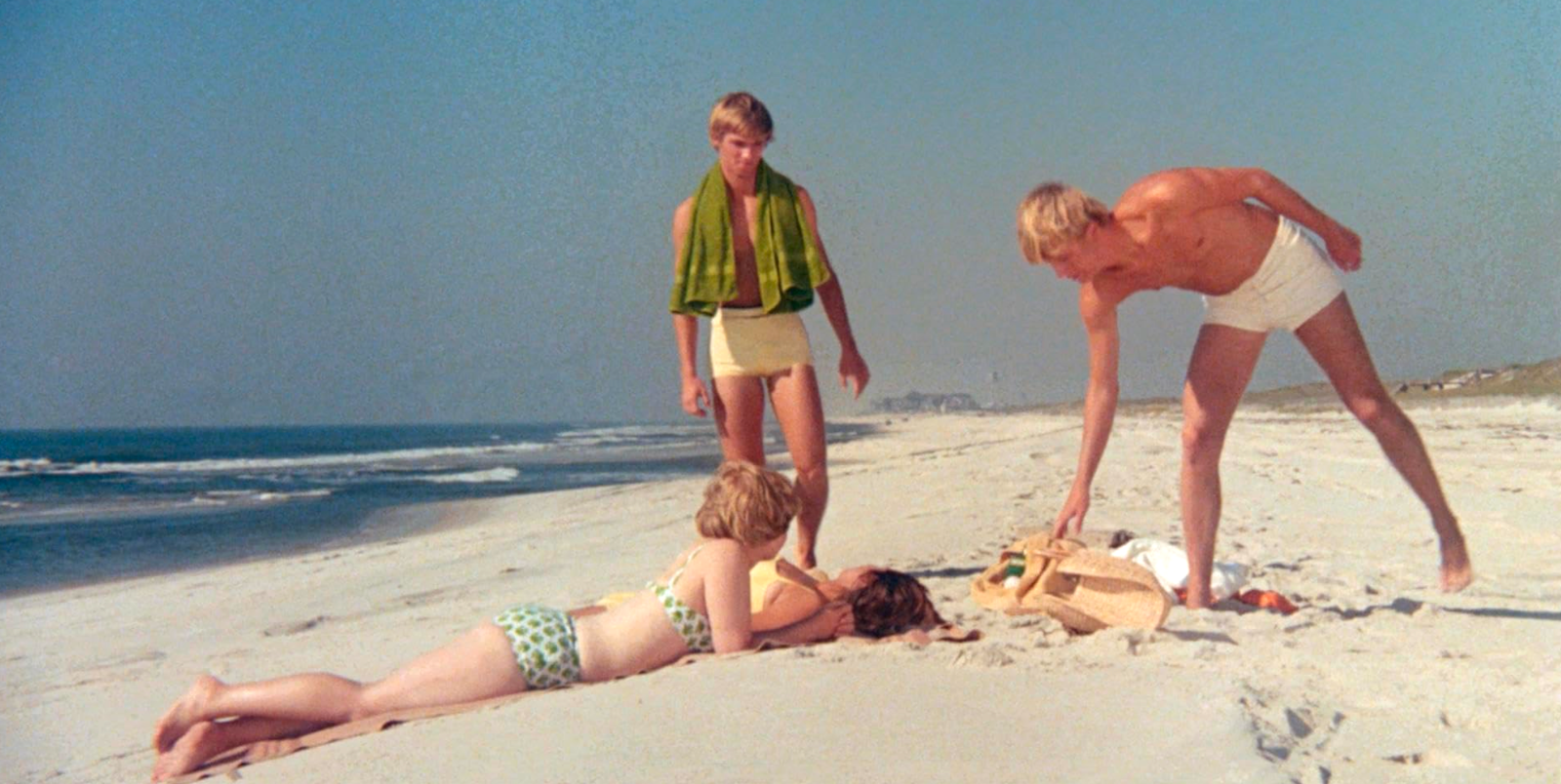
“Last summer was too beautiful to forget. And too painful to remember.”
This original advertising tagline … which seemingly became lyrics for The Way We Were.
I admire the movies Frank and Eleanor Perry made together — yes, even Ladybug, Ladybug and the much fiddled-with The Swimmer — and I believe Last Summer is their best work. [A Christmas Memory is pretty close, though.]
This is a skillful, sensitive adaptation by Eleanor of Evan Hunter’s 1968 novel, beautifully pared down to focus almost entirely on the dialogue and interactions of the four teenagers at liberty in summer. Hunter, a very good writer, was interested in the humanity of his characters, but (as a veteran crime novelist) he tended to drill down a tad hard on their possible (or probable) sociopathy or inherent evil. Ms. Perry leaves it up to us to perceive and interpret. Understand, or not.

And it is directed with seeming simplicity and fluidity by Frank, whose ability to bring out relaxed, wholly natural and believable performances from relatively inexperienced young actors is astonishing. Even now, after I don’t know how many viewings of this over the decades, I don’t really regard these kids on the screen as actors; they seem to simply be who they are. The picture bears no casting credit, but this was some magnificent job of assembling a cast.
Barbara Hershey had some television experience and had been a regular on an ABC western a few years earlier; she also had small roles in With Six You Get Eggroll (1968) and Heaven With a Gun (1969). Richard Thomas had stage and New York television experience, and had extensively acted in network soap operas; he played Paul Newman’s son in Winning (1969). Bruce Davison had never appeared in either television or film before being cast in the picture. Catherine Burns had appeared in a single television program (a TV production of The Crucible). Different levels of experience — and inexperience — but, gosh, you’d never know it. This is a tight group. Mr. Perry manages to keep everyone on the same page in the same size type, if you take my point.

Hershey is, I think, especially impressive in a difficult part. It would have been easy and even tempting to overplay this — amplify the character’s sexuality, boost the evident effect Sandy has on Dan and Peter, make her a real femme fatale. It was better and more interesting to keep it subtle, letting us know that Sandy is only slowly beginning to learn about her sexuality and its effect on others. Thomas is excellent in a role hardly less complex. Peter had come to care for Rhoda, perhaps more than he would publicly admit. Despite his misadventures with the trio, Peter may still have a conscience — or at least a low cautioning inner voice — and he’s torn, trying to decide whether to heed it. He sees himself as a good guy, damn it! What happened? Davison is very good as the easygoing, charming Dan, who is always trying to plan the most effective way he and Peter might cajole Sandy into bed.
They all quickly headed for big things after this. Hershey went into a small part in Wyler’s last film, The Liberation of L.B. Jones (1970), the lead in James Bridges’ The Baby Maker (1970) and a co-starring role in Robert Mulligan’s The Pursuit of Happiness (1971). Thomas co-starred with Catherine Burns in James Goldstone’s film of Richard Bradford’s Red Sky At Morning (1971) *** and played a supporting part in Barry Shear’s The Todd Killings (1971) before starring in the 1971 CBS Christmas special The Homecoming… which served as the pilot for The Waltons. Davison was almost immediately cast in the lead of MGM’s film of The Strawberry Statement (1970), and then played the title role in Willard, a big hit in the summer of 1971.

Then there was Catherine Burns. She gave the most remarkable, most luminous performance in Last Summer, and was recognized for this to a degree — she received an Academy Award nomination for Best Supporting Actress. But the offers which might have come in for this one-of-a-kind talent… never really did. Burns disliked promotion, and hated self-promotion most of all. Producer Hal Wallis admired Last Summer, and cast Richard Thomas and Burns as the lead teenagers in his 1971 production of Red Sky At Morning. The period drama had its adherents, but it was unsuccessful. That was Burns’ final appearance in a theatrical feature. Burns continued to act on television for a while in the ‘seventies — there’s a kind of offbeat movie-of-the-week murder mystery called Two for the Money (1972) which features Burns, Walter Brennan, Mercedes McCambridge and Robert Hooks that’s worth a look, as is Burns’ guest star appearance on a season two episode of The Waltons (“The Substitute”). But by the mid ‘eighties, she was out of the business. She wrote for the CBS soap The Guiding Light for a while, penned some unproduced plays and screenplays and published a children’s book, The Winter Bird. After a time, Burns dropped out of sight entirely. She passed away in 2019.
[In 2020, The Hollywood Reporter published a fascinating, poignant feature article about the late Catherine Burns and her ‘disappearance’ from Hollywood. Well worth the read.]
There are any number of movies set in summer on or around the beach, but few seem quite so full of radiant heat as Last Summer. Sometimes it almost feels hot to look at the movie. Frank Perry and director of photography Gerald Hirschfeld have suffused so much of the film with the oppressive brightness of the sun at its apex. We’re almost constantly reminded that this is deepest summer, and brain-addlingly hot besides; adults have enough problems making rational decisions under such duress, what luck can kids have? Some very nice work by Hirschfeld here, keeping the camera mobile and the image fairly sharp (despite all the diffusion he uses).
A small detail, but not an insignificant one: John Simon composed an original rock score for the movie, almost all of which is heard diegetically. [Exception: Simon’s cryptically melancholy “Last Summer Theme” is heard briefly over a montage early in the picture and again over the closing credits.] That is, whenever music or songs are heard coming from a radio or other source in the film, it was penned by Simon for the picture. He assembled a sensational group of studio musicians to perform the tunes, including Levon Helm (vocals, drums, guitar, mandolin), Rick Danko (bass), Henry Diltz (vocals), Cyrus Faryar (vocals), Plas Johnson (tenor sax), Garth Hudson (horns), Mama Cass Elliot (harmony vocals), Richard Manuel (harmonica), Buddy Bruno (vocals) and Simon (vocals, roxicord, bass, piano, organ, horns, trombone) among others. Simon hired Collin Walcott to compose and record a sitar piece for the sequence in which the kids get high. He also brought in a pair of WABC disc jockeys to record station i.d.s to give the ‘radio broadcasts’ some verisimilitude.
The overall effect of this is to give the movie a tantalizing feeling of being adrift in time. We know the film is set in the latter ‘sixties, but this music… these songs… I can’t place ’em! Are they circa ’67? ’68? ’70? Is this some alternate world where these tunes were hits?

The Warner Archive Collection Blu-ray of Last Summer finally resurfaced on a fully remastered Blu-ray, on July 14.
It’s no secret that Last Summer has been essentially missing-in-action for many years. The picture had dropped from sight. Almost all prints had vanished, the negative of the movie’s final reel was nowhere to be found and there seemed nothing to be done. There were gray-market videos of sub-par transfers of the film (some of them of heavily trimmed TV prints), and one reportedly almost acceptable if slightly tattered circulating print making the rounds of some repertory houses, but that was it. End of story. Another dream lost.
As a big fan for many decades of this dark story of youth, I must express my considerable gratitude to Larry Karaszewski, the talented co-screenwriter of such films as Ed Wood, The People vs. Larry Flynt and Big Eyes, for devoting much time and effort over the years toward sounding the horn and leading the charge for Last Summer and its eventual first-rate restoration. I had started to believe that I’d never see the day… Many thanks also, of course, to George Feltenstein and the restoration team at the Warner Archive. Not only does the movie again look like it did back in 1969, there’s no perceptible trace of restoration — it simply looks right.
After all this time, it remains a great movie. And Catherine Burns’ sad, evocative voice still drives me to tears.
Evan Hunter’s Come Winter
In the spring of 1973 Doubleday published Come Winter, Evan Hunter’s sequel to Last Summer. In the story, set five years after the summer on the island, the trio reunite at a posh ski lodge in the heart of snow country. They aren’t kids any longer; they’re technically adults. But dangerous as ever. There was some talk in the early ‘seventies about reassembling the original cast, perhaps luring Frank Perry back to direct again. But this never happened, and I don’t think it could have. Apart from the cast and other creatives from the first film having all scattered and moved on to other projects, I don’t see anyone involved with the original picture wanting to diminish its effect with a sequel.
Last Summer and the M.P.A.A.
There has been so much discussion, online and off, regarding the matter of Last Summer and the Motion Picture Association of America ratings board, it might be worth trying (all right, trying) to clarify some of these issues here.
In early May of 1969, Allied Artists, a small distributor, ran trade advertisements announcing the completion of Frank Perry’s Last Summer.
Allied had been domestically releasing foreign films of late, and had done well with Bunuel’s Belle de Jour and Pontecorvo’s The Battle of Algiers. AA had also distributed Lelouch’s A Man and a Woman domestically, and that had set a record as the top-grossing foreign language film ever released in the U.S. to that time. But Allied wasn’t simply the distributor of Last Summer — it was also the film’s backer. It was the first film that AA had actually produced in five years.
Allied took the picture to Cannes (on a non-competing basis) to show it off. It was well received; Variety gave it a strong notice.
A week or so later, Last Summer received an X rating from the MPAA. Variety noted in its weekly ‘Rating Box Score’ column, “Allied Artists’ ‘Last Summer‘ by Frank Perry took the X. It is about teenagers, which means many won’t see it.”
On June 10, Last Summer premiered in New York at the Cinema I. Despite the X rating, the film — fueled by strong reviews and terrific word-of-mouth — grossed $31,450 in its first week at the 700 seat arthouse. Variety called this figure “astounding.” The picture went on to gross an “amazing” $36,300 in its second week. Summer would play at the Cinema I until early October. [Incidentally, a X rating didn’t seem to be hurting another picture playing a few steps down Third Avenue — Midnight Cowboy took in $53,241 in its third week at the Coronet.]
Seven weeks after bestowing its X rating on Summer, the MPAA announced that Allied had made certain changes in the picture and that the film was now formally rated R.
As Variety blithely put it, “Frank Perry’s teenage drama ‘Last Summer‘ is the latest film to do some shearing in order to have its rating changed from X to R by the MPAA. Some visuals in the climactic… scene of the pic have been cut; the most common four-letter word for fornication has been redubbed as ‘frig’; and the usual five-letter word indicating the male sexual organ has been made indistinct on the soundtrack. Film has played for several weeks at the Cinema I in Gotham as an X. Shearing follows that of Paramount’s ‘If…‘ a few months ago, this film likewise doing the necessary cutting while pic was in world preem NY engagement. And reasoning is the same: Now teenagers will be able to see a film about their own age group, albeit, if under 16, only when accompanied by parent or adult guardian.”
There remains a puzzlement, though. I have no data at this time regarding the release of Summer in other cities, but I can speak a little to the film’s distribution in New York. The Last Summer print ads in the NY papers continued to feature an X rating for perhaps two weeks time. [The final X rated Summer ad ran in NY papers on August 6; the R rated ads began on August 7.] No idea why.
A few years later — in late 1971 — Allied decided to make some more trims in Last Summer to get a PG rating for the film; it received a PG in early January of 1972. This did not sit very well with Frank Perry, who was not consulted by the studio regarding the cuts. The filmmaker told me in 1982 that he was “embarrassed” by the abbreviated version, adding, “it was like a TV print.” Perry said he had “words” with AA’s Manny Wolf about the truncated theatrical print. Eventually the shortened PG rated print was pulled from release and supplanted by the R rated version; the picture was formally re-rated R in mid-1974. But I believe that trimmed ‘PG’ version did indeed become the basis for Last Summer’s television syndication print.
Frank Perry had a lot to say about this business of Last Summer cuts over the years, but a comment he made in the fall of 1969 still sticks in the mind.
“I had to eliminate one Saxon expletive and remove a half-thrust in a… scene. I didn’t think saving them was worth denying the film to a large audience,”
he told Variety’s Jim Harwood.

Here’s Larry Karaszewski on Last Summer:
I saw this film about 5 or 10 years ago somewhere (maybe TCM), but I think it was the edited for TV version. I am a huge fan of ALL the Perry films but was left with a “what’s the point” feeling about “Last Summer” but watching the (mostly) uncut version has changed my mind and I really do appreciate it now. All the Perry films are good, but I think the weakest is “Diary of a Mad Housewife” because it just seems like a wonderful mess and that a lot of the film got left on the cutting room floor (the edited TV version is very different and has some quality). Their films all deserve a second look by everyone.
A very L-O-N-G, but interesting, take on this film.
I’m not exactly a jackrabbit in my own reviews which I why I appreciate the trim notices by Charlie Largent. There’s a lot of detail here that I’d otherwise forget. And I’m especially grateful because it’s an important disc that I didn’t want to write about myself.
I learned of this movie by looking at the list of Oscar-winners and nominees released in 1969. I hope to see it eventually.