

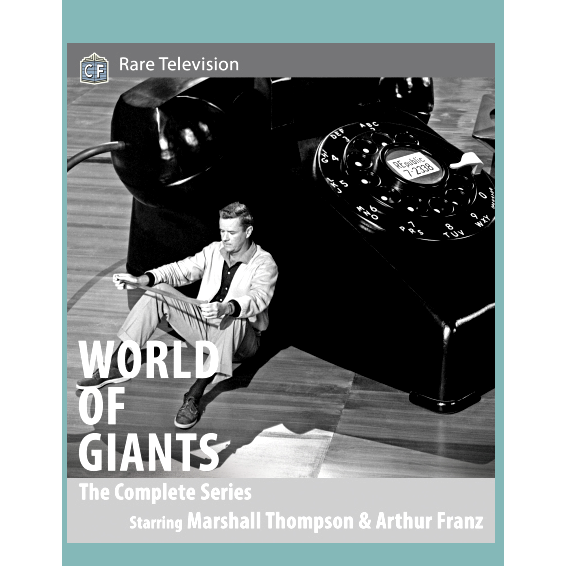

It’s interesting that this review should follow so closely after the drive-in monster movies made by Texas radio magnate Gordon McLendon, because ZIV TV, the producers of scores of syndicated TV shows, began in syndicated radio as well. Independent producers that pitched ideas to the big three networks often had to make a number of episodes, sometimes on their own dime. ZIV partnered with some independents, and some shows not picked up by CBS, NBC and ABC were retained by ZIV for syndicated playoff. Network affiliates had non- prime time hours to fill as well, and also booked shows from ZIV or one of its competitors. It was a complicated set-up, likely very insular and politics-minded.
ZIV was behind three science fiction shows of the 1950s. Producer Ivan Tors’ Science Fiction Theater ran for two years starting in 1955. Much more elaborate was Tors’ Men into Space (1959), which featured extensive special effects. It ran only one season (38 episodes). A third ZIV sci-fi show was derived from the ‘shrinking-giant’ subgenre of matinee thrillers, most notably Jack Arnold’s The Incredible Shrinking Man. The producer of World of Giants was former Universal-International Sci-fi mainstay William Alland, who had recently done some additional fantastic film producing over at Paramount.
World of Giants did not attain full syndication status. According to the ClassicFlix disc notes, momentum for the project fell off after the networks passed, even though CBS was involved in the show’s development. ZIV backed away as well — did they decide to roll the dice on the more expensive but also more topical Men into Space? ZIV itself would soon cease operations.

The thirteen World of Giants episodes premiered in early September 1959, finished up at Thanksgiving time and rattled about in spotty syndication for years thereafter. ZIV was sold to United Artists Television in 1960, reportedly because the 3 networks were now producing more of their non- prime time programming. UA TV (now MGM Television) owns many but not all of the shows, and World of Giants is not among their holdings. ClassicFlix has been presenting former ZIV programming on disc, seemingly through a relationship with the Wisconsin Center for Film and Theater Research.
What ClassicFlix Rare Television presents here is an entire short-run Sci-fi series, an amusing Cold War spy show featuring a six-inch secret agent. That’s his overall height. We like it for the personnel involved, and the chance to see its makers improve their product greatly over a very few episodes.

Every episode is introduced on screen with the booming voiceover “WOG – World of Giants.” The early shows feel underproduced, with a lot of dialogue. The special effects are also limited in the first two half-hours, but later shows become much more adventurous.
Every show begins with a stock shot (from the 1940’s!) of a Government building housing an intelligence agency that fights foreign spies from behind the Iron Curtain. On assignment somewhere in Eastern Europe, Federal Counter-Espionage Agent Mel Hunter (Marshall Thompson) was caught in a rocket fuel explosion. He survived but then started to shrink; the experts stopped the process at six inches. This back story happens off screen, and is recounted several times in dialogue in later episodes. At least one episode has Mel learning that, yes, the medical experts still haven’t found a way to reverse the process: ‘Breaking News! — You’re still a shrimp.”
Mel continues to work with his former partner Agent Bill Winters (Arthur Franz). Bill carts Mel around in a special valise rigged with a pilot’s chair and a round window so he can see out. In one episode Mel is transported about in a hollow box camera. Mel is able to sneak into places to find special information, overhear villainous plans, etc.. He and Bill are considered American’s most secret secret weapon. Mel must take risks related to his tiny stature, while Bill is wounded a couple of times in standard action confrontations. Episodes often end with Mel giving Bill critical information to pass on, and we only hear about the bad guys being rounded up off-screen. But one of the last episodes ends with Bill fast-draw shooting three men in a Jazz nightclub.
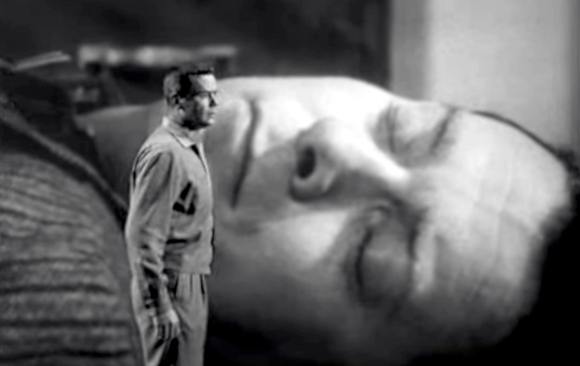
At first we’re given situations from Shrinking Man and Attack of the Puppet People: ‘look out for that giant pencil, Mel!’ ZIV’s resources are less than Universal but greater than Bert I. Gordon’s. Very good oversized sets and props are used; art designer Robert Kinoshita (Forbidden Planet) is credited with these. Much use is also made of rear projection. It clearly becomes evident that the footage with the ‘tiny’ Marshall Thompson was filmed separately, when the other actors didn’t have to be around. Most of the series directors blend the normal and the ‘miniaturized’ well enough. It’s obvious that a modern CGI extravaganza like Ant-Man shows more fantastic content in any given minute, than all of this series combined. If that negates earlier achievements, the discussion can quit right now.
The first four or five shows use somewhat dry Mel Hunter voiceovers, narrating his own exploits. He also addresses the camera at the finale, as would a series host. The fifth episode drops that format and introduces a new character. Miss Brown (Marcia Henderson of The Hypnotic Eye) is a secretary / nurse / dietician. She argues with Mel and warms up to Bill. She’s a welcome addition, as someone with a personality for the two spy partners to interact with.

By the time Miss Brown arrives Mel is living in a miniature house in Bill’s living room. Some of the special effect composites to marry the different-scaled sets together are excellent. In the last couple of shows, the doll house automatically disappears into a wall, like something from a Thunderbirds episode.
The later episodes also show more variety. Two have foreign settings and manage the requisite number of ‘exotic’ stereotypes and clichés. But one of the last shows features a respectable, nicely integrated role for black actor Bill Walker. His character ‘Daddy Dean’ is the only ‘civilian’ allowed to discover Mel Hunter’s amazing itty bitty status. He and Mel play music together . . . perhaps the plan was for Daddy Dean to become a recurring character.
The show doesn’t dwell on Mel Hunter’s psychological situation. He never brings up his past status as a full-sized man, and his mental state is mentioned only a bit in the first episodes. We’re assured that ‘keeping busy’ with spy work is the best medicine. Mel also doesn’t seem to miss having a sex life. When Bill and Miss Brown get semi-romantic in the last few episodes, dancing the mambo and even necking in a car (as part of an undercover operation), Mel doesn’t feel cheated. Back in his original novel The Shrinking Man, Richard Matheson made Robert Scott Carey’s sexual anxiety into a major story element.
The early shows confect to have Mel menaced by a cat, an opossum, and a dog. A show with a KS (killer squirrel) features an imaginative scene in a burrow rigged with a nasty vermin trap. Later on, Mel must repeatedly improvise when hiding in an enemy lair or ejected into some unexpected environment. He’s locked in a freezer and must hide next to a slot machine. He has to dive into a fancy swimming pool and even ‘zip-lines’ his way into a bad guy hideout. When Mel climbs inside a grand piano, the special effects are excellent.

Fans that watch old TV series to catch favorite actors will meet up with at least one familiar face per episode. Were some shows cast with people known from sci-fi movies? Note the links . . . Peggie Castle seduces Gavin MacLeod in one show ↑ , and Allison Hayes wears two swimsuits and clocks a KOUD (kiss of unusual duration) in another. Pamela Duncan is busy in an episode involving domestic treachery, while Palestinian-American actress Ziva Rodann plays Chinese in another. There’s also Berry Kroeger and Nestor Paiva as nasty enemies of freedom, and Harry Lauter and Gregg Palmer as good guys, with a walk-on by Brett Halsey.
Both of the show’s stars are of course steeped in fantastic film credits, even if that path wasn’t part of their career plan. Marshall Thompson opposed a snake monster, anti-matter brains, a Martian stowaway and a mutated spaceman. Hard-working Arthur Franz got sucked into fantastic fare early, flying to Mars, battling Martians back here, searching for a lost satellite, fighting an evolutionary throwback, and fighting yet more aliens under the polar ice cap.
One of the series producers hired himself to direct the first two episodes, but later shows employed directors noted for juggling assignments loaded with special effects. Oscar-winning art director-turned director Nathan Juran did four highly creative episodes. Harry Horner (2 episodes) was a celebrated art director as well. The hiring of producer William Alland’s ex-collaborator Jack Arnold is a natural; he did 2 episodes. But the one episode each by celebrated fantastic-film directors Byron Haskin and Eugène Lourié are possibly the best — they manage to get more interesting angles during the action scenes.

God bless these boutique DVD/BRD companies! I like Marshall Thompson and Arthur Franz, but holy Toledo, talk about two actors who define the term soporific. Irwin Allen’s LAND OF THE GIANTS from 1968-70 also had Tom Thumb-size people but a different premise. I’ve never seen either series; the ’50s show must not have aired in my area, and I was living in a college dorm when the Allen series ran, with little or no access to a TV.
I wish they would release a complete set of “Way Out”, but I’m not holding my breath.
The creature that Marshall Thompson battled was from Mars, not Venus. At least, if we’re both thinking of It! The Terror from Beyond Space.
Hah! Thanks. I will turn in my Space Cadet badge, in shame!