


As soon as some critic related the bloodletting in Sam Peckinpah’s The Wild Bunch to the politics of Vietnam, makers of westerns tried to push the boundaries of screen violence further – outright carnage became not something to carefully avoid, but a ‘production value.’ Several westerns took a dive into truly rotten taste: Soldier Blue all but advertised that it was about Vietnam, and gleefully showed Yankee cavalrymen mutilating Indian women in gory close-up.

Robert Aldrich had helped to kick off the flood of violence with his The Dirty Dozen. Several years later he returned to revisionist action genre pieces with Too Late the Hero, The Grissom Gang and eventually Emperor of the North. Although Aldrich had mixed feelings about it, his best picture of this period is Ulzana’s Raid, a for-its-time almost intolerably brutal western that dares to call an Apache an Apache, so to speak. Rather than telling us about savage atrocities, the show’s complex storyline forces us to experience them. When was the last time a western was genuinely scary? This is one picture that, when we walked back to our cars, we didn’t take the dark alley short cut.

Burt Lancaster had helped to launch Robert Aldrich’s directing career with 1954’s Apache, which filtered the Indian wars through the then-current Civil Rights issue. Ulzana reunited them after an eighteen-year break. The talented, beloved Lancaster was a powerful man who didn’t mind pushing people around to get his way (as is covered in the extras for The Swimmer). Aldrich was no pushover either, as proved by the fact that he had tamed Crawford and Davis ten years before. Because Lancaster held a partial financing stake, Ulzana’s Raid became a production battleground, resolved only in a truce. Two separate versions were finished, and released in different markets. Aldrich’s cut was shown in the United States, and Lancaster’s version in the UK. Lancaster’s cut dropped some scenes, added a few bits, and occasionally uses different takes for performance. Aldrich and Lancaster’s wrangling wasn’t personal, based on the fact that they worked together again five years later.

Ace screenwriter Alan Sharp (The Last Run, Night Moves, Rob Roy) takes the cruelty of frontier clashes a step beyond Sam Peckinpah’s bloody Major Dundee, where an Indian Scout offers a simple explanation for why Apache ‘renegades’ slaughter innocent settlers wholesale: “Because it’s their land, all of it.” Ulzana is almost a generation removed from Dundee in time. Just nine Apaches have skipped from the reservation but all of Arizona is scared to death, for good reason. Sharp and Aldrich don’t just report the carnage, they try to explain why the Indians do what they do.
The indigenous tribe may seem like blinking savages, but they’re really just on the losing side of the struggle for possession of The West. As the whites legislate away their land and rights, various Apache holdouts periodically express their displeasure, broad and bloody. The Apaches consider themselves part of the land itself, which is by its nature hostile and unforgiving.

Alan Sharp’s great screenplay reveals the Army’s mindset without sarcasm. Nine braves led by the cagey Ulzana (Joaquín Martinez) have split from captivity and are threatening violence against settlers. The stodgy Major Cartwright (Douglass Watson), following the book, stalls before sending help. To avoid dangerous duty, the experienced Captain Gates (Lloyd Bochner) nominates the green West Pointer Lt. Garnett DeBuin (Bruce Davison), a preacher’s son, to lead the patrol. He’s accompanied and advised by scout McIntosh (Burt Lancaster), an Indian expert whose common-law wife (Aimee Eccles) is an Apache. Due to the delay, the patrol is always one step behind Ulzana. A rider sent to warn close-in settlers is killed along with the farm wife he tries to protect. Another settler becomes a victim of play-torture, as are other unlucky farmers left mutilated and/or roasted alive. DeBuin and McIntosh repeatedly arrive too late to do anything, but they do ‘rescue’ a rape victim (Dran Hamilton) purposely left behind to slow them down. The expert tracking of Apache Scout Ke-Ni-Tay (Jorge Luke) helps McIntosh to overcome Ulzana’s advantage. The patrol will split up, and when Ulzana dares to attack one half, the other will come to its rescue. But that strategy requires the inexperienced Lt. DeBuin to develop some battlefield smarts, really quickly.
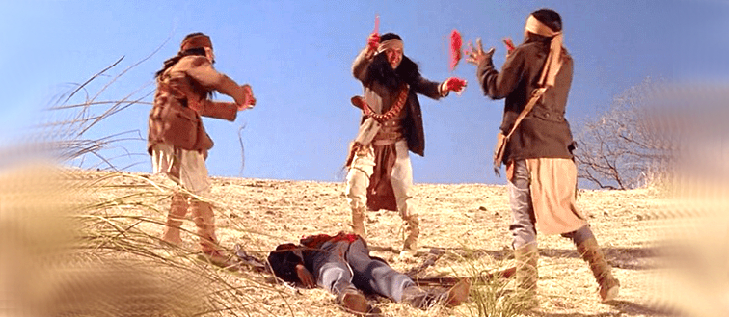
From a brutality standpoint Ulzana is far more explicit about Apache terror tactics than was Major Dundee, which opens with a full-on massacre. Alan Sharp details specific tortures by mostly showing the aftermath. This may be the first film to tell the truth behind the old plot chestnut about ‘saving a bullet for the lady’ so she won’t suffer a fate worse than death. Rather than be captured alive, a trooper commits a panicked murder-suicide. Another victimized woman is found tied to a wagon and beaten bloody, and surely gang-raped. The Apaches believe that killing a living man robs him of his ‘power,’ which is why they ignore corpses but go to town on their fresh kills. One man has his heart cut out and used for a game of catch. (top image ↑ ) A boy witness to the carnage is left untouched: boys aren’t men, and therefore have no power to be stolen. [Note – just today I heard a sociologist on the radio theorize that ‘important’ men molest women as a way of ‘taking their power.’]

One of Ulzana’s raiders is his own son. At one point the Apache chief uses a wickedly clever ruse to trick a settler (Karl Swenson of Dundee) into thinking that the cavalry has ridden to the rescue. Almost like the submarine-destroyer guesswork battle in The Enemy Below, McIntosh treats the desert like a big chessboard, and tries to out-think his opponent Ulzana. He reckons that the Apache has pulled a clever ’empty horses’ trick to throw the troopers off the track, and responds with a long-shot recon gambit. But even when the patrol successfully turn the tables on the Apaches, a dumb mistake and plain bad luck bring on chaos. The mission achieves its goal, but almost everyone we care about is killed. The show is a Robert Aldrich regulation high-tension ordeal, not a leave ’em laughing experience.
Burt Lancaster may have been on a power trip, but his acting shows no sign of star attitude. As he often did post- The Swimmer, Lancaster sublimates his bigger-than-life personality to play the cavalry scout who tries to teach a thing or two to Bruce Davison’s young Lieutenant. Not far removed from playing a teenaged rapist (in the grim Last Summer), Davison is excellent as the eager shave-tail in over his head. After a couple of encounters with mutilated corpses, Lt. DeBuin decides that he hates all Indians and wants them dead. Richard Jaeckel contributes an excellent performance as a seasoned sergeant well aware that ordinary troopers will suffer for bad decisions made by the officer in charge. He knows he’s in trouble when DeBuin sends him on an unnecessary, dangerous side mission.

Joaquín Martinez is excellent as Ulzana, who speaks no English and precious little Apache as he commands his nine cohorts with the skill of great General. Mexican actor Jorge Luke is also excellent as Ki-Ni-Tay, whose conversations with DeBuin bring out the thorny, somewhat perverse Apache philosophy of resistance against the white man. Although made by a committed liberal Ulzana’s Raid is no screed wailing over racial injustices. It acknowledges the naked racism involved in this unavoidable conflict for possession of the land.

As is the case with most Robert Aldrich’s movies, Ulzana’s Raid is neither visually elegant, nor does it pass the time with scenic pictorials. The opening establishing shots of Ft. Lowell are a series of ugly pans. The rocky Nevada and Arizona locations are impressive just the same. Michael Luciano’s editing helps clarify a great deal of complex action, and gives the moments of gore a jumpy, ‘did I just see that?’ quality. On a first viewing the final battle is a little confusing. We don’t always know exactly where the opposing forces are, or how the heck DeBuin is supposed to know when to ride to the rescue.
The cultural details are as good as Alan Sharp’s frequent dialogue zingers – it’s a very smart script. We see the troops playing baseball but we don’t get a good look at most of them as individuals. The gore and shock scenes up front guarantee that the remaining ninety minutes will be an edge-of-seat experience. The closest Ulzana’s comes to a liberating moment is when McIntosh, all alone, finds that his Sherlock-like guesswork has paid off. He gallops into a pursuit, flipping his rifle in the air as he prepares to fight like a knight of old. But despite what happens in the movies, only a trick shooter can hit anything from a galloping horse. The ever- realistic Sharp and Aldrich have McIntosh dismount before opening fire.
