
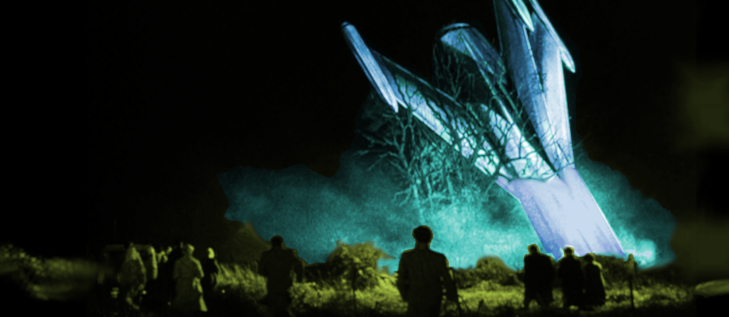


Writer-director Val Guest always said that he accepted the job of transforming the BBC serial The Quatermass Experiment into a feature film for Hammer, with the stipulation that he could do it his way, as a ‘reality’ show instead of a haunted house monster movie. The big success The Quatermass Xperiment doesn’t look like a handheld docudrama, but it also isn’t studio-bound or decorated with visuals previously associated with fantasy. Val Guest’s idea of ‘reality’ was simply to film in ordinary locations, without glamorous actors. An effort was made to treat the fantastic content — a crashed space ship, various slimy appearances of an outerspace organism — as if they were ‘just there’ and a camera was trained on them.
The newly restructured Hammer Films got serious with their library in 2024, creating massive multi-disc special editions curated with meaningful extras. It isn’t just for the big titles, either — the somewhat humble Four Sided Triangle received carte blanche treatment as well. Hammer’s breakthrough Sci-fi thriller merits the regal presentation: Nigel Kneale’s ‘monster from Outer Space’ is biologically convincing and genuinely frightening.
This is the first English Sci-fi classic of the 1950s, and arguably the most influential. The idea of an organic invasion from outer space uses us as its point of infection — a luckless astronaut becomes the organic raw material for a species from beyond the stars. Hammer would quickly follow with a variation on the idea, while exploitative blob-monsters appeared across the globe, in Japan, the U.S., and Italy. The astronaut’s fate gave a preview of David Cronenberg’s ‘body horror’ films made two decades later, with their bizarre tumors and organic transformations. The idea isn’t magic — as every Monarch butterfly knows well.

Forget bug-eyed monsters and death rays: if a ship from the tropics can bring a deadly virus to Europe, why can’t a rocket bring an unknown alien contagion back from outer space? Hammer exploited the BBFC’s ‘X’ certificate as a marketing gimmick by giving Kneale’s title an alternate spelling. Co-writer and director Val Guest distilled the BBC’s multi-part teleplay down to eighty suspenseful minutes. In June of 1956, nine months after the London debut, United Artists’ slightly abridged import version hit American screens with the title The Creeping Unknown.
England has a ‘Rocket Group.’
England has a special project for space exploration. Professor Bernard Quatermass (Donlevy) rushes to the crash site of his rocket group’s first manned spaceship. Astronaut Victor Carroon (Richard Wordsworth) stumbles alone from the sealed cockpit; his two companions are inexplicably missing from the tightly sealed ship. Victor is in a sickly trance, unable to speak. Doctor Briscoe (David King-Wood) discovers that his tissues are undergoing disturbing changes. Convinced that Quatermass has quarantined her husband for his own interests, Judith Carroon (Margia Dean) hires private detective Christie (Harold Lang of Hammer’s Cloudburst) to spirit the sick astronaut from the hospital. The now deranged Carroon instead kills Christie and escapes into the streets, leaving Quatermass with no choice but to help Scotland Yard’s Inspector Lomax (popular English actor Jack Warner) track him down
What happened in space? The Professor has the answer: an alien entity entered the spaceship in flight, consumed the other two astronauts and took up residence in Carroon’s body. The space ‘thing’ collects and incorporates living organic matter into its biology. No longer himself, Victor absorbs other organisms (a cactus plant, zoo animals, unlucky humans) for raw material. By the time Quatermass corners Carroon in Westminster Abbey, the astronaut has become a mollusk-like mass of protoplasm.

Writer Nigel Kneale kept the supernatural out of his Sci-fi concepts: Demonic Posession has been replaced by Parasitic Infestation. The ‘space contagion’ may not even be intelligent. Unlike American Sci-fi scripts compelled to by the Production Code to respect a religious theme, this show dispenses with the notion that the unknown is God’s domain, that scientists are trespassers. The unflattering truth about man’s place in the cosmos is that the difference between a human being and crawling vermin is apparently just a few hundred switch-throws on a helix of DNA.
The courageous space pioneer Carroon was in the wrong space ship at the wrong time . . . he knew the job was dangerous, but can’t have imagined this might happen. It’s the same progress vs. humanism problem seen in David Lean’s The Sound Barrier. Kneale’s Quatermass character assumeat s that space is man’s future, and that risking the lives of brave astronauts is necessary.
Quatermass and Briscoe treat Victor Carroon like a test subject in a research clinic. They keep him in a loose quarantine, not realizing that Victor is himself the disease. An interesting test: find the exact point where Quatermass and Lomax stop regarding Carroon as human to be rescued, and start thinking of him as a monster to be exterminated. When does the change in attitude take place?

Inspector Lomax is the film’s voice of humanism, a decent fellow who finds himself taxed with saving London from alien monsters. The Bernard Quatermass from Nigel Kneale’s TV serials was a similar fellow, a kindly and responsible gentleman. Given the American actor Brian Donlevy, Val Guest reinterprets the Professor as a human blunt object, shouting at his colleagues and bashing through bureaucratic obstacles. Bernard doesn’t brood over his hard decisions, as did his American predecessor Dr. Fleming (Morris Ankrum) in co-producer Robert Lippert’s earlier Rocketship X-M. Quatermass wastes no time in mourning. The failure of the first space mission only makes the next more urgent.
Why Brian Donlevy as Quatermass? American producing partner Lippert may have remembered Donlevy’s part nine years earlier in MGM’s propaganda whitewash of the Manhattan Project, The Beginning or the End. Donlevy’s Quatermass runs his ‘Rocket Group’ as seriously as his General Leslie Groves oversees his Atom Project. It’s an important movie to see, in the wake of the recent blockbuster Oppenheimer.

The Quatermass Xperiment excels because its creature is more than a man in a scary costume. Growing inside the pathetic Carroon, the cosmic parasite is a disturbing thing to contemplate. It rearranges Victor’s internal structure as it absorbs more living things. The creature grows differently depending on what organic matter it absorbs, an idea that echoes the shape-shifting creature in the famous science fiction story Who Goes There? The parasite’s possession-control capability is made shockingly clear when Carroon is compelled to painfully smash his hand into a cactus plant. The result is an arm that sprouts grotesque plant-like thorns; its swollen appearance also reminds us of photos of nuclear accident victims. By the time the Carroon-creature is killing and absorbing zoo animals, we see only its staring eye, and hear its bulk dragging along the ground. The only hint of Carroon’s final form is the snail-like slime trail he leaves on wet cobblestone streets.
An early ‘Found Footage’ experiment.
Is the show a debut for ‘found footage’ filmmaking? We see no flashbacks to the space flight. The rocket’s on-board automatic camera recorded time-lapse images of the flight, just as had been done on WW2 bombing missions. Quatermass and his Rocket Project assistant Marsh (Maurice Kaufmann, unbilled) instead look for clues to the mystery by viewing the film recovered from the crashed rocket.
Guest’s realistic approach adopts the urban-dull look of realistic British crime films. Ten years after the war, the London we see is still economically depressed; Carroon makes contact mostly with working-class people like Thora Hird’s alcoholic street vagrant. Xperiment was a medium to low-budget production. Hammer’s local Bray Fire Brigade was enlisted for the opening with the crashed rocket, which sticks out of the ground like a dart. Because London’s Westminster Abbey denied admission to Hammer’s film crews, special effects man Les Bowie used static mattes to insert live action into still photos of the famous church. A nighttime dragnet scene economizes by incorporating stock shots from an earlier atom extortion thriller, the highly recommended Seven Days to Noon. It has the exact same semi-documentary approach employed by Val Guest.
In addition to supplying additional financing and actor Brian Donlevy, the American producer Lippert nominated his actress-girlfriend Margia Dean for the film’s only substantial female role. Dean receives star billing on American posters but is poorly dubbed and does not come off well. Also in the cast are favorites Gordon Jackson as a TV director, and Lionel Jeffries as a harried Rocket Establishment bureaucrat.

Alien life always “finds a way” too.
Nobody forgets Richard Wordsworth’s haunted-looking astronaut. The actor’s mime neatly balances sympathy and menace, projecting the idea that a malevolent ‘other’ is in control. As sympathetic as Frankenstein’s monster, Carroon has a beautifully acted and directed Karloff-like encounter with a little slum girl, who doesn’t know how lucky she is. The child is a very young Jane Asher, who only wants to play Tea with her favorite dolly. Ms. Asher was later to become an accomplished actress (The Masque of the Red Death, Alfie) but for a long time was more famous as the girlfriend of Paul McCartney.
In the (now mostly lost) original TV production, the alien invader inside Caroon could communicate with Quatermass. The organism also retained the consciousness of the other two ‘ingested’ spacemen. Could that icky concept have inspired Roger Corman’s Attack of the Crab Monsters, or had a score of Sci-fi pulp stories already used a similar premise?
The Quatermass Xperiment is acknowledged as a major step forward in filmed Science fiction. Sci-fi thrillers of the ’50s offered violent threats and conservative sermons about ‘irresponsible’ science. Part of the unease behind Xperiment is its suggestion that, where Life in the Universe is concerned, Earth may be little more than an orbiting Petri Dish waiting to be colonized by whatever alien organisms might drift by. In other words, the cosmos is more likely ruled by cruel competitive biology, than a benevolent God.
Hammer Films would acquire all three of the Nigel Kneale’s BBC Quatermass serials for adaptation to the big screen. The company followed up quickly with the even more exciting Quatermass 2, also starring Brian Donlevy. The third installment was delayed by seven years while the studio pursued its lucrative gothic horror subjects. Packed with imaginative and intellectually stimulating ideas, Nigel Kneale’s Quatermass trilogy is now considered a high point of classic British science fiction filmmaking.

This box set is indeed worth the purchase, especially if you have a player that is Region Free. The only downside is the presentation of “The Creeping Unknown” US edit, as it has a major editorial boo-boo, caused via an oversight by the restorationists, during the scene when Quatermass first meets Inspector Lomax in his office: the original American edit cuts from Lomax recieving his shaving kit to a police officer announcing that Quatermass is here to see the Inspector. But, because the restorationists use the restoration of the longer British version with the American edit as a guide, they accidentally edit out the police officer entering and immediately cut to Quatermass entering the office! No worries, the presentation of the British cut is complete, but I did inform Hammer about this editorial mistake and they said a replacement disc isn’t in the works yet. That aside, this box set is worth the purchase.
Thank you, Chris! These new Hammer boxes are pricey, but WHOA! what content! Christmas list, here they come!
Now can we get a 4K of Quatermass and The Pit?