
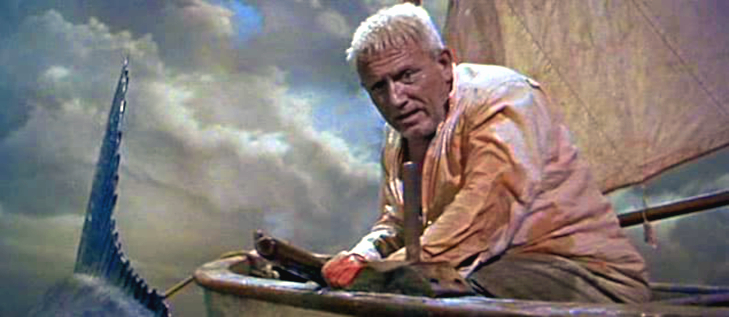


The 1958 adaptation of Ernest Hemingway’s The Old Man and the Sea has the reputation of an expensive flop, yet it’s not a terrible picture. It went on record as one of those drawn-out productions that learned nothing from previous films’ mistakes and invented new pitfalls of its own. The price tag somewhere north of 5 million dollars is astonishing for a picture only 87 minutes long, that consists mostly of one man in a boat. Producer Leland Hayward had sterling successes on Broadway and Television, but his three forays into producing for Warner Bros. were rife with problems . . . mainly of the ‘who’s in charge here?’ variety.
Made from Hayward’s long-running Broadway production, Mister Roberts became an ongoing fight between its star Henry Fonda and its two directors; John Ford pushed its sentimental comedy to an extreme. Hayward then produced the beautiful biography The Spirit of St. Louis but gave Charles Lindbergh too much veto power. At the aviator’s personal whim, entire sections of Billy Wilder’s vision were cut out and thrown away.

For The Old Man and the Sea Hayward allowed Ernest Hemingway to inflate the budget, and denied the perfectionist director Fred Zinnemann crucial decision-making power. John Huston was skipped over as director as was Anthony Quinn as the ‘Old Man’; Hemingway and Warners wanted Spencer Tracy even though the heavy Irishman would never convince as a starving Cuban fisherman. Nobody could decide how to structure the film; writer John Osborne invented new storylines, dropping the narration and making the ordeal of Santiago in the boat alternate with the young boy’s problems back on land.
Zinnemann reportedly added business about the economic plight of the poor fisherman, which reminds us of the director’s early film in Mexico, a political drama about a fishermans’ strike (Redes). Spencer Tracy was difficult to work with. The famed actor’s promise to lose weight had come to nothing. Lost shooting days were chalked up to Tracy’s health issues that even he admitted was a drinking problem. Over budget and unable to shoot scenes with Tracy at sea, Zinnemann eventually quit Old Man.

The filming of The Old Man and the Sea is a full chapter in Glenn Lovell’s Escape Artist, a fine biography of Zinnemann’s replacement, director John Sturges. Just four years before Sturges had slugged his way through another expensive and mismanaged ocean-going adventure for Howard Hughes at RKO, Underwater! Sturges admired Zinnemann’s footage of the fishing village and the ocean skies, but little else was useable. A lot of money was expended trying to get footage to represent a giant marlin fish fighting at the end of the Old Man’s fishing line. A $75,000 junket to Peru was a bust — Hemingway himself was an advisor on the trip.
Under Sturges’ firm hand, underwater experts shot shark attacks in Hawaii. The unobtainable marlin fishing footage was purchased from a private party — who receives special notice in the film’s credits. Spencer Tracy performed much of his role in a studio tank, and on an insert stage to film traveling matte process close-ups.
Hemingway comes in for a lot of revisionist derision these days, what with the lessened popularity of his macho attitude. But in the 1950s his reputation was unassailable, an aura that bolstered the film adaptation despite its drawbacks. The show looks good but has very little Caribbean flavor. We take Tracy as more of a Hemingway figure than an old Cuban fisherman — even though the book’s Santiago is described as a blue-eyed transplanted Spaniard. The many composite shots of the old fisherman ringed by telltale matte lines were a distraction in old substandard TV prints. Even with excellent camera angles and good editing, we’re always aware that Tracy is a movie star emoting in a studio tank.

Early in the inception phase, one advisor recommended that the movie be filmed as a minimalist recital of Hemingway’s dramatic prose, that producer Hayward should simply illustrate Spencer Tracy’s narration with shots of the ocean, sky, and distant views of a man in a little boat. But that was never the Hollywood way of doing things. Writer Peter Vertiel (We Were Strangers, Decision Before Dawn, The Sun Also Rises) followed Hemingway’s story closely.
Yet Tracy’s narration did end up as the film’s backbone. Tracy at first didn’t like the idea of performing as Santiago, with his voice also providing a simultanous voiceover from an omnicient author. To convince Tracy, director Sturges had to first record Joseph Cotten reading an entire narration track. That sounds like a clever maneuver: what star ego would yield so much of the limelight to another actor’s voice?
That’s just not how we do things in Hollywood.
The finished movie is in no way minimalist, even with Zinnemann and James Wong Howe’s impressive images of the windy fishing village and the beach at night. The interior of Santiago’s cabin is clearly a Hollywood set. Actor Harry Bellaver (!) puts on a light accent but neither he nor his cantina conjure much Cuban flavor. With the entire film a Gringo concoction, there’s not enough contrast to bring out the irony of the tourists at the finale. Santiago’s interior life is expressed in sidebar sequences — the memory of an arm-wrestling bout in a noisy bar (not bad), and some images from a stock film library to illustrate his recurring dream of ‘lions playing on a beach.’
We’re told that Sturges ordered up the blur-smear opticals that lend a hallucinatory feel to the lion footage. They’re rather good — some of the effects look more psychedelic than what was concocted eight years later for Roger Corman’s The Trip. Similar organic-blur opicals are used during the long sail back to port, when the exhausted Santiago begins to lose his vision.

A tough-minded but artistic organizer, John Sturges got the needed images on film — his special second unit shoot of the underwater shark attack obtained excellent results. But what really made Sturges the ideal director for Old Man was his track record working with Spencer Tracy, on MGM’s The People Against O’Hara and of course Bad Day at Black Rock. But Tracy was becoming more troublesome with each new movie, making unreasonable demands and ducking out of starring commitments. He had unpredictable bouts of ‘bad health’ — an expensive publicity junket for Old Man had to be cancelled when he fell sick after flying to New York. Tracy trusted Sturges enough to take his direction and yield to his judgment.
Yet the star delivers a compelling performance . . .
Despite being technically miscast and physically limited, Spencer Tracy is excellent in the movie. He underplays everything with a natural ease, the struggle with the fish and the battle with the sharks. His eyes shine with the light proclaimed in Hemingway’s text. The entire show is his, and he lets himself relax in it. With nobody to upstage, Tracy doesn’t pull attention-getting tricks. That’s quite an achievement for a performance constructed from bits of action filmed on an insert stage, or sitting in a boat floating on a Warner sound stage. *

Spencer Tracy’s voiceovers are magnificent; after seeing the movie it’s difficult not to ‘hear’ his voice when reading the book. Sturges entreated Hemingway to honor his commitment to the project by writing some new bridging voiceover, to help the continuity. Tracy’s voice binds the drama together, softening the impact of the mixed visual surface — Cuban locations, stock shots of marlins and lions, and artificial shots revealing the curved edge of an ‘interior ocean’ below a painted cyclorama. ↑ Adding greatly to the film’s emotional mood is composer Dimitri Tiomkin’s beautiful music score, avoiding the bombast heard in some of his epics. The gentle music is a fine background for Tracy’s soothing voice.
The movie did not chalk up a big success at the box office. Hemingway criticized the end result and refused to directly endorse it. Warners opened the show in an enormous New York picture palace that it could in no way fill. It was accompanied by a ballet short subject, so audiences wouldn’t feel cheated for time. Although it can’t compare with John Huston’s superb filmization of Stephen Crane’s The Red Badge of Courage, The Old Man and the Sea is not the total failure it could have been. Fred Zinnemann, James Wong Howe and John Sturges all contributed to a literary adaptation that captures some of Hemingway’s flavor.
Anthony Quinn got his chance to play The Old Man for a TV movie many years later. John Sturges would consult on the pre-production for Jaws, advising the 1970s filmmakers that if they filmed at sea, they might spend a year trying to get the ocean to cooperate with their storyboard plans. That’s pretty much exactly what Spielberg did — but his movie certainly wouldn’t have worked if it were filmed in a studio tank . . .

