Unique added-value extras may justify a fan double-dip for Studiocanal’s U.K. Region B release of Roger Corman’s horror classic. The new restoration of this colorful 1964 shocker knocks us out with reinstated censor trims and an improved image quality. The Masque of the Red Death is a familiar title, but I’ll still cover the basics before weighing in on this specific presentation.
Along with Elia Kazan’s Panic in the Streets and Steven Soderbergh’s Contagion, this film thriller seems closely attuned to our current worldwide pandemic. Corman’s pestilence strikes at a discreet literary distance hundreds of years in the past, yet complacent First Worlders can readily relate to the social and economic inequity it depicts. Poe’s wealthy nobleman rides out the catastrophe in style, while the poor and dispossessed must accept that ‘it is what it is.’

It’s the Middle Ages, a sinkhole of feudal injustice. When the plague comes Prince Prospero (Vincent Price) invites his sycophantic noble neighbors to wait it out in the safety of his castle. He also takes under his sinister ‘protection’ a local peasant girl, the beautiful Francesca (Jane Asher). Francesca thinks she will save the lives of her beloved Gino (David Weston) and her father (Nigel Green), but Prospero has no intention of keeping his promise: he commits evil deeds in worship to his master, Satan. Juliana (Hazel Court) becomes jealous and seeks to win Prospero back by proving her devotion to Satan in an eerie ceremony. Prospero throws a major costume party to celebrate the suffering going on outside the castle walls. His court jester Hop Toad (Skip Martin) uses the revels to take revenge on Prospero’s most abusive guest Alfredo (Patrick Magee), for striking his fellow performer, the tiny dancer Esmerelda (Verina Greenlaw).
Is this Corman’s most successful Poe adaptation? After his second color gothic The Pit and the Pendulum Corman strained to keep the series fresh — trying out a multi-story format, a different lead actor, and comedy self-parodies. Relocating to England did the trick. Masque does more than sidestep the ‘twisty red candle’ economizing. It can afford a whole new look thanks to the cost savings to be found in England — and access to the highly creative English cameraman Nicholas Roeg.
This Poe source story lends itself well to feature adaptation, especially after Charles Beaumont and R. Wright Campbell incorporate Poe’s story Hop Frog as a sadistic sidebar. The quasi-Italian background isn’t as jarring as the phony Spain of Pit and the Pendulum. Corman was somehow able to bring his designer Daniel Haller with him to England, where a set from Becket was combined with mix-n-match standing flats to create large warrens of corridors, chambers, battlements and dungeons. Prospero’s decadent parties are brightly lit but elsewhere Roeg gives Masque an eerie, color-coded dread.

Vincent Price’s Prince Prospero is grand, commanding and convincingly cruel. He orders executions and burns villages as if disciplining himself to be evil. His attraction to the innocence of Jane Asher is well-motivated. Prospero doesn’t just spout pro-Satanic sentiments; he fancies himself a devout disciple and aspires to gain favor with the Dark One by being as ignoble as possible. True to the source story, Prospero has misread the balance of power in the universe. If Satan exists, he has influence only over the human mind. The specter of Death (or Deaths) hold sway over the Human Condition, and nobody can bargain with death.
Charles Beaumont and R. Wright Campbell were already veteran Corman screenwriters. For Masque they firmly establish each character’s relationship to the main question of Evil in the world. It’s assumed that deflowering innocent girls is one of Prospero’s favorite pastimes. His guests are decadent hedonists unmoved by the inequities suffered by the common folk. Patrick Magee (of the Wright/Corman The Young Racers and Francis Coppola’s Dementia 13) is given dialogue that spells out his interest in having sex with the tiny Esmerelda. ↑ Prospero encourages such liberties in his guests, as their perversity supports his twisted worldview. As an active petitioner to Satan, he has selfishly granted himself exalted status.
Prospero’s interest in Francesca deepens his character — the prince claims that he wishes to ‘educate’ her in dark depravities. Francesca is appalled by Prospero’s cruelty and dismayed by his self-justifications, his insistence that the world is horrible and that Francesca’s loving God is dead. Yet Prospero regards Francesca’s courage and convictions as worthy values. He praises her courage to what he thinks is an emissary of the Devil.

↑ Jane Asher is terrific in a difficult role — sweet and vulnerable, yet morally strong. Her first humiliation is a nude bath with Prospero and Juliana looking on. That Corman gets away with this scene in 1964 is fairly amazing (although a glimpse here and a couple of frames there were trimmed from original prints). For being slighted as a ‘girlfriend of a Beatle’ Ms. Asher has a fine record as an actress, both as a child in Val Guest’s The Quatermass Xperiment and later in Lewis Gilbert’s Alfie, as a ‘bird’ that rejects Michael Caine’s cockney chauvinism.
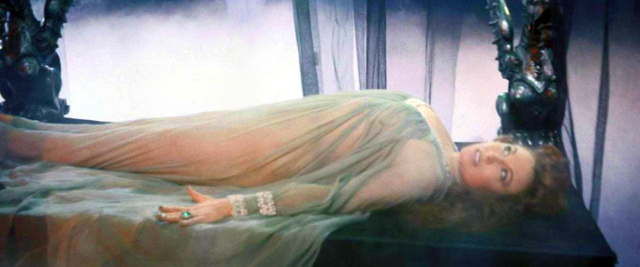
↓ This may be the strongest screen role for the great Hazel Court, who reigned in Hammer’s premiere horrorshow in color (The Curse of Frankenstein) and didn’t mind returning to the genre in The Man Who Could Cheat Death and Corman’s own The Premature Burial and The Raven. Court’s Juliana is the rare female horror character that voluntarily seeks the Dark Side — her Satanic belief is as strong as Propero’s. She’s convinced that by ‘going all the way’ she will win some kind of immortality. Her mania seems more credible now than it did fifty years ago — fanatics routinely throw their lives into religious and political insanity for irrational beliefs.
Juliana is granted this Corman/Poe film’s regulation dream sequence, stylized with a blue or green color wash, overlaid mist and visual distortion… did Corman do similar ‘drug trip’ hallucination sequences before the first Poe House of Usher? It’s a semi-subjective experience for the terrified Juliana, what with demonic warlocks from ancient civilizations threatening her with daggers. Ms. Court throws all she has into those screams. The dream-hallucination neatly sets up the next scene with the falcon, and raises more questions about the exact nature of Masque’s cosmology: (spoiler) Is Juliana merely another of Prospero’s victims, or are demonic forces really at work?

The Masque of the Red Death allows no relief from the morbid Poe/Corman formula. The parade of cruelties never stops. Miserable peasants are burned from their homes and scattered. Supplicants that beg for mercy at the castle walls are met with deadly arrows, peasant and noble alike. Displays of courage are answered with games of death. Poor Gino and Francesca’s father are forced to play a suicide game for Prospero, who is amused by their foolish efforts to be virtuous.
Did Roger Corman ever risk censorship before this film? We never heard of him challenging the Production Code in his low-budget work, if only to avoid spending money unnecessarily. But Masque pushes the standards of 1964, English and American. No ‘positive’ authority figure challenges Prospero’s twisted theories. His cruelties are dished out without filmmaker comment, and no force of mercy and decency comes to the rescue. Every set piece is played straight and sadistic. We have no reason to believe that the rebellious Hop Toad, the innocent Esmerelda or the courageous Francesca’s efforts to survive will come to anything.
Vincent Price’s performance stands separate from his more parodic Poe villains — there’s no ‘wink’ in this character. Prospero is a victim of his own vanity and presumption. His kindness toward Francesca seems a major misstep for a mortal who wants to impress The Devil.

Masque seemed a new experience this time, with Nicolas Roeg’s lighting making most of the movie look far better than the earlier Poes. The stagey quality of the hill where the color-coded Deaths meet still reminds us of those shallow interiors back at the rental studio on Hollywood’s Van Ness Avenue. Although very good, the masked ball scene isn’t the crowning climax it might have been. The lighting and choreography seem rushed and Corman’s camera direction is less creative. It doesn’t attempt the full-tilt delirium of similar scenes in the English- classic Dead of Night and John Parker’s overachieving oddity Dementia.
Several interesting actors draw our attention. ↓ Skip Martin’s dwarf performer Hop Toad sees a pragmatic way to get free of Prospero’s terror. Esmerelda is played not by a midget but by an 8-year-old girl, Verina Greenlaw, who three years before was the lost tyke ‘Trixie’ in Val Guest’s The Day the Earth Caught Fire. Familiar player Nigel Green (The Ipcress File) gets little attention from Corman’s camera, and his one dialogue line sounds as if it were dubbed by someone else. Keeping things ship-shape in Prosepero’s torture dungeon is Robert Brown, remembered from Hammer Films’ The Abominable Snowman, and a future ‘M’ in Roger Moore and Timothy Dalton 007 films.

Perhaps the most successful blend of script, design, cinematography and direction comes with Prince Prospero’s string of colored rooms, chambers that suggest a passage from reality into the devil’s domain. It expresses the notion that the road to Evil is a series of steps, like the river voyage in Heart of Darkness. The final chamber is a black room with a scarlet window; it seems psychologically workable that Juliana could use the ‘magic’ chamber to will herself into a state of ‘malevolent enlightenment.’
Take another look at Paul Schrader’s Hardcore and you’ll see that its conclusion borrows wholesale the motif of Masque’s ‘colored rooms.’ When George C. Scott rescues his daughter from a sleazy brothel he smashes through a series of identical but differently-painted sex cribs. He finds her in the last chamber, at the ‘heart of porno darkness.’ It’s a nice allusion to the Corman film & the Poe story.
Roger Corman stays true to Poe right to the end. We expect a conventional Christian victory over Satan with lovers sharing a kiss. Even though the Deaths spare the little girl, the finale instead opts for a nihilistic statement. Forget the battle between good and evil or God and Satan — there is only the common denominator of extinction.