


Good movies get re-assessed over the years, and as new eyes evaluate them almost all end up ‘dating,’ i.e., picking up the need for some topical flaw to be explained, perhaps even excused. John Frankenheimer’s The Manchurian Candidate is somehow more topical than ever. Once considered an artifact of a troubled time, it now seems to know something about those times that nobody else knew. It’s still good for a solid hour of heated discussion, if not outright argument.
Only a choice few political thrillers of the 1950s and 1960s have grown in stature, but no film has made as complete a jump from fantasy to plausibility as this one. It’s the key link between films noirs and the later conspiracy-minded movies of the 1970s. Predating the first Kennedy assassination, the movie weirdly predicts our national shift toward political distrust and insecurity. Author Richard Condon may have meant his book as a Cold War satire, but both it and the movie have now taken on bigger meanings. In 1962 the idea that a deep cover agent could be hypnotized and programmed to carry out the orders of a foreign enemy was taken as science fiction or fantasy. Now we aren’t so sure.
Representing the best filmmaking work by everyone involved, The Manchurian Candidate becomes more complex the more one sees it. The title is now commonly evoked to describe conspiracies real and imagined. In later years critics and analysts have claimed that the ‘conspiratorial’ filmmakers hid a secret or two within the movie itself. I shall explain.
The story takes place in the Red Scare years just after the Korean War. Former POW Captain Bennett Marco (Frank Sinatra) has recurring dreams that tell him there’s something false about his experience in combat. He investigates his old platoon buddy and fellow ex-prisoner Sgt. Raymond Shaw (Laurence Harvey), a Medal of Honor winner. Unbeknownst even to himself, Raymond has been brainwashed. Russian and Chinese communists have psychologically programmed him to function as a conscienceless assassin. The spies are waiting for the right moment to put Shaw into action. But who is controlling him?

This synopsis has been minimized with the idea that someone out there may not have seen The Manchurian Candidate; we wouldn’t want to spoil that experience for anybody. In fact, if you like intelligent thrillers and haven’t seen the movie, stop reading this. It’s unlike any other. Frankenheimer’s film is the essence of the paranoid thriller subgenre that came into its own in the 1970s and is commonly linked to the cultural cynicism over Vietnam, Watergate and the previous decade’s political assassinations. With so much lying and covering-up going on, the public was ready to believe anything about anybody. Now, of course, we as a nation are constantly distracted by so many outright lies that ordinary relevant facts have been crowded out of the public discourse.
But just ten years earlier Candidate was far-fetched fantasy. It also flopped on release, a development that confounded those critics that instantly recognized a superior entertainment. Perhaps it was a bad year for intense intellectual anxiety, what with Americans worried about the bomb. We would instead turn for reassurance to the upbeat escapism of James Bond. Variety reviewed Dr. No the same week as The Manchurian Candidate and praised it as well.
Yet The Manchurian Candidate stuck in the collective consciousness as a special movie that might be more true than it seemed. Rumors abounded as to why it was withdrawn from circulation, to be seen only infrequently. A persistent rumor has been that Frank Sinatra felt guilty because of the film’s similarities to the Kennedy assassination. In reality the problem was a financial tiff between Sinatra’s company and United Artists. The show was withdrawn simply so it wouldn’t drain the profits from other better-received Sinatra pix like the terrible Gunga Din remake, Sergeants Three. In any case, neither Sinatra nor anybody else expressed similar concerns over the actor’s earlier film Suddenly, in which he plays a sniper preparing to assassinate the President; it continued to play on late-night TV without comment. Sinatra starred in yet another sniper-assassin picture four years later with The Naked Runner. So much for the Guilt theory.

The Manchurian mystery has outlasted all of these rumors and myths. The film advances the notion that Communist experts could use Pavlovian techniques to brainwash American soldiers into becoming the unknowing pawns of spymaster-controllers. Using a programmed trigger, in this case the Queen of Diamonds playing card, the controllers instruct Raymond Shaw to do anything they want him to do and then order him to forget that he had ever done it. Previously, the Remote Control of Human Beings had been subject matter for comic books and outlandish science fiction films like Invaders from Mars. That makes The Manchurian Candidate science fiction as well.
The jovial Chinese mastermind Dr. Yen Lo (Khigh Dhiegh) chortles at the naïve idea that “people can’t be hypnotized to do things they wouldn’t normally do.” That commonly held belief is indeed foolish when one realizes that all one need do to circumvent the inhibitions of a hypnotized subject is to create a false reality. Stage hypnotists do this all the time, telling a subject they’re alone at home where no one can see them. Then they suggest that the subject do something silly that they wouldn’t normally do in public.
Laurence Harvey often looked stiff and uncomfortable in his movies. His better pictures Expresso Bongo and Room at the Top are exceptions to this; The Manchurian Candidate uses Harvey’s more typical unhappy presence to good effect. Angela
Lansbury’s harpy of a mother is correct when she says that it looks as if Raymond’s head is “about to come to a point in the next thirteen seconds.” Harvey always seems on the verge of a migraine, a perfect stance for a man with a head stuffed full of other people’s software commands.
The main theme in Condon’s book is McCarthyism. James Gregory’s John Yerkes Iselin may be a clown, but he’s a very dangerous one. Unlike the boorish self-promoter McCarthy, Iselin is a mere puppet following the directions of his wife, played by Angela Lansbury as a uniquely American female monster. Loud, prejudiced and insultingly dismissive of those around her, Mrs. Iselin is a brilliant but frustrated castrating female. To get her hands on power she’s willing to let the world go to ruin. She’s the engine of destruction in the American landscape, a species of grand misogynistic demon.

Lansbury actually has very little screen time in this intensely economical movie, but we know right away who is in charge. It’s her most assured, intense film performance.
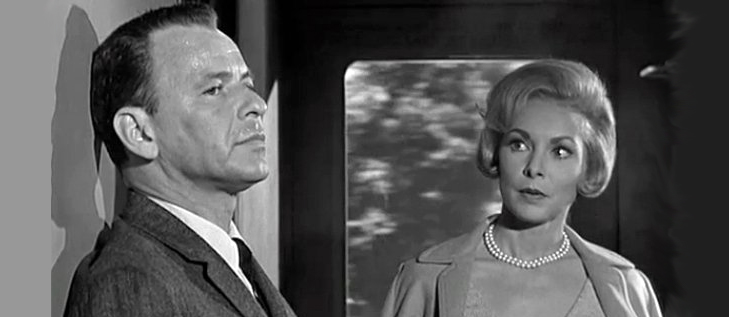
The intriguing pair-up in the show is Frank Sinatra and Janet Leigh. Sinatra had a bad habit of skating through his pictures, ignoring his directors and falling back on his casual, audience-pleasing ring-a-ding behaviors. He’s more committed to The Manchurian Candidate, giving many scenes his maximum concentration. He’s especially good when feverish and disoriented. Janet Leigh also gives her part a completely professional spin. She initially appears to serve little real function in the story. As William Friedkin explains, the Eugenie Rose Chaney character is just “the girl,” someone for Sinatra to romance between panic attacks. Or is she?
The movie is famous for George Axelrod’s eccentric writing, with weird dialogue stranger than anything in his Lord Love a Duck. Sinatra occasionally reverts to hip phrases, but nothing that breaks his character. Yet there is a vein of dialogue that some writers have pegged as placing a whole new perspective on the movie.
The oddities with Marco pile up very quickly. What’s with the dozens of books on all those weird subjects lying around his apartment? Why is he filling his head full of arcane knowledge? What exactly is happening in Rose’s introductory scene with Marco on the train? She keeps asking him questions and making statements with the names of states in them. She talks about being “one of the original Chinese who laid the track on this line.” Then they exchange comments that confuse the notions of being married and being Arabic. On the surface this talk is all nonsense. Marco and Rose recite it like it’s hipster jargon, with we the audience excluded from the joke.

The theory is that Raymond Shaw wasn’t the only soldier in China to be assigned a controller. Rose Chaney is Marco’s controller. Perhaps she rattles through several state names because saying them in a particular order will trigger Marco the way the Queen of Diamonds triggers Raymond. The Chinese laborers would seem an obvious reference to Dr. Yen Lo. What the, “Or are you Arabic?” line means is obscure, except that one of the books Marco was reading was about Arabic customs.
Rose Chaney — the girl with a thousand faces? — would appear to enter the conspiracy to babysit Marco and keep tabs on him. She first intercepts him when he’s on his way to his New York reunion with Raymond Shaw. She comes on strong, offering herself as both a lover and a nurturing mother figure. She commiserates with Marco over his bad luck and never interferes with his plans. She soon has him completely dependent upon her. Notice how professionally Rosie deflects Marco’s marriage proposal. She changes the subject as if she were talking to a child.
Frankly, in a movie as carefully organized as The Manchurian Candidate it makes no sense for Rosie to be “just the girl” for Sinatra. The commercial quota of sexy scenes is satisfied with Leslie Parrish. Why waste the screen time? And why return for that coda where Marco recites some facts about Medal of Honor winners before breaking down in remorse? The only explanation is that Rosie is still on the job, babysitting the only surviving brainwashing victim that can put the puzzle pieces together — or serve as the next phantom trigger man. As with later paranoid conspiracy films the movie ends with the villains still at large and their conspiracy intact. This particular five-year plan didn’t pay off, but the thinkers in Peiping surely have more projects in the works. Elect that loser Nixon, perhaps?
This interpretation has been around a long time, in various forms. It’s not considered a wild theory, but a legitimate read of the movie. The clearest explanation I’ve read is in Greil Marcus’ book The Manchurian Candidate, BFI Classics series, 2002.

The difference between The Manchurian Candidate and the decade’s more successful escapist spy movies is its sense of unease, perhaps inherited from film noir. 1989’s similarly plotted The Package builds up a nice momentum as Gene Hackman seeks to thwart an assassination plot. But Things become tame by the halfway point: we know Hackman will save the day in the nick of time. Even with its dark ending the film is reassuring. We’re never certain about anything in The Manchurian Candidate. It’s more than a simple case of “things are not as they seem.” Unlike Gene Hackman cutting the baddies down to size, we have no confidence that Marco will save the day. And he doesn’t, not really.
The supporting cast of The Manchurian Candidate is brilliantly chosen. Leslie Parrish (Daisy Mae in the overlooked musical L’il Abner) is cool and eccentric. Henry Silva is a stereotyped Korean who doesn’t look Korean. Various other roles veer toward cartoonishness without upsetting the rest of the film’s documentary surface. Making comic actor John McGiver represent the liberal opposition does not reassure us in the least. McGiver’s ineffective liberal is mocked with a freaky camera composition that makes it look as if the wings of an American Eagle are sprouting from his head, telegraphing that he’s about to become an angel. Similarly, James Gregory’s Iselin is frequently juxtaposed with images of Lincoln, reinforcing the notion that assassination is a historical tradition in America. It’s undeniably weird that right after The Manchurian Candidate political assassinations became the scourge of the decade.
The film contains director Frankenheimer’s cinematic masterstroke, an objective/subjective circular scene that confuses a Communist seminar with a ladies’ garden party. The conceptually challenging scene has a wicked sense of humor, and it explains itself solely through its visuals. The same Mad Tea Party is repeated from the POV of a black soldier (James Edwards), who then imagines all the garden ladies as black. But there’s always a sting in the tail — just as we’re laughing, we get a shockingly graphic bullet to the head. How many pre-1962 movies can you remember that show bloody brains splattering across a wall?
