


A few weeks back I had the pleasure of reviewing Jonathan Demme’s Melvin and Howard. Honest movies that create a good feeling about people aren’t common; a fellow reviewer told me that Demme’s good heart ‘just lights up that movie.’ As good fortune would have it, a similar picture is set to debut on Blu-ray, Hal Ashby’s The Landlord. It’s also postitive about the struggle to get along in America, and it has smart, non-abrasive things to say about race relations. Imagine that, a non-simplistic movie on the subject of race, made in a time of racially-sourced violence.
The Landlord is probably too humanist and sophisticated for 2019, let alone 1970. It’s a real beauty. It’s the first features directed by Hal Ashby, one of the most celebrated directors of the New Hollywood years. Ashby had already cut several award winning pictures for Norman Jewison, who nominated him to take on a project Jewison had planned for himself. The screenplay is by the impressive Bill Gunn, who also wrote and directed the cult hit Ganja and Hess.
The story confronts the issue of race directly, without falling into some of the liberal traps of other progressive pictures of 1970. Although technically a farce, the people we meet are too individual to be pinned down as ‘types.’ The cast is a dream team of new and established faces, some of whom are given their best roles.

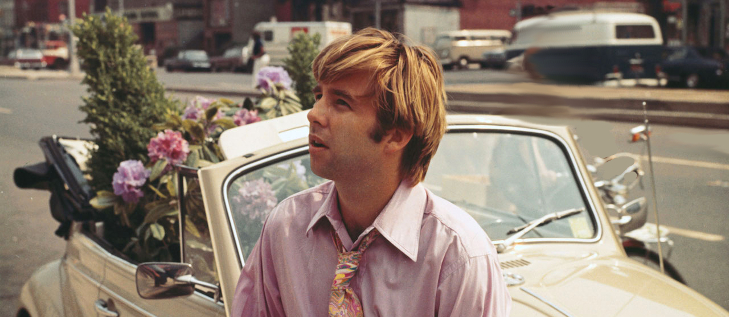
Home for the 29 year-old Elgar Enders (Beau Bridges) is a Long Island mansion dominated by his rich, success-oriented father William (Walter Brooke) and his elitist, superficial mother Joyce (Lee Grant). Elgar’s businessman brother William Jr. (Will Mackenzie) is swiftly climbing the career ladder, while Elgar is considered to be the loser offspring. Having quite a bit of money of his own, Elgar has bought a tenement in a depressed black N.Y. neighborhood. His first thought is to evict the deadbeat residents and remodel it as a trendy ‘personal project.’ When his parents object, Elgar throws a fit, challenging their openly racist attitudes in the presence of the black servants.
But Elgar isn’t welcome in his new home either. His arrival is met with harassment and suspicion. Tenants in the basement refuse to answer the door, and the ‘professor’ Duboise (Mel Stuart) snubs him. Elgar is tentatively befriended by Marge (Pearl Bailey), who manipulates him to avoid paying rent and to torpedo his eviction plans. Elgar becomes close with the other tenants, a troubled family. Young Wally Gee (Douglas Grant) extorts Elgar for money to buy cigarettes. The father Coupee (Louis Gossett Jr.) acts eccentric but is actually suffering from depression. The mother Fanny (Diana Sands) was once a ‘Miss Sepia’ beauty winner and now doesn’t know how to hold her family together. She gives Elgar a hard time but soon feels protective toward him, a relationship that becomes much more when they return from a party drunk one night.
Mom tries to get involved when Elgar falls in love with Lanie (Marki Bey), a club dancer who could pass for white. When Joyce comes to help decorate her son’s tenement, she ends up spending the afternoon getting stone drunk with Marge, so zonked that she gives Marge one of her credit cards. Elgar’s notion of evicting his tenants evaporates on its own. His emotional involvement continues with both Fanny and Lanie, until Fanny brings home news that could cause big problems…

The Landlord feels like a breath of fresh air. Former ace editor Ashby delivers stylish storytelling, finding elegant ways to incorporate avant-garde ideas. This is the kind of movie that could easily become a freewheeling farce pegged to a lot of showoff editorial gimmicks, like Francis Coppola’s You’re a Big Boy Now. Ashby instead subordinates the comedy to character detail. Outrageous things happen, but the show doesn’t try to deliver a big joke every few seconds.
We instead fall in love with the characters. Beau Bridges’s Elgar is naïve but not an idiot. In short order he commits 101 racial faux-pas, but he means well and his puppy-dog personality wins over most everybody. This should have been Bridges’ breakout role, and maybe it was, considering the industry respect that it earned him. It was Beau’s brother Jeff who would attain first-rank stardom in The Last Picture Show the very next year.
Lee Grant had a rough career, considering her terrific debut twenty years earlier in Detective Story; effectively blacklisted from films, she was relegated to stage and TV until she was in her mid-thirties. Grant’s performance is every bit as impressive as Anne Bancroft’s Mrs. Robinson in The Graduate. Her Long Island socialite Joyce is a thoughtlessly unconscious bigot too charming to be an outright villainess. Bill Gunn’s stealth-compassionate script sees to it that the GUILTY WHITE FEAR of the prosperous Elgars bobs to the surface, no matter the situation. Joyce displays twenty varieties of unconscious racism — when told that Elgar’s new girlfriend Lanie is light-skinned, she warns her son against potential female trickery, suggesting that Lanie may really be Jewish.

The movie has three more impressive performances by women. We lost the captivating Diana Sands so early that she gave us only a handful of film performances. Had the business been different in 1961 A Raisin in the Sun might have made her a star. Seeing Ms. Sands in Willie Dynamite was worthwhile, but we have yet to catching up with her co-starring role in Ben Maddow’s obscure, elusive An Affair of the Skin (1963). That leaves Diana Sands’ deeply felt, sympathetic Fanny in The Landlord as my favorite performance by a black actress. Fanny is funny, seductive, understanding and forgiving. She loves her husband even as she’s attracted to Elgar… and we don’t judge her for it. Fanny can’t hold Elgar to account for the problems of their relationship, but she can make him step beyond his irresponsibly ‘casual’ lifestyle choices. Sands and Louis Gossett Jr. also share the funniest dialogue scene of the decade, the speech about Fanny’s barbecue sauce.
This is probably the best film outing for Pearl Bailey as well. She’s warm and loose as Marge, the tenant who can have a roaring good time getting drunk with Joyce Enders, and then use Joyce’s drapery fabric to make new shirts for everyone. The Landlord sees its black characters as open and loving, yet withholding a basic trust when it comes to dealing with white people.

I’m not sure I want to see Marki Bey’s starring role in Paul Maslansky’s Sugar Hill, but I am knocked out by her Lanie, who falls in love with Elgar even though he asks her to dance thinking she’s all-white. Lanie’s in a strange position, able to pass but in no hurry to identify with white America. An impressive scene sees her sister go-go dancers giving her grief for being ‘high yaller,’ as if her light skin is a slight on black identity and black pride. The really smart people in this movie are all black women, and Lanie is no exception. The callow Elgar’s ‘cultural education’ doesn’t make him weak, as he becomes morally stronger, more responsible.
The Landlord was my first exposure to some great talent — Hal Ashby was either a genius for choosing winners, or he had good casting advice. We know that Marki Bey came from the chorus line of Pearl Bailey’s stage presentation of Hello, Dolly. The choice of other black actors is equally good. Louis Gossett Jr.’s last feature of note had been A Raisin in the Sun too. We first saw Mel Stuart in a great scene in Odds Against Tomorrow, which gave Diana Sands an early bit part. The remarkable Carl Lee makes an appearance as well.

The Landlord appears to be the first feature of Trish Van Devere, as one of Elgar’s girlfriends. The same goes for Susan Anspach as Elgar’s cheerful dope-smoking sister; Susan would continue in the center of New Hollywood with Five Easy Pieces and Blume in Love. Robert Klein has a smaller part, and he does have to wear blackface for one scene, but he adroitly trades competitive words with Elgar’s pompous father. Daddy’s money is in tobacco; Klein counters with napalm and deodorants. Walter Brooke will always be known as the ‘plastics!’ man from The Graduate. His presence tilts the show dangerously toward shallow sermonizing, but Ashby keeps those sequences short and to the point. Could the production have been aware that the movie Patton was in production? For a swanky costume party themed around ‘dead American heroes,’ father comes as General Patton. The charity party begins with a moment that looks as if the wealthy guests are pledging allegiance to a fancy convertible.
In the midst of the social comment, Hal Ashby applies just enough visual stylization and editorial finesse to distinguish The Landlord from 1970’s crop of art-movie pretenders. One early sequence is a non-linear discussion of blackness, which pops from face to face like a slice of experimental theater. A slightly expressionist lovemaking scene is reduced simply to abstract shots of faces and intertwined hands in semi-silhouette, that communicate a sharp sense of intimacy. Ashby twice cuts away to jolting images of stereotyped blacks, to illustrate Joyce Enders’ fearful racist thoughts. A croquet party begins on an expanse of green lawn, with the Enders’ guests standing like statues, as did the blasé swells at the Ascot race track in My Fair Lady. When we’re concerned about what may happen to a character in a hospital, Ashby creates a time-twisting suspense effect by extending a nurse’s walk down a corridor across three minutes of scenes.

An essential affection for people is a quality Hal Ashby shares with director Jonathan Demme, who can’t even make a movie about serial killers without expressing a basic respect for underdogs everywhere. In the end The Landlord is a humanistic appraisal of white guilt and black patience. Elgar ends up destabilizing Fanny’s already unstable family, with the result that even Lou Gossett’s ‘comic’ character deepens. How the movie’s thicket of ugly racial problems produces so many sympathetic characters is a wonder. Almost fifty years later, letting white attitudes off the hook is no longer an excuse, yet The Landlord doesn’t seem as dated as other socially conscious movies from the Age of Aquarius that were too quick to prescribe love and understanding as the solution for nearly everything. Maybe that criticism applies to this movie as well, but the richness of the characters pushes the message into positive territory. The end may be a fairy tale, but it’s a merciful fairy tale.
Besides, when it comes time to tell the truth the movie unerringly shows real teeth. Elgar’s re-defined statement of what “NAACP” stands for (which is too terrific to spoil by quoting), elicits the perfect reaction from his parents.
Pop: “What does that mean?”
Mom: “He just called us niggers.”
Fanny’s final words to Elgar step around her love for him, to cut deep:
“I want him to grow up casual like his daddy.”

