

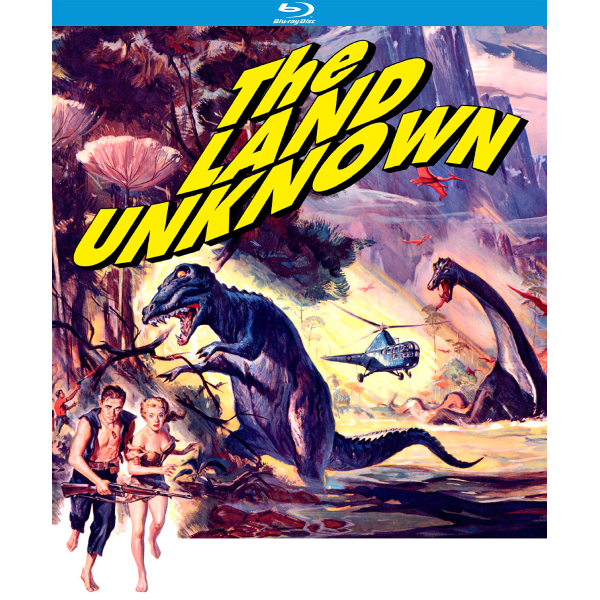

The Land Unknown is a surprising Universal Sci-Fi in that it doesn’t really deliver on its promise. An epic tale that creates an alternate Sir Arthur Conan Doyle Lost World in the Antarctic wastes, it comes through with high marks on things that were scarce in late-‘fifties sci-fi: convincing hardware, an impressive prehistoric world, and rather good special optical effects. Yet it fails to give us an engaging story. Not even eighty minutes long, it lacks forward momentum and feels like a slow two hours. We’re told that it was the most expensive of Universal’s fantasy films of this time — racking up higher bills than even the Technicolor This Island Earth. Yet the clunky, half-baked The Mole People from the year before is more entertaining.
Director Virgil Vogel may have been the last Universal editor to segue to directing, just in time to secure himself a TV directing career before the merit system broke down and contract directors were no longer needed for ‘B’ units. He is, after all, the editor of Touch of Evil and deserving of exalted status even if Orson Welles directed his hands in the cutting room. Universal must have believed in The Land Unknown to spend the kind of money it did, but the stage-bound production and the excitement-challenged screenplay somehow make this ‘big’ movie seen claustrophobic.
I recommend Tom Weaver’s audio commentary for in-depth production facts, that illuminate the shaky factory setup at Universal, with department heads worried about losing their jobs, and the house producer already in the process of jumping ship to a possible better deal at Paramount. Yet Universal lavished resources on William Alland’s The Land Unknown and Albert Zugsmith’s The Incredible Shrinking Man, even as they were phasing out fantasy productions.

In CinemaScope (but not color) The Land Unknown has a good look. The group of explorers about to embark on a major military examination of Antarctica is joined by Maggie Hathaway (Shawn Smith), a beautiful reporter. Once in sight of ice, they take a helicopter into the interior, heading straight for a mysterious ‘warm zone’ reported by the 1947 Byrd expedition. Descending way below sea level through a thick fog, the party ends up stranded in a prehistoric Lost World at the bottom of a deep canyon ruled by giant lizards, a pterodactyl, a Tyrannosaurus Rex and an aquatic elasmosaur. An actuator rod on their rotor is damaged, causing them to be stuck until a replacement can be dropped. But the battery for the radio is accidentally drained, which makes contacting the base impossible. They instead stay in the valley for months, eking out a living and avoiding contact with the colossal dinosaurs. More danger comes when they encounter a ‘savage’ who turns out to be Dr. Carl Miller (Henry Brandon), a member of the earlier expedition who has been fighting for survival for a full ten years.

The acting in The Land Unknown is adequate but colorless, with Shawn Smith (aka Shirley Patterson) the most animated of the castaways. Her entrance is wince-inducing — as the only female in a room of males, she accepts their wolf whistles like Shirley Temple being handed a lollipop. Star Jock Mahoney is the commander and therefore first in line as potential boyfriend material. Lean and muscular, the ex-stunt man and future Tarzan proudly does his own stunts, diving from heights and swimming at top speed. Utility player William Reynolds is handsome and acquits himself well, but leaves little impression. Poor Phil Harvey seems to have inherited all the doofus chores in the script — he’s invariably the one who screws up, futzing the radio battery and putting lives in danger.
The most experienced actor is Henry Brandon (The Searchers, Vera Cruz), whose feral Dr. Hunter at least generates a certain intensity. But when Hunter claims Maggie as his future cave-woman, it’s just not the conflict we were waiting for. Events in the lost world lack urgency. The castaways seem only inconvenienced when pursued by carnivorous beasts. The magical fixit solution for getting out feels entirely arbitrary. You’re telling me that a part from a 1947 helicopter is going to work perfectly years later in a 1957 helicopter? If we were talking Volkswagens I might buy that notion.
Everybody comes to The Land Unknown to see the special effects promised by Reynold Brown’s exciting poster art. The show delivers the effects, minus the excitement. The A+ contribution is the work of the optical department, which creates excellent wide views of the valley that incorporate numerous elements into what appears to be large miniatures, at at least two scales, with trees, vegetation, a river, and painted cycloramic backdrops. Mist and smoke accents help out as well. The quality of some of the optical composites is even better than what’s shown in The Incredible Shrinking Man. As with the 1925 The Lost World, little patches of live-action are slotted into parts of the frame, to show the humans staring out at the vista, or regarding an approaching Tyrannosaurus. Even better, little human figures are added to scenes by means of traveling mattes much better than we’re used to seeing. This allows Jock Mahoney and Shawn Smith to run in front of the dinosaur and even crouch under a pathway rock while the monster passes overhead. It’s very skilled, successful work — we only wish the action were more exciting.

The optical folk succeed with shots that ought not to work. In some wide views when the river is split by a tree or a rock, the water on one side is a live-action shot, and on the other a painting.

But the movie self-destructs with its dinosaurs, which are the dullest and least exciting I can remember. The poorly animated ‘Gumbysaurs’ of Lost Continent (1951) fare better — they do some interesting things. (Right →) The unconvincing Allosaurus costume in 1940’s One Million, B.C. looks better, because the filmmakers wisely placed it behind bushes and a tree, avoiding unobstructed views.
The monitor lizards that fight are even more animated that those in One Million, and shots of one crawling forward past the expedition’s helicopter look quite good. A rubber pterodactyl is stiff but okay. But the other two dinos are worse than pathetic — they not only don’t seem alive, they give no indication of being anything but what they are. The elasmosaur is shapeless, with an ugly, stiff head. It apparently works on rails in a stage pool. The hydraulics to make it go are elaborate, but it moves like something one would see in an animated window display at Macy’s.
None of these monsters should have been shown as clearly as they are seen in the completed film.

Remember the goofy, stiff dinosaur costumes from the budget-challenged 1948 Unknown Island, in glorious Cinecolor? (← Left) The Tyrannosaurus in this picture is no less laughable, and not half as endearing. The design just wasn’t meant to be seen all at once, in a full body view. The legs and feet aren’t bad but the tail is short and silly. The skin texture is better than the gloppy elasmosaur, but it still looks like an accident in a rubber factory. The stiff head is on a par with the average Mardi Gras costume. “Anatomically unsound,” Randall William Cook would say. If this thing were to be seen in pieces, through fog, bits of it showing through rocks and trees, they might have something. The Land Unknown’s rubbersaurus is in full view, where it all too painfully looks like something for a grade-school play, albeit with a better finishing job. By comparison, the man-in-suitasaur Godzilla looks as if it were sculpted by Michelangelo, and Gorgo is a first-class work of art.
I can see kids exiting The Land Unknown wondering why they weren’t blown away, and staring at the exciting, rather eccentric dinos pictured in Reynold Brown’s poster art. The rather horse-faced Tyrannosaurus on the poster bears a likeness to another monster from the same year, Mario Bava’s dragon guarding the Golden Fleece in the Steve Reeves hit Hercules. It is also a rather stiff man-in-suitasaur, but it moves well. Along with excellent sound effects, Bava’s camera angles lend scale and excitement. We see the dragon in the same shots as Hercules — without any optical work.

Now here’s a question for readers more familiar than I with optical processes of the 1950s…
The most impressive aspect of the effects is that they’re done in CinemaScope, but that raises some questions. Miniatures filmed in ‘Scope are usually enormous, simply because the anamorphic lenses were just not good for in-close work. They had a shallow depth of focus, not to mention a badly warped field. With any object closer than eight feet the horizontal axis tended to stretch out, creating the ‘CinemaScope Mumps.’ In CinemaScope, even the sophisticated double-exposures in The Rains of Ranchipur jiggle and shift all over the place. Everything in The Land Unknown, from the wide scenes to the relative close-ups of those monitor lizards, has excellent depth of field and consistently flat optical field. All of the delicate traveling mattes are rock solid.
The question is, could it be that the effects were shot flat and then blown up / cropped for the final squeezed CinemaScope image? This appears to be what Toho did on much of its effects work, especially when working in-close — the outtake reels of miniature effects on old Tokyo Shock / Media Blasters DVDs are definitely flat photography.
But blowing up 35mm that way, even in B&W, usually results in heavy grain, which we don’t see. The solution arrived at later on for optical effects work was to shoot on a larger format, so the grain wouldn’t be evident in the reduction duplicate. Did Universal’s optical department have a VistaVision camera, or would that work have been farmed out? Clifford Stine obviously had to do some pretty fancy opticals a couple of years later on the Super Technirama 70 Spartacus.
