


Class-act director Stephen Frears made a number of fine Brit TV movies in the 1970s that we wish were available here. They routinely featured actors like Judi Dench and Ian McKellen that would only later become well known in America. Frears’ mainstream features range from sold hits (Dangerous Liaisons, High Fidelity) to shows with issues (The Hi-Lo Country, Mrs. Henderson Presents). But he has an excellent record with sophisticated crime pictures, starting with the diverting Gumshoe. His best-known here is 1990’s The Grifters, and Dirty Pretty Things (2002) is also highly recommended.
But best of all may be The Hit, a sharp-edged character study that benefits from a superb cast. Everything clicks in this story of English gangsters in Spain, starting with Peter Prince’s lean and unpretentious screenplay.

It only takes a minute to sort out the sordid situation of hoodlum Willie Parker (Terence Stamp). After ratting out his criminal associates on the witness stand, Willie has spent ten years under police protection in a small town north of Madrid. That’s when freelance hit man Braddock (John Hurt) shows up to take Willie to Paris, where the mob is waiting to repay him for his treachery. The pitiless Braddock is assisted by Myron, a street thug on his first big job, who has a bad habit of talking too much (Tim Roth of Rob Roy and Pulp Fiction). In swapping out their getaway car, the killers end up kidnapping a young Spanish bargirl, Maggie (Laura del Sol). Braddock is a fastidious detail man who thinks nothing of killing a stranger to ensure the security of the mission. Thanks to missteps made along the way, he comes realizes that they have little chance of reaching the French border. The only question is, who to kill? And when?
The Hit is a top-notch British crime film, a rewarding variant on earlier noir versions of Ernest Hemingway’s The Killers. Like the murder victim in the 1946 and 1964 films of that title, Willie Parker seems irrationally passive about his fate and forgoes numerous opportunities to resist or flee. This lack of concern irritates the grinning Myron, who becomes insecure when his intimidation tricks have no effect. He’s convinced that Willie’s attitude masks a clever escape plan.
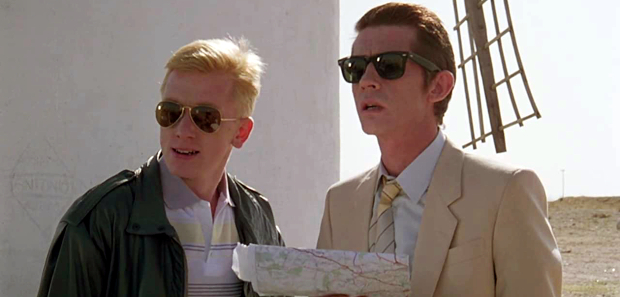
The film also resembles a seedy gangster riff on the celebrated Budd Boetticher – Randolph Scott westerns. The drama in the car is a four-sided game of survival. Realizing that the foreigners intend to kill her, Maggie is frustrated when Willie just shrugs his shoulders at her suggestion of a joint escape: Willie just isn’t cut out to play the Randolph Scott role. The Spanish beauty thenceforth shifts her attention to Myron. Making a mess of his first big-league job, Myron indulges in needless mayhem, brandishing a bicycle chain and other hooligan weapons to tear up some Spaniards at a roadside beer stand. Willie undermines Myron’s sense of security by casting doubt on the competence of his boss. The inexperienced punk loses his indifferent edge, and is soon whining to Braddock that killing Maggie just isn’t fair.
At the center is John Hurt’s Braddock, a calculating mastermind who resists revealing his personal feelings. Although Braddock fully intends to fulfill his kidnap-murder assignment, it’s obvious that he’s also letting himself be affected by the personalities of his fellow traveler. He begins to commit errors of judgment. Is Braddock envious of Willie’s flight from the criminal life?

At one point Maggie bites Braddock’s hand so hard that she draws blood. The gangster clearly finds her bravado extraordinary. Does Maggie’s valorous resistance inhibit Braddock from killing her? It’s a subtle return to the noir convention of tough killers attracted to even tougher femmes fatale. Maggie is Braddock’s kind of woman.
We expect good things from Terence Stamp and John Hurt, and they deliver in full — Hurt is particularly chilling. This is Tim Roth’s first feature film, and he’s nothing short of marvelous when embodying Myron’s puffed up self-confidence. He’s so accustomed to playing the sadist, he doesn’t realize that he’s capable of other emotions. The film also introduced some American audiences to Laura Del Sol, a genuine Iberian bombshell. Fans of Spanish film had just seen her set the screen on fire in Carlos Saura’s popular ‘flamenco’ Carmen (1983). Del Sol’s character is so ‘full of life’ that even the stone-faced Braddock is moved.

Stephen Frears directs The Hit without undue stylistic flourishes, allowing us to concentrate on the interior states of his characters. Much of the movie is filmed in a moving car on the Spanish plains. Willie has spent his time in hiding reading literature. As they pass a chain of medieval castles he makes comments about Napoleon and Roland. A stop at a windmill brings up another classic association that comments on the sordid mission at hand.
The police aspect is nicely handled as well. The kidnappers’ bloody path is traced by the Spanish policía led by the iconic actor Fernando Rey. An Australian thug (Bill Hunter) is threatened on the balcony of a Madrid skyscraper, and an attendant tries to rescue Maggie when she calls for help at a gas station. Frears observes violent acts in a matter-of-fact way, a strategy that doesn’t make them any less brutal. He covers Myron’s sadistic dust-up at the beer stop in one very convincing telephoto shot. A later struggle between Maggie and Braddock is shown in a wide shot aimed straight down from a great height. The figures move like specimens on a microscope slide.
The Hit receives high marks for freshness and innovation, occasionally transcending its own genre. Nobody behaves as expected. The doomed target maintains a philosophical detachment, the hard-boiled hit men betray weakness and the helpless female is anything but. Despite the constant threat of killing, each of the characters reveals a need for meaningful human contact.
Popular actor Jim Broadbent can be briefly seen as a prosecutor questioning Willie in a courtroom prologue.
