

Some movies are simply inspirational. Director Michael Powell cut his teeth in the era of English quota quickie filmmaking. Young hopefuls like Powell and David Lean used that low-budget, low-expectation opportunity to prove themselves and try out new ideas. Before the ambitious Powell met his future ‘Archers’ collaborator Emeric Pressburger, he convinced an American producer-investor to bankroll a wildly innovative movie. The Edge of the World was filmed by a skeleton crew on a remote island in the Shetlands (Foula), far from production support of any kind. That it was made in near-primitive conditions in terrible weather is remarkable, as every scene reveals a great artist at work.
Powell’s story is simple enough that the dramatic scenes can do without a lot of dialogue. Emotional conflicts are partly expressed with silent movie techniques similar to those employed by Alfred Hitchcock and Anthony Asquith, such as 1928’s Underground. Every few minutes, a visual embellishment provides a jolt of understanding that doesn’t need dialogue.
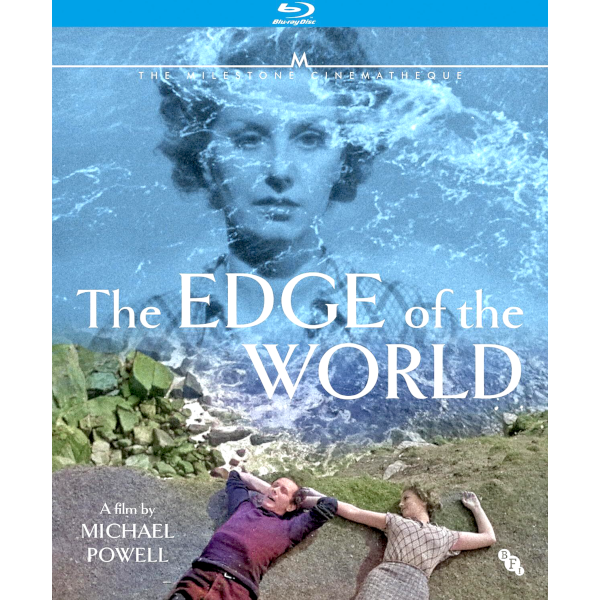
The Milestone Cinematheque released a fine DVD of The Edge of the World almost exactly twenty years ago. This Blu-ray remaster marks a big improvement in picture and sound, and includes the same excellent extras.
Our film school lecturers stressed The Edge of the World’s ethno-documentary aspect, when we now fixate on the poetic artcraft of the maker of later masterpieces like A Matter of Life and Death and Black Narcissus. The setting on a Scottish island also looks forward to Powell’s marvelous I Know Where I’m Going! The two films share an actor or two, plus the general view that the Atlantic isles of Scotland are a sacred wonderland — no matter how rough the weather may be. They also share scenes involving a bird of prey, to emphasize the wildness of nature.

Michael Powell was inspired by true accounts of Scottish islands that were being abandoned because of shrinking populations and difficult living conditions. He wanted to communicate the character of people in a disappearing way of life. Aided by a tiny crew and some adventurous actors, Powell overcame all obstacles. Edge was not a monster hit, but praise from film critics elevated Powell to a higher rank of British filmmaking.
The tiny Scottish island of Hirta is dying, for a combination of reasons. It is so inaccessible that its residents have no modern medical facilities and no regular form of communication with the outside world. Agriculture on its wind-blown fields is difficult, and the mainland’s industrial fishing methods are making it harder for its sail-powered fisherman to bring in good catches. A generation of young men have already left, and few babies are being born. Three young people must decide whether to stay or to leave. Robbie Manson (Eric Berry) has already found work on a fishing trawler. He plans to emigrate because he can’t ask his Norwegian girlfriend to live in such primitive conditions.

Robbie’s sister Ruth (Belle Chrystall) is also caught in a dilemma. Her father Peter Manson (top-billed John Laurie of The 39 Steps and The Reptile) is in denial about the coming end of Hirta. Ruth’s local beau Andrew Gray (Niall MacGinnis) wants to remain on the island as he hates the modern mechanized fishing. His father James (Finlay Currie of Ivanhoe and Ben-Hur) is more reasonable about the likelihood that Hirta will have to be abandoned.
When the island’s menfolk are split on the issue, Robbie unfortunately suggests that the matter be decided not with a vote, but a 19th-century ritual — a perilous climbing race up one of the precipitous cliffs that ring most of Hirta. It’s a deadly test of bravery.
The film uses a brief framing device, a visit to Hirta by a rich yachtsman and his girlfriend (Michael Powell and Frankie Reidy). Only ten years later, the isle is a dead land of abandoned stone houses. Working as a sailor, Andrew Gray sees the ruins and is reminded of the tragedies that accompanied the mass emigration.
The Edge of the World recreates a way of life that now seems very strange. Because Powell’s film is not a strict documentary, it is more engaging than Robert J. Flaherty’s account of an island in a similar fix, Man of Aran, which reportedly falsified some scenes. Compared to Flaherty’s footage of Aran, life on Hirta looks reasonably hospitable, just extremely isolated. Perhaps in the 19th century, such isolation would appeal to people evading diseased cities or religious persecution.
The story is set in the 1920s. In addition to losing out on other advantages of modern life, we learn that the islanders are tenant farmers and sheepmen, crofters. A Laird owns everything, and manages his island as an investment. It’s no wonder that the next generation has left — there’s nothing permanent for them to work for.

The movie isn’t just filmed on location, it lives the location. Every scene reflects a harsh life accepted as normal by those living it. Anything one does on Hirta requires a demanding hike, often near those frightening thousand-foot cliffs. Old James Gray is a hardy man who cannot change the opinion of Peter Manson, a stubborn herdsman dead-set against Andrew marrying his daughter Ruth. Yet Peter tenderly rescues a sheep caught on a cliffside. In a nice detail, Peter helps his frail mother (Kitty Kirwan) settle into a chair in the sun outside her hut so she can hear the Sunday singing coming from the direction of the church.
We see a dance, several male-only political gatherings, and a church meeting. Despite the primitive filming conditions, director Powell manages impressive shots, especially some fluid trucking dollies where we don’t expect them. Numerous close-ups are ‘cheated’ back in the studio, with expert techniques clearly learned back in his quota quickie days. Powell also knows how to make a point and move on. His picture devotes a lot of footage to craggy cliffs and treacherous-looking waves, but it also shows an island people (most of them actual islanders) adapted to a harsh landscape.
The story’s melodramatic components hold our attention from the start. Ruth and Robbie are doting siblings, and her romance with Andrew must work around the need to appear chaste and proper in church. Director Powell is not above going for the obvious thrills of the rock-climbing race and other scenes that play out on the treacherous cliffs. Mail boats only come infrequently, so when Ruth is desperate to communicate with Andrew far away, Powell adds the notion of toy ‘letter boats’ being sent out in hopes that a fishing boat will find and forward the letter. We know that the two warring fathers have reconciled, when they also resort to the last-ditch letter boats.
Several other Michael Powell films focus on sailors and jeopardy on the ocean. Edge concocts an urgent medical emergency in a storm. A baby desperately needs a mainland doctor, and the banished Andrew shows up to help in the rescue. It’s pure ’30s melodrama, distinguished from Selznick-type Hollywood hokum by the simplicity of the telling and the avoidance of heart-tugging effects. Events test young Andrew and Ruth’s strength of character.

The Artist’s Eye.
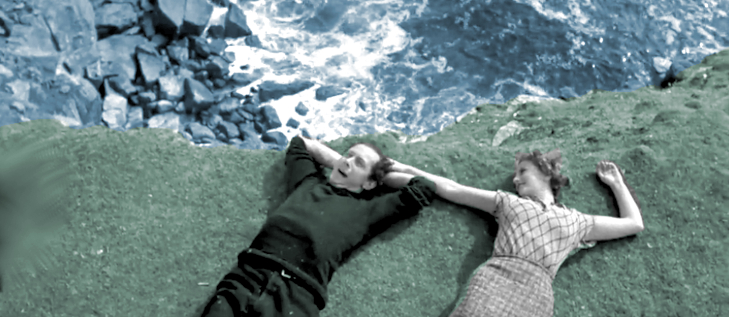
In the midst of all this realism abound beautiful visuals. The coverage of the water and landscape is consistently imaginative, with cameras placed in unusual but appropriate positions. Many landscape shots are so dramatic, we’d think they were matte paintings. We look down on a clifftop to see the heroes lying on the grass right at the brink of a precipice, while waves crash almost a thousand feet below. The cameramen must have been on a platform just inches from the (ulp) edge.
Even more remarkable are poetic visuals that communicate the emotional component of Michael Powell’s story, expressing feelings without words. Hirta 1937 transforms into Hirta 1927 with an image of a rotting church belfry lap-dissolving to add a bell being rung. Andrew Gray feels haunted by his memories — expressed by a line of phantom ‘ghost villagers’ that file past. It looks as if Niall MacGinnis was tasked to stand stock still to shoot this double exposure: he’s slightly ‘phantomized’ himself. ↑

The most powerful visual is a superimposition of white waves and dark water over Belle Chrystall’s face. It expresses Ruth’s confusion and unhappiness perfectly, while transforming her into a piece of modern art. The waves appear to warp her sad features, as if she’s losing herself in her thoughts. Is Ruth contemplating suicide? It’s worth a page of expository dialogue. ↑ Michael Powell’s later fixation on quasi-spiritual visual effects is very much in evidence — this show is one of his marvelous, rich experiences.
The Edge of the World was a tough shoot reportedly enjoyed by Powell’s London based actors, all of whom bring in restrained and nuanced performances. ↓ John Laurie and Finlay Currie became Powell regulars; Currie was an ubiquitous presence in later Hollywood Biblical & costume dramas produced in England. Trim and muscular Niall MacGinnis will shock genre fans, who know him as the portly necromancer Julian Karswell in Night of the Demon and as Zeus in Jason and the Argonauts. Although given low billing, MacGinnis makes Edge extra-accessible to genre-savvy audiences. He’s always good even in tiny parts, and here he carries much of the show.


Enjoyed your informative article for the new release of THE EDGE OF THE WORLD. Not only was it formally released as a DVD but in 2012 the BFI issued it as a Blu-ray which I have. The disc seems to include most if not all of the Extras that you refer to in your piece. The Blu-ray bit rate is not terrible high but the image and sound are very nice. I hadn’t rewatched the disc since I originally purchased it until I read your current review. Appreciated your comments and look forward to revisiting all of the Extras as the films of Michael Powell are among my most treasured film experiences.
Glenn, your personal sidebars are often the most engaging sections of your always excellent reviews.