


Adult science fiction thrills don’t get better than this top-ten genre classic from the ‘ban the bomb’ years of the late 1950s and early ’60s, when hundreds of of thermonuclear bombs were tested. An ecological apocalypse is caused not by an atomic war but by atomic testing itself. It’s the anti- Susan Sontag Sci-fi story: instead of imagining disaster on a giant scale, Val Guest’s The Day the Earth Caught Fire dramatizes a worldwide apocalypse on a personal, intimate scale. Frankly, in the summer of 2020 here in Los Angeles, we can relate.

The ‘preposterous’ story hook invented by screenwriters Guest and Wolf Mankowitz is absurd only by degree. That part of society that still believes in science now accepts that human activity is indeed altering the world’s climate. We’ve already experienced some of the show’s scary social effects in the Coronavirus crisis: shortages of vital resources, the abdication of governmental responsibilities. The dysfunctional world pictured here closely resembles our own, with troubles made worse by governments protecting economic interests. At the moment at least, The Day the Earth Caught Fire is the most relevant science fiction film ever made. Kino’s new disc, long delayed in Region A, is almost an exact copy of the fine British Film Institute Blu-ray release of 2014.
Guest and Mankowitz’s screenplay borrows the fast pace and snappy talk of vintage American newspaper movies. Depressed over his divorce, cynical reporter Peter Stenning (Edward Judd) is drinking too much and letting his job go to pot. Colleague Bill Maguire (Leo McKern) covers for him as best he can, as the news of odd weather catastrophes and major climactic aberrations begin to gel into a disturbing pattern. Peter uncovers the truth through Jeannie (Janet Munro), a new girlfriend who brings him classified information from a government office. The truth is plenty scary: simultaneous nuclear blasts at the North and South poles have altered both the tilt of the Earth and its orbit around the sun. Civilization begins to crumble as cyclones hit London and the Thames dries up. Jeannie and Peter find romance … while the temperature climbs to the Fahrenheit 140° mark.
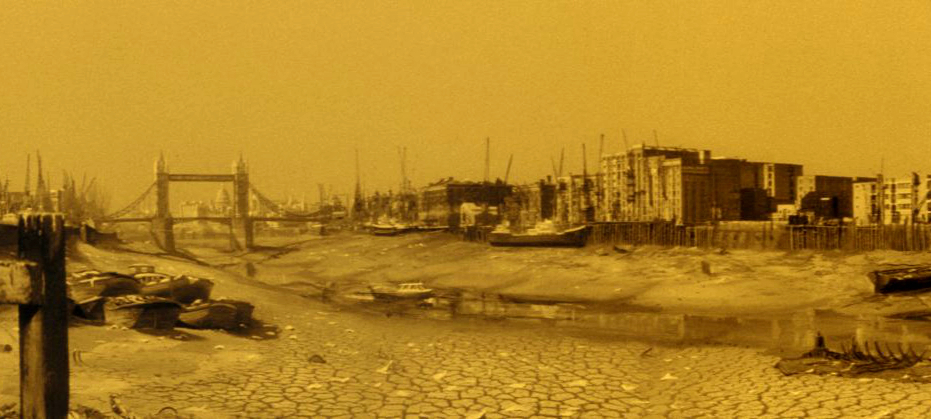
By the end of the 1950s movie science fiction was almost completely associated with fantastic monsters and futuristic secret weapons. The Day the Earth Caught Fire was something entirely fresh for the genre. A pair of bombs tossing the Earth out of kilter ought to seem as juvenile as the orbit-shift in Toho’s Gorath. But the show treats it as just another official secret that newspaper heroes must ferret from stubbornly unresponsive government officials. Actual newspaper editor Arthur Christiansen served as Caught Fire’s technical advisor, as well as playing a major role, editor ‘Jeff’ Jefferson. His unflappable newsmen occasionally coax the truth from uncooperative sources just as did the heroes of All The President’s Men. Most Sci-fi depicts rancor between scientists and soldiers, or soldiers and the public, but Caught Fire sees the free press as the only institution that will speak for ordinary people and keep the government honest. No ‘fake news’ lies here, this movie can join President’s Men and Park Row as epitaphs for real journalism. If the events of this film occurred today, I’m not sure the average TV anchor would know what to do, besides put up fearful graphics to boost viewership. As it is, they’ve learned how to report the most horrible news as an everyday routine. As stated in Bertrand Tavernier’s Death Watch, ‘everything is interesting, but nothing matters.’
We immediately identify with Wolf Mankowitz’s absorbing group of characters. The stylized newsroom dialogue follows the Ben Hecht/Charles MacArthur myth that newsmen speak exclusively in words of sarcastic wisdom and wit. Bill Maguire and Peter Stenning have jobs, regret their broken families and quietly lust after the bartender’s wife. Bill helps his alcoholic best friend Peter stay employed with an affection similar to that of Edward G. Robinson in Double Indemnity. Peter’s advances toward the fetching working girl Jeannie are met with a complex mix of reproach, good humor, and adult teasing.

Val Guest became the father of class-act Brit sci-fi by emphasizing a realistic, documentary approach for his first Quatermass film. Guest’s fluid direction more than does the script justice. There isn’t a scene that doesn’t convince, a compliment indeed considering the phenomena the actors must react to. The bizarre weather events begin with an unseasonable heat wave. A a strange thick mist brings London to standstill, followed by a freak typhoon that rips through the city. Effects expert Les Bowie’s ambitious mattes and especially painted cycloramas are quite successful: CGI artists should study what a small outfit accomplished with so few resources. With the exception of one shot of the mist rolling up the Thames, the views of empty riverbeds, fog-enshrouded streets and scorched landscapes are superb. Bowie appears to use huge photo blowups to create scenic London backdrops, especially for night scenes. In several of those shots the perspectives look a bit skewed; weirdly, some matte paintings appear to be skewed as well, with straight lines seeming to lean to one side.
I have never seen newsreels of fires and storms used to such good effect. Val Guest’s clever matching shots tie-in with the stock footage. One gets the feeling that pandemonium is indeed breaking out all over the world. We appreciate editor Jefferson’s sober, responsible reaction to catastrophic news. When the Soviets release an irrefutable doomsday announcement, Jeff simply states that he doesn’t see what the Russians would have to gain by lying.
In addition to his realistic scenes of disorder and desolation, Guest stages his own ‘ban the Bomb’ demonstration in Trafalgar Square, augmented with scenes captured at a real anti-nuke rally. Although underreported here, England held massive nuclear protests in the late ’50s. It’s surprising to see the disarmament advocates brandishing the peace symbol we would later associate with Vietnam War activism. Caught Fire is an impressive think-piece about real world politics. What is the real function of the news? What aren’t we being told ‘for our protection?’

It is a cliché of Sci-Fi that the public is just a mob waiting to happen. At the drop of a scare headline, the riots and social havoc commence. Some films revel in exploitative chaos and forget to make a coherent point; 1970’s hysterical No Blade of Grass is a good example. Guest and Mankowitz envision the breakdown of social civility as starting with the rationing of water. In short order people are hoarding, and black-market H20 launches an epidemic of typhus. Until a few months back, the closest equivalent to water rationing in the USA were our gas shortages of the 1970s. With today’s pandemic showing that a simple microbe can bring society to a crashing halt, the logical events in The Day the Earth Caught Fire no longer feels like total fantasy. We’re all living a science fiction story, almost identical to the thriller Contagion. Guest and Mankowitz’s expression of social breakdown is a water riot in which wild youth roam the streets. They waste stolen water, loot and vandalize property. Inexplicably, the teenagers of 1961 riot to the tune of Monty Norman’s very Dixieland ‘beatnik music.’ Where’s Black Leather Rock when it’s needed?
Once rumored as a candidate for James Bond, Edward Judd knows how to spin the racy dialogue. He smacks a couple of rioters around but doesn’t become an action hero. Judd is also a fine match for the wonderful Janet Munro, here making a big effort to exit her cutesy Disney roles into grown-up film work. Munro’s Jeannie is often covered with perspiration, which just makes her seem more sexy. The dependable Leo McKern is best at delivering Mankowitz’s wisecracking, overlapping patter. It comes at us without a break, as fast as the chatter in vintage pre-Codes like The Front Page.
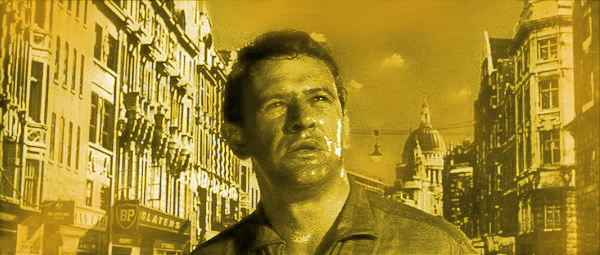
The Day the Earth Caught Fire uses a flashback structure, framed with bookend scenes tinted a visually jolting pale yellow. The tints put across the notion that London has become a 140° furnace, hot enough to melt the rubber on typewriter carriages. Savant UK correspondent David Carnegie was a projectionist in England when Day the Earth Caught Fire was new and verifies that the original tint was yellow. The old 2000 Anchor Bay DVD colored them a bright orange. None of the graphics in this review reflect the correct color as seen on the disc; the image below of Jeannie at the telephone switchboard comes the closest.
Some reviewers have criticized the conclusion, which leaves the story on a thoughtful and poetic note. As classic Science Fiction oratory, Edward Judd’s final speech is up there with Robert Scott Carey’s soliloquy at the end of The Incredible Shrinking Man:
“So Man has sown the wind, and reaped the whirlwind. Perhaps in the next few hours there will be no remembrance of the past and no hope for the future that might have been. All the works of man will be consumed in the great fire out of which he was created. But perhaps at the heart of the burning light into which he has thrust his world, there is a heart that cares more for him than he has ever cared for himself. And if there is a future for man, insensitive as he is, proud and defiant in his pursuit of power, let him resolve to live it lovingly, for he knows well how to do so. Then he may say once more, ‘Truly the light is sweet, and what a pleasant thing it is for the eyes to see the sun.’ “

Few Americans have seen the great The Day the Earth Caught Fire in a decent presentation, which seems wrong considering its ever-increasing relevance. As drought, flood and fire seasons become longer and more violent (“This is unprecedented !”), every new extreme weather event reminds me of Val Guest’s movie.
You don’t want to miss this one. Because it’s about people and not warfare or wholesale slaughter, this may be the most thoughtful and persuasive of the Cold War doomsday films. It’s neither hysterical exploitation nor morbid soap opera like the excellent On the Beach and Testament. Val Guest’s earlier Quatermass 2, Joseph Losey’s These are The Damned and The Day the Earth Caught Fire are the top classics of British Science Fiction.
As a parting shot, here’s a link to a real science news item (January 2019) that sounds particularly relevant to this movie: Earth’s Magnetic Pole Is Wandering, Lurching Toward Siberia. That’s not the same as the Earth tilting on its axis, but it sill sounds ominous.
Here's Josh Olson on Val Guest's classic:

