

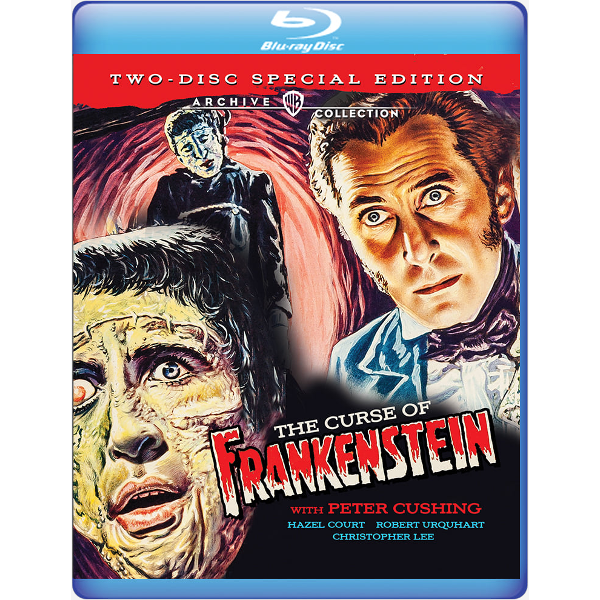

Ah, what was old is new again — with a generous application of digital rejuvenation. My pals were too young to catch 1957 films when new but The Curse of Frankenstein took our heads off in 1964 when it was lucratively double billed with its follow-up Horror of Dracula. What an afternoon — one of my top ten lifetime movie experiences, breathless one minute and cheering the next. I had seen Hammer’s The Mummy around 1960 and was a new reader of the schoolyard Bible Famous Monsters of Filmland so I was just beginning to appreciate Peter Cushing and Christopher Lee. I remember that Forry printed a photo of Lee in his full makeup, eating his lunch at the Bray commissary. Yes, I thought, I guess when they make movies, even the monster actors have to eat.
I doubt that I can impress anybody by ‘explaining’ a horror milestone that my fellow film fans have been reading about for ages. The screenplay by Jimmy Sangster moves along rather well, and is soon confronting us with the surgical nightmares conjured up by the amoral, egotistical Baron Doctor Frankenstein. To say that we weren’t accustomed to morally ambivalent characters is an understatment. Victor revives a dead puppy — how evil can he be? Peter Cushing and Christopher Lee were teamed here for the first time, in unequal roles. They became an unbeatable acting duo as powerful as Boris Karloff and Bela Lugosi.

Orphaned at 15 years of age the wealthy Baron Victor Frankenstein (Melvyn Hayes) hires a tutor, Paul Krempe (Robert Urquhart) and with him spends a decade exploring science, medicine, and the forbidden secrets of life. After reviving a dead dog Victor shifts his attention to the creation of a man assembled from random corpses, a quest that turns Paul against him. But when Victor’s fianceé Elizabeth (Hazel Court) comes to live in the house, Paul stays to protect her. Thanks to an accident with a murdered professor’s brain, the Creature (Christopher Lee) is not only ugly, but mentally crippled as well; it escapes and commits more killings before Paul slays it. Returning three months later to celebrate Victor’s wedding, Paul finds that the Creature has been returned to life yet again. Victor has been performing more brain surgery on it, and he intends to continue his vile experiments.
Editor-turned director Terence Fisher had served his apprenticeship at Gainsborough, a studio known for its sensational stories and cleverly paced thrills. Fisher had become a competent maker of similar melodramas (So Long at the Fair) before the smash hit of The Curse of Frankenstein made him the world’s top director of horror. Fisher, Cushing and Lee were largely responsible for making Hammer’s thrillers a significant export product for the English film industry. The top British critics weren’t at all ready for horror shockers showcasing bloody violence and mangled body parts — one suggested that the upstart film be given a new rating, ‘S.O. – for Sadists Only.’
But the public worldwide loved the new combination of bright Eastmancolor and crimson gore. Severed heads, hands, eyes, and brains dripped and oozed on cue. Fine acting from Peter Cushing (and a few choice sound effects) give the impression that bodies and viscera were are cut and spliced into a hideous new monster. In one take, Cushing’s Baron tells us that he’s going to get rid of the head of a corpse he’s stolen from a gallows. We watch Cushing labor, his hands off-screen, miming movements with a scalpel. He wipes his bloody fingers on his coat, and then wraps you-know-what in a burlap sack. Cushing’s precise performance wins the Decapitator’s Seal of Approval. The cool Hammer Guignol continues as Frankenstein carries the head to his conveniently located ACID BATH, the ideal lab feature for tidying up unwanted viscera and removing potential murder evidence. And you know the rule governing acid baths in horror movies — show one in the first act, and you’d better put it to good use in the third.

The experts say that Hammer Films’ Frankenstein picture was careful to avoid similarities with the Karloff original. The Creature design was made completely different from the jar-headed, electrode-wired ghoul copyrighted by Universal a quarter century before. Phil Leakey’s pasty-white makeup indeed looks like a nightmare, covering Chris Lee’s head with nasty scars from the gibbet crows. Lee wasn’t crazy for the role — no dialogue, no gallantry, no singing — but his mime is terrific, adding a pathos that the script does not provide. He’s killed twice. The first on-screen slaying is a shotgun blast to the face that is still shocking 63 years later — gun and victim are in the same frame. The other I-can’t-believe-I-just-saw-that scene is a fatal fall taken by a stuntman onto his head. It’s done in one cut and shown from an angle that hides nothing. It gets a big audience reaction whenever it’s shown — how the stuntman didn’t break his neck is a mystery.
Jimmy Sangster’s script suffices even if Paul Krempe and Elizabeth’s characters remain stuck in holding patterns for most of the picture. Hazel Court’s lovely Elizabeth ignores all the bad vibes in Frankenstein’s Swiss chalet. She idles (for months?) waiting for wedding bells and earning her keep by establishing Hammer’s reputation for abundant cleavage. One or two of Court’s costumes appear to have been altered (or simply had a flower added) to tone things down a bit. Robert Urquhart’s Paul is the most wishy-washy Man of Conscience in all of Hammer. Paul never acts on his knowledge of Victor’s crimes. He keeps asking Elizabeth to run away with him, but he’s too gentlemanly (?) to share the information she needs to make such a decision. Just a hint of the abominations going on in the upstairs lab would have Liz packing her bags in a big hurry.
Valerie Gaunt’s maid Justine is also in for gratuitous sex appeal, giving the monster a victim while establishing the Baron as not only a murderer but a cad as well. Victor’s enthusiasm for playing God in the lab has its positive aspect, so I suppose other vices were needed to make him a villain deserving of punishment. Someone tell the critics that the movie does show some proper restraint — we see two male victims immersed in Victor’s acid bath, but Hammer drew the line at showing victor disposing of a woman’s body that way.
We heartily agree that Hammer’s early Gothics gave us a terrific group of heroines in distress — Hazel Court, Valerie Gaunt, Melissa Stribling, Carol Marsh, Eunice Gayson, Marla Landi, Yvonne Furneaux, Marie Devereaux, Jan Holden, Yvonne Monlaur, Andree Melly, Dawn Addams, Yvonne Romain, Catherine Feller. All created interesting, memorable characters, and none were simply present to exploit the ability to show more cleavage in costume dramas. Not that we complained.

The disc commentators are right, COF creates tension by never fully condemning The Baron. Victor’s multiple felonies and refusal to accept responsibility doesn’t jibe with Paul’s occasional endorsement. Swayed by Victor’s brilliance, Paul continues to believe that he’s basically sane and fundamentally good. Hammer (or just Jimmy Sangster) developed some screwy notions about the relationship of physical deformity to murderous malice. Almost the only false step in the first sequel The Revenge of Frankenstein arrives when the doctor’s Brain Transplantee receives a bad rap on the noggin. Previously 100% benign, he immediately degenerates into cannibalism.
Chris Lee’s Creature looks like he was fed into a wood chipper, but his brain is supposed to be that of a kindly professor, albeit sliced up by broken glass. The Creature’s first act is to attempt to kill Victor — is that the old professor taking revenge, or is Sangster telling us that brain-damaged people are homicidal, by axiom? After the added complication of a shotgun hit to the head, the Creature seems relatively subdued — until he sees the Baron on the castle rampart. Then he seems to know exactly what he’s doing, and what he wants.
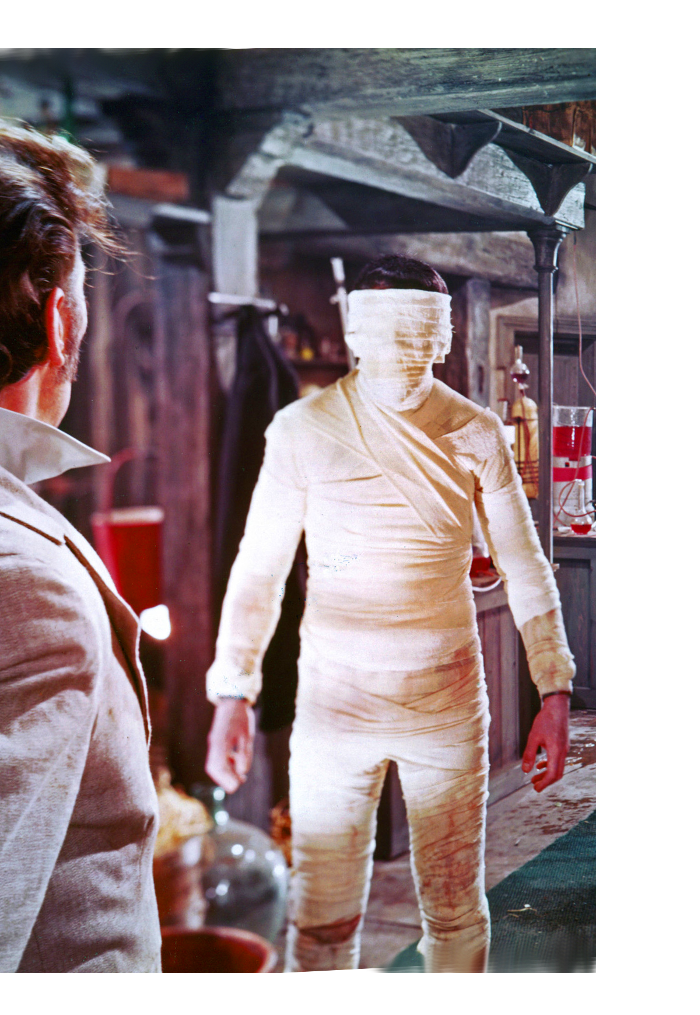
Terence Fisher disguises his lean budget by setting up several well-blocked one-setup scenes. We also get to know the stairway path to the lab in Frankenstein’s Swiss chalet fairly well — everybody climbs it at least once. But Fisher’s core material is extremely well done — we are taken in by Paul and Victor’s enthusiasm, and mesmerized whenever the Creature is on screen. Sangster and Fisher’s unmasking scene is a classic, a stunner that never fails to surprise. The flashback bookends work well, neatly framing the story from a death-row cell. Peter Cushing grabs us with his portrayal of the desperate Baron at the end of his rope … or blade.
Did Sangster and Fisher intend for Elizabeth never to actually see the Creature? I think that accounts for the odd bit of staging on the roof, where Victor accidentally shoots her in the shoulder. It’s possible that Elizabeth never sees what grabbed her from behind. Perhaps that’s why she can honestly back up Paul’s claim that there never was a monster, that Victor murdered Justine. It’s no wonder that Elizabeth says nothing as Victor goes to the executioner — so far as she knows, her husband shot her on purpose.
On the other hand, Paul Krempe’s actions aren’t as noble as they appear. He’s fully complicit with Victor for the heretical creation of the Creature and becomes an accessory after the fact when he does not come forward to report additional crimes. Getting rid of Victor is the only way that Paul can sweep his own guilt under the rug. He has apparently lied to Elizabeth as well.
With that knowledge, I wish Urquhart had returned in one of the sequels, so that the revived Dr. Frank could take his justified revenge on the perjurer. So there.
I believe that one reason we kids were so impressed by the early Hammer films is that they were so serious. They had not a drop of the self-parody that crept into A.I.P. films, where the titles for the Teenage Werewolf and Frankenstein were meant to be a joke on at least one level. Even Disney spoofed the trend in his The Shaggy Dog … horror films were in danger of becoming harmless fun.
I certainly don’t believe that the heightened violence and blood were bad for us. I guess some girls in the audience were squeamish about depictions of blood, but for the rest of us it was a major thrill, as if a curtain had been thrown back from previously forbidden movie content. Anything was now possible — horror movies no longer had to restrict gory details to dialogue descriptions, or shamefully cut away from their own core subject matter. Everybody enjoyed Hammer’s Gothic thrills. When the box office receipts came in, a worldwide renaissance of screen horror was begun.

