

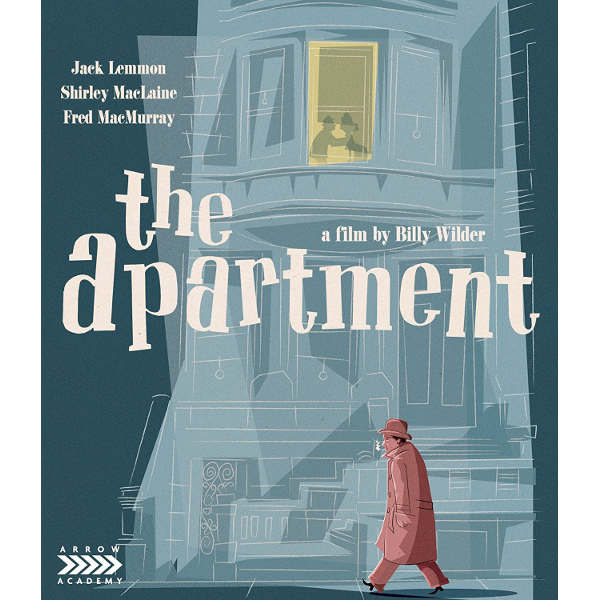

… and it’s also the all-time champion New Years’ movie.
After spending years wondering why Billy Wilder wasn’t rated at the very summit of Hollywood achievement, it has felt good in the last two decades or so seeing and reading about the greater acceptance of his films. But there’s been an undesirable push-back fairly recently, I think fed by vacant online opinionizers that either don’t understand what great writing and directing is, or that refuse to look at older films in terms of the context of their times. In a post- millennial world where many young people have no consciousness of the greats of the past beyond John Wayne and Marilyn Monroe, it may be that only dedicated film fans will appreciate pictures in B&W, with characters whose mindset precedes today’s cell phones and other instant gratifications. To the naysayers that find Billy Wilder terminally un-cool, I say ‘Get a Life.’ Or better, ‘Become a mensch.’ Comedy doesn’t have to be crass or grindingly obvious, although Wilder once told his writing partner I.A.L. Diamond that their work needed to avoid obscurities: “Make it obvious.” When Diamond asked about subtleties, Wilder replied, “Make them obvious too.”
Upon its arrival in 1960 Billy Wilder’s The Apartment was alternately savaged and praised by the critics. The ones that didn’t like it may have been stuck in older ideas of what constituted acceptable adult-themed entertainment — or were perhaps personally biased by Wilder’s tendency toward caustic cynicism. But this story of a nice guy in the corporate jungle succeeds on as many levels as a Hollywood film can. Wilder retains his nasty streak of cynicism realistic outlook while evoking the sentimental sweetness of his mentor Ernst Lubitsch. The slightly tarnished example of Jack Lemmon’s ambitious C.C. Baxter taught a generation of men that aspiring to ‘mensch’ status might be a good idea, personal outlook-wise.

A crown jewel of United Artists and The Mirisch Corporation, this prestigious title won five Oscars including Best Picture. Arrow’s deluxe, Criterion-level release gives Wilder’s masterpiece the class presentation it never received from its distributor MGM.
Billy Wilder and I.A.L Diamond’s screenplay is a masterpiece of intricate character plotting. Trapped in a sea of desks, lowly insurance clerk C.C. Baxter (Jack Lemmon) has found a unique way to climb the corporate ladder: he lends his apartment key to his philandering superiors, as a place to take their illicit sex partners. This questionable practice goes smoothly until the big boss Mr. Sheldrake (Fred MacMurray) finds out. Instead of getting canned, Baxter commences loaning his key to Sheldrake on an exclusive basis. The ambitious employee doesn’t mind sleeping on park benches or getting a bad reputation with the neighbors. But when he discovers that Sheldrake’s promiscuous bedroom partner is his own dream girl, elevator operator Fran Kubelik (Shirley MacLaine), Baxter must choose between his heart and his career.
(Everything about this review is a spoiler, so most of it should be read only after seeing the movie.)
Who would dare malign cinema master Billy Wilder, you ask? Lots of critics did. Andrew Sarris said Wilder was ‘too cynical to believe his own cynicism.’ Others mauled him for savaging poor Shirley MacLaine, and condemned her Christmas Eve suicide attempt as the nadir of poor taste. They cited the cruel treatment that Wilder allegedly dished out to actresses Jean Arthur, Audrey Hepburn and others, as evidence that the director was a sour malcontent and possible misogynist. The average film critic of 1960 was in the business of recommending family entertainment, and wanted screen romances to steer clear of sordid problems that didn’t happen to ‘nice people.’ Philandering, adultery and grim workplace opportunism were bad enough, but a realistic suicide attempt was simply not appropriate for a show billed as a comedy.

But oh, were they wrong … The Apartment builds an enormous feeling of love and romantic good will. It is also a gem of construction, character development, and thematic clarity. Sure, C.C. Baxter is a morally compromised guy in a corrupt world. His only hope of getting ahead involves dirty business, although I doubt anyone today would be shocked by Baxter’s gimmick. [I just finished seeing the good drama Molly’s Game, in which a highly educated woman runs a poker game for years, catering to decadent millionaire misanthropes and eventually laundering Russian Mafia money. Her father’s final verdict on her activities lauds her initiative: she became a millionaire on her wits alone.]
C.C. Baxter’s hindsight excuse is that his predicament snuck up on him when he wasn’t looking. The view of the business world is as cold-blooded as anything in Double Indemnity. J.D. Sheldrake’s my-way-or-the-highway mindset is not only accurate, but mild compared to how big companies run today. The same sort of things happen now, except the added impersonality of modern Human Resources departments would keep any of the duped aspirants from ever finding out exactly how the favored ‘buddy boy’ got his promotion.
Jack Lemmon is perfect in the role as he never was before or since: just experienced enough not to be a naïve dolt, but not yet grating (The Out-of-Towners) or insufferably self-pitying (April Fools, Save the Tiger). Shirley MacLaine is adorable, whether showing spunk in her elevator job or trying to be discreet about her sad, guilty philandering. And Fred MacMurray plays a heel as only he can. The beloved father of My Three Sons plays the part with hardly an inflection altered — just a switch of morals. This trio has what must be the best supporting cast in film history, led by Ray Walston as the sneering Mr. Dobisch, and Jack Kruschen (so wasted in the same year’s The Angry Red Planet) as the warm and wise Dr. Dreyfuss. Hope Holiday’s Christmas Eve bar scene with Lemmon is unforgettable. Joan Shawlee and Joyce Jameson are lovable office bimbos. Edie Adams takes time off from selling cigars in provocative TV ads to play a bitter, double-crossed secretary.

Wilder and Diamond’s world-class screenplay makes them all better than the sum of their talents. Everyone remembers the great bits of business, rendered so accurately in Joe LaShelle’s gray-on-gray B&W Panavision: Baxter marching through endless rows of identical desks, a la King Vidor’s The Crowd, and straining spaghetti through a tennis racket; Fran Kubelik breaking down on Christmas Eve. Wilder stages these things brilliantly, as when he forgoes a close-up on the forlorn Fran as she weeps, choosing instead to make us watch her sob from the other side of the room. Wilder orchestrates his verbal jokes and physical gags for maximum efficiency. His confected coincidences and surprise identity revelations become cruel twists of fate. We’ve all experienced romantic setbacks that seem doubly cruel, as if fate were rubbing salt in our wounds. Emotional touches that might elsewhere become clichés (such as the cracked hand-mirror) hit like slugs to the stomach. In this triangle of deceit, Baxter and Kubelik’s vulnerabilities assault them with a you-asked-for-it vengeance. When irony strikes, it is never some contrivance, but a romantic logic that doesn’t care whose heart is broken.
In Wilder’s vision real love only comes through pain. The residue of romance hangs over the film’s loser-lovers like a dark cloud. Sheldrake’s secretary is a woman changed for the worse through love. Hope Holiday’s heartbreak over her jockey jailed by Castro may be a joke, but her loss is sincere. The Apartment’s romantic couple is neither perfect nor without sin. They’re adrift in a world where their personal plight is no more ‘important’ than anyone else’s.
Perhaps the critics were shocked by the film’s rejection of standard goody-goody moralizing. The eager young Baxter happily takes a short cut to get his new office, convinced that a little cheating is part of the game. Would they have preferred Baxter to pray for material success, as seems to happen in so many films influenced by the Production Code? The critics might also then be repulsed by a heroine with low self esteem, one always getting the fuzzy end of the lollypop like Marilyn Monroe in Some Like it Hot. Add this to an overall story that sees infidelity and sordidness unchallenged by a higher morality, and you can understand why conservatives would be dismayed. A big section of America never outgrew the fairy tale mentality, where a good deed can be guaranteed to precipitate an avalanche of reformed hearts and merry good will.
Wilder was often accused of brutalizing actresses in his movies, even if only in a verbal joke. Suicide attempts feature in Sunset Blvd. and Sabrina. (Baxter also talks about killing himself, with a .45 automatic.) The depths of depression become all too believable when poor Fran shivers with tears, alone in ‘some schmuck’s apartment’ convinced that she’s let herself become a whore.

Wilder is as good a director as he is a writer. For this observer the film’s most cinematic moment is a brilliant use of objective and subjective shots. How often have we seen a shot that’s first presented as a person’s subjective point of view, but then becomes objective when that person walks into the shot. If we take the shot’s subjective function literally, our first reaction should be, ‘the person has an identical double.’ I think that Billy Wilder makes conscious use of this effect in the scene in which MacLaine’s Fran Kubelik decides to kill herself.
Washing her face at Baxter’s bathroom sink, Fran spies the pill bottle in the iris-inset reflection of a shaving mirror. Without a cut back to Kubelik, we see a disembodied hand reach in and take the pills. It’s as if the hand belongs to another person, not Fran: Whose hand is that? she might be thinking. I’ve read that survivors sometimes describe suicide attempts as happening in the third person, as if somebody else was committing the act, and the victim was a mere observer. The psychological disassociation is expressed in visual terms. In her shaky emotional state, Fran is not responsible.
‘Cynical’ Wilder manages a gloriously positive ending. Fran’s dash through the streets to a blast of unabashedly romantic music has got to be Shirley MacLaine’s best moment on screen. But the lovers must still reckon with reality. Sure, they’re together and they’re in love, but without a job between them they won’t be able to stay in New York much longer. Wilder is famous for nailing a Soviet critic at a European festival, who took a potshot at the U.S.A. by praising The Apartment as anti-American. The critic opined that only in decadent America could such a story take place. Wilder shot back that he agreed entirely, that his story could never happen in Moscow — because in Moscow there was no such thing as a lendable apartment! Perhaps this awareness of political tensions got Wilder’s blood up for his next film, the marvelous Cold War joke-athon One, Two, Three.

