
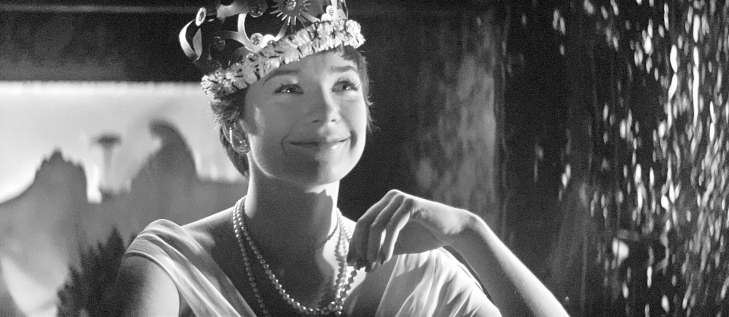


Here’s to entertainment that that makes us feel human warmth, involving us with characters we can identify with, with problems we understand. An all but perfect picture, Billy Wilder’s The Apartment became an instant success in 1960. Audiences had loved the big laughs of Some Like It Hot, but for their next outing Wilder and I.A.L. Diamond opted for a comic drama with potentially disturbing edges. Combining scathing satire and heartbreaking romance, the tale of a Manhattan clerk has a lot to say about the price of ambition in a system where cheating is the norm both in business and in love.
Billy Wilder’s show would become a big award-winner, back when Oscars really meant something. But quite a few reviewers and critics took offense at its adult look at romance in the workplace. The unamused critics may have been stuck in older ideas of what constituted acceptable adult-themed entertainment — or perhaps they distrusted Wilder’s caustic sense of humor. But this story of a nice guy in the corporate jungle succeeds on as many levels as a Hollywood film can. Wilder retains his realistic regard for human weakness while evoking the sentimental sweetness of his mentor Ernst Lubitsch. Jack Lemmon’s slightly tarnished good guy C.C. Baxter taught a generation of men that aspiring to ‘mensch’ status might be a good idea, personal outlook-wise.

Does one have to compromise one’s ethics to get anywhere in the world? Anonymous insurance clerk C.C. Baxter (Jack Lemmon) has found a unique way to pursue a promotion: he lends his apartment key to his philandering superiors, as a place to take their illicit sex partners. The admittedly sleazy practice goes smoothly until the big boss J.D. Sheldrake (Fred MacMurray) finds out. But instead of getting canned, Baxter commences loaning his key to Sheldrake on an exclusive basis. The ambitious employee doesn’t mind sleeping on park benches or getting a bad reputation with the neighbors. But everything changes when he discovers that Sheldrake’s promiscuous bedroom partner is his own dream girl, elevator operator Fran Kubelik (Shirley MacLaine).
Who would dare malign cinema master Billy Wilder, you ask? Lots of critics did. Andrew Sarris said Wilder was ‘too cynical to believe his own cynicism.’ Others mauled him for savaging poor Shirley MacLaine, and condemned her Christmas Eve suicide attempt as the nadir of poor taste. Some pegged him as a misogynist, citing the cruel treatment that Wilder allegedly dished out to actresses Jean Arthur, Audrey Hepburn and others. The average film critic of 1960 was in the business of recommending family entertainment, not screen romances about sordid problems that didn’t happen to ‘nice people.’ Philandering, adultery and grim workplace opportunism were bad enough, but a realistic suicide attempt was simply not appropriate for a show billed as a comedy.

But oh, were they wrong . . . The Apartment builds an enormous feeling of love and romantic good will. It is also a gem of construction, character development, and thematic clarity. Sure, C.C. Baxter is a morally compromised guy in a corrupt world, although I doubt anyone today would be outraged by Baxter’s gimmick. The view of the business world is as cold-blooded as anything in Double Indemnity, and J.D. Sheldrake’s my-way-or-the-highway mindset is mild compared to how actual big companies are run.
C.C. Baxter’s hindsight excuse is that his predicament snuck up on him when he wasn’t looking. Jack Lemmon is perfect in the role as he never was before or since: just experienced enough not to be a naïve dolt, but not yet grating (The Out-of-Towners) or insufferably self-pitying (April Fools, Save the Tiger). Shirley MacLaine is adorable, whether showing spunk in her elevator job or trying to be discreet about her sad, guilty philandering. And Fred MacMurray plays a heel as only he can. The beloved father of My Three Sons changes nothing about his performing style — the only change is a switch of morals.
This trio enjoys capable acting support, led by Ray Walston as the sneering Mr. Dobisch, and Jack Kruschen (so wasted in the same year’s The Angry Red Planet) as the warm and wise Dr. Dreyfuss. Hope Holiday’s Christmas Eve bar scene with Lemmon is unforgettable. Joan Shawlee and Joyce Jameson are lovable office workers that might as well wear ‘I’m available’ signs on their foreheads. Singer-comedienne Edie Adams took time off from selling cigars in provocative TV ads to play a bitter, double-crossed secretary.
Wilder orchestrates his verbal jokes and physical gags for maximum efficiency. Everyone remembers the great bits of business, made iconic by Joe LaShelle’s gray-on-gray B&W Panavision. When Baxter is ‘kicked upstairs,’ he marches through endless rows of identical desks, a la King Vidor’s The Crowd. He strains spaghetti through a tennis racket, monkeys with kleenex and a nasal spray bottle, and expresses growing feelings of unease when passing his apartment key through the interoffice message system.

For Baxter, every poetic coincidence and surprise identity reveal becomes a cruel twist of fate. We’ve all experienced romantic setbacks that feel as if life were rubbing salt in our wounds. Emotional touches that might elsewhere become clichés (such as Fran’s cracked hand-mirror) hit like slugs to the stomach. When irony strikes it’s with a logic that doesn’t care whose heart is broken. Wilder stages Fran Kubelik’s Christmas Eve breakdown without a standard close-up. We want to comfort the tiny, defenseless Fran but instead must watch her sob and quake from the other side of the room.
In Wilder’s vision real love comes only through pain; perhaps that’s what distinguishes his ‘touch’ from that of his mentor Ernst Lubitsch. The residue of romance hangs over the film’s loser-lovers like a dark cloud. Sheldrake’s secretary is a woman changed for the worse through love. Hope Holiday’s heartbreak is over her jockey boyfriend jailed by Castro; she may be a joke but her loss is genuine. The Apartment’s romantic couple is neither perfect nor without sin. They’re adrift in a world where their personal plight is no more ‘important’ than anyone else’s.
Was the story’s rejection of standard goody-goody moralizing really that dangerous? The eager young Baxter is convinced that a little cheating is part of the game, and the heroine suffers from low self esteem. No higher moral authority protests the general infidelity and sordidness on exhibit. Did reviewers really prefer Debbie Reynolds movies? Perhaps they saw Wilder as a corrupt European mocking decent American values.

The theme of suicide was not encouraged in Hollywood yet Wilder repeatedly touched upon it, often only in dialogue. Overt suicide attempts feature in Sunset Blvd. and Sabrina. Baxter talks about once considering killing himself with a .45 automatic. Fran Kubelick’s flash of suicidal despair is wholly understandable, and Wilder makes of it a humanist, moral statement. Alone in ‘some schmuck’s apartment’ and lost in a situation that ‘nice’ movies never acknowledged, poor Fran is the era’s most effective refutation of the Playboy philosophy.
Billy Wilder isn’t given enough credit as a superb visual storyteller. For this observer the film’s most cinematic moment is a brilliant use of an objective/subjective shot, in the scene in which MacLaine’s Fran Kubelik decides to kill herself; I’ve never read or heard it called out by a critic. Washing her face at Baxter’s bathroom sink, Fran spies the pill bottle in the iris- like inset reflection of a shaving mirror. Without a cut-back to Fran we see a disembodied hand reach in and take the pills. It’s as if the hand belongs to another person: Whose hand is that?, Fran might be thinking. Suicide survivors sometimes describe their attempts as happening in the third person, as if somebody else was committing the act, and they were a mere observer. Wilder expresses that psychological disassociation in visual terms. In her shaky emotional state, Fran is not responsible.
‘Cynical’ Wilder manages a gloriously positive ending. Fran’s dash through the streets to a blast of unabashedly romantic music has got to be Shirley MacLaine’s best moment on screen. The ‘happily ever after’ finale is tempered by reality: sure, they’re together and in love, but they’ll have to start over again from scratch. Wilder famously nailed a Soviet critic at a European festival, who took a potshot at the U.S.A. with the comment that only in decadent America could such a story take place. Wilder shot back that he agreed entirely, that his story could never happen in Moscow — because in Moscow there was no such thing as a lendable apartment. Perhaps this awareness of political tensions got Wilder’s blood up for his next film, the marvelous Cold War joke-athon One, Two, Three.


