

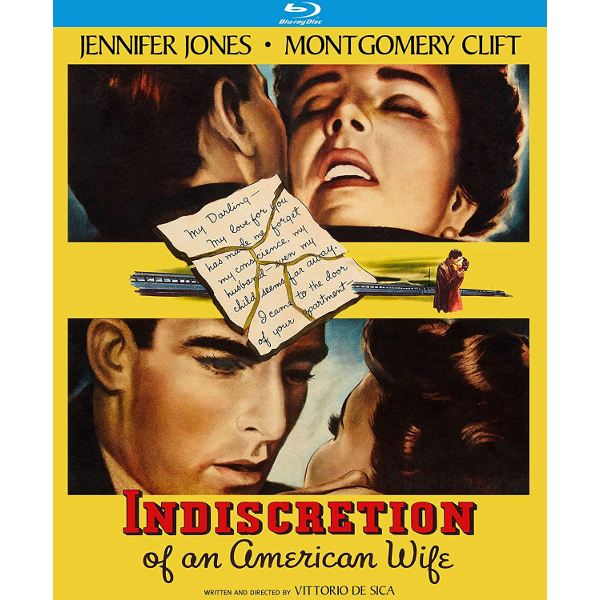

This is a story of a deal with a moviemaking devil. Didn’t Vittorio De Sica know that David O. Selznick tried to interfere with Carol Reed’s The Third Man? That the producer had recently re-edited Powell & Pressburger’s Gone to Earth, obliterating the work of the Archers? Selznick did exactly the same thing with De Sica, on an even more humiliating level.

The evidence is here for us to peruse — both versions of Vittorio De Sica’s glamorous/neo-realist romance, originally known as Terminal Station (Stazione Termini). Perhaps the failure of Umberto D. found the director in need of a producer, but getting involved with the meddling David O. Selznick wasn’t a good alternative. Selznick provided the stars, and personally involved himself in the production. De Sica’s original version has its flaws, but is a good movie. Selznick took it upon himself to re-edit and re-dub for America, tossing on the then-sleazy title, Indiscretion of an American Wife.
As Jennifer Jones and Montgomery Clift are an incredibly attractive couple, the potential chemistry between them seems unlimited. But why cast the very American Clift as an Italian? Well, he is supposed to be only half- Italian.
The basic idea could have been suggested by the somber railroad station scene in Brief Encounter — this movie stretches David Lean’s painful parting situation out to feature length. American Mary Forbes (Jennifer Jones) wants to leave Rome to return to her husband and daughter in Philadelphia, but her illicit lover, professor Giovanni Doria (Montgomery Clift) finds her at the station and begs her to stay. She misses one train, but will she catch the next? Mary’s young nephew Paul (Richard Beymer) is suspicious of her new friend. Worst of all, when they find a vacant railroad car to talk and kiss in private, they’re arrested and hauled up before the station’s police commissioner (Gino Cervi). The slight ‘indiscretion’ could well become a scandal.

The only questionable thing about this presentation of De Sica’s Stazione Termini version is that it is the English-language export version, with an English-language Terminal Station title sequence. Thus, much of the Italian, not just the background voices, has already been shifted to English. It’s likely that Jennifer Jones and Montgomery Clift were dubbed into Italian on the domestic Italian version, which certainly isn’t good either. It’s a shame that a true bilingual version with alternating subtitles couldn’t be put together, as watching these Italians speak phony English isn’t very satisfactory. The 1966 movie Is Paris Burning? is the one that needs a multi-lingual re-dub the most, to make the French speak French, the Germans speak German, Orson Welles speak whatever he was speaking, etc.
De Sica sets his borderline sordid romance in the middle of the enormous train station, a teeming river of life. In his version, the context sidebar stories of random travelers have almost equal emphasis to Jennifer Jones’ anxiety and Montgomery Clift’s desperation. Various mashers follow and stare at Jennifer, including the amusing Paolo Stoppa. Crowds of travelers bustle in every direction. All seem to comment on Jennifer’s lapsed status as a housewife in good standing. Every cute kid reminds her of her daughter Kathy, back home in Philadelphia. With its hundreds of participants, De Sica’s original is halfway to becoming Jacques Tati’s delightfully weird comedy Playtime.

Selznick always tried to direct his movies through memos. He had become a perfect example of the spoilsport who ruins the game, changing the rules because he owns the bat and the ball. By this point in his career Selknick was shooting himself in the foot nine times out of ten, demonstrating an uncanny knack for lousy judgment. He hadn’t had the chance to gum up The Third Man, but he mangled Michael Powell’s impressive Gone to Earth beyond recognition. De Sica had his cameraman G.R. Aldo use soft and natural lighting throughout, even on the close-ups of the actors. Suddenly Selznick intervenes, importing cameraman Oswald Morris to light and shoot all the close-ups of his wife. Thus we see minutes of deep-focus, naturalistic Italian photography, into which are cut shallow-focus, diffused closeups of Jennifer with dramatic shadows on her face. Of course she looks great, but no different than we’ve seen her since Love Letters or Portrait of Jennie. The whole point to working with De Sica and the Italians was to try something new, an ambition that Selznick smothered. According to Leonard Leff, Jennifer Jones wanted to accede to De Sica’s plan — why else did she come all the way to Italy? It is said that she ran screaming at every sign of her husband’s destructive interference.
Still thinking in terms of a glamour vehicle for Jennifer, Selznick assumed control of the American version of Stazione Termini and gutted it by 27 minutes. He threw away almost all of De Sica’s vignettes focusing on other travelers in the massive train station. Many little set pieces were tossed, such as when Clift is confronted by a wedding party (the bride is Maria Pia Casilio, the maid from Umberto D.). The bride gives him a wedding cookie, and Clift tosses it to the ground as he walks away. It’s a telling comment on Clift’s character. Indiscretion of an American Wife underplays Jones’s heartfelt indecision, while making Clift seem just a spoiled brat, hardly more mature than the overeager (but unspoiled) kid played by Richard Beymer. A bit with Jones giving some candy to three kids has been expanded into an elitist vignette — the over-sentimentalized children are ever-so grateful for the rich American’s handout.

To bring the shortened movie back to feature length, Selznick slapped on a short subject, Autumn in Rome. It’s basically a music video of Patti Page singing the title song (not a bad one) in a Manhattan apartment. It’s directed by William Cameron Menzies and shot by James Wong Howe, but it’s still dull.
Italian audiences reportedly didn’t take to the mix of realism and Hollywood glamour in their version. They preferred the sidebar vignettes, like the one about a working man and his pregnant wife. The Clift and Jones characters are worried about what people in Philadelphia might think. Who cares?

In the U.S. it was even worse, as preview houses laughed where they shouldn’t and catcalled at poor Richard Beymer’s earnest character. That’s too bad, as the same thing happened for Beymer eight years later in some screenings of West Side Story. Jones’es character was read as wishy-washy, and her and Clift’s carefully modulated performances went for naught. Being caught in the petty humiliation of trespass-necking in the railroad car is just the kind of miserable non-offense that might happen to an ordinary couple in an Italian Neorealist film. In Selznick’s over-inflated romance it plays as ridiculous: star characters in U.S. movies routinely walk away from major transgressions, let alone a petty inconvenience like this. An average audience of 1953 would surely have expected Clift to just push the conductor aside and walk away with his girl.
With yet another disaster on his hands, Selznick let Indiscretion be released with one of the most insulting trailers of all time. Ugly fake newspaper headlines grossly misrepresent the film’s storyline. The simple embarrassment in the train car is now a huge police case and scandal. Clift dodging past a train is falsely turned into a horror moment like the end of Anna Karenina. In the trailer, Jennifer Jones’s lover comes off as a lustful tramp. It’s really depressing, and must have made poor Jones and Clift sick. Selznick’s career would soon spin down to the expensive irrelevance of A Farewell to Arms.
Just the same, fans of Jennifer Jones & Montgomery Clift will find a lot to like in Indiscretion of an American Wife / Terminal Station. There is some great acting here. Impressive takes include a full two-minute silhouetted conversation in the train car. The photography in the giant station is memorable, as are the faces of a multitude of extras. Cicognini’s rhapsodic love theme is very good, although the movie might have benefited from a more spare sound track, if De Sica were allowed to follow through with his original concept.

