

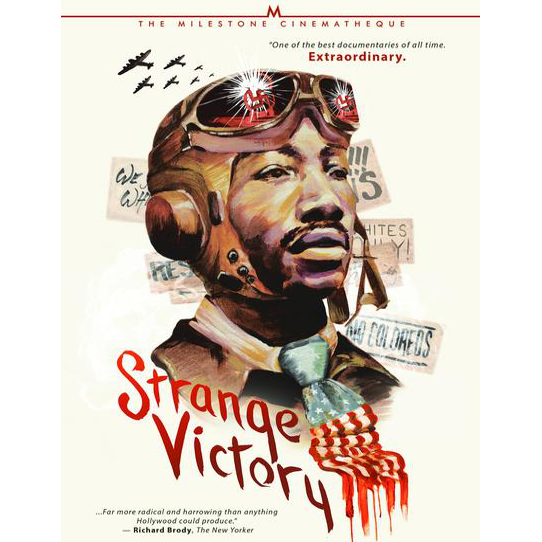

Strange Victory is the most important, invigorating film I’ve seen this year. Branded as communist propaganda in its brief non-release in 1948, the issues it brings up are still with us today, worse than ever. Filmmaker Leo Hurwitz forfeited his career over his beautifully written and constructed cry for American values. The new poster art gives the impression that it focuses on the problems of returning black veterans, when the film’s far wider purview addresses the dark evils of the country’s political soul. With its emotionally compelling images and music, Hurwitz’s message flies in the face of the consensus fairy tale that America lives up to its lofty ideals. It’s a ‘strange victory,’ when vile Nazi ideas so readily flourish.
The picture is packed with riveting montages and images heavy with meaning — and the cry for core human values applies strongly to today’s political miasma. At one point we see Nazi footage filmed in a concentration camp. Small children are being led down a barbed-wire path. I believe that they’ve just been separated from their parents, and are on their way to be gassed. It’s not just ancient history, it’s our story too.

Is this a documentary or propaganda? In 1948 the modern notion of documentary film hadn’t yet fully come together. The films of (usually) state-supported artists like Humphrey Jennings or Pare Lorentz were mostly screened in museums, alongside avant-garde and experimental pictures. Most nonfiction films were commissioned by companies to extol their industries in un-critical terms, and distributed non-theatrically. There was little in film that one would call investigative reporting. There were no exposés about the garment industry. A newsreel might show a deadly sweatshop fire, but a movie explaining the factual context would likely be an institutional picture about happy workers.
Documentary film artist Pare Lorentz of the Depression years won government contracts to make films that political detractors would decry as propaganda showcases for Roosevelt’s public works. On The Plow that Broke the Plains Lorentz hired several openly leftist cameramen-filmmakers from ‘The Worker’s Film and Photo League,’ which had braved police dogs to document strikes and protests. Paul Strand, Ralph Steiner and Leo Hurwitz criticized Lorentz’s softball approach to the causes of the Dust Bowl. The Plow preaches that the disaster was caused by poor farming practices, whereas the cameramen wanted the film to stress that predatory banking practices incentivized the farmers to abuse their land. The lesson from this is that no documentary is politically neutral. To a logging company aiming to secure public lands for business profit, a Public Service ad for Smokey the Bear is propaganda.
Just before war broke out, Leo Hurwitz and Paul Strand made Native Land, a powerful advocacy film that uses cinema poetics to protest the collusion of companies and politicians in the crushing of the labor movement. It uses some of the Photo League’s footage from the decade before, particularly the powerful image of armed company goons threatening strikers. Much of the film, though, is a music-and-images poem celebrating the beauty of America. Between the dramatizations of anti-Union terror, the singer Paul Robeson provides both songs and narration.

Native Land was screened in just one theater in New York, and despite positive reviews disappeared almost immediately. With war newly declared America was in no mood for social criticism. But the FBI was taking names — the film’s cast includes future blacklistees Art Smith and Howard Da Silva. The subsequent State Department persecution of Paul Robeson went way beyond simple blacklisting.
Leo Hurwitz spent part of the war in New York helping launch the nascent TV industry, even before regular broadcasts began. But he felt creatively and politically cramped, and when the war ended took a break to make the privately-funded Strange Victory. In my experience it is the most important political advocacy film of the late 1940s. Milestone has released the newly restored hour-long picture with some terrific interview extras and other short films by Hurwitz and Co..

Far better organized than Native Land, Strange Victory is likewise built around a narration script that is lyrical and sensitive, yet also quite brutal. I’ve seen no better expression of the oft-described postwar mood of anxiety and dread: by all reports there was a ‘moral depression’ stemming from the realization that the post-victory world of peace and social justice just wasn’t happening. Was the promised better future always an illusion, or was it betrayed?
Hurwitz builds most of his case from newsreel footage, but his main cinematic ingredient is the human face. Ordinary New Yorkers read the distressing headlines at a Central Park newsstand. What was the war we just fought all about, when more conflict is in the news? More efficient than a Frank Capra wartime Why We Fight morale-propaganda picture, Victory makes heavy use of excellent war footage, allied and enemy, to demonstrate the appalling human suffering inflicted by fascist principles.
Hurwitz and Saul Levitt’s compelling narration script then drills right into the marrow of American fascism, showing how blacks in particular are still oppressed, and that hatemongers are actively spreading vicious lies about Jews, Catholics and other minorities on a mass scale. One section of the film shows images of the German villains responsible for Hitler’s reign of terror. It then proclaims that American Nazis, white supremacists and even the Ku Klux Klan are stronger than ever. It backs up the claim with the names and faces of various popular bigots, fascists, and white supremacists: bigot politician Joe McWilliams, convicted seditionist William Dudley Pelley, America First Party founder Gerald L.K. Smith, anti-Semite George E. Deatherage; Democratic Congressman, racist and HUAC founder John Elliott Rankin, pro-Fascists Merwin K. Hart and Lawrence Dennis, and white nationalists Homer Loomis and Emory Burke. Use the links and look them up — it’s a gallery of rogues unlikely to be profiled on Fox News.

The show uses extreme war images in a way that a modern liberal news organization would consider loaded with ‘triggers.’ Not just the images from the death camps, but the Nazi cameramen’s dispassionate recordings of Russian women weeping over dead and mangled bodies. Images of bloody-faced, traumatized young Russian women are here, likely just freed from being beaten and raped.
In 1948 this disturbing war footage was only three years old, and not yet openly viewable. * Later films made use of some of these same images in an ugly, exploitative context. Putting literal ‘dead baby’ footage in any film essay usually throws down flags of critical protest — back in WWI, American films staged scenes of Huns killing children to generate anti-German hatred. But the hardball approach makes sense here. Strange Victory is directly about Nazi values persisting on American soil. Hurwitz and his producer were well aware that a goodly percentage of Americans hold the belief I’ve heard expressed more than once, from surprising sources:
“Hitler may have done some bad things, but he had some good ideas too, you know.”
What does it take to convince Americans that Social Justice is a real need and a worthy cause? How do people ignore the still images from American lynchings, with happy crowds watching the atrocious murders of black men? Was the title Strange Victory derived from the song title Strange Fruit? Strange Victory was made years before the Civil Rights movement got underway, before affirmative action, etc. Race equality in the Armed Forces would soon be achieved on paper. It didn’t come about because it was the right thing to do: it was politically convenient to maintain a peacetime army with blacks unable to find civilian employment.

Hurwitz’s other ‘loaded dice’ cinematic content is just as powerful: a visual focus on beautiful babies and their mothers in maternity wards, images that elicit an immediate positive emotional reaction. The narration offers the adorable babies advice about what some of them will face as they grow up — their futures will depend on
“the color of your skin… the slant of your eyes… the breadth of your nostrils… the shape of your nose.”
In a shockingly direct montage of babies being slapped at birth, the narration brands some of them with a social curse:
‘Nigger!’ ‘Kike!’ ‘Wop!’
It feels like we’re being slapped as well.
Only in the last act do we get to the image of the black aviator on the artwork poster. A staged scene at a postwar airstrip shows decommissioned cargo and bomber planes being refitted for commercial use. A black man (Virgil Richardson) applies for a pilot’s job but is turned down. We’ve just seen shots of him in an Army Air Corps cockpit; the actor was himself one of the now-lauded Tuskeegee Airmen. The narration says that a thousand blacks were allowed to fly as fighter pilots for America. Despite the postwar aviation boom, not one black pilot could find employment. Virgil walks away, realizing that he fought for an America that will allow him to work only in menial jobs. Another montage of staged scenes underlines the discrimination against blacks and Jews in employment. Recited statistics tell us how few black professionals are employed in America. If blacks live in slums it’s because decent, desirable housing is ‘restricted’: off limits to minorities and Jews.

Strange Victory’s rude jolt of truth came just before the HUAC ax fell on progressive politics in the arts. A number of Hollywood Social Issue pictures touched on the same ideas, but usually at a dramatic remove. George Cukor’s Keeper of the Flame addresses American Fascism, yet presents it as distant from everyday reality. The late Stanley Rubin’s screenplay for the noirish Violence is about a grassroots bigot rallying disgruntled veterans into a political movement. The prestige movies defending the civil rights of blacks and Jews — Gentleman’s Agreement, Crossfire, Home of the Brave — now seem conflicted, tamed by outside pressure to not be too extreme. Smaller movies with less-diluted reportage about ugly societal flaws were marginalized or suppressed depending on how effective were their arguments: Lost Boundaries (passing for black to secure a decent living), The Lawless (anti-Mexican-American bigotry). In the early 1950s, the pro-Union production Salt of the Earth was made under constant government attack.
The truth is that direct politics was never big box office material. Exhibitors didn’t like being picketed by the American Legion, nor receiving the death threats and vandal attacks that tended to happen only to left-wing political films. Strange Victory’s ideas weren’t really radical. The big Broadway musical South Pacific, which debuted in 1949, self-censored ‘dangerous’ speeches about racial equality because the ‘postwar American audience would have found such onstage sentiments to be offensive.’
In her interview in the book Tender Comrades, activist and future animator Faith Hubley talks about working as Leo Hurwitz’s assistant. She says that Strange Victory was made just before the HUAC onslaught against Hollywood began. In an interview preserved on Milestone’s disc, Leo Hurwitz explains that network executives that previously praised his work refused to have anything to do with him after seeing Strange Victory. Instead of returning to his promised TV directing job he was blacklisted, investigated, and even denied a passport. His next American credit would be in 1961, on another self-produced cinematic essay film. Hurwitz wasn’t issued another passport until he was chosen to supervise the videotaping of the Israeli Eichmann trial for Television.

The film’s five excellent narrators are the Broadway star Alfred Drake, actor Gary Merrill, Saul Levitt, Faith Elliott Hubley and singer and actress Muriel Smith. The ‘unknown’ Smith ought to be more famous, as we’ve all heard her voice: she does the uncredited singing for Zsa Zsa Gabor’s Jane Avril in Moulin Rouge, April Olrich’s Uruguayan entertainer in The Battle of the River Plate and Juanita Hall’s Bloody Mary in the film of South Pacific.
The beauty of Strange Victory is in Leo Hurwitz’s ease with the film medium — it communicates its ideas on waves of editorial harmony. The busy, dynamic David Diamond music score fits the show like a glove, building a strong emotional charge. Yes, the movie goes in for extremes — the images of babies are emotionally loaded, and some viewers shrink from scenes of real cruelty no matter what the context. But the context is a legitimate, forceful debate about the quality of our lives. The poetic text has gravity, a moral strength not heard in anybody’s modern political filmmaking. Most of the supposedly ‘best’ documentaries in this recent list are lightweight trifles compared to the relatively unknown Native Land and especially Strange Victory.
2018 is a year of political discord, with the notion of liberalism attacked from all sides. Strange Victory may sound like bad news but it is heartening — seventy years ago (!) this film proclaimed a positive, aggressive truth about America, and its maker paid a price for his patriotism. We need the same kind of forthright courage now.
