


I was just listening to NPR, where some actors were discussing the way the new women’s rights movement is changing the theater. Somebody expressed the idea that all those sexist old plays and operas need to be updated to empower the women characters. By that yardstick 80% of older movies would be condemned to PC purgatory. This delightful musical, a film original, was conceived as a satire of classic literature, but its jokes are attuned to 1953, not 2018. I can already hear the enlightened backlash — its women are mostly ninnies that *want* to be carried off by rapacious men.
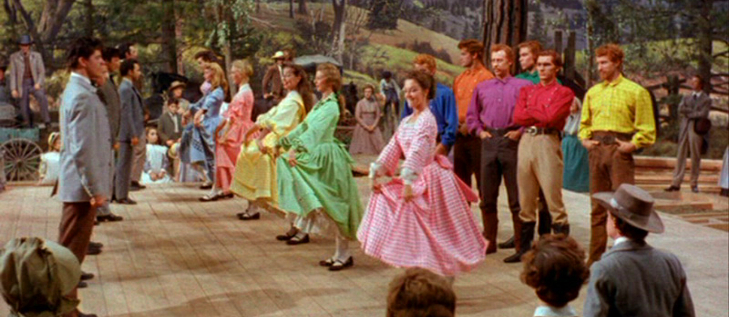
The poor cousin of 1954’s Brigadoon, Seven Brides for Seven Brothers was given a third of the budget but is twice the movie even without top talent like Gene Kelly. Filmed in the great indoors of MGM, the bright and witty jaunt still manages an outdoorsy feel, thanks mainly to Johnny Mercer and Gene de Paul’s lusty score and peppy dance numbers, including action scenes choreographed just like dancing moves. Jane Powell and Howard Keel make an attractive couple, the brides and grooms are an engaging group of studio up-and-comers, and the entire enterprise is so spirited that one wouldn’t guess that the MGM musical era was grinding to a halt.
Warners packs this two- Blu-ray set with not one but two versions of the picture. The extra copy is a rarely screened separate shoot version (see below).

It’s 1850 in the relative wilds of Oregon, where marriageable women are scarce, yet still treated like chattel. Farmer Adam Pontipee (Howard Keel) picks a prospective bride the way he might shop for a frying pan: he courts and weds town cook Milly (Jane Powell) in only a matter of minutes, neglecting to tell her that he has six uncouth brothers she’ll be expected to care for as well. Milly schools the near-feral louts in the finer arts of courting women, only to have them all turn lovesick for town girls out of their reach. From Milly’s copy of Plutarch, Adam gets the idea of kidnapping six brides for his six brothers … and the trouble begins.
The original songs for Seven Brides for Seven Brothers score much higher than MGM’s average — they’re consistently witty, well motivated and in the service of an interesting story, something few musicals can claim. The cast breaks out in a ballad of one kind or another every few minutes, yet even musico-phobes enjoy this one. The plot hook recounts The Rape of the Sabine Women in a rough West painfully short on prospective housework slaves eager wives. Adam’s six girl-hungry hick brothers don’t realize that kidnapping sweethearts is not the way to win a mate.

It’s a farce, of course, but one with a human edge. Jane Powell’s character Milly is already an overworked drudge. She’s sick of cooking for a lot of strange men, but Howard Keel essentially tricks her into becoming the new Snow White nanny for seven irresponsible dwarves bachelors up in them thar hills. There’s a certain desperation to Milly’s establishing a reasonable facsimile of civilization; the womenfolk must teach their men the rules of decent living from the ground up. What I’m wondering is, it seems as if these gorgeous and desirable females hold all the cards; they ought to be able to dictate the terms of any fraternization between the sexes, married or otherwise. I’m surprised that their fathers don’t demand an exorbitant dowry. And where are the mothers? They’d surely see the daughter-poaching Pontipees strung up by sundown.
Even though the proceedings are made hayride-chaste and squeaky clean for the uptight 1950s (the censors flipped over innocent lyrics about men sleeping with sheep), the whole enterprise has the fun appeal of girls and boys bundled together in a snowdrift-covered cabin. Once again the Powell character must act as a chaperone while the two sexes play teasing games.
Michael Kidd’s choreography uses extended takes and timed routines to excellent effect, and pulls off an acrobatic tour-de-force for the celebrated barn raising number. As many as ten dancers at a time risk their necks tumbling and cavorting atop raised planks, platforms, etc. The choreography is both exhilarating and funny, a combination of dance and acrobatic stunts guaranteed to win over insecure male viewers normally made uncomfortable by ‘prissy’ dance musicals.

Screenwriters Albert Hackett and Frances Goodrich are now best known for cooking up It’s a Wonderful Life for Frank Capra. They and the other writers keep everything in balance and in good taste. Most of the unlikely events squeak by (not a single girl really minds being kidnapped) and the story nimbly sidesteps an ending that seems headed for Hang Them Seven Brothers High. As the thick-skulled Howard Keel character learns a few valuable lessons about women, it all seems to have emotional depth.
The cast mixes non-dancing actors with pros from movies and the stage. The talented Tommy Rall contributed mightily to Kiss Me Kate, Good News, My Sister Eileen and even Funny Girl, yet is not a well-known name. Jeff Richards was reportedly not trained as a dancer, but certainly holds his own athletically; he began as a baseball player. Ruta Kilmonis would later be better known as Ruta Lee. Then an accomplished tumbler, Russ Tamblyn was just beginning to develop the musical skills he’d use only a few times, in West Side Story and two George Pal adventures. And there’s always the to-die-for Julie Newmar, at least four inches taller than her girlfriends but already the feline beauty that would become the definitive Catwoman on TV’s Batman.

