


We can imagine that Val Lewton turned pale when he learned that the RKO front office decreed that his second horror production must be titled I Walked with a Zombie. The latest Hollywood appearance of zombies was in Monogram’s budget-challenged King of the Zombies, a little second-feature horror romp that padded out its hour-long running time with clowning from the popular black comedian Mantan Moreland. Lewton cleverly avoided catastrophe by making his zombie picture a genre hybrid, grafted with a worthy literary classic. When Lewton’s film became a success, Monogram seemingly chased it by doing King of the Zombies again, only different … and probably cheaper.
Producer Lindsley Parsons lucked out by securing the services of actor John Carradine, who was just committing to horror pictures as a regular habit. Carradine was already an established film villain, but had also played positive, unforgettable characters in John Ford’s classics Stagecoach and The Grapes of Wrath. He recently had memorable parts in both John Farrow’s Five Came Back and John Cromwell’s Son of Fury. Carradine could make any dialogue function well, which was just what Monogram’s Revenge of the Zombies needed — the screenplay is not only anemic, it barely makes sense.

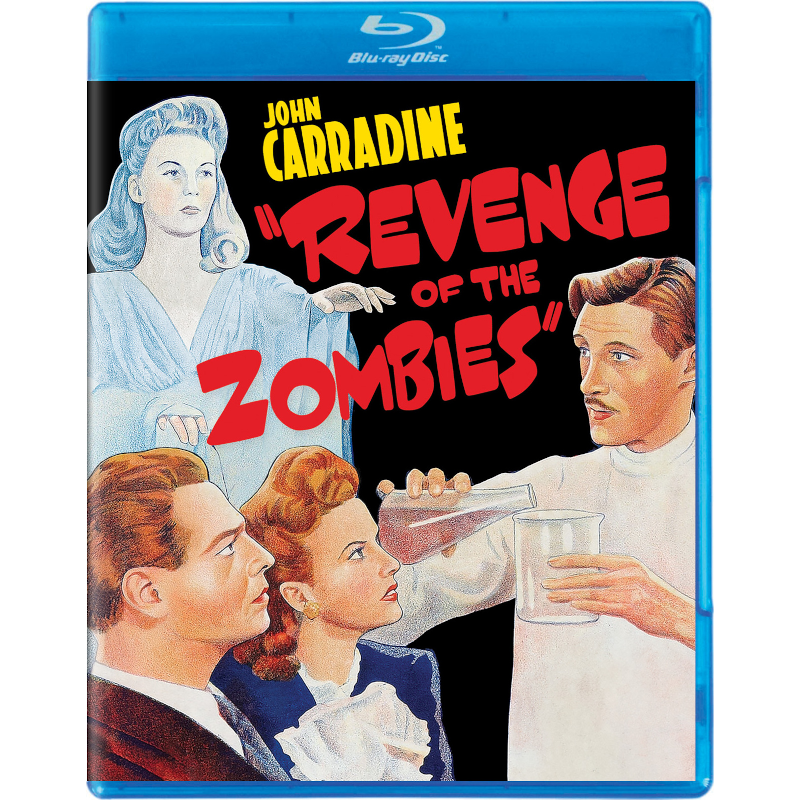
Somewhere in a Louisiana swamp, Dr. Max Heinrich Von Altermann (Carradine) is performing weird experiments. Learning that Altermann’s wife Lila (Veda Ann Borg) has died, her brother Scott (Mauritz Hugo) arrives to see if she has been poisoned, accompanied by a detective, Larry Adams (Robert Lowery of House of Horrors). Von Altermann offers a genteel welcome, and his secretary Jennifer (Gale Storm) is friendly, but we already know that Lila is a living-dead zombie, and that seven more walking corpses are shuffling around the bayou. One of them is the white-haired Lazarus (James Baskett), who does the doctor’s bidding and calls him ‘Master.’ Von Altermann also receives another visitor — a Nazi agent (old-time cowboy star Bob Steele) enthused to learn that the mad doctor can create an army of living dead soldiers to fight for der Führer.
The thriller complications are of the random variety. The elderly housemaid Mammy Beulah (Madame Sul-Te-Wan) shows Larry that Von Altenberg is indeed using drugs in his work, perhaps even poisons. A couple of characters have big secrets to reveal. Both Lila’s body and a local doctor disappear for a while. The friendly, funny chauffeur Jeff (Mantan Moreland) wants to romance the cook Rosella (Sybil Lewis) but is instead spooked by the zombie laborers, not to mention a tattooed body that keeps showing up, and then disappearing. When Von Altermann realizes that the jig is up, he tells Jennifer to ‘pack for Germany.’ But the zombified Lila is still a ‘headstrong woman’ — her response is to take control of the zombies and turn them against their Master.

We tend to favor Poverty Row ’40s horror films that have something to offer — a performance by Karloff or Lugosi, or perhaps a story surprise. Usually we find ourselves happy if anything about a PRC or Monogram program-filler is competent. Revenge showcases John Carradine, who a year before had worked almost exclusively for the big studios but had lately been in no-budget PRC productions for Edgar G. Ulmer, the nearly un-watchable Isle of Forgotten Sins and the well-reviewed Bluebeard. Carradine’s solid performance — his mad doctor waxes fanatic only once — keeps the weak dialogue afloat.
Most of the rest of the cast sleepwalk through scenes that mark time, in a script where NMH (Nothing Much Happens). The exceptions are the black actors. Mantan Moreland delivers a great pop-eyed coward act, and even gets to show off with a dance bit. Moreland received marginally more respect than black comedians working under demeaning stage names names; his talent is a major reason to watch all those Charlie Chan movies.
Also way on the plus side is the direction of refugee Steve Sekely (István Székely), a visual stylist who had 30 Hungarian comedies, dramas and musicals on his resume. Sekely gives Revenge of the Zombies a much better look than the average Monogram programmer. Instead of the usual static setups, Sekely frequently moves the camera, coming up with occasional expressive compositions. Just a few months before, another displaced European director hit the jackpot while working on Poverty Row. Douglas Sirk’s Hitler’s Madman for PRC turned out so well that it was purchased by MGM. Sirk was suddenly directing much more prestigious pictures. Sekely may have been hoping to catch the same kind of career miracle.

But Hitler’s Madman was a good drama about a very hot topic. Hollywood insiders would likely equate Sekely’s improvements to Monogram’s zombie movie with putting lipstick on a pig. Frankly, Revenge never had much going for it. The film’s plotting and general logic is so flawed, it verges on the absurd. Dr. Von Altermann is only vaguely suspected of poisoning his wife, when in any other 1943 film, his Teutonic surname alone would scream ‘enemy villain.’ A local doctor disappears on the Von Altermann estate, but the other visitors don’t seem that concerned. Two characters switch identities for a few hours, a ploy that goes nowhere. Secretary Jennifer must be on tranquilizers, as she pays no attention to the weird behavior of Lazarus. Likewise, she isn’t aware of the six zombies ambling about in plain sight.
The disc commentary makes us think that the only script work on Revenge was done to placate the Production Code Office. Dr. Von Altermann’s sudden passion for Jennifer comes out of nowhere — the idea that he zombified Lili to clear his path to Jennifer was apparently dropped to get censor approval, leaving the doctor with a big romantic disconnect. The heel-clicking Nazi agent apparently disguises himself as a Louisiana sheriff, complete with Southern accent. He is later revealed to have a third unconvincing identity.
Screenwriter Edmund Kelso also wrote the earlier King of the Zombies; this script is basically a retread that includes repeat roles for Mantan Moreland and Madame Sul-Te-Wan. Is it fair to ask if co-writer Van Norcross did the rewrite, and Monogram gave Kelso a credit for the re-use of his script?

The black cast members are at least never disparaged. The ancient-looking Madame Sul-Te-Wan cackles, while big James Baskett is so vacant and passive, we feel sorry for him. Baskett didn’t make many movies, but he made a big splash in Disney’s part-animated musical Song of the South, being made an honorary Oscar recipient for his portrayal of Uncle Remus. We’re impressed that talented black entertainers like James Baskett and Moreland stayed sane. The film industry was just as racist as the rest of America. With the daily indignities they had to put up with, the occasional tribute or prize to a performer like Baskett or Hattie McDaniel could have felt like an insult disguised as an honor.
Second-billed Gale Storm would continue gracing bit parts with her infectious dimpled smile; her career would improve with better roles in shows like It Happened on Fifth Avenue, before she became a household name in the TV comedy My Little Margie. Veda Ann Borg’s performance as the zombified Lili must have been infuriating. As a corpse, Lili walks about in a negligee. Who does her hair? Lili speaks in a poorly-engineered ghostly overdub that sounds like it was recorded in a shower stall.
Normal Monogram shooting schedules offered no time for a third take, let alone anything like visual finesse. We have to think that Steve Sekely’s polished camera moves slowed down a shoot likely scheduled for a five-day week. At one point, the supposedly catatonic Lili flashes a sneaky smile at her murderous husband. For all we know, Veda Ann Borg improvised the smile, just to have one shot where she does something. Another bit of business looks much more like an improvisation — when Lazarus orders his living-dead slaves to march in a line, the stiff-legged zombies look like they’re trying to goose-step. It’s not likely that anybody protested in the dailies screening: “Hey, REAL bayou zombies wouldn’t do that!”

Carradine and Veda Ann Borg deserve applause for dedication to their craft — in their final scene, it appears that they didn’t use doubles to sink into the swamp, glub glub. That ‘bog’ set would surely have been a dank interior, with unheated water. There can’t have been a take two either, what with Borg’s elaborate hairdo.
I Walked with a Zombie was released in April of 1943, and Revenge of the Zombies followed in September, so it’s very possible that Monogram was playing follow-the-leader with the Lewton film. But when Val Lewton had to figure out how to make a zombie picture, he likely screened Monogram’s earlier King of the Zombies along with White Zombie and Black Moon. Lewton cast Darby Jones of King as his main zombie ‘Carrefour.’ Jones would reprise his zombie role as ‘Kalaga’ in RKO’s later spoof Zombies on Broadway.
