

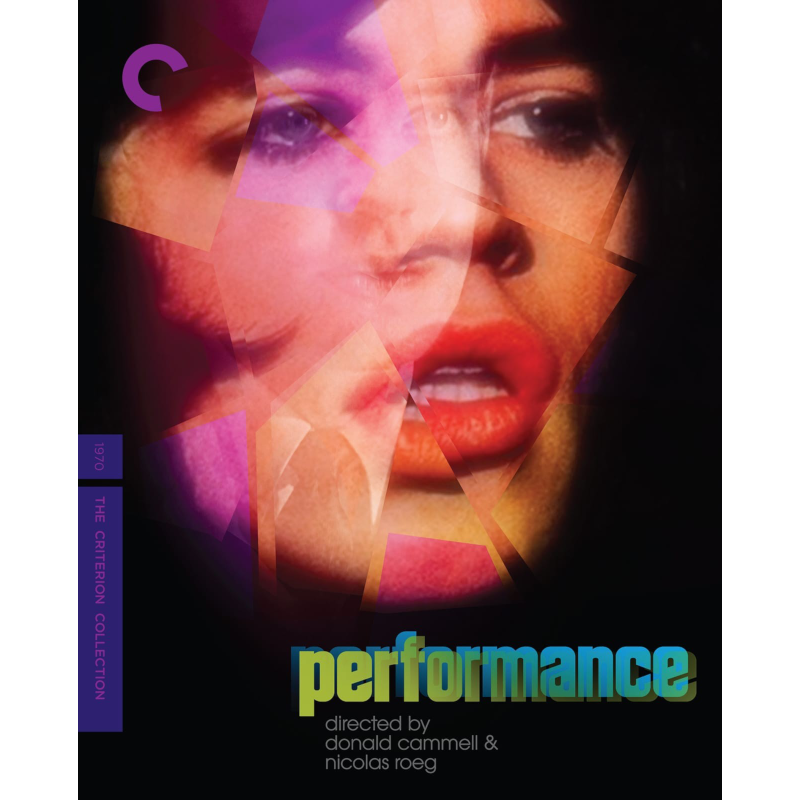

Donald Cammell and Nicolas Roeg’s Performance was something of a legend way back in film school. Around 1974 a professor managed to get a projectable, but incomplete print from Warner Bros., and even the color looked a little sick. We later found that studios sometimes pulled from circulation films deemed ‘out of favor.’ The exiles usually lasted a couple of years, but Ken Russell’s uncut The Devils is still mostly AWOL. Performance did resurface at repertory theaters, but was it complete? Why did the prints look so beat-up?
Our film school showing of Performance shook us up, with its fragmented visuals and strange, brutal storyline. The show never lost its status as an acting showcase for rock legend Mick Jagger. He and James Fox are at opposite ends of a disturbing ‘binary character’ tale. It’s not a film to warm up to. Jagger’s musical number Memo From Turner is truly powerful, and disturbing as well.
By 1970 ‘the kids’ were rejecting exploitation films about drugs, sex and rock ‘n’ roll. Most of the big-studio attempts to repeat the success of Easy Rider were flops. That included Michelangelo Antonioni’s art film Zabriskie Point. Its advertising pandered to the youth market: “How you get there, depends on where you’re at!”
Performance was something entirely different. What begins as a gangster tale morphs into an investigation of the meaning of identity, complete with references to the literary puzzle master Luis Borges. The splintered cutting style constantly throws fragmented, disorienting images at us: flashbacks, flash-forwards, flashes every which way but loose. Shots come and go before one barely has a chance to read them — was that a close-up of a nipple? Optical effects are used as well, but the movie avoids standard psychedelic clichés.

Mick Jagger’s character doesn’t enter for 40 full minutes. Until then Performance is a very nasty U.K. underworld tale, as brutal as Villain, Get Carter and The Squeeze. A special consultant (covered in the disc extras) advised on authentic street jargon.
One wonders what Donald Cammell’s shooting screenplay was like. The finished film uses cross-cutting to create parallel connections between the hoodlum life and the radical Rock lifestyle. London thug Chas (James Fox) terrorizes people for the local crime boss Harry Flowers (Johnny Shannon). Chas dresses posh but is a sadistic psychopath, a potential liability for the rackets. When Harry shifts his business elsewhere, Chas barely escapes a torture session run by one of his old enemies. He holes up in a rented room on a run-down street, that happens to be owned by Turner (Mick Jagger), a ‘retired’ rock star. Turner has dropped out because he’s lost the ‘demon’ that drives him to perform.
Chas is in an alien environment, but on his best behavior because he needs to stay off the street. Suddenly seeming an ultra-square, he pretends to be a juggler with a variety act. The deception fools nobody, especially not Turner’s long-time girlfriend Pherber (Anita Pallenberg). The free-form social and sexual setup in the house is also beyond Chas’s understanding. Turner, Pherber and a third playmate Lucy (Michèle Breton) decide to find out what makes their new friend tick by feeding him magic mushrooms. Chas asks for a passport photo, initiating a game of identities that eventually blurs the boundaries between host and tenant.
Warner Bros. put a lot of money into Performance and must have had high commercial hopes for the dramatic film debut of Rolling Stones’ superstar Mick Jagger. They reportedly did not interfere in the filming at all. Could they possibly have expected an upbeat, family friendly musical like the Beatles’ A Hard Day’s Night?

“The only performance that makes it, that really makes it, that
makes it all the way, is the one that achieves madness.”
When the first cut of Donald Cammell and Nicolas Roeg’s violent, symbolic art film was screened, the Brown Sugar hit the fan. Some in the preview audience were revolted. Shaken, the Warner brass decided that the film was too incoherent to release. Donald Cammell was dismissed, but brought back months later to perform at least two re-cuts. The final version is still a brutal experience, as mainstream pictures got in 1970. Content to equal this wouldn’t arrive until the next year’s crop of explicit sex and violence: Straw Dogs, The Devils, A Clockwork Orange. Yet the spoken dialogue is not vulgar — I’m not sure we ever hear a single curse word.
The rough stuff that offended the preview audience began with a half-hour of gangland brutality. The London hoods use threats to take over smaller rackets: “We prefer the word merge.” James Fox’s well-dressed extortionist goes way too far in his methods of intimidation. To keep Harry Shannon’s name out of a serious court case, Chas and his crew terrorize an uncooperative solicitor. They ruin the attorney’s Rolls-Royce by dousing it with acid. Chas ties the lawyer’s chauffeur to the front bumper and shaves his head; the man is spared an acid bath only because they haven’t brought enough.
Even before we meet the Rock ‘n’ Roll idol Turner, the film has given us scores of flash-cut bits of sex scenes. We soon bear witness to a post-Mod happening of the kind fantasized by rock fans, but that only rock stars experience. When not trying out new ideas in his studio, Turner carries on an endless orgy of sex and drugs with his old lady Pherber and their visa-challenged French playmate. Scenes in Turner’s oversized bed and giant tub have one thing in common with the same year’s bohemian squalor-fest Quiet Days in Clichy — some of the sex on view may be real.

Can you say, “Drug-fueled identity swap?”
Hiding in Turner’s house, Chas tries to arrange a way to slip out of London. He instead becomes a subject of study for the curious Turner and Pherber. She invades Chas’ bed with the challenge to ‘investigate his feminine side’ — something fairly revolutionary for a 1968 film. We see Pherber inject herself with what she claims is Vitamin B-12. She also takes apart Chas’s automatic pistol … much in the same way that she and Turner use psychedelic mushrooms to dismantle Chas’s brain.
The film’s fragmented, disturbing editing forces us to pay attention to details, which allows the psychological scheme to sneak up on us. Chas and Turner eventually play a psychedelic variation on the personality-warp dramatized in Joseph Losey’s The Servant. The mind games go beyond mirror images and superimposed faces, to a The Secret Sharer blurring of identities.
The two men are like unstable molecules, ready to exchange properties. When Chas intimidated his underworld victims, he called himself a ‘performer.’ Turner sees through Chas’s deception but has an appreciation for his arrogant stance. Turner is acutely aware that his creative motivation, his Demon, has left him. Can Chas perhaps help bring it back?

Co-directors Cammell and Roeg invigorate the picture via inventive direction, excellent staging and luminous camerawork. There are many odd camera angles but few are conventionally ‘trippy.’ The most familiar are Persona– like dissolves between Chas and Turner as they begin to morph into a composite identity. Roeg seems incapable of making a dull image. One of the intimate sex scenes benefits from a rosy look — the light seems to be filtered through a blanket.
Performance goes way beyond attempts to represent drug trips with imitation light-show effects, and cutaways to clips from horror movies. The simple disorientation of psychedelics is much closer to reality. When Chas trips, he fixates on the multicolored inlays of Turner’s coffee table, as if examining an angel fallen from heaven. His response reveals his basic materialistic alignment: “This is beautiful. I want to buy this.”
James Cammell elicited committed performances from his stars, who felt they were working on something significant. James Fox is excellent as the chilling gang enforcer. In one of his few starring roles, Mick Jagger does much more than just play himself. He reportedly based his characterization on one of his fellow Stones band members. Anita Pallenberg ( Barbarella) has the look of a beauty slightly hardened by the drug life; she reportedly contributed to the screenplay. Chas’ gangster associates are a clutch of cutthroats led by Johnny Shannon’s preening Harry Flowers, a bespectacled and gay ‘business entrepreneur.’

Jagger sings a couple of songs in a natural mode. To demonstrate a bit of his performing style for Chas, he prances about his recording studio dancing with a neon tube. The film’s most ironic line comes when Chas watches Turner dance: “You’ll be a funny geezer when you’re fifty.” Who knew that Jagger and the Stones would go on seemingly forever?
The movie’s many themes reach their peak in a bravura musical number, Memo From Turner. It has the feel of an early ’80s, MTV- style music video … but dark. Turner assumes a new identity that combines facets of both Chas and Harry Flowers. With his hair slicked back, Turner takes on Chas’ threatening stance and belts out the lyrics while chairing a meeting of sexually subservient mobsters. It’s both funny and scary.
Performance could well mark the end of the carefree image of Swinging London, just as Gimme Shelter made Woodstock seem a bad-news coffin nail for counterculture harmony. We’re told that the first cut originally resolved with more gangster action and a drug deal, but that Warners demanded less crime and more Mick. The film as finished dives straight into the brains of the two leading characters and really never comes up for air. The final minutes wind up with a not-bad stab at psychological profundity. Is it Chas or Turner that climbs into Harry Flowers’ car, perhaps to be ‘taken for a ride?’


I remember walking out on this film after 20 minutes when I was a kid and I had a pretty strong stomach. There was a punk band that was going to play at the end of the movie that I wanted to see, but I left anyway.
Hey! That’s interesting because I too walked out after about 20 minutes. Not my kind of film at all although I do like gangsters films which are done sensibly, i.e. unpretentiously. I notice Ann Sydney in the credits. Isn’t she the English girl who won the Miss World beauty contest?